Electrolysis MCQs Concise Class-10 ICSE Chemistry Selina Solutions Chapter-6. We Provide Step by Step Answer of MCQ questions of Exercise-6 for ICSE Class-10. The given Solutions is according to the Latest editions. Visit official Website CISCE for detail information about ICSE Board Class-10.
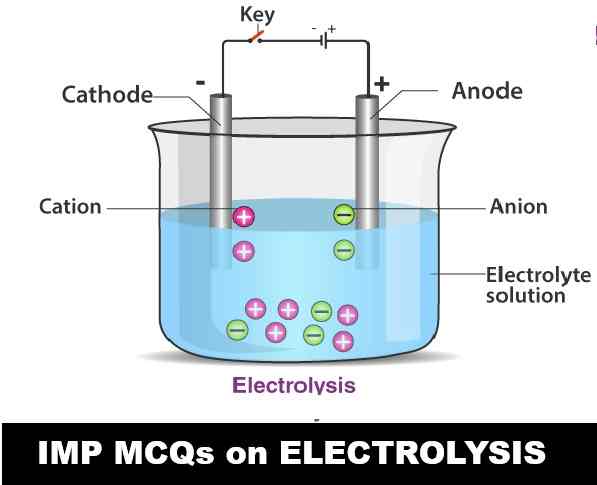
Electrolysis MCQs Concise Class-10 ICSE Chemistry Selina Solutions Chapter-6
| Board | ICSE |
| Book / Publication | Concise / Selina |
| Subject | Chemistry |
| Class | 10th |
| Writer | Dr SP Singh |
| Chapter-6 | Electrolysis |
| Topics | MCQs |
| Edition | 2025-2026 |
MCQs Questions on Electrolysis
Page-119
Que-1: During the electrolysis of molten lead bromide, which of the following takes place?
(a) Bromine is released at the cathode
(b) Lead is deposited at the anode
(c) Bromine ions gain electrons
(d) Lead is deposited at the cathode
Ans: (a) Lead is deposited at the cathode
Hint: The positive lead ions (Pb2+) migrate towards the cathode when the current is turned on. They take 2 electrons each and become neutral lead atoms.
Pb2++ 2e- ⟶ Pb
Silvery gray metal lead is formed on the cathode.
Que-2: The aqueous solution of the compound which contains both ions and molecules is :
(a) H2SO4
(b) HCl
(c) HNO3
(d) CH3COOH
Ans: Acetic acid (d) CH3COOH
Hint: Acetic acid is a weak electrolyte and particles in a weak electrolyte are ions and unionized molecules.
Que-3: A compound which during electrolysis in it’s molten state liberates a reddish brown gas at the anode :
(a) Sodium chloride
(b) Copper (II) oxide
(c) Copper (II) sulphate
(d) Lead (II) bromide
Ans: (d) Lead (II) bromide
Hint: During electrolysis of Lead [II] bromide, Br-1 ions are discharged at the anode. Reddish brown fumes are due to bromine vapours.
Que-4: Identify the weak electrolyte from the following:
(a) Sodium Chloride solution
(b) Dilute Hydrochloric acid
(c) Dilute Sulphuric acid
(d) Aqueous acetic acid.
Ans: (d) Aqueous acetic acid.
Hint: Aqueous acetic acid is a weak electrolyte because they partially dissociate and allow small amount of electricity to flow through them.
Que-5: An aqueous electrolyte consists of the following ions. The ion which could be discharged most readily during electrolysis is :
(a) Fe2+
(b) Cu2+
(c) H+
(d) Al3+
Ans: (b) Cu2+
Hint: Ion’s place in the electrochemical (reactivity) series determines how easily they discharge during electrolysis. Ions in a lower position discharge more easily and are less reactive.
Que-6: During silver plating of an article using potassium argento-cyanide as an electrolyte, the anode material should be :
(a) Cu
(b) Ag
(c) Pt
(d) Fe
Ans: (b) Ag
Hint: During silver plating using potassium argento-cyanide as an electrolyte, the anode should be block of pure clean silver.
The anode dissolves, supplying Ag⁺ ions to the electrolyte. These Ag⁺ ions then get reduced at the cathode (the article to be plated) and deposited as metallic silver.
Que-7: State which of these will act as a non-electrolyte :
(a) Liquid carbon tetrachloride
(b) Acetic acid
(c) Sodium hydroxide aqueous solution.
(d) Potassium chloride aqueous solution.
Ans: (a) Liquid carbon tetrachloride
Hint: Carbon tetrachloride (CCl4) is a liquid that does not conduct electricity because it is a non-polar covalent compound. In the case of CCl4, carbon atom shares electrons with four chlorine atoms. The electrons are shared equally between the atoms, and the molecule has no permanent dipole moment, meaning there is no separation of charge. Therefore, there are no ions present in the compound, and no free electrons to carry an electrical current.
Que-8: The observation seen when fused lead bromide is electrolysed is:
(a) a silver grey deposit at anode and a reddish brown deposit at cathode.
(b) a silver grey deposit at cathode and a reddish brown deposit at anode.
(c) a silver grey deposit at cathode and reddish brown fumes at anode.
(d) silver grey fumes at anode and reddish brown fumes at cathode.
Ans: (c) a silver grey deposit at cathode and reddish brown fumes at anode.
Hint: Silver grey colour is due to lead metal deposited at cathode and reddish brown fumes at anode is due to bromine vapours.
Que-9: During electroplating an article with silver, the electrolyte used is:
(a) Silver nitrate solution
(b) Silver cyanide solution
(c) Sodium argentocyanide solution
(d) Nickel sulphate solution
Ans: (c) Sodium argentocyanide solution
Hint: Sodium argentocyanide solution is used as electrolyte during silver plating because it allows slow and smooth plating, which is essential for a uniform and bright finish. If silver nitrate solution is used directly instead of double cyanide of sodium and silver, the deposition of silver will be very fast and hence not very smooth and uniform .
Que-10: The metallic electrode which does not take part in an electrolytic reaction :
(a) Cu
(b) Ag
(c) Pt
(d) Ni
Ans: (c) Pt
Hint: Platinum is used as a inert electrolyte, as they will not take part in the electrolytic reaction.
Que-11: The ion which is discharged at the anode during the electrolysis of copper sulphate solution using platinum electrodes as anode and cathode is:
(a) Cu2+
(b) OH–
(c) SO42-
(d) H+
Ans: (b) OH-
Hint: The SO42- and OH– ions both migrate to the anode. The OH– ions, being lower in electrochemical series as compared to SO42- ions, discharge to form neutral (OH) radical. The neutral (OH) radicals reunite to form water and oxygen.
4OH– – 4e– ⟶ 4OH
Que-12: When dilute sodium chloride is electrolysed using graphite electrodes, the cation which is discharged at the cathode most readily :
(a) Na+
(b) OH-
(c) H+
(d) Cl-
Ans: (c) H+
Hint: Na+ and H+ (H3O+) migrate to cathode. But despite high concentration of Na+, H+ gains electron more easily than Na+, (sodium is above hydrogen in electro-chemical series). It is the H+ ions that accept electrons.
H+ + e- ⟶ H
Que-13: Cathode is a reducing electrode because :
(a) it has less number of electrons
(b) it has deficiency of electrons
(c) cations gain electrons from cathode
(d) anions lose electrons to cathode
Ans: (c) cations gain electrons from cathode
Hint: The reaction at cathode involves reduction of cations as they gain electrons to become neutral atoms. Hence, cathode is a reducing electrode and cations gain electrons from cathode.
Que-14: Which statement about conduction of electricity is correct?
(a) Electricity is conducted in an aqueous solution by electrons.
(b) Electricity is conducted in a metal wire by ions.
(c) Electricity is conducted in a molten electrolyte by electrons.
(d) Electricity is conducted in an acidic solution by ions.
Ans: (d) Electricity is conducted in an acidic solution by ions.
Hint: Acids when dissolved in water get ionized into their respective ions.These ions are mobile and allow the solution to carry electric current.
For example :
HCl in water conduct electricity through ions like H⁺ and Cl⁻.
Que-15: The oxidation reaction among the following is :
(a) Fe3+ + 3e– ⟶ Fe
(b) Fe2+ – e– ⟶ Fe3+
(c) Cl2 + 2e– ⟶ 2Cl–
(d) Cu2+ + 2e– ⟶ Cu
Ans: (b) Fe2+ – e– ⟶ Fe3+
Hint: Oxidation is defined as a process in which an atom or an ion loses electron(s).
In the reaction Fe2+ – e– ⟶ Fe3+
Fe2+ loses one electron and forms Fe3+. So, this is an oxidation reaction.
Que-16: During electrolysis, what happens to metallic ions and at which electrode do they get discharged ?
P Reduction of metallic ions, cathode
Q Oxidation of metallic ions, anode
R Oxidation of metallic ions, cathode
(a) Only P
(b) Only Q
(c) both P and Q
(d) Both Q and R
Ans: (a) Only P
Hint: Metallic ions, which are positively charged cations, migrate to the cathode during electrolysis. At the cathode, they gain electrons and are discharged as neutral metal atoms. Hence, during electrolysis, reduction of metallic ions occurs at cathode.
The following questions are Assertion-Reason based questions. Choose the answer based on the codes given below.
1. Both A and R are true and R is the correct explanation of A.
2. Both A and R are true but R is not the correct explanation of A.
3. A is true but R is false.
4. A is false but R is true.
Que-17:
Assertion (A): Electrolysis establishes a relationship between electrical energy and chemical energy.
Reason (R): Substances like metals, carbon (graphite) are conductors while salts like NaCl, KCI are electrolytes.
(a) (1)
(b) (2)
(c) (3)
(d) (4)
Ans: (b) (2) Both A and R are true but R is not the correct explanation of A.
Explain why:- Electrolysis is a process that demonstrates the conversion of electrical energy into chemical energy. Hence, assertion (A) is true.
Metals and graphite are conductors, while salts like NaCl and KCl (in molten or aqueous form) are electrolytes. Hence, Reason (R) is true.
However, knowing which substances are conductors or electrolytes does not establish the relationship between electrical and chemical energy. Hence, both assertion (A) and reason (R) are true but reason (R) is not the correct explanation of assertion (A).
Que-18:
Assertion (A): Benzene acts as non-electrolyte.
Reason (R): Benzene does not have free ions.
(a) (1)
(b) (2)
(c) (3)
(d) (4)
Ans: (a) (1) Both A and R are true and R is the correct explanation of A.
Explain why:- Benzene is a non-electrolyte that does not have ions even in solution. They contain only molecule. Hence both assertion (A) and reason (R) are true and reason (R) is the correct explanation of assertion (A).
Que-19:
Assertion (A): Metals and alloys conduct electricity with the help of electrons.
Reason (R): Non-metals do not have free electrons.
(a) (1)
(b) (2)
(c) (3)
(d) (4)
Ans: (b) (2) Both A and R are true but R is not the correct explanation of A.
Explain why:- Metal and alloys (mixtures of metals) conduct electricity using free electrons in their outer shells that move easily in solid state. Hence assertion (A) is true. Non-metals generally do not have free electrons, which is why they are poor conductors of electricity. Hence the reason (R) is true.
However, it does not precisely explain why metals and alloys conduct electricity , the reason (R) only explains why non-metals are poor conductor of electricity. Hence reason (R) is not correct explanation for assertion (A).
Que-20:
Assertion (A): Weak electrolytes do not allow any electricity to flow through them.
Reason (R): Substances which are composed of only molecules do not allow any current to flow through them.
(a) (1)
(b) (2)
(c) (3)
(d) (4)
Ans: (d) (4) A is false but R is true.
Explain why:- Electrolytes which allow small amounts of electricity to flow through them are called weak electrolytes. These are poor conductors of electricity. Hence the assertion (A) is false.
Substances which are composed of only molecules are non electrolytes, they do not allow any current to flow through them. For example, Benzene, glucose.
Hence the reason (R) is true.
Que-21:
Assertion (A): NaCl is an example of an electrolyte.
Reason (R): NaCl conducts electricity in aqueous or molten state.
(a) (1)
(b) (2)
(c) (3)
(d) (4)
Ans: (a) (1) Both A and R are true and R is the correct explanation of A.
Explain why:- NaCl is an electrolyte because it conducts electricity when dissolved in water or in molten form, due to the presence of free-moving ions. Therefore, both the assertion (A) and the reason (R) are true, and the reason correctly explains why NaCl is an electrolyte.
Que-22:
Assertion (A): An electrolyte can be acid, base or salt.
Reason (R): An electrolyte is a substance which can conduct electricity in aqueous or molten state.
(a) (1)
(b) (2)
(c) (3)
(d) (4)
Ans: (b) (2) Both A and R are true but R is not the correct explanation of A.
Explain why:-Electrolytes include acids (like HCl), bases (like NaOH), and salts (like NaCl). Hence, assertion (A) is true.
Electrolytes conduct electricity in aqueous or molten states because they produce ions. Hence, Reason (R) is true.
The reason correctly describes what an electrolyte does, but it doesn’t directly explain why acids, bases, and salts are classified as electrolytes. Hence, both assertion (A) and reason (R) are true but reason (R) is not the correct explanation of assertion (A).
Que-23:
Assertion (A): Oxidation occurs at the anode.
Reason (R): Electrons are gained at the anode.
(a) (1)
(b) (2)
(c) (3)
(d) (4)
Ans: (c) (3) A is true but R is false.
Explain why:- The reaction at anode involves oxidation of anions as they lose electrons to become neutral. Hence the assertion (A) is true.
Electrons are donated or lost at the anode. However, gain of electrons takes place at cathode, where cations are reduced. Hence the reason (R) is false.
Que-24:
Assertion (A): Polar covalent compounds can form ions when dissolved in water.
Reason (R): Electrovalent compounds show dissociation.
(a) (1)
(b) (2)
(c) (3)
(d) (4)
Ans: (b) (2) Both A and R are true but R is not the correct explanation of A.
Explain why:- Polar covalent compounds are converted into ions in water , and these ions conduct electricity. Hence assertion (A) is true.
For example : water.
Electrovalent compounds when melted or dissolved in water, electrostatic force of attraction is broken and they dissociate into ions and conduct electricity.
Therefore, the reason (R) is true.
Since reason (R) doesn’t explain the ionisation of polar covalent compound it is not correct explaination of assertion (A).
Que-25:
Assertion (A): A block of pure silver metal is used as anode during silver plating.
Reason (R): Silver ions are deposited as metal at the anode.
(a) (1)
(b) (2)
(c) (3)
(d) (4)
Ans: (c) (3) A is true but R is false.
Explain why:- The block of pure silver is used as anode because it is active electrode, as it slowly dissolves in the solution, Ag⁺ ions are produced for the plating process. Hence the assertion (A) is true.
Silver ions are deposited on to the article that acts as cathode. Hence reason (R) is false.
—: End of Electrolysis MCQs Concise Class-10 ICSE Chemistry Selina Solutions : –
Return to:- Concise Selina Chemistry for ICSE Class-10 Solutions
Please Share with Your Friends if Helpful
Thanks