Electrolysis Short Ans Concise Class-10 ICSE Chemistry Selina Solutions Chapter-6. We Provide Step by Step Answer of Short Ans Questions of Exercise-6 for ICSE Class-10. The given Solutions are according to the Latest editions. Visit the official Website CISCE for detail information about ICSE Board Class-10.
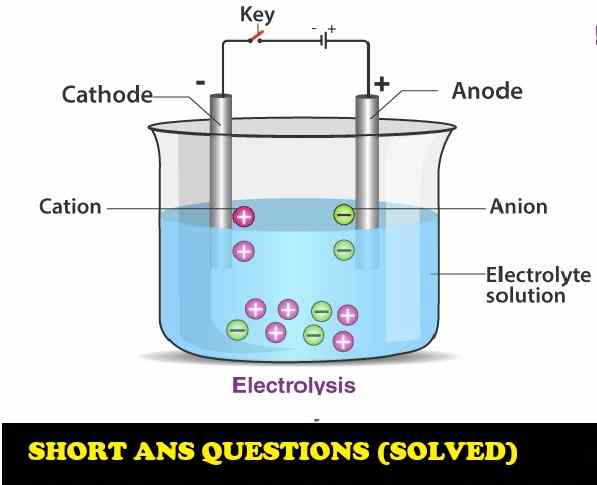
Electrolysis Short Ans Concise Class-10 ICSE Chemistry Selina Solutions Chapter-6
| Board | ICSE |
| Book / Publication | Concise / Selina |
| Subject | Chemistry |
| Class | 10th |
| Writer | Dr SP Singh |
| Chapter-6 | Electrolysis |
| Topics | Short Ans |
| Edition | 2025-2026 |
Short Ans Questions on Electrolysis
Page-120
Que-1: Give reasons for the following:
(a) The blue colour of aqueous copper sulphate fades when it is electrolyzed using platinum electrodes.
(b) Lead bromide undergoes electrolytic dissociation in the molten state but is a non-electrolyte in the solid state.
(c) Aluminium is extracted from its oxide by electrolytic reduction and not by conventional reducing agents.
(d) The ratio of hydrogen and oxygen formed at the cathode and anode is 2:1 by volume.
(e) In the electrolysis of acidified water, dilute sulphuric acid is preferred to dilute nitric acid for acidification.
(f) Ammonia is unionized in the gaseous state but in the aqueous solution, it is a weak electrolyte.
(g) A direct current instead of alternating current should be used in electrolysis.
(h) Carbon tetrachloride is a liquid but does not conduct electricity.
(i) Potassium is not extracted by electrolysis of its aqueous salt solution.
(j) The electrolysis of acidulated water is considered to be an example of catalysis.
(k) During electrolysis of molten lead bromide, graphite anode is preferred to other electrodes.
(l) Electrolysis of molten lead bromide is considered to be a redox reaction.
Ans:
(a) The blue colour of copper ions fades
due to decrease in Cu+2 ions and finally the solution becomes colourless as soon as Cu+2 ions are finished.
(b) Lead bromide dissociate into ions in the molten state
whereas it does not dissociate in solid state. The ions become free when lead bromide is in molten state but in the solid state the ions are not free since they are packed tightly together due to electrostatic force between them. Therefore, lead bromide undergoes electrolytic dissociation in the molten state.
(c) Aluminium has great affinity towards oxygen,
so it is not reduced by reducing agent. Therefore it is extracted from its oxide by electrolytic reduction.
(d) As per electrolytic reactions, 4H+1 are needed at cathode and 4OH– at the anode and two molecules of water are produced at the anode. Hence for every two molecules of water, two molecules of hydrogen and one molecule of oxygen are liberated at the cathode and anode respectively.

(e) This is because HNO3 is volatile.
(f) Ammonia is a covalent compound.
Therefore, it is unionized in the gaseous state but in the aqueous solution it gives NH4OH which is a weak electrolyte and dissociates into ions.
(g) Direct current flows in one direction, allowing the electrodes to maintain fixed polarity. One electrode is always the anode (+) (where oxidation occurs), and the other is always the cathode (–) (where reduction occurs).
(h) Carbon tetrachloride is a liquid and does not conduct electricity because it is a covalent compound and there are no free ions present and contain only molecules.
(i) Potassium is not extracted from its aqueous salt solution by electrolysis as it can react with water.
(j) Water in pure state consists almost entirely of molecules. It is a polar covalent compound and can form ions when traces of dilute sulphuric acid is added. As dilute sulphuric acid catalyses this ionisation, hence this electrolysis of acidified water is considered as an example of catalysis.
(k) As graphite is unaffected by the reactive bromine vapours released at the anode hence, a graphite anode is preferred to other inert electrodes like platinum during the electrolysis of molten lead bromide.
(l) Electrolysis of molten lead bromide involves oxidation and reduction reactions and hence is a redox reaction.
Reduction reaction at cathode:
Pb2+ + 2e– ⟶ Pb
Oxidation reaction at the anode:
Br1- – 1e– ⟶ Br
Br + Br ⟶ Br2
Que-2: Explain :
(a) Sodium Chloride will conduct electricity only in fused or aq. soln. state.
(b) In the electroplating of an article with silver, the electrolyte sodium argento-cyanide solution is preferred over silver nitrate solution.
(c) Although copper is a good conductor of electricity, it is a non-electrolyte.
Ans:
(a) The ions Na+ and Cl– are not free but held together by strong electrostatic force of attraction. In fused or molten state the ions break free and move. Hence, NaCl will conduct electricity only in fused state or aq. soln. state.
(b) Migration of Ag1+ ions from sodium argento-cyanide solution is slow compared to that from silver nitrate. Hence, an even deposition of metal silver is obtained on the article. Therefore, the electrolyte sodium argento-cyanide solution is preferred over silver nitrate solution.
(c) Copper does not undergo chemical decomposition due to flow of electric current through it. Hence, copper is a good conductor of electricity but it is a non-electrolyte.
Que-3: Write two applications of electrolysis in which the anode diminishes in mass.
Ans:
- Electroplating of metals
- Electrorefining of metals
Que-4: A soln. contains magnesium ions (Mg2+), iron (II) ions (Fe2+) and copper ions (Cu2+). On passing an electric current through this soln. which ions will be the first to be discharged at the cathode? Write the equation for the cathode reaction.
Ans: Cu2+ (Copper ions will get discharged at cathode) as between magnesium, iron and copper, copper is the lowest in electrochemical series.
Reaction at Cathode:
Cu2+ + 2e– ⟶ Cu
Que-5: During electroplating of an article with nickel
(i) Name:
A. The electrolyte
B. The cathode
C. The anode
(ii) Give the reaction of the electrolysis at
A. The cathode
B. The anode
Ans:
(i)
A. The electrolyte — Aq. soln. of nickel sulphate
B. The cathode — Cleaned article to be electroplated
C. The anode — Plate or block of nickel metal
(ii) the reaction of the electrolysis at:
A. At Cathode: Ni2+ + 2e– ⟶ Ni
B. At Anode : Ni – 2e– ⟶ Ni2+
Que-6: A, B and C are three electrolytic cells connected in different circuits. Cell ‘A’ contains NaCl solution. And the bulb in the circuit glows brightly when the circuit is completed. Cell ‘B’ contains acetic acid and the bulb glows dimly. Cell ‘C’ contains sugar solution, and the bulb does not glow. Give reason for each observation.
Ans: As NaCl is a strong electrolyte (i.e., cell A), therefore it allows large amount of electricity to flow through it. Hence, the bulb glows brightly.
Acetic acid is a weak electrolyte (i.e., cell B) and it allows a small amount of electricity to flow through them hence, the bulb glows dimly.
Sugar soln. is a non-electrolyte (i.e., cell C), therefore it does not conduct electricity and do not undergo chemical decomposition due to the flow of current through it. Hence, the bulb does not glow.
Que-7: Differentiate between electrical conductivity of copper sulphate solution and that of copper metal.
Ans:
| Electrical conductivity of copper sulphate solution |
Electrical conductivity of copper metal |
|---|---|
| The flow of electricity takes place by flow of ions which are denser compared to electrons. | The flow of electricity takes place by flow of electrons which have negligible mass. |
| Good conductors of electricity in aq. soln. or molten state but not in solid state. | Good conductor of electricity in solid and in molten state. |
| During conduction through copper sulphate solution, there is transfer of ions. | During conduction through copper metal, there is no transfer of matter. |
| The flow of electricity decomposes the electrolyte and new products are formed. | The flow of electricity only produces heat energy and no new products are formed. |
Que-8: State one appropriate observation for : Electricity is passed through molten lead bromide.
Ans: When electricity is passed through molten lead bromide solution, dark reddish brown fumes of bromine evolve at the anode.
Br- – e- ⟶ Br
Br + Br ⟶ Br2
Que-9: State your observation: At the cathode when acidified aqueous copper sulphate solution is electrolysed with copper electrodes.
Ans: Copper, a brownish pink metal is deposited at the cathode when acidified aqueous copper sulphate solution is electrolysed with copper electrodes.
Que-10: State observation at the anode when aqueous copper sulphate solution is electrolysed using copper electrodes.
Ans: Copper anode shows a loss in mass.
Que-11: State which electrode: anode or cathode is the oxidizing electrode. Give a reason for the same.
Ans: Anode is the oxidizing electrode.
Que-12: M2O is the oxide of a metal ‘M’ which is above hydrogen in the activity series. M2O when dissolved in water forms the corresponding hydroxide which is a good conductor of electricity.
(i) State the reaction taking place at the cathode
(ii) Name the product at the anode
Ans:
(i) At the cathode: M+ + 1e–→ M
(ii) At the anode: Oxygen gas
—: End of Electrolysis Short Ans Concise Class-10 ICSE Chemistry Selina Solutions : –
Return to:- Concise Selina Chemistry for ICSE Class-10 Solutions
Please Share with Your Friends if Helpful
Thanks