Ellipse Class 11 OP Malhotra Exe-24A ISC Maths Ch-24 Solutions. In this article you would learn about Sketching the Ellipse, Focal Properties of Ellipse. Step by step solutions of latest textbook has been given as latest syllabus. Visit official Website CISCE for detail information about ISC Board Class-11 Mathematics.
Ellipse Class 11 OP Malhotra Exe-24A ISC Maths Solutions Ch-24
| Board | ISC |
| Publications | S Chand |
| Subject | Maths |
| Class | 11th |
| Chapter-24 | Ellipse |
| Writer | O.P. Malhotra |
| Exe-24(A) | Sketching the Ellipse, Focal Properties of Ellipse. |
Sketching the Ellipse, Focal Properties of Ellipse.
Ellipse Class 11 OP Malhotra Exe-24A ISC Maths Ch-24 Solutions.
Que-1: Find the eccentricity of the ellipse of which the major axis is double the minor axis.
Sol: Let a be the length of semi-major and semi-minor axis of the ellipse.
According to given condition, a = 2b
We know that b2 = a2 (1 – e2)
⇒ b2 = 4b2(1 – e2)
⇒ 1/4 = 1 – e² ⇒ e² = 1 – (1/4) = 3/4
⇒ e = √3/2 [∵ e > 0]
Thus required eccentricity of an ellipse be √3/2.
Que-2: If the minor axis of an ellipse is equal to the distance between its foci, prove that its eccentricity is 1/√2.
Sol: Let e be the eccentricity of an ellipse according to given condition, we have
2b = 2ae ⇒ b = ae
We know that b2 = a2 (1 – e2)
⇒ a2e2 = a2 (1 – e2)
⇒ e2 = 1 – e2
⇒ 2e2 = 1 ⇒ e = 1/√2 [∵ e > 0]
Que-3: Find the latus rectum and eccentricity of the ellipse whose semi-axes are 5 and 4.
Sol: Given a = 5 and b = 4
Let e be the eccentricity of an ellipse Then b2 – a2 (1 – e2)
⇒ 16 = 25 (1 – e2)
⇒ 1 – e2 = 16/25 ⇒ e² = 9/25
⇒ e = 3/5 (∵ e > 0)
∴ length of latus-rectum = 2b²/a
= 2 × (4²/5) = 32/5
Que-4: Find the eccentricity of the ellipse whose latus rectum is (/) half its major axis, (ii) half its minor axis.
Sol: Let a be the length of semi-major and b be the length of semi-minor axis of an ellipse and e be the eccentricity of an ellipse.
(i) According to given condition,
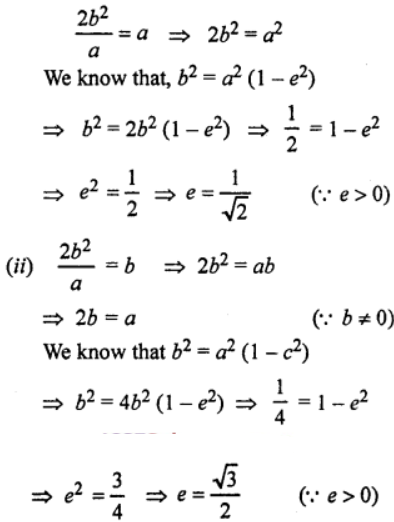
Que-5: If the eccentricity is zero, prove that the ellipse becomes a circle.
Sol: We know that, b2 = a2 (1 – e2) …(1)
We have given e = 0 ∴ from (1) ; we have
b2 = a2 b = a (∵ b, a > 0)
Thus the given eqn. of ellipse reduces to,
(x²/a²) + (y²/a²) = 1
⇒ x2 + y2 = a²
Que-6: Find the equation to the ellipse with axes as the axes of coordinates.
(i) major axis = – 6, minor axis = 4 ;
(ii) which passes through the points (- 3, 1) and (2, – 2) ;
(iii) axes are 10 and 8 and the major axis along
(a) the axis of x, (b) the axis of y ;
(iv) major axis 9/2 and eccentricity 1/√3, where the major axis is the horizontal axis ;
(v) latus rectum is 5 and eccentricity 2/3,
(vi) foci are (± 4, 0) and e = 1/3;
(vii) distance between the foci is 10 and its latus rectum is 15 ;
(viii) distance of the focus from the corresponding directrix is 9 and eccentricity is 4/5;
(ix) the minor axis is equal to the distance between the foci, and the latus rectum is 10.
Sol: (i) Let a and b are the lengths of major and minor axes of an ellipse respectively and the eqn. of ellipse be
(x²/a²) + (y²/b²) = 1 …(1)
where a > b > 0
given 2a = 6 ⇒ a = 3
and 2b = 4 ⇒ b = 2
∴ eqn. (1) reduces to;
(x²/9) + (y²/4) = 1
⇒ 4x² + 9y² = 36
(ii) Let the eqn. of ellipse be
(x²/a²) + (y²/b²) = 1, where a > b > 0 …(1)
eqn. (1) pass through the points (- 3, 1) and (2, – 2)
∴ (9/a²) + (1/b²) = 1 …(2)
(4/a²) + (4/b²) = 1 …(2)
4 × eqn. (2) – eqn. (3); we have
32/a² = 3 ⇒ a² = 32/3
∴ from (2); 9×(3/32) + (1/b²) = 1
⇒ 1/b² = 5/32
⇒ b² = 32/5
Thus eqn. (2) reduces to;
(3x²/32) + (5y²/32) = 1;
⇒ 3x² + 5y² = 32
(iii) (a) Here, major axis along x-axis and minor axis along y-axis. Let the eqn. of ellipse be,
(x²/a²) + (y²/b²) = 1, where a > b > 0 …(1)
given 2a = 10 ⇒a = 5
and 2b = 8 ⇒ b = 4
∴ eqn. (1) reduces to;
(x²/25) + (y²/16) = 1 ⇒ 16x² + 25y² = 400
(b) Here, major axes along y-axis and minor axis along x-axis.
Let the eqn. of ellipse be taken as
(x²/b²) + (y²/a²) = 1 …(1)
when a> b> 0
according to given a = 5 and b = 4
∴eqn. (1) reduces to ; (x²/16) + (y²/25) = 1
⇒ 25x² + 16y² = 400
which is the required eqn. of an ellipse,
(iv) Since the major axis is the horizontal axis and let the eqn. of ellipse can be taken as
(x²/a²) + (y²/b²) = 1 …(1)
where a > b > 0
given 2a = 9/2 ⇒ a = 9/4 and e = 1/√3
We know that b² = a² (1 – e²)
⇒ b² = (9/4)²[1−(1/3)] = (81/16) × (2/3) = 27/8
Thus eqn. (1) reduces to ;
(16x²/81) + (8y²/27) = 1 ⇒ 16x² + 24y² = 81
which is the required eqn. of an ellipse,
(v) Let a and b are the lengths of semi-major and semi-minor axes of an ellipse. Let e be the eccentricity of an ellipse. Let the eqn. of ellipse be,
(x²/a²) + (y²/b²) = 1 …(1)
given e = 2/3 and 2b²/a = 5
⇒ b² = 5a²
We know that, b² = a²(1 – e²)
⇒ 5a² = a² (1−(4/9)) = 5a²/9
⇒ a = 9/2
∴ from (1) ; b² = (5/2) × (9/2) = 45/4
Putting the value of a and b in eqn. (1); we have
(4x²/81) + (4y²/45) = 1
⇒ (20x²+36y²)/405 = 1
⇒ 20x² + 36y² = 405
Which is the required eqn. of an ellipse.
(vi) given foci are (± 4, 0) i.e. both foci lies on x-axis and hence x-axis be the major axes.
Thus eqn. of ellipse can be written as (x²/a²) + (y²/b²) = 1 …(1)
where a > b > 0
Its foci are (± ae, 0) ∴ ae = 4
and also given e = 1/3
∴ a = 12
We know that b² = a² (1 – e²)
= 144 (1−(1/9)) = 144 × (8/9)
⇒ b² = 128
Thus, eqn.(1) reduces to;
(x²/144) + (y²/128) = 1 ⇒ 8x² + 9y² – 1152 = 0
which is the required eqn. of an ellipse.
(vii) Let a and b be the length of semi-major and semi-minor axes of an ellipse and let the eqn. of ellipse can be taken as
(x²/a²) + (y²/b²) = 1 …(1)
where a > b > 0
given distance between foci = 10
⇒ 2ae = 10 ⇒ ae = 5 …(2)
and 2b²/a = 15 ⇒ b² = 15a/2 …(3)
We know that b² = a² (1 – e²)
⇒ 15a/2 = a² – 25
⇒ 2a2 – 15a – 50 = 0
⇒ 2a2 – 20a + 5a – 50 = 0
⇒ 2a (a – 10) + 5 (a – 10) = 0
⇒ (a-10) (2a + 5) = 0
⇒ a= 10 (∵ a > 0)
∴ from (3); b2 = (15×10)/2 = 75
Thus eqn. (1) reduces to ;
(x²/100) + (y²/75) = 1
⇒ 3x² + 4y² = 300
which is the required eqn. of an ellipse.
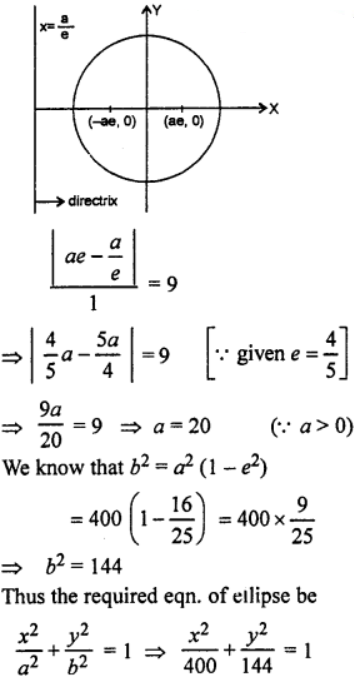
(viii) Given distance of focus (ae, 0) from
directrix x – ae = 0 = 9 (given)
(ix) Let a be the length of semi-major axis and b be the length of semi-minor axis and let e be the eccentricity of required ellipse.
Let the required eqn. of an ellipse be,
(x²/a²) + (y²/b²) = 1 …(1)
where a > b > 0
According to given condition,
2b = 2 ae ⇒ b = ae …(2)
and (2b²/a) = 10
⇒ b² = 5a …(3)
We know that, b2 = a2 (1 – e2)
⇒ b2 = a2 – b2
⇒ 2b2 = a2
⇒ 2 × 5a = a2 [using (2) and (3)]
⇒ a = 10
∴ b2 = 5 × 10 = 50
Thus eqn. (1) reduces to ;
(x²/100) + (y²/50) = 1
⇒ x² + 2y² = 100
which is the required eqn. of an ellipse.
Que-7: Find the equation of the ellipse whose centre is at (- 2, 3) and whose semi-axes are 3 and 2, when the major axis is
(i) parallel to the axes of x ; (ii) parallel to the axis of y.
Sol: (i) Since the centre of required ellipse be C (- 2, 3) and mojor axis is parallel to x-axis.
Hence the eqn. of ellipse can be taken as,
{(x+2)²/9} + {(y−3)²/b²} = 1 …(1)
where a > b > 0
Clearly length of semi-major axis = a = 3
and length of semi-minor axis = b = 2
∴ eqn. (1) reduces to,
{(x+2)²/9} + {(y−3)²/4} = 1
⇒ 4 (x² + 4x + 4) + 9 (y² – 6y + 9) = 36
⇒ 4x² + 9y² + 16x – 54y + 61 = 0
which is the required eqn. of ellipse.
(ii) The eqn. of ellipse having centre C (-2, 3) and major axis is parallel to y-axis be taken as
{(x+2)²/b²} + {(y−3)²/a²} = 1 …(1)
where a > b > 0
given length of semi-major axis = a = 3
and length of semi-minor axis = b = 2
∴ eqn. (1) reduces to,
{(x+2)²/4} + {(y−3)²/9} = 1
⇒ 9 (x + 2)2 + 4(y – 3)2 = 36
⇒ 9x2 + 4y2 + 36x – 24y + 36 = 0
which is the required eqn. of an ellipse.
Que-8: Find the equation of the ellipse with its centre at (4, – 1), focus at (1, – 1), and passing through (8, 0).
Sol: Let S’ (α, β) be the other foci of the required ellipse. Thus C (4, -1) be the mid-point of SS’.
(α+1)/2 = 4
α = 7
and (β-1)/2 = -1
β = -1
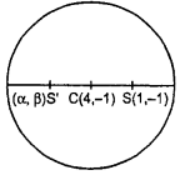
Thus the coordinates of other foci are S’ (7, – 1).
Since the ordinate of points S and S’ are equal. Thus major axis is parallel to x-axis and it is a horizontal ellipse.
Let the eqn. of ellipse be
{(x−4)²/a²} + {(y+1)²/b²} = 1 …(1)
where a > b > 0
Distance between foci = 2ae = 6 ⇒ ae = 3
We know that b² = a² (1 – e²) = a² – 9
Thus eqn. (1) reduces to;
{(x−4)²/a²} + {(y+1)²/(a²−9)} = 1 …(2)
eqn. (2) passes through the point (8, 0), we get
{(8−4)²/a²} + {1/(a²−9)} = 1
⇒ (16/a²) + {1/(a²−9)} = 1
⇒ 16 (a2 – 9) + a2 = a2 (a2 – 9)
⇒ 17a2 – 144 = a4 – 9a2
⇒ a4 – 26a2 + 144 = 0
⇒ a4 – 18a2 – 8a2 + 144 = 0
⇒ a2 (a2 – 18)- 8 (a2 – 18) = 0
⇒ (a2 – 18) (a2 – 8) = 0
⇒ a2 =18, 8
When a2 = 8 ∴ b2 = a2 – 9 = 8 – 9 = – 1
which is false
Thus a2 = 18 ∴ eqn. (2) reduces to ;
{(x−4)²/18} + {(y+1)²/(18−9)} = 1
⇒ {(x−4)²/18} + {(y+1)²/9} = 1
⇒ (x – 4)² + 2 (y + 1)² = 18
⇒ x² + 2y² – 8x +4y = 0
which is the required eqn. of ellipse.
Que-9: Find the equation of the ellipse with its centre at (3, 1), vertex at (3, – 2), and eccentricity equal to 1/3
Sol: Since the centre of required ellipse be C (3, 1) and vertex A (3, – 2). Let the other vertex of ellipse be A’ (α, β). Then C (3, 1) be the mid point of line segment A A’.
∴ 3 = (α+3)/2 ⇒ α = 3
and 1 = (β−2)/2 ⇒ β = 3
∴ Coordinates of other vertex of an ellipse be A’ (3, 4).
Also x-coordinates of A and A’ are equal
∴ major axis of required ellipse is parallel to y-axis.
Now a = | CA | = | CA’ | = 3
and e = eccentricity of ellipse = 13
∴ b² = a² (1 – e)² = 9 (1−(1/9)) = (9×8)/9 = 8
Thus required eqn. of ellipse having centre C (3, 1) and major axis parallel toy-axis is given by
{(x−3)²/b²} + {(y−1)²/a²} = 1
⇒ {(x−3)²/8} + {(y−1)²/9} = 1
⇒ 9 (x – 3)²+ 8(y – 1)² = 72
⇒ 9x² + 8y² – 54x – 16y + 17 = 0
Que-10: Find the equation of the ellipse whose centre is at (0, 2) and major axis along the axis of y and whose minor axis is equal to the distance between the foci and whose latus rectum is 2.
Sol: Let the eqn. of ellipse with centre at (0, 2) and having major axis along y-axis be given by
{(x−0)²/b²} + {(y−2)²/a²} = 1 …(1)
where a > b > 0
Also, 2b = 2ae ⇒ b = ae …(2)
Further 2b²/a = 2 ⇒ b2 = a …(3)
We know that, b2 = a2 (1 – e2)
⇒ a = a2 – a (using (2) and (3)]
⇒ 2a = a2 ⇒ a = 2 [∵ a > 0]
from (3); b2 = 2
Thus eqn. (1) reduces to ;
(x²/2) + {(y-2)²/4} = 1
⇒ 2x2 + (y – 2)2 = 4
⇒ 2x2 + y2 – 4y = 0
which is the required eqn. of an ellipse.
Que-11: Find the equation of the ellipse with (i) focus at (1, – 1), directrix x = 0, and e = √2/2;
(ii) focus at (0, 0), eccentricity is 56, and directrix is 3x + 4y – 1 = 0
Sol: (i) Let P (x, y) be any point on the parabola s.t | PF | = e | PM |
√{(x−1)²+(y+1)²} = √2|x| / 2
On squaring both sides ; we have
(x – 1)² + (y + 1)² = 1/2 x²
⇒ 2 [(x – 1)2 + (y + 1)2] = x2
⇒ x2 + 2y2 – 4x + 4y + 4 = 0
which is the required eqn. of an ellipse.
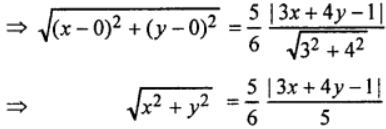
(ii) Let P (x, y) be any point on ellipse
Then by def. | PF | = e | PM |
On squaring both sides ; we have
36(x2 + y2) = (3x + 4y – 1)2
⇒ 36 x2 + 36 y2 = 9x2 + 16y2 + 1 + 24xy – 8y – 6x
⇒ 27x2 + 20y2 – 24xy + 8y + 6x – 1 = 0
which is the required eqn. of an ellipse.
Que-12: Find the equation of the ellipse from the following data : axis is coincident with x = 1, centre is (1, 5), focus is (1, 8) and the sum of the focal distances of a point on the ellipse is 12.
Sol: Let the eqn. of ellipse be
{(x−1)²/b²} + {(y−5)²/a²} = 1 …(1)
Since axis of ellipse is coincident with x = 1 i.e. required ellipse be a vertical ellipse, given centre of ellipse be C (1, 5) and Focus be S (1, 8).
∴ | CS | = √{(1−1)²+(8−5)²} = 3
⇒ ae = 3 …(2)
Further sum of focal distances from any point on the ellipse = |PS| + |PS’| = 2a = 12
⇒ a = 6
∴ from (2); e = 3/6 = 1/2
We know that b² = a² (1 – e²)
⇒ b² = 36(1−(1/4))
⇒ b² = 36 × (3/4) = 27
∴ eqn. (1) reduces to ;
{(x−1)²/27} + {(y−5)²/36} = 1
which is the required eqn. of an ellipse.
Que-13: A point P (x, y) moves so that the product of the slopes of the two lines joining P to the two points (- 2, 1) and (6, 5) is – 4. Show that the locus is an ellipse and locate its centre.
Sol: Let the given points are A (- 2, 1) and B (6, 5).
slope of line joining P (x, y) and A (- 2, 1) = (y−1)/(x+2) = m1
slope of line joining P (x, y) and B (6, 5) = (y−5)/(x−6) = m2
product of slopes of both lines = – 4
⇒ {(y−1)/(x+2)} {(y−5)/(x−6)} = – 4
⇒ (y – 1) (y – 5) + 4 (x + 2) (x – 6) = 0
⇒ y2 + 4x2 – 6y – 16y – 43 = 0
which is the required eqn. of an ellipse.
4x2 – 16x + y2 – 6y = 43
⇒ 4 (x2 – 4x + 4 – 4) + (y2 – 6y + 9 – 9) = 43
⇒ 4 (x – 2)2 + (y – 3)2 = 68
⇒ {(x−2)²/17} + {(y−3)²/68} = 1
Clearly centre of an ellipse be C (2, 3).
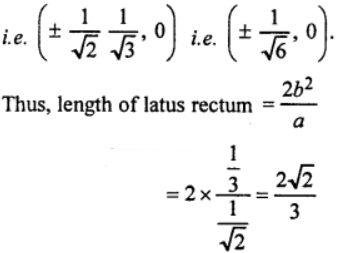
Que-14: Find the eccentricity, the coordinates of the foci, and the length of the latus rectum of the ellipse 2x2 + 3y2 = 1.
Sol: Given eqn. of an ellipse be
2x² + 3y² = 1
⇒ {x²/(1/2)} + {y²/(1/3)} = 1 …(1)
On comparing with (x²/a²) + (y²/b²) = 1,
where a > b > 0
a² = 1/2; b² = 1/3
We know that b² = a² (1 – e²)
⇒ 1/3 = 1/2 (1 – e²) ⇒ 2/3 = 1 – e²
⇒ e² = 1 – (2/3) = 1/3
⇒ e = 1/√3 [∵ e > 0]
Thus required eccentricity of an ellipse be 1/√3. Foci are given by (± ae, 0)
Que-15: For the ellipse, 9x2 + 16y2 = 576, find the semi-major axis, the semi-minor axis, the eccentricity, the coordinates of the foci, the equations of the directrices, and the length of the latus rectum.
Sol: Given eqn. of an ellipse be
9x² + 16y² = 576
⇒ (x²/64) + (x²/64) = 1 ….(1)
On comparing with (x²/a²) + (y²/b²) = 1;
where a > b > 0
∴ a² = 64 and b² = 36
We know that b² = a² (1 – e²)
⇒ 36 = 64 (1 – e²)
⇒ 36/64 = 1 – e²
⇒ e² = 1 – (36/64) = 1 – (9/16) = 7/16
∴ e = √7/4 [∵ e > 0]
Thus required eccentricity of an ellipse be √7/4
Here, a = 8 ; b = 6 (∵ a > b > 0)
∴ length of semi major-axis = a = 8
and length of semi minor axis = b = 6
foci are given by (± ae, 0)
i.e. (±8×(√7/4),0) i.e. (±2√7,0)
length of latus rectum = (2b²/a) = (2×36)/8 = 9
eqns. of directrices are given by x = ±ae
i.e. x = ±8/√7 × 4 = ±32/√7.
Que-16: Find the length of the axes, the co-ordinates of the foci, the eccentricity, and latus rectum of the ellipse 3x2 + 2y2 = 24.
Sol: Given eqn. of ellipse be 3x² + 2y² = 24
⇒ (x²/8) + (y²/12) = 1;
where a > b > 0
On comparing with (x²/b²) + (y²/a²) = 1
we have a² = 12 ; b2 = 8
i.e. a = 2√3
and b = 2√2
length of major axis = 2a = 4√3
and length of minor axis = 2b = 4√2
we know that b² = a² (1 – e²)
⇒ 8 = 12(1 – e²)
⇒ 1 – e² = 2/3
⇒ e² = 1/3
⇒ e = 1/√3 (∵e > 0)
Thus foci of an ellipse be (0, ± ae)
i.e. (0,±2√3×(1/√3)) i.e. (0, ± 2)
length of latus-rectum = (2b²/a) = {2×(2√2)²} / 2√3 = 8√3
Que-17: Find the eccentricity of the ellipse, 4x2 + 9y2 – 8x – 36y + 4 = 0.
Sol: Given eqn. of an ellipse be,
4x2 + 9y2 – 8x – 36y + 4 = 0
⇒ 4(x2 – 2x + 1 – 1) + 9(y2 – 4y + 4 – 4) + 4 = 0
⇒ 4 [(x – 1)2 – 1] + 9 [y – 2)2 – 4] + 4 = 0
⇒ 4 (x – 1)2 + 9 (y – 2)2 = 36
⇒ {(x−1)²/9} + {(y−2)²/4} = 1 …(1)
On comparing with (x²/a²) + (y²/b²) = 1 ; where a > b > 0
Here, a² = 9 and b² = 4
we know that, b² = a² (1 – e²)
⇒ 4 = 9 (1 – e²) ⇒ 1 – e² = 4/9
⇒ e² = 5/9 ⇒ e = √5/3 (∵ e > 0)
Thus, required eccentricity of an ellipse be √5/3.
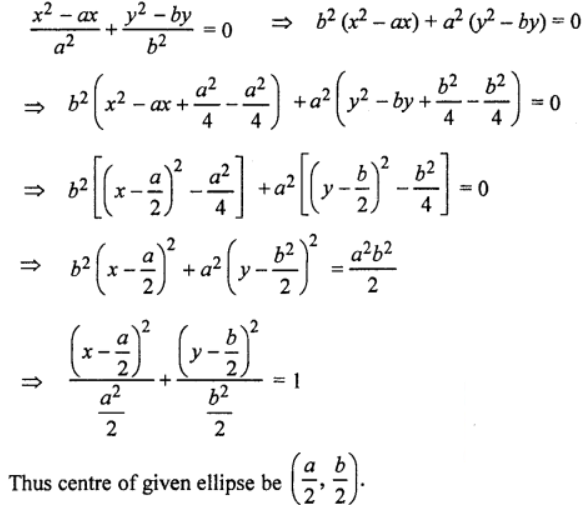
Que-18: find the centre of the ellipse, {(x²−ax)/a²} + {(y²−by)/b²} = 0.
Sol: Given eqn. of an ellipse be
Que-19: Find the distance between a focus and an extremity of the minor axis of the ellipse
(i) 4x² + 5y² = 100
(ii) (x²/a²) + (y²/b²) = 1
Sol: (i) Given eqn. of ellipse be 4x² + 5y² = 100
⇒ (x²/25) + (y²/20) = 1 …(1)
On comparing eqn. (1) with (x²/a²) + (y²/b²) = 1
we have
where a > b > 0
a² = 25 and b² = 20
We know that b² = a² (1 – e²)
⇒ 20 = 25 (1 – e²)
⇒ 4/5 = 1 – e²
⇒ e² = 1 – (4/5) = 1/5
⇒ e = 1/√5 (∵ e > 0)
∴ required distance = distance between focus (ae, 0) and (0, b)
√{(ae-0)²+(0-b)²} = √(a²e²+b²)
√[25(1/5)+20] = √25 = 5
(ii) Given eqn. of ellipse be (x²/a²) + (y²/b²) = 1
∴ required distance = √(b²+a²e²) = √a² = a
[∵ b2 = a2 (1 – e)2 ⇒ b2 + a2e2 = a2]
Que-20: Given the ellipse 36x2 + 100y2 = 3600, find the equation and the lengths of the focal radii drawn through the point [8, (18/5)]
Sol: Given eqn. of ellipse be,
(x²/100) + (y²/36) = 1 …(1)
On comparing with (x²/a²) + (y²/b²) = 1
we have a² = 100; b² = 36
We know that, b² = a² (1 – e²)
⇒ 36 = 100 (1 – e²) ⇒ 1 – e² = 36/100 = 9/25
⇒ e² = 1 – (9/25) = 16/25
⇒ e = 4/5 (∵ e > 0)
required lengths of focal radii drawn through the point (8,18/5) = a ± ex1
= 10 ± (4/5) × 8 = 10 ± (32/5) = (82/5), 18/5
foci are given by (± ae, 0) i.e. (±10×(4/5),0) i.e. (± 8, 0)
The eqns. of focal radii joining the points (± 8, 0) and (8,18/5) be given by
![Que-20: Given the ellipse 36x2 + 100y2 = 3600, find the equation and the lengths of the focal radii drawn through the point [8, (18/5)]](https://icsehelp.com/wp-content/uploads/2025/08/b-2.png)
Que-21: The focal distance of an end of the minor axis of the ellipse is k and the distance between the foci is 2h. Find the lengths of the semi-axes.
Sol: Given, the focal distance of an end of minor axis be k.
The ends of minor axes be (0, ± b).
i.e. given a – ex1 = k ⇒ a – e × 0 = k
⇒ a = k
distance between foci = 2h ⇒ 2ae = 2h
⇒ ae – h ⇒ e = h/k
We know that b² = a² (1 – e²)
⇒ b² = k² [1−(h²/k²)]
⇒ b² = k² – h²
⇒ b = √(k²−h²)
Que-22: Find the eccentricity of the ellipse whose latus rectum is 4 and distance of the vertex from the nearest focus is 1.5 cm.
Sol: Let e be the eccentricity of an ellipse
According to given condition, (2b²/a) = 4 ⇒ b² = 2a …(1)
Also, a – ae = 1.5 …(2)
Also we know that b2 = a² (1 – e²) ⇒ 2a = a² (1 – e²) …(2)
⇒ 2a = a² – (a−(3/2))²
⇒ 2a = a² – a² – (9/4) + 3a ⇒ a = (9/4)
∴ from (2); 9/4 (1 – e) = 3/2
⇒ 1 – e = (3/2) × (4/9)
⇒ 1 – e = (2/3) ⇒ e = 1/3
Thus the required eccentricity of an ellipse be 1/3
Que-23: The directrix of a conic section is the line 3x + 4y = 1 and the focus S is (- 2, 3). If the eccentricity e is 1/√2, find the equation to the conic section.
Sol: Given focus of ellipse be F (- 2, 3) and eqn. of corresponding directrix is 3x + 4y – 1 = 0 and eccentricity e = 1/√2.
Let P (x, y) be any point on ellipse and PM be the ⊥ drawn from P on given directrix. Then by definition of ellipse, we have | PF | = e | PM |
⇒ √{(x+2)²+(y−3)²} = (1/√2) |3x+4y−1| / √(3²+4²)
On squaring both sides ; we have
(x + 2)² + (y – 3)² = (1/2) × (1/25)(3x + 4y – 1)²
⇒ 50 [(x + 2)2 + (y – 3)2] = (3x + 4y – 1)2
⇒ 50 (x2 + y2 + 4x – 6y + 13) = 9x2 + 16y2 + 1 + 24xy – 8y – 6x
⇒ 41x2 + 34x2 – 24xy + 206x – 292y + 649 = 0 which is the required eqn. of ellipse.
Que-24: Find the equation to the conic section whose focus is (1, – 1), eccentricity is (1/2) and the directrix is the line x – y = 3. Is the conic section an ellipse ?
Sol: Given focus of ellipse be F (1, – 1) and eqn. of directrix be x – y – 3 = 0 and e = 1/2
Let P (x, y) be any point on ellipse. Then by def. of ellipse, we have | PF | = e | PM | where PM be the ⊥ drawn from P on given directrix.
⇒ √{(x−1)²+(y+1)²} = (1/2) |x−y−3| / √{1²+(−1)²}
On squaring both sides, we have
8 [(x – 1)2 + (y + 1)2] = (x – y – 3)2
⇒ 8(x2 – 2x + y2 + 2y + 2) = x2 + y2 + 9 – 2xy + 6y – 6x
⇒ 7x2 + 7y2 + 2xy – 10x + 10y + 7 = 0 which is the required eqn. of ellipse.
Que-25: Find the equation of the ellipse whose foci are (- 1, 5) and (5, 5) and whose major axis is 0.
Sol: Given foci of an ellipse are S (- 1, 5) and S’ (5, 5).
Since ordinates of both foci are same.
Thus, eqn. of axes of an ellipse be parallel to x-axis and let C (α, β) be the coordinates of centre of an ellipse i.e. C (α, β) be the mid-point of SS’.
Thus, α = (−1+5)/2 and β = (5+5)/2
i.e. a = 2 and p = 5
Let the required eqn. of ellipse be
{(x−2)²/a²} + {(y−5)²/b²} = 1 …(1)
given 2a = 10 ⇒ a = 5
Also, 2ae = 6 ⇒ ae = 3 ⇒ e = 3/5 < 1
We know that b² = a² (1 – e²)
⇒ b² = 25(1−(9/25)) = 16
Thus eqn. (1) reduces to ;
{(x−2)²/25} + {(y−5)²/16} = 1
which is the required eqn. of an ellipse.
Que-26: Find the ellipse if its foci are (± 2, 0) and the length of the latus rectum is 10/3
Sol: Given foci of ellipse are (± 2, 0) and both foci lies on x-axis. So x-axis being the major axes of an ellipse.
Let the eqn. of ellipse be taken as
{(x−0)²/a²} + {(y−0)²/b²} = 1 …(1)
Clearly ae = 2 …(2)
and 2b²/a = 10/3 ⇒ b² = (5/3)a …(3)
We know that b² = a² (1 – e²)
⇒ (5a/3) = a² – 4 [using eqn. (2) and (3)]
⇒ 3a² – 5a – 12 = 0
⇒ (a – 3) (3a + 4) = 0
⇒ a = 3 [∵ a > 0]
∴ from (2); e = (2/3) < 1
Thus b² = (5/3) × 3 = 5 [using (3)]
Hence eqn. (1) reduces to ; (x²/9) + (y²/5) = 1
which is the required eqn. of an ellipse.
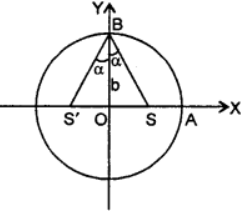
Que-27: Find the eccentricity of the ellipse of minor axis 2b, if the line segment joining the foci subtends an angle 2a at the upper vertex. Also, find the equation of the ellipse.
Sol: Let e be the eccentricity of an ellipse.
In △BOS, we have OS = b tan α
∴ SS’ = 20S ⇒ 2ae – 2b tan α
⇒ ae = b tan α …(1)
We know that b2 = a2 (1 – e2)
⇒ b2 = a2 – a2e2 = a2 – b2 tan2 α
⇒ b2 (1 + tan2 α) = a2
a = b sec α …(2)
From eqn. (1) and eqn. (2); we have
e = (b tan α) / (b sec α) = sin α
Thus required eqn. of ellipse becomes ;
[x²/{b²sec²α] + (y²/b²) = 1
⇒ x2 cos2 α + y2 = b2
which is the required eqn.
–: End of Ellipse Class 11 OP Malhotra Exe-24A ISC Maths Ch-24 Solutions. :–
Return to :- OP Malhotra ISC Class-11 S Chand Publication Maths Solutions
Please share with your friends
Thanks