Equation of Plane Through Intersection of Two Planes Class 12 OP Malhotra Exe-24D ISC Maths Solutions Ch-24 The Plane. In this article you would learn how to find equation of a plane which is passing through intersection of two plane easily. Visit official Website CISCE for detail information about ISC Board Class-12 Mathematics.
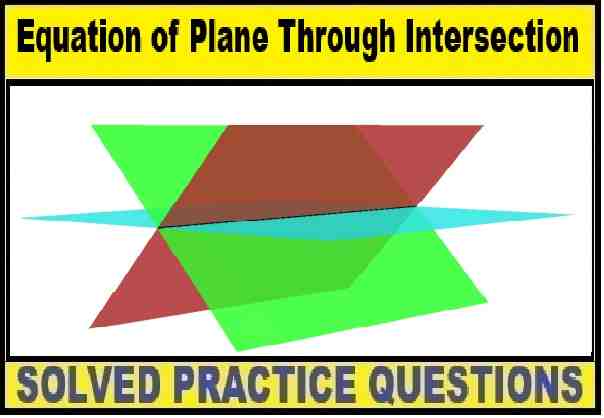
Equation of Plane Through Intersection of Two Planes Class 12 OP Malhotra Exe-24D ISC Maths Solutions Ch-24 The Plane
| Board | ISC |
| Publications | S Chand |
| Subject | Maths |
| Class | 12th |
| Chapter-24 | The Plane |
| Writer | OP Malhotra |
| Exe-24(d) | Equation of Plane Through Intersection of Two Planes |
Equation of Plane Through Intersection of Two Planes
The Plane Class 12 OP Malhotra Exe-24D Solutions
Que-1: Find the equation of the planes through the intersection of the planes
x + 2 y + 3 z + 5 = 0,2 x – 4 y + z – 3 = 0 and the point (0, 1, 0)
Sol: Given equations of planes are :
x + 2 y + 3 z + 5 = 0
2 x – 4 y + z – 3 = 0
and Thus the eqn. of plane through the inter-section of planes (1) and (2) is given by
(x + 2 y + 3 z + 5) + λ(2 x – 4 y + z – 3) = 0
Also plane given by eqn. (3) passes through the point (0, 1, 0).
∴(0 + 2 + 0 + 5) + λ(0 – 4 + 0 – 3) = 0
⇒ 7 – 7 λ = 0
⇒ λ = 1
Putting the value of λ in eqn. (3); we have
(x + 2 y + 3 z + 5) + (2 x – 4 y + z – 3) = 0
⇒ 3 x – 2 y + 4 z + 2 = 0
which is the required eqn. of plane.
Que-2: Find the equation of the plane containing the line of intersection of the plane x + y + z – 6 = 0 and 2 x + 3 y + 4 z + 5 = 0 passing through the point (1, 1, 1).
Sol: The eqn. of plane passing through the line of intersection of given planes be
r→ (î + ĵ + k̂) = 6 and r→ (2î + 3ĵ + 4k̂) + 5 = 0
be given by [r→ (î + ĵ + k^) – 6] + λ[r→ (2î + 3ĵ + 4k̂) + 5] = 0
⇒ r→ [(1 + 2 λ)î + (1 + 3 λ)ĵ + (1 + 4 λ)k̂] – 6 + 5 λ = 0
Since the plane (1) passes through the point (1, 1, 1)
∴ The vector î + ĵ + k̂ lies on eqn ………… (1)
we get (î + ĵ + k̂)
[ (1 + 2 λ)î + (1 + 3 λ)ĵ + (1 + 4 λ)k̂] – 6 + 5 λ = 0
⇒ 1(1 + 2 λ) + 1(1 + 3 λ) + 1(1 + 4 λ) – 6 + 5 λ = 0
⇒ 14 λ = 3 ⇒ λ = 3/14
putting the value of λ in eqn. (1)
we have r→ [20/14 î + 23/14ĵ + 26/14k̂] – 69/14 = 0
⇒ r→ [(20î + 23ĵ + 26 k̂] = 69 be the required eqn. of plane.
Que-3: Find the direction ratios of the normal to the plane passing through the point (2, 1, 3) and the line of intersection of the planes x + 2 y + z = 3 and 2 x – y – z = 5.
Sol: The given planes are
x + 2 y + z = 3
2 x – y – z = 5
and
Thus, the eqn. of plane through the line of intersection of planes (1) and (2) is given by
(x + 2 y + z – 3) + λ(2 x – y – z – 5) = 0
Now plane (3) passes through the point (2, 1, 3).
∴ (2 + 2 + 3 – 3) + λ(4 – 1 – 3 – 5) = 0
⇒ 4 + (-5 λ) = 0 ⇒ λ = 4 / 5
Putting the value of λ = 4 / 5 in eqn. (3); we have
(x + 2 y + z – 3) + 4/5 (2 x – y – z – 5) = 0 ⇒ 13 x + 6 y + z – 35 = 0
Thus the direction ratios of normal to plane (4) are < 13, 6, -1 >
Que-4: Find the equation of the plane passing through the intersection of the planes
r→(2î +ĵ + 3k̂) = 7 and r→ (2î + 5ĵ + 3k̂) = 9 the point (2, 1, 3)
Sol: The eqn. of plane passing through the line of intersection of given planes be
r→ (2î +ĵ + 3k̂) = 7 and r→ (2î + 5ĵ + 3k̂) = 9
is given by [r→ (2î +ĵ + 3k̂) – 7] + λ[r→ (2î + 5 ĵ + 3k̂) – 9] = 0
⇒ r→ [(2 + 2 λ)î + (1 + 5 λ)ĵ + (3 + 3 λ)k̂] – 7 – 9 λ = 0
Since the plane (1) passes through the point (2, 1, 2).
∴(î + ĵ + 3k̂) [(2 + 2 λ)î + (1 + 5 λ)ĵ + (3 + 3 λ)k̂] – 7 – 9 λ = 0
⇒ 2(2 + 2 λ) + (1 + 5 λ) + 3(3 + 3 λ) – 7 – 9 λ = 0 ⇒ 9 λ = -7 ⇒ λ = −7/9
putting the value of λ in eqn. (1); we get
r→ [4/9î – 26/9ĵ + 6/9k̂] – 7 + 7 = 0
⇒ r→ (2î – 13ĵ + 3k̂) = 0 be the required eqn. of plane.
Que-5: Find the equation of the plane passing through the intersection of the planes 2 x + 3 y – z + 1 = 0, x + y – 2 z + 3 = 0 and perpendicular to the plane 3 x – y – 2 z – 4 = 0.
Sol: The eqn. of plane through the intersection of two given plane
2 x + 3 y – z + 1 = 0 and x + y – 2 z + 3 = 0 be given by :
2 x + 3 y – z + 1 + λ(x + y – 2 z + 3) = 0
⇒ (2 + λ) x + (3 + λ) y + (-1 – 2 λ) z + 1 + 3 λ = 0
∴ Direction ratios of normal to plane (1) are < 2 + λ, 3 + λ, -1 – 2 λ >
Since the plane (1) is ⊥ to given plane 3 x – y – 2 z – 4 = 0
where d ratios of normal to plane are < 3, -1, -2 >
∴(2 + λ) 3 + (3 + λ)(-1) + (-1 – 2 λ)(-2) = 0 ⇒ 6 λ + 5 = 0 ⇒ −5/6
putting the value of λ in eqn. (1); we have
(2 – 5/6) x + (3 – 5/6) y + (-1 + 5/3) z + 1 – 5/2 = 0
⇒ 7/6 x + 13/6 y + 2/3 z – 3/2 = 0
⇒ 7 x + 13 y + 4 z – 9 = 0 which is the required eqn. of plane.
Que-6: Find the equation of the plane through the point 2î + j^ – k^ and passing through the line of intersection of the planes r→ (î + 3 ĵ – k̂) = 0 and r→ (ĵ + 2 k̂) = 0.
Sol: The eqn. of given planes are :
r→ (î + 3 ĵ – k̂) = 0
r→ (ĵ + 2k̂) = 0
and
Thus the eqn. of plane through the line of intersection of planes (1) and (2) is given by
r→ (î + 3ĵ –k̂) + λr→ (ĵ + 2k̂) = 0
⇒ r→ [î + (3 + λ)ĵ + (-1 + 2 λ)k̂] = 0
Since the plane (3) passes through the point where P.V is 2î + ĵ – k̂
∴ (2 î + ĵ – k^) [î + (3 + λ)ĵ + (-1 + 2 λ)k̂] = 0
⇒ 2(1) + 1(3 + λ) – 1(-1 + 2 λ) = 0
⇒ 2 + 3 + λ + 1 – 2 λ = 0 ⇒ 6 – λ = 0 ⇒ λ = 6
putting the value of λ = 6 in eqn. (3); we get
r→ (î + 9ĵ + 11 k^) = 0 which is the required eqn. of plane.
Que-7: Find the vector equation of the plane through the point (1, 4, -2) and perpendicular to the line of intersection of the planes x + y + z = 10,2 x – y + 3 z = 18.
Sol: The equations of given planes are
and
x+y+z-10=0
2 x-y+3 z-18=0
∴ d ratios of normal to planes (1) and (2) are < 1, 1, 1> and < 2, -1, 3 >.
Let the eqn. of plasses through the point (1,4,-2) is given by
a(x – 1) + b(y – 4) + c(z + 2) = 0
where < a, b, c> are the direction ratios of normal to plane.
Since plane (3) is ⊥ to plane (1) and (2)
∴ a + b + c = 0
2 a – b + 3 c = 0
Solving eqn. (4) and eqn. (5) by cross multiplication method, we have
a/3+1 = b/2−3 = c/−1−2
i.e. a/4 = b/−1 = c/−3 = k (say)
i.e. a = 4 k ; b = -k ; c = -3 k where k ≠ 0
4 k(x – 1) – k(y – 4) – 3 k(z + 2) = 0
⇒ 4 x – y – 3 z = 6 which is the reqd. eqn. of plane
Que-8: Find the equation of the plane through the intersection of the planes x + 3 y + 6 = 0 and 3 x – y – 4 z = 0 and whose perpendicular distance from the origin is unity.
Sol: The eqns. of given planes are
x + 3 y + 6 = 0
3 x – y – 4 z = 0
and
Thus the eqn. of plane through the line of intersection of planes (1) and (2) be given by
(x + 3 y + 6) + λ(3 x – y – 4 z) = 0
⇒ (1 + 3 λ) x + (3 – λ) y – 4 λ z + 6 = 0
It is given that ⊥ distance from origin (0, 0, 0) to plane (3) = 1
⇒ |(1+3λ)0+(3−λ)0−4λ×0+6|/√(1+3λ)²+(3−λ)²+(−4λ)² = 1
⇒ 6 = √(1+3λ)²+(3−λ)²+16λ²
On squaring both sides; we have
36 = (1 + 3 λ)² + (3 – λ)² + 16 λ²
⇒ 36 = 1 + 9 λ² + 6 λ + 9 + λ² – 6 λ + 16 λ²
⇒ 26 λ² = 26
⇒ λ² = 1
⇒ λ = ± 1
Putting the values of λ in eqn. (3); we have
(1 + 3) x + (3 – 1) y – 4 z + 6 = 0 and (1 – 3) x + (3 + 1) y + 4 z + 6 = 0
i.e. 4 x + 2 y – 4 z + 6 = 0 and -2 x + 4 y + 4 z + 6 = 0
i.e. 2 x + y – 2 z + 3 = 0 and x – 2 y – 2 z – 3 = 0
which are the required eqns. of planes.
Que-9: Find the equation of the plane passing through the intersection of the planes 4 x – y + z = 10 and x + y – z = 4 and parallel to the line with direction ratios 2,1,1. Also, find the perpendicular distance of (1, 1, 1) from this plane.
Sol: The eqn. of plane through the line of intersection of two given planes
4 x – y + z = 10 and x + y – z = 4 is given by
(4 x – y + z – 10) + λ(x + y – z – 4) = 0
i.e. (4 + λ) x + (-1 + λ) y + (1 – λ) z – 10 – 4 λ = 0
∴ D ratios of normal to plane, are < 4 + λ, -1 + λ, 1 – λ >
Also plane (1) parallel to line having direction ratios < 2, 1, 1 >
Thus normal to plane (1) is ⊥ to given line.
∴ 2(4 + λ) + (-1 + λ) 1 + (1 – λ) 1 = 0
⇒ 8 + 2 λ + λ – 1 + 1 – λ = 0
⇒ 8 + 2 λ = 0 ⇒ λ = -4
Putting the values of λ in eqn. (1) ; we have
-5 y + 5 z + 6 = 0 ⇒ 5 y – 5 z – 6 = 0
∴ required ⊥ distance of point (1, 1, 1) from plane (2)
= |5×1−5×1−6|/√5²+5² = 6/√50 = 6/5√2 = 3√2/5 units
Que-10: Find the equation of the plane which passes through the line of intersection of the planes x + 5 y – 2 z = 6 and 5 x – 4 y + 5 z = 2 and parallel to the line joining the points (5, 1, 4) and (4, -2, 3).
Sol: The eqn. of plane through the line of intersection of given planes
x + 5 y – 2 z – 6 = 0 and 5 x – 4 y + 5 z – 2 = 0 be given by
(x + 5 y – 2 z – 6) + λ(5 x – 4 y + 5 z – 2) = 0
i.e. (1 + 5 λ) x + (5 – 4 λ) y + (-2 + 5 λ) z + (-6 – 2 λ) = 0
∴ D ratios of normal to plane (1) are < 1 + 5 λ, 5 – 4 λ,-2 + 5 λ >
Since the plane (1) is || to line joining (5, 1, 4) and (4, -2, 3)
∴D ratios of given line are < 4 – 5, -2 – 1, 3 – 4 > i.e. < -1, -3, -1 > i.e. < 1, 3, 1 > Thus, normal to plane (1) is ⊥ to given line.
(1 + 5 λ) 1 + (5 – 4 λ) 3 + (-2 + 5 λ) 1 = 0
5 λ + 1 + 15 – 12 λ – 2 + 5 λ = 0
⇒ -2 λ + 14 = 0
⇒ λ = 7
⇒ 5 λ + 1 + 15 – 12 λ – 2 + 5 λ = 0
⇒ -2 λ + 14 = 0 ⇒ λ = 7
Putting the value of λ in eqn. (1); we get
36 x – 23 y + 33 z – 20 = 0 which is the reqd. eqn of plane.
Que-11: Find the equation to the plane through the line of intersection of the planes a x + b y + c z + d = 0, a’ x + b’ y + c’ z + d’ = 0 and
(i) parallel to the x-axis,
(ii) perpendicular to x y-plane.
Sol: (i) The eqn. of plane through the line of intersection of given planes
a x + b y + c z + d = 0 and a’ x + b’ y + c’ z + d’ = 0 is given by
(a x + b y + c z + d) + λ(a’ x + b’ y + c’ z + d’) = 0
⇒ (a + λ a’) x + (b + λ b’) y + (c + λ c’) z + d + λ d’ = 0
Now plane (1) is || to x-axis
∴ perpendicular to Y O Z plane i.e. x = 0 ⇒ 1 x + 0 y + 0 z = 0
Thus, (a + λ a’) 1 + (b + λ b’) 0 + (c + λ c’) 0 = 0
⇒ λ = −a/a′
Putting the value of λ in eqn. (1); we have
(b – ab′/a′) y + (c – ac′/a′) z + d + (−a/a′) d’ = 0
⇒ a'(b y + c z + d) = a(b’ y + c’ z + d’) be the reqd. plane.
(ii) Now plane (1) is ⊥ to plane x y i.e. z = 0 i.e. 0 x + 0 y + 1 z = 0
So normal to plane (1) is ⊥ to plane (3).
∴(a + λ a’) 0 + (b + λ b’) 0 + (c + λ c’) 1 = 0
⇒ λ = −c/c′
putting the value of λ in eqn. (1); we have
(a – a′c/c′) x + (b – b′c/c′) y + d + (−c/c′) d’ = 0
⇒ c'(a x + b y + d) = c(a’ x + b’ y + d’)
which is the reqd. eqn. of plane.
Que-12: Find the equation of the plane which passes through the y-axis and the point (4, 2, -3).
Sol: The eqn. of plane passes through the y-axis i.c. intersection of x y plane and y z plane i.e. through the planes z = 0 and x = 0 be given by
z + k x = 0
Further eqn. (1) passes through the point (4, 2, -3).
∴-3 + 4 k = 0 ⇒ k = 3/4
putting the value of k in eqn. (1) ; we get
z + 3/4 x = 0
⇒ 3 x + 4 z = 0 be the required plane.
Que-13: Find the equation of the plane passing through the line of intersection of the planes x + 2 y + 3 z – 5 = 0 and 3 x – 2 y – z + 1 = 0 and cutting off equal intercepts on x-axis and z-axis.
Sol: The eqn. of piane through the line of intersection of given plane
x + 2 y + 3 z – 5 = 0 and 3 x – 2 y – z + 1 = 0 be given by
(x + 2 y + 3 z – 5) + λ(3 x – 2 y – z + 1) = 0
i.e. (1 + 3 λ) x + (2 – 2 λ) y + (3 – λ) z = 5 – λ
⇒ (1+3λ)x/5−λ + (2−2λ)y/5−λ + (3−λ)z/5−λ = 1
⇒ x/(5−λ) + x/1+3λ + 5−λ/2−2λ + 5−λ/3−λ = 1
Thus the intercepts cut off by plane (2) on x-axis and z-axis are 5−λ/1+3λ and 5−λ/3−λ.
According to given condition ; we have
5−λ/1+3λ
= 5−λ/3−λ
⇒ (5 – λ)[3 – λ – 1 – 3 λ] = 0
⇒ (5 – λ)(2 – 4 λ) = 0
⇒ λ = 5, 1/2 ; since λ ≠ 5
∴ λ = 1/2
putting the value of λ in eqn. (1); we have
(x + 2 y + 3 z – 5) + 1/2(3x−2y−z+1) = 0
⇒ 5 x + 2 y + 5 z – 9 = 0 which is the required plane.
Que-14: Find the vector equation of the plane containing the line of intersection of the planes x – 3 y + 2 z – 5 = 0 and 2 x – y + 3 z – 1 = 0 and passing through the point (1, -2, 3).
Sol: The equation of any plane passing through the line of intersection of given planes
x – 3 y + 2 z – 5 = 0 and 2 x – y + 3 z – 1 = 0
(x – 3 y + 2 z – 5) + λ(2 x – y + 3 z – 1) = 0
⇒ (1 + 2 λ) x + (-3 – λ) y + (2 + 3 λ) z – 5 – λ = 0
Since plane (1) passing through the point (1, -2, 3)
∴ (1 + 2 λ) 1 + (-3 – λ)(-2) + (2 + 3 λ) 3 – 5 – λ = 0
⇒ 1 + 2 λ + 6 + 2 λ + 6 + 9 λ – 5 – λ = 0 ⇒ 12 λ = -8 ⇒ λ = −2/3
Since plane (1) passing through the point (1, -2, 3)
∴ (1 + 2 λ) 1 + (-3 – λ)(-2) + (2 + 3 λ) 3 – 5 – λ = 0
⇒ 1 + 2 λ + 6 + 2 λ + 6 + 9 λ – 5 – λ = 0 ⇒ 12 λ = -8 ⇒ λ = −2/3
putting the value of λ in eqn. (1); we get
−x/3 – 7/3 y + 0 z – 13/3 = 0
⇒ x + 7 y + 13 = 0
⇒ (xî + yĵ + zk̂) (î + 7ĵ + 0k̂) + 13 = 0
⇒ r→ (î + 7ĵ + 0k̂) + 13 = 0
be the required vector eqn. of plane in scalar product form
Que-15: Find the equation of the plane passing through the line of intersection of the pianes 2 x + y – z = 3 and 5 x – 3 y + 4 z + 9 = 0 and parallel to the line x−1/2 = y−3/4 = z−5/5
Sol: The eqns. of given planes are ;
2 x + y – z = 3
5 x – 3 y + 4 z + 9 = 0
Thus, the eqn. of plane passing through the line of intersection of planes (1) and (2) be given by
(2 x + y – z – 3) + λ(5 x – 3 y + 4 z + 9) = 0
(2 + 5 λ) x + (1 – 3 λ) y + (-1 + 4 λ) z – 3 + 9 λ = 0
∴D’ ratios of normal to plane are < 2 + 5 λ, 1 – 3 λ, -1 + 4 λ >
The eqn. of given line be x−1/2 = y−3/4 = z−5/5
Sine plane (3) is || to line (4).
Thus normal to plane (3) is ⊥ to line (4).
(2 + 5 λ) 2 + (1 – 3 λ) 4 + (-1 + 4 λ) 5 = 0
⇒ 4 + 10 λ + 4 – 12 λ – 5 + 20 λ = 0
⇒ 18 λ + 3 = 0
⇒ x = -1 / 6
putting the value of λ in eqn. (3); we have
(2 x + y – z – 3) – 1/6(5x−3y+4z+9) = 0
⇒ 7 x + 9 y – 10z – 27 = 0 which is the required plane.
Que-16: Show that the lines x+4/3 = y+6/5 = z−1/−2 and 3 x – 2 y + z + 5 = 0 = 2 x + 3 y + 4 z – 4 intersect. Find the equation of the plane in which they lie and also their point of intersection.
Sol: The eqn. of given line be
x+4/3 = y+6/5 = z−1/−2 = t (say)
any pont on line be given by (3 t – 4, 5 t – 6, -2 t + 1) eqn. of given planes are
3 x – 2 y + z + 5 = 0
2 x + 3 y + 4 z – 4 = 0
and
Now given line (1) intersects given planes if any point on given line (1) lies on planes (2) and (3).
and
3(3 t – 4) – 2(5 t – 6) + (-2 t + 1) + 5 = 0
2(3 t – 4) + 3(5 t – 6) + 4(-2 t + 1) – 4 = 0
if 9 t – 12 – 10 t + 12 – 2 t + 1 + 5 = 0 and 6 t – 8 +1 5 t – 18 – 8 t + 4 – 4 = 0
if -3 t + 6 = 0 and 13 t – 26 = 0 if t = 2 and t = 2
Thus given line and pianes intersects.
So point of intersection is given by (3 × 2 – 4, 5 × 2 – 6, -2 × 2 + 1)
i.e. (2, 4, -3) eqn. of any plane through the line of intersection of planes (2) and (3) be given by
(3 x – 2 y + z + 5) + λ(2 x + 3 y + 4 z – 4) = 0
(3 + 2 λ) x + (-2 + 3 λ) y + (1 + 4 λ) z + 5 – 4 λ = 0
Now line (1) lies on plane (4) ∴normal to plane (4) is ⊥ to line (1).
∴(3 + 2 λ) 3 + (-2 + 3 λ) 5 + (1 + 4 λ)(-2) = 0
⇒ 13 λ – 3 = 0
⇒ λ = 3/13
putting the value of λ in eqn. (4); we have
(3 x – 2 y + z + 5) + 3/13(2x+3y+4z−4) = 0
⇒ 45 x – 17 y + 25 z + 53 = 0
which is the required eqn. of plane.
–: End of Equation of Plane Through Intersection of Two Planes Class 12 OP Malhotra Exe-24D ISC Maths Solutions :–
Return to :- OP Malhotra ISC Class-12 S Chand Publication Maths Solutions
Please share with your friends
Thanks