Exercise I on Pure Substances and Mixtures; Separation of Mixtures Class 6 Concise Chemistry ICSE Solutions Ch-5. In this article you would learn how to solve Exercise I on Pure Substances and Mixtures; Separation of Mixtures with hint and reason. Visit official Website CISCE for detail information about ICSE Board Class-6.
Exercise I on Pure Substances and Mixtures; Separation of Mixtures Class 6 Concise Chemistry ICSE Solutions
| Board | ICSE |
| Publications | Selina Publication |
| Subject | Chemistry |
| Class | 6th |
| Chapter-5 | Pure Substances and Mixtures; Separation of Mixtures |
| Book Name | Concise |
| Topics | Solution of Exercise I |
| Academic Session | 2025-2026 |
Exercise I on Pure Substances and Mixtures; Separation of Mixtures
Objective Type Questions
Que-1: A mixture of mustard oil and water forms:
(i) a compound
(ii) an alloy
(iii) a homogeneous mixture
(iv) a heterogeneous mixture
Ans- a heterogeneous mixture
Reason — Mustard oil and water are immiscible liquids, their mixtures are not uniformly distributed throughout, Hence, they form a heterogeneous mixture.
Que-2: A heterogeneous mixture is:
(i) made up of only one kind of atoms
(ii) made up of only one kind of molecules
(iii) made up of different kinds of atoms and molecules.
(iv) one that looks uniform.
Ans-made up of different kinds of atoms and molecules.
Reason — A heterogeneous mixture is made up of different kinds of atoms and molecules which do not mix uniformly.
Que-3: An example of a homogeneous mixture is :
(i) distilled water
(ii) tap water
(iii) sand and water
(iv) sawdust and water
Ans-tap water
Reason — Tap water is a homogeneous mixture because it has minerals and salts, which are evenly mixed and looks uniform throughout.
Que-4: Which among the following is a set containing only mixtures ?
(i) gold, common salt, water, alloy
(ii) alloy, ink, honey, ice-cream
(iii) alloy, mercury, air, sea water
(iv) milk, duralumin, brass, silver.
Ans– alloy, ink, honey, ice-cream
Reason — The set “alloy, ink, honey, ice-cream” has only mixtures, because:
(a) Alloy : Mixture of metals
(b) Ink : Mixture of dyes and solvents
(c) Honey : Mixture of sugar and water
(d) Ice-cream : Mixture of milk, sugar, flavors and air.
Que-5: Copper is not a part of the alloy :
(i) brass
(ii) bronze
(iii) steel
(iv) duralumin
Ans– steel
Reason — Brass, bronze and duralumin has copper as their component along with other metals. Whereas, steel has iron and carbon.
Que-6: Which of the following is not a mixture?
(i) Sugar solution
(ii) Tap water
(iii) Milk
(iv) Distilled water
Ans-Distilled water
Reason — Distilled water is a pure substance, consisting of only H2O molecules without any dissolved salts, minerals.
Que-7: Which of the following is a mixture ?
(i) Sugar
(ii) Honey
(iii) Common salt
(iv) Iron sulphite
Ans-Honey
Reason— Honey is a mixture of water and sugar.
Identify
Que: Identify the mixtures and compounds from the following list:
Air, water, sugar, salt, milk, tea, alcohol, honey, soil, glucose.
(ii) Compounds — Water, sugar, salt, alcohol, glucose.
Classify the Following
Que: Select homogeneous and heterogeneous mixtures from the following:
Salt solution, petrol and water, sand and charcoal, alcohol and water, air dissolved in water, air, sea water, fruit juices, mist, brass.
Ans- (i) Homogenous mixture : Salt solution, Alcohol and water, Air, Air dissolved in water, Sea water, Brass, Fruit juice
(ii) Heterogeneous mixture : Petrol and water, Sand and charcoal, Mist
Select the Odd One
Select the odd one out from the following:
(i) Salt solution, sugar solution, water and alcohol, sand and water
(ii) Chalk and sand, water and petrol, iron and sulphur, salt and water
(iii) Gold, iron sulphite, milk, water
Reason — Sand and water is a heterogeneous mixture, while others are homogeneous mixture.
(ii) Salt and water
Reason — Salt and water is a homogeneous mixture, others form heterogeneous mixture.
(iii) Milk
Reason — Milk is a mixture, whereas, iron sulphide, gold and water are pure substances.
Short Answer Questions
Que-1: Give two examples for each of the following types of mixtures.
(i) solid-solid
(ii) solid-liquid
(iii) liquid-gas
(iv) gas-gas
Ans- (i) Solid–Solid Mixtures: Sand and salt, Iron filings and sulphur powder
(ii) Solid–Liquid Mixtures: Salt dissolved in water, Sugar dissolved in water
(iii) Liquid–Gas Mixtures: Carbon dioxide dissolved in soft drinks (soda water), Oxygen dissolved in water
(iv) Gas–Gas Mixtures: Air (mainly nitrogen and oxygen), Natural gas (mixture of methane and other gases)
Que-2: Name the components present in the following mixtures:
(i) Brass
(ii) Duralumin
(iii) Tap water
(iv) Bronze
Ans-(i) Brass — Copper and zinc.
(ii) Duralumin — Aluminium, copper, magnesium and manganese.
(iii) Tap water — Water, dissolved salts, dissolved gases, minerals
(iv) Bronze — Copper, Tin and Zinc.
Que-3: Define the following with an example for each:
(i) Pure substance
(ii) Impure substance
(iii) Alloy
(iv) Solution
(v) Heterogeneous mixture
(vi) Homogeneous mixture
Ans- (i) Pure Substance: A substance made up of only one kind of particle and having a fixed composition.
Example: Distilled water, gold (24 carat).
(ii) Impure Substance: A substance that contains two or more different kinds of particles mixed together.
Example: Air, seawater.
(iii) Alloy: A homogeneous mixture of two or more metals, or a metal and a non-metal.
Example: Brass (copper and zinc), bronze (copper and tin).
(iv) Solution: A homogeneous mixture in which one substance (solute) is dissolved in another (solvent).
Example: Salt solution, sugar solution.
(v) Heterogeneous Mixture: A mixture in which the components are not uniformly distributed and can be distinguished.
Example: Sand and water, oil and water.
(vi) Homogeneous Mixture: A mixture in which the components are uniformly distributed throughout and cannot be distinguished.
Example: Air, salt dissolved in water.
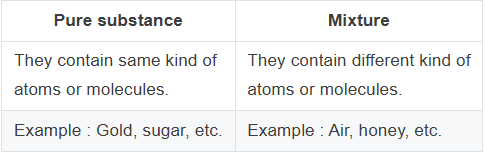
Que-4: Give one difference between pure substances and mixtures.
Ans- The difference between pure substances and mixture are given below:
Que-5: What do you observe when a magnet is brought near a mixture of iron and sulphur ?
Ans- When a magnet is brought near a mixture of iron and sulphur, the iron particles are attracted by the magnet and get separated from the mixture, while the sulphur particles remain unaffected.
Observation: Iron filings stick to the magnet, whereas sulphur powder does not.
This shows that iron and sulphur in the mixture retain their individual properties and can be separated by physical means.
Long Answer Questions
Que-1: Give reason:
(i) Why do sugar and water retain their individual properties in a sugar solution?
(ii) Why do petrol and water form a heterogeneous mixture ?
(iii) Why does sulphur dissolve when carbon disulphite is added to a mixture of iron and sulphur but not when it is added to iron sulphite ?
Ans- (i) Sugar and water retain their individual properties in a sugar solution because a sugar solution is a mixture, not a new substance. Sugar and water do not react chemically with each other; they only mix physically. Therefore, both sugar and water retain their individual properties.
(ii) Petrol and water form a heterogeneous mixture because petrol and water are immiscible liquids and do not mix uniformly with each other. They form two separate layers, so the composition is not the same throughout the mixture, making it a heterogeneous mixture.
(iii) In a mixture of iron and sulphur, sulphur retains its own properties and dissolves in carbon disulphite, while iron does not. However, in iron sulphite, iron and sulphur are chemically combined to form a new compound. Since sulphur no longer exists as a separate substance, it does not dissolve in carbon disulphite.
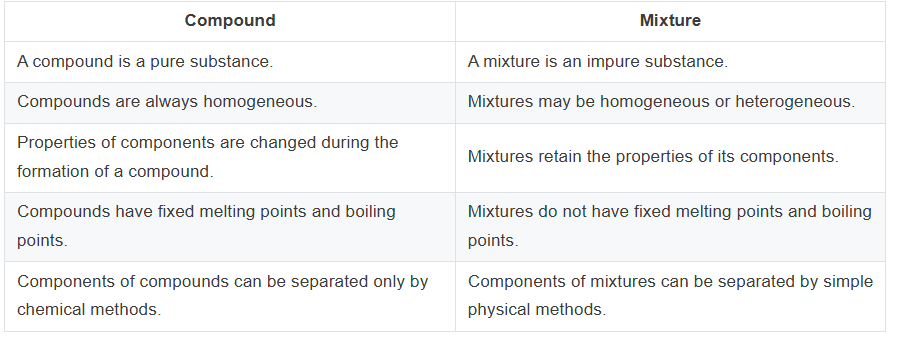
Que-2: (i) State: Four differences between compounds and mixtures.
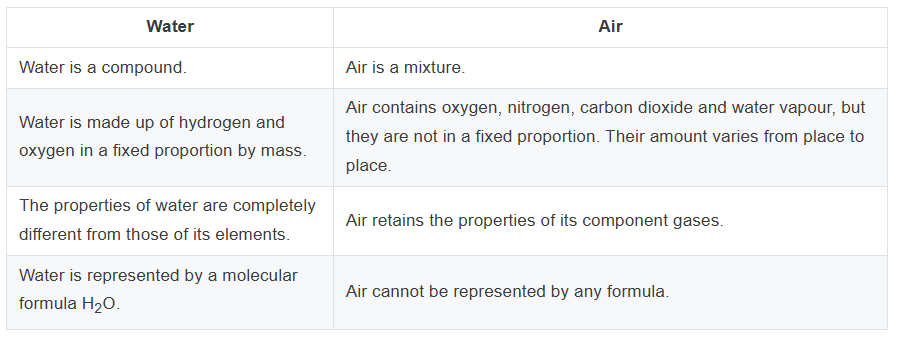
(ii) State: Three differences between water and air.
Ans-(i) The differences between compound and mixtures are given :
(ii) The difference between water and air are given :
Que-3: (i) Define ‘mixture’.
(ii) List four characteristics of a mixture.
Ans-(i) A mixture is a substance formed by the physical combination of two or more elements or compounds in any proportion, without any chemical reaction taking place between them.
(ii) Four characteristics of a mixture:
(a) The components of a mixture retain their individual properties.
(b) The components are not chemically combined.
(c) The components can be separated by physical methods.
(d) The composition of a mixture is not fixed; the components can be present in any proportion.
— : End of Exercise I on Pure Substances and Mixtures; Separation of Mixtures Class 6 Concise Chemistry ICSE Solutions :–
Return to:- ICSE Class-6 Concise Selina Solutions
Please, Share with your friends
thanks