Exercise II on Air Atmosphere Class 6 Concise Chemistry ICSE Solutions Ch-6. In this article you would learn how to solve Exercise II on Air Atmosphere with hint and reason. Visit official Website CISCE for detail information about ICSE Board Class-6.
Exercise II on Air Atmosphere
| Board | ICSE |
| Publications | Selina Publication |
| Subject | Chemistry |
| Class | 6th |
| Chapter-6 | Air Atmosphere |
| Book Name | Concise |
| Topics | Solution of Exercise II |
| Academic Session | 2025-2026 |
Exercise II on Air Atmosphere
Objective Type Questions
Que-1: Rust is:
(i) hydrated iron oxide
(ii) hydrated copper sulphate
(iii) anhydrous iron oxide
(iv) none of the above
Ans- hydrated iron oxide
Reason — The reddish brown powdery mass that gets coated on the surface of some iron object when kept in moist air for a few days is called as rust. It is chemically know as hydrated iron oxide (Fe2O3.xH2O)
Que-2: Photosynthesis is a process in which plants:
(i) take in oxygen and give out carbon dioxide
(ii) take in carbon dioxide and give out oxygen
(iii) take in nitrogen and give out oxygen.
(iv) none of the above
Ans- take in carbon dioxide and give out oxygen
Reason — Photosynthesis is a process through which green plants prepare their food in presence of sunlight with the help of carbon dioxide and water. In this process carbon dioxide is consumed and oxygen is released.
Que-3: Fuels which do not leave any residue on burning are:
(i) coal and wood
(ii) coal and LPG
(iii) wood and CNG
(iv) LPG and CNG.
Ans- LPG and CNG.
Reason — LPG And CNG are modern day fuels which do not leaves any residue on burning.
Que-4: Respiration :
(i) is a slow process
(ii) is a natural and continuous process
(iii) takes place at body temperature
(iv) all of the above
Ans- all of the above
Reason — Respiration is slow, natural and continuous process, and takes place at body temperature.
Que-5: Which of the following is common in combustion and respiration ?
(i) oxygen
(ii) release of heat and light
(iii) natural process
(iv) nitrogen
Ans- oxygen
Reason — Oxygen present in air is required for respiration of all living organisms and without oxygen, burning cannot take place. Hence oxygen is common in combustion and respiration.
Que-6: Which of the gas present in air is required for the synthesis of proteins in plants ?
(i) Oxygen
(ii) Nitrogen
(iii) Ozone
(iv) Carbon dioxide
Ans- Nitrogen
Reason — Nitrogen is needed to prepare a vital nutrient ‘protein’.
Que-7: Which component of air controls the climatic conditions?
(i) Inert gases
(ii) Oxygen
(iii) Water vapour
(iv) Nitrogen
Ans- Water vapour
Reason — Water vapour present in the air provides moisture and helps in predicting climatic conditions of a particular area. Its amount varies from place to place from time to time.
Name the Following
Que-1: Name two important processes supported by oxygen present in air.
Ans- Two important processes supported by oxygen present in air are:
(i) Respiration
(ii) Combustion (Burning)
Que-2: Name the gas used in:
(i) weather balloons
(ii) traffic lights
(iii) electric bulbs
Ans- (i) Helium
(ii) Neon
(iii) Argon
Short Answer Questions
Que-1: State the full forms of LPG and CNG.
Ans- (i) LPG — Liquefied Petroleum Gas
(ii) CNG — Compressed Natural Gas
Que-2: Define the following:
(i) Respiration
(ii) Photosynthesis
(iii) Combustion.
Ans- (i) Respiration: Respiration is the process by which living organisms use oxygen to break down food and release energy, producing carbon dioxide and water.
(ii) Photosynthesis: Photosynthesis is the process by which green plants prepare their food from carbon dioxide and water in the presence of sunlight and chlorophyll, releasing oxygen.
(iii) Combustion: Combustion is the process of burning a substance in oxygen or air with the production of heat and usually light.
Que-3: What are fuels? Give two examples of modern fuels.
Ans- Fuels are substances that produce heat energy on burning. Two examples of modern fuels are CNG and LPG.
Que-4: Give two uses of the following components present in air:
(i) oxygen
(ii) nitrogen
(iii) carbon dioxide
(iv) water vapour
Ans- (i) Oxygen
(i) It is essential for the respiration of living organisms.
>(ii) It supports combustion and is used in welding and cutting metals.
>(ii) Nitrogen
(i) It is used in the manufacture of fertilizers such as ammonia and urea.
>(ii) It is used for filling electric bulbs to prevent the filament from burning out.
(iii) Carbon Dioxide
(i) Plants use it for photosynthesis.
(ii) It is used in fire extinguishers.
(iv) Water Vapour
(i) It helps in the formation of clouds and rainfall.
(ii) It maintains humidity in the atmosphere, which is important for living organisms.
Que-5: How is air useful to:
(i) water boats
(ii) agriculture
(iii) windmills
(iv) scooters and cars?
Ans- (i) Water boats: Air helps sailboats move forward by filling their sails and providing the force needed for movement.
(ii) Agriculture: Air supplies carbon dioxide needed by plants for photosynthesis and oxygen required for respiration. Wind also helps in pollination and seed dispersal.
(iii) Windmills: Moving air (wind) turns the blades of windmills, which can be used to pump water or generate electricity.
(iv) Scooters and cars: Air provides oxygen needed for the combustion of fuel in the engines of scooters and cars, enabling them to run.
Que-6: What is the importance of dust particles present in air ?
Ans- Dust particles are important because they provide surfaces on which water vapour condenses to form clouds and rain. They also scatter sunlight, producing colourful sunrises and sunsets.
Long Answer Questions
Que-1: Give reason:
(i) Aquatic animals and plants are able to survive in water.
(ii) A burning candle stops burning if covered with a glass tumbler.
(iii) Mountaineers and divers carry oxygen cylinders with them.
(iv) When water is heated, we see bubbles rising up.
Ans- (i) Aquatic animals and plants are able to survive in water because water contains dissolved oxygen, which they use for respiration.
(ii) A burning candle needs oxygen for combustion. When it is covered with a glass tumbler, the limited oxygen inside gets used up and no fresh air can enter, so the candle stops burning.
(iii) At high altitudes, the air contains less oxygen available for breathing. Divers underwater cannot obtain oxygen from the surrounding water directly. Therefore, both mountaineers and divers carry oxygen cylinders to supply oxygen for respiration.
(iv) Water contains dissolved air. On heating, the dissolved air escapes from the water in the form of bubbles, which rise to the surface.
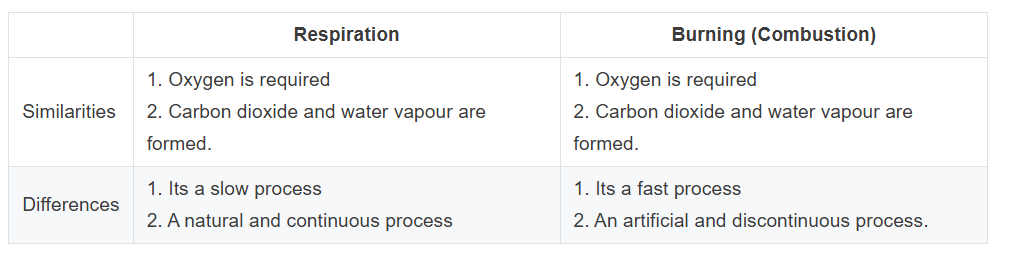
Que-2: State two similarities and two differences between respiration and burning.
Ans- The similarities and differences between respiration and burning are given :
Que-3: Define rusting. What are the two necessary conditions for rusting of iron ? Give the chemical name of rust.
Ans- Rusting is the slow process by which iron reacts with oxygen and moisture present in the air to form a reddish-brown coating called rust.
Two necessary conditions for rusting of iron are:
(i) Presence of oxygen (air).
(ii) Presence of water or moisture.
Chemical name of rust:
The chemical name of rust is hydrated iron(III) oxide (Fe₂O₃·xH₂O).
Que-4: Name the processes which maintain the balance between oxygen and carbon dioxide in the air. How is it done?
Ans- The processes that maintain the balance between oxygen and carbon dioxide in the air are photosynthesis and respiration.
How is it done?
(i) Photosynthesis: Green plants take in carbon dioxide from the air and, in the presence of sunlight and chlorophyll, prepare food. During this process, oxygen is released into the atmosphere.
(ii) Respiration: Humans, animals, and plants use oxygen to break down food and release energy. During respiration, carbon dioxide is given out into the air.
Thus, photosynthesis removes carbon dioxide and adds oxygen, while respiration removes oxygen and adds carbon dioxide, maintaining a balance of these gases in the atmosphere.
Que-5: (i) Why is nitrogen important to all living beings?
(ii) What is nitrogen fixation?
Ans- (i) Nitrogen is important to all living beings because it is an essential component of proteins and nucleic acids (DNA and RNA), which are required for growth, repair, and proper functioning of the body.
(ii) Nitrogen fixation is the process by which free atmospheric nitrogen is converted into nitrogen compounds (such as nitrates and ammonia) that plants can absorb and use.This process is carried out by certain bacteria, lightning, and industrial methods.
— : End of Exercise II on Air Atmosphere Class 6 Concise Chemistry ICSE Solutions :–
Return to:- ICSE Class-6 Concise Selina Solutions
Please, Share with your friends
thanks