Exercise II on Elements, Compounds, Symbols and Formulae Class 6 Concise Chemistry ICSE Solutions Ch-4. In this article you would learn how to solve Exercise III on Elements, Compounds, Symbols and Formulae with hint and reason. Visit official Website CISCE for detail information about ICSE Board Class-6.
Exercise II on Elements, Compounds, Symbols and Formulae Class 6 Concise Chemistry ICSE Solutions
| Board | ICSE |
| Publications | Selina Publication |
| Subject | Chemistry |
| Class | 6th |
| Chapter-4 | Elements, Compounds, Symbols and Formulae |
| Book Name | Concise |
| Topics | Solution of Exercise II |
| Academic Session | 2025-2026 |
Exercise II on Elements, Compounds, Symbols and Formulae
Objective Type Questions
Que-1: Atoms of different kinds combine to form molecules of:
(i) an element
(ii) a compound
(iii) a mixture
(iv) all of the above
Ans- a compound
Reason — When atoms of two or more different elements combine, they form a molecule of a compound. Whereas, molecule of element forms when two or more atoms of the same element combine.
Que-2: The compound used as common salt is:
(i) sodium chloride
(ii) calcium chloride
(iii) sodium oxide
(iv) hydrogen chloride
Ans- sodium chloride
Reason — The compound used as common salt is sodium chloride made up of sodium and chlorine.
Que-3: Sand is a compound of:
(i) silicon and nitrogen
(ii) silicon and oxygen
(iii) oxygen and sulphur
(iv) none of the above
Ans- silicon and oxygen
Reason — Sand or silica is a compound of silicon and oxygen in the ratio of 1 : 2 .
Que-4: The atomicity of ozone is:
(i) 2
(ii) 3
(iii) 4
(iv) 8
Ans- 3
Reason — The number of atoms in a molecule of an element is called its atomicity. Ozone (O3) is made of three oxygen atoms, hence the atomicity of ozone is three.
Que-5: The molecular formula of ammonia is:
(i) NO
(ii) NH3
(iii) NO2
(iv) N2O
Ans- NH3
Reason — Ammonia is made up of nitrogen and hydrogen. The valency of nitrogen is 3 and valency of hydrogen is 1.
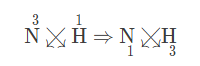
NH3
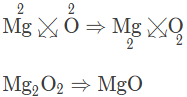
Que-6: The combining power of magnesium and oxygen is the same, i.e. 2. What will be the molecular formula of magnesium oxide ?
(i) Mg2O2
(ii) MgO2
(iii) Mg2O
(iv) MgO
Ans- MgO
Reason— The combining power of magnesium and oxygen is the same, i.e. 2.
Short Answer Type Questions
Que-1: Define:
(i) Atom
(ii) Molecule
(iii) Atomicity
(iv) Formula
Ans- (i) Atom : An atom is the smallest unit of an element that retains the chemical properties of that element.
(ii) Molecule : A molecule is the smallest particle of a substance that can exist independently and shows the properties of that substance. It consists of two or more atoms chemically bonded together.
(iii) Atomicity : Atomicity is the number of atoms present in one molecule of a substance.
(iv) Formula : A chemical formula is the symbolic representation of a molecule or compound showing the types and numbers of atoms present in it.
Que-2: State the difference between the following:
(i) 2H and H2
(ii) H2O and 3Н2О ?
Ans- (i) 2H represents two atoms of hydrogen while H2 represents one molecule of hydrogen.
(ii) H2O indicates that water molecule is formed by the combination of two elements i.e., Hydrogen and Oxygen. The number of hydrogen atom is two and that of oxygen atom is one.
If we write 3Н2О it represents three molecules of water. It contains six atoms of hydrogen and three atoms of oxygen.
Que-3: Write the molecular formulae of compounds calcium oxide, hydrogen sulphide , lead sulphide , zinc oxide and carbon dioxide.
Ans- (i) Calcium oxide — CaO
(ii) Hydrogen sulphide — H2S
(iii) Lead sulphide — PbS
(iv) Zinc oxide — ZnO
(v) Carbon dioxide — CO2
Que-4: Give two examples each of compounds existing in the following states:
(i) Solid
(ii) Liquid
(iii) Gaseous
Ans- (i) Solid compounds
(a) Sodium chloride
(b) Calcium carbonate
(ii) Liquid compounds
(a) Water
(b) Ethanol
(iii) Gaseous compounds
(a) Carbon dioxide
(b) Ammonia
Que-5: State two conditions necessary to write the molecular formula of a compound.
Ans- Two conditions necessary to write the molecular formula of a compound are:
(i) The valency of the elements forming the compound must be known (for example, the valency of Hydrogen is 1 and Oxygen is 2).
(ii) The symbols of the elements present in the compound must be known.
Long Answer Type Questions
Que-1: State the number of atoms of each element, present in
(i) C6H12O6
(ii) H2SO4
(iii) HNO3
(iv) CaCO3
Also name these compounds.
Ans- (i) C6H12O6 — Glucose
- Carbon (C): 6 atoms
- Hydrogen (H): 12 atoms
- Oxygen (O): 6 atoms
(ii) H2SO4 — Sulphuric acid
- Hydrogen (H): 2 atoms
- Sulfur (S): 1 atom
- Oxygen (O): 4 atoms
(iii) HNO3 — Nitric acid
- Hydrogen (H): 1 atom
- Nitrogen (N): 1 atom
- Oxygen (O): 3 atoms
(iv) CaCO3 — Calcium carbonate
- Calcium (Ca): 1 atom
- Carbon (C): 1 atom
- Oxygen (O): 3 atoms
Que-2: Why are symbols and formulae of substances important?
Ans- Symbols and formulae of substances are important because:
(i) They represent elements and compounds in a short and simple form, making chemical writing easier (for example, Water instead of writing the full name repeatedly).
(ii) They show the composition of a substance, i.e., the types and number of atoms present in a molecule (such as Carbon dioxide showing one carbon atom and two oxygen atoms).
(iii) They help in writing and understanding chemical reactions and equations clearly and universally.
Que-3: Mention three gaseous elements and write their molecular formulae.
Ans- Three gaseous elements and their molecular formulae:
(i) Hydrogen — H₂
(ii) Oxygen — O₂
(iii) Nitrogen — N₂
Que-4: State the information obtained from the formula of a compound.
Ans- Information obtained from the formula of a compound:
From the formula of a compound we can know:
(i) The elements present in the compound (for example, Water contains hydrogen and oxygen).
(ii) The number of atoms of each element present in one molecule of the compound.
(iii) The ratio in which the atoms combine to form the compound.
— : End of Exercise II on Elements, Compounds, Symbols and Formulae Class 6 Concise Chemistry ICSE Solutions :–
Return to:- ICSE Class-6 Concise Selina Solutions
Please, Share with your friends
thanks