Exercise III on Matter Class 6 Concise Chemistry ICSE Solutions Ch-3. In this article you would learn how to solve Exercise III on Matter with hint and reason. Visit official Website CISCE for detail information about ICSE Board Class-6.


Exercise III on Matter
| Board | ICSE |
| Publications | Selina Publication |
| Subject | Chemistry |
| Class | 6th |
| Chapter-3 | Matter |
| Book Name | Concise |
| Topics | Solution of Exercise III |
| Academic Session | 2025-2026 |
Exercise III on Matter
Objective Type Questions
Que-1: A kind of matter which can sublime is :
(i)water
(ii)plastic
(iii)milk
(iv)iodine
Ans-iodine
Reason — Iodine is a substance that directly change from from the solid state to gaseous state without passing through the liquid state. Iodine sublimes into a violet gas when heated.
Que-2: A substance which can change its state is:
(i)wood
(ii)oxygen
(iii)paper
(iv)cloth
Ans- oxygen
Reason — Oxygen can change from its gaseous state to its liquid state at lower temperature by the process called condensation or liquefaction.
Que-3: The process by which a solid changes into a liquid is called :
(i)freezing
(ii)melting
(iii)condensation
(iv)evaporation
Ans- melting
Reason — The process by which a substance changes from solid state to liquid state is called melting or fusion.
Que-4: The change of state of liquid into vapour below its boiling points is called:
(i)melting
(ii)freezing
(iii)boiling
(iv)evaporation
Ans- evaporation
Reason — The change of state of a liquid into vapour below boiling point is called evaporation. Evaporation takes place even at room temperature but it becomes faster on heating.
Que-5: When a substance is heated, it can:
(i)undergo a chemical change
(ii)change its state
(iii)show expansion
(iv)all of the above
Ans- all of the above
Reason — Heating causes substance to change its physical state as well as bring about a chemical change. All the three states of matter expands on heating, which is referred as thermal expansion. Hence, all the options are correct.
Fill in the blanks
Que-1: Water is matter because it has … ….. … and occupies .. …. …..
Ans- Water is matter because it has mass and occupies space.
Que-2: Any matter which has a definite .. ….. …. but no definite shape is called a … …. …..
Ans- Any matter which has a definite volume but no definite shape is called a liquid.
Que-3: … ….. … and … … ….. can flow.
Ans- Liquids and gases can flow.
Que-4: The molecules are at a greater distance in … ….. … as compared to liquids.
Ans- The molecules are at a greater distance in gases as compared to liquids.
Que-5: Water boils at .. …. ….. °C.
Ans- Water boils at 100°C.
Que-6: The physical state of a substance, which has neither fixed volume nor fixed shape is a …. … ….
Ans- The physical state of a substance, which has neither fixed volume nor fixed shape is a gas .
State True or False
Write whether the following statements are true or false.
Que-1: Only water can exist in three different states. ……………
Ans- False
Correct Statement — Many substances like carbon dioxide, iodine, etc., can exist in solid, liquid, and gaseous states under suitable conditions.
Que-2: If the container in which a gas is collected has an opening, the gas will flow out and spread itself indefinitely. ……………
Ans- True
Que-3: Solids have the largest inter-molecular space. ……………
Ans- False
Correct Statement — Gases have the largest intermolecular space. Solids have very tightly packed particles.
Que-4:There is no difference between evaporation and boiling. ……………
Ans- False
Correct Statement — Evaporation is a slow surface-level process that occurs at any temperature, while boiling is a rapid, bulk process that happens at the boiling point.
Que-5: All solids, on heating, first change to liquid and then to the gaseous state. ……………
Ans- False
Correct Statement — Some solids like camphor, iodine, and dry ice undergo sublimation, changing directly from solid to gas without becoming liquid.
Que-6: The intermolecular force of attraction is the weakest in gases. ……………
Ans- True
Que-7: A gas has no free surface. ……………
Ans- True
Match the Following
| Column A | Column B |
|---|---|
| (a) Solids | (i) Can flow in all directions. |
| (b) Sublimation | (ii) The temperature at which a liquid changes into its gaseous state |
| (c) Boiling point | (iii) Can have any number of free surface |
| (d) Gases | (iv) Gaps between molecules |
| (e) Intermolecular space | (v) Change of state directly from solid to gas. |
Ans- (i) – (iii)
(ii) – (v)
(iii) – (ii)
(iv) – (i)
(v) – (iv)
Select the odd one out from the following:
Que-1: solid, liquid, gas, volume
Ans- Volume
Reason — Solid, liquid and gas are the states of matter, while volume is a property of matter.
Que-2: water, fruit juice, air, stone, milk
Ans- Stone
Reason — Water, fruit juice, air and milk are fluids and can flow, while stone is a solid and cannot flow.
Que-3: Iron, aluminium, wood, gold
Ans- Wood
Reason — Iron, aluminium and gold are metals, whereas wood is a non-metal.
Que-4: Freezing, condensation, melting point, evaporation
Ans- Melting point
Reason— Freezing, condensation and evaporation are processes of state change, while melting point is a temperature, not a process.
Solid, Liquid, or Gas
For each of the following statements, say whether it describes a solid, a liquid or a gas.
Que-1: Particles move about very quickly but do not leave the surface.
Ans- Liquid
Que-2: Particles are quite close together.
Ans- Solid
Short Answer Type Questions
Que-1: Name the phenomenon which causes the following changes:
(i) Formation of water vapour from water.
(ii) Disappearance of camphor when exposed to air.
(iii) Conversion of ice into water.
(iv) Conversion of water into steam.
Ans- (i) Evaporation
(ii) Sublimation
(iii) Melting
(iv) vaporisation
Que-2: Give two examples for each of the following:-
(i) Substances which sublime.
(ii) Substances which do not change their state.
(iii) Substances which are rigid and not compressible.
Ans- (i) Camphor and dry ice (solid carbon dioxide)
(ii) Paper and sugar
(iii) Stone and iron
Que-3: Define the following terms:
(i) Fusion
(ii) Vaporisation
(iii) Condensation
(iv) Sublimation
(v) Diffusion
(vi) Melting point
(vii) Boiling point
(viii) Liquefaction
(ix) Evaporation
Ans- (i) The process by which a substance changes from solid state to liquid state is called melting or fusion.
(ii) The process by which a substance changes from a liquid state to vapour state on heating is called vaporisation or boiling.
(iii) The process by which a substance in gaseous state changes into its liquid state is called condensation or liquefaction.
(iv) The conversion of a solid substance into its vapour without undergoing liquid state on heating is called sublimation.
(v) The phenomenon of intermixing of particles of one kind with another kind is called diffusion.
(vi) The fixed temperature at which a solid changes into a liquid at a given pressure is called its melting point.
(vii) The fixed temperature at which a liquid starts changing into gaseous state is called its boiling point.
(viii) The process by which a substance in gaseous state changes into its liquid state is called condensation or liquefaction.
(ix) The change of state of a liquid into vapour below boiling point is called as evaporation.
Long Answer Type Questions
Que-1: (a) Define: interconversion of states of matter.
(b) What are the two conditions for the interconversion of states of matter?
Ans- (a) Interconversion of states of matter is the process by which a substance changes from one state of matter (solid, liquid, or gas) to another and back again by changing temperature or pressure without changing its chemical composition.
(b) Two conditions for interconversion of states of matter:
(a)Change in temperature .
(b)Change in pressure .
Que-2: (a) Differentiate between solidification and condensation.
(b) Differentiate between melting and boiling.
(c) Differentiate between gas and vapour.
(d) Differentiate between miscible and immiscible liquids.
(e)Differentiate between vaporisation and evaporation.
Ans- (a) The difference between Solidification and condensation is given below:
| Solidification | Condensation |
|---|---|
| The process by which a substance in liquid state changes into a solid state | The process by which a substance in gaseous state changes into its liquid state |
| Example : Conversion of water to ice | Example : Conversion of steam to water |
(b) The difference between Melting and boiling is given below:
| Melting | Boiling |
|---|---|
| The process by which a substance changes from solid state to liquid state | The process by which a substance changes from a liquid state to vapour state on heating |
| Example : Ice to water | Example : water to steam at 100°C |
(c) The difference between gas and vapour is given below:
| Gas | Vapour |
|---|---|
| A state of matter that stays in the gas form under normal conditions | The gaseous form of a substance that is usually a liquid or solid at room temperature |
| Example : oxygen, nitrogen | Example : water vapour |
(d) The difference between miscible and immiscible liquids is given below:
| Miscible | Immiscible |
|---|---|
| Liquids which mix with each other | Liquids which do not mix with each other |
| Example : Water and alcohol | Example : Water and oil |
(e) The difference between vaporisation and evaporation is given below:
| Vaporisation | Evaporation |
|---|---|
| The process by which a substance changes from a liquid state to vapour state on heating | The change of state of a liquid into vapour below boiling point |
| It includes boiling and evaporation | It a slow form of vaporisation at surface level |
| Example : Water to water vapour | Example : Drying of wet clothes |
Que-3: State the three effects of heat on matter.
Ans- (i) Change (interconversion) in states of matter — The process by which matter changes from one state to another and back to the original state, without any change in its chemical composition is called interconversion of states of matter.
(ii) Thermal expansion of the matter — All the three states of matter, i.e. solid, liquid and gas expand on heating. i.e. they increase in size, without changing their composition. This process is called thermal expansion.
(iii) Chemical change — A chemical change is where a substance is transformed into a new substance with different properties.
Que-4: How is interconversion of states of matter different from a chemical reaction ?
Ans- Interconversion of states of matter is a physical change in which a substance changes from one state (solid, liquid, or gas) to another by changing temperature or pressure, but its chemical composition remains the same and no new substance is formed. For example, ice changing into water and water into steam. A chemical reaction, on the other hand, is a chemical change in which one or more substances react to form new substances with different properties and a different chemical composition. For example, when iron reacts with oxygen to form rust.
Que-5: How does a liquid change into its gaseous state? Explain in brief.
Ans- A liquid changes into its gaseous state when heat is supplied to it. The heat increases the kinetic energy of the liquid particles, so they start moving faster and move farther apart. When the particles gain enough energy to overcome the attractive forces between them, they escape from the surface of the liquid and change into gas. This process is called vaporization, which can occur either by evaporation (slowly at any temperature) or boiling (rapidly at a fixed temperature).
Que-6: What happens to a metal ball when it is heated? What does this show ?
Ans- When we heat a metal ball for about 5-6 minutes, it expands. This shows that a solid substance expands on heating. When we cool a solid substance, it again contracts to its original size.
Que-7: Why does a candle become smaller on burning with time?
Ans- A candle becomes smaller on burning with time because the wax near the flame melts and then vaporizes due to the heat of the flame. The wax vapour reacts with oxygen in the air and burns in a chemical reaction, producing substances like carbon dioxide and water vapour. As the wax is continuously used up in this process, the candle gradually becomes smaller.
Que-8: State the two characteristics of a chemical change.
Ans- Two characteristics of a chemical change are.
(i) It is is permanent change in which new substances are formed from the original substances.
(ii) The properties of the new substances are entirely different from those of the original substances.
Que-9: Look at the diagram given alongside and answer the questions that follow:
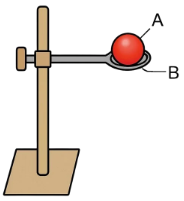
(a) Label A and B.
(b) What is the purpose of this experiment?
Ans- (a) A — Metal ring
B — Metal ball
(b) The purpose of this experiment was to show that a solid expands on heating and when it is cooled back down, it contracts back to its original size.
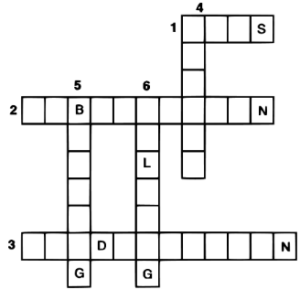
Que-10: Given below is a crossword puzzle based on this lesson. Read the clues across and clues downwards and fill up the blank squares.
Across:
1. Quantity of matter
2. Solid changes directly into vapou
3.Gas changes into liquid
Down:
4. Occupies space and has mass
5. Liquid is heated to change into vapour
6. Solid changes into liquid.
Ans-
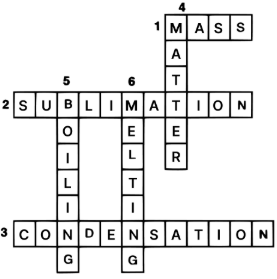
Across:
1. Mass
2. Sublimation
3. Condensation
Down:
4. Matter
5. Boiling
6. Melting
Case Study Type Questions
Que-1: Anshul visited the beach and collected a handful of small pebbles to play with later at home. Once home, he carefully stacked them into a tall tower. Then he decided to pour water over the tower. He observed that water flowed through the gaps between the pebbles and spread everywhere on the floor.
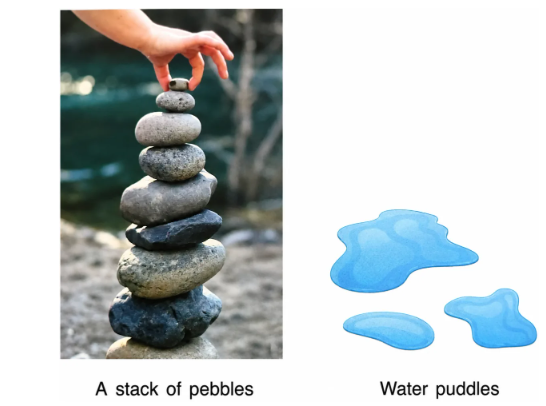
(i) Why was it possible to stack pebbles?
(ii) Why did the water spread on the floor?
(iii) What happens to the water after it spreads across the floor?
(iv) Which other state of matter can flow in all directions?
Ans- (i) Pebbles are solids, so particles are closely packed. They have strong intermolecular forces and a fixed shape. Therefore, pebbles can be stacked one over another.
(ii) Water is a liquid, so particles have weaker intermolecular forces. They can move freely. Therefore, water flows through gaps and spreads on the floor.
(iii) Water evaporates slowly into the air after it spreads across the floor.
(iv) Gases can flow in all directions.
— : End of Exercise III on Matter Class 6 Concise Chemistry ICSE Solutions :–
Return to:- ICSE Class-6 Concise Selina Solutions
Please, Share with your friends
thanks