Heat and Energy Class-9 Exe-6B MCQs Concise Physics ICSE Selina Solutions Ch-6. In this article you would learn to solve MCQS on Energy Flow and its Importance. Visit official Website CISCE for detail information about ICSE Board Class-9.
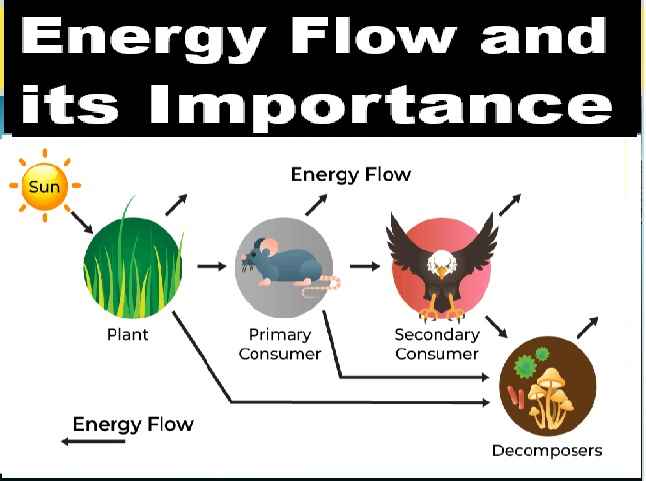
Heat and Energy Class-9 Exe-6B MCQs Concise Physics ICSE Selina Solutions Ch-6
| Board | ICSE |
| Class | 9 |
| Subject | Physics |
| Writer / Publication | Concise Selina Publishers |
| Chapter-6 | Heat and Energy |
| Exe-6B | Energy Flow and its Importance |
| Topics | Solution of Exe-6(B) MCQs Type |
| Academic Session | 2025-2026 |
Energy Flow and its Importance
Heat and Energy Class-9 Exe-6B MCQs Concise Physics ICSE Selina Solutions Ch-6
page -148 (Choose the correct answer from the option given below).
Que-1: Out of the following components, which one is not abiotic ?
(a) trees
(b) light
(c) heat
(d) rain
Ans: (a) trees
Hint- Biotic components in an ecosystem are the living organisms (i.e., producers, consumers and decomposers) and abiotic components are the non-living factors. Hence, in the options above, trees are biotic whereas light, heat, rain are abiotic.
Que-2: Plants use …………… of the total energy absorbed by them in photosynthesis for producing their food.
(a) 40%
(b) 50%
(c) 5%
(d) 0.02%
Ans: (d) 0.02%
Hint- Out of the 8% heat energy falling on plants, they use only 0.02% in photosynthesis for producing their food.
Que-3: Food chain begins with :
(a) respiration
(b) photosynthesis
(c) decomposition
(d) decay
Ans: (b) photosynthesis
Hint- In a food chain, the first level are the producers (photosynthetic plants). They synthesize organic substances by the process of photosynthesis (i.e., they combine simple compounds with the help of solar energy into complex organic substances).
Que-4: The source of energy in an ecosystem is :
(a) sun
(b) decayed bodies
(c) green plants
(d) sugar
Ans: (a) sun
Hint- The most significant source of energy for all ecosystems is the sun..
Que-5: Energy enters in a food chain through:
(a) primary consumers
(b) secondary consumers
(c) tertiary consumers
(d) producers
Ans: (d) producers
Hint- In a food chain, the first level are the producers (photosynthetic plants). They utilize the energy received from the sun to synthesize organic substances by the process of photosynthesis (i.e., they combine simple compounds with the help of solar energy into complex organic substances).
Que-6: The place of human being in food chain in an ecosystem is as:
(a) producer
(b) consumer
(c) decomposer
(d) both (a) & (b)
Ans: (b) consumer
Hint- Human beings are consumers in the food chain.
Que-7: Secondary consumers are :
(a) Herbivores
(b) Carnivores
(c) Krill
(d) All of the above
Ans: (b) Carnivores
Hint- Secondary consumers are organisms that feed on primary consumers (herbivores). Hence, they are carnivores. For example, Krill can act as secondary consumers in marine ecosystems by feeding on phytoplankton (primary producers)
Que-8: In an aquatic ecosystem, …………… act as producers:
(a) small fishes
(b) plants
(c) krill
(d) large fishes
Ans: (b) plants
Hint- Plants are the primary producers in aquatic ecosystems. They convert sunlight and nutrients into energy through photosynthesis, serving as the foundation of the food chain. Other organisms, such as small fishes, krill, and large fishes, typically act as consumers rather than producers in the aquatic ecosystem.
Que-9: First law of thermodynamics is also known as the law of:
(a) conservation of mass
(b) conservation of energy
(c) conservation of force
(d) conservation of momentum
Ans: (b) conservation of energy
Hint- According to the first law of thermodynamics — Energy can be transformed from one form to another form, but it can neither be created nor destroyed. Hence, energy is always conserved.
Que-10: Choose the correct statement(s):
A. According to the first law of thermodynamics, when energy is put to work, a part of it is always converted to non-useful form such as heat, mainly due to friction and radiation.
B. According to the second law of thermodynamics, energy can be transformed from one form to another, but it can neither be created nor destroyed.
(a) Both (A) and (B)
(b) only (B)
(c) only (A)
(d) None of these
Ans: (d) None of these
Hint- The laws of thermodynamics are stated below:
- First law of thermodynamics (Law of conservation of energy) — Energy can be transformed from one form to another form, but it can neither be created nor destroyed.
- Second law of thermodynamics — When energy is put to work, a part of it is always converted in non useful form mainly as heat, due to friction and radiation.
— end of Heat and Energy Class-9 Exe-6B MCQs Concise Physics ICSE Selina Solutions Ch-6. :—
Return to:– Concise Selina Physics ICSE Class-9 Solutions
Thanks.