Heat and Energy Exe-6A MCQs Class-9 Concise Physics ICSE Selina Solutions Ch-6. In this article you would learn to solve MCQs on Heat and Temperature. Visit official Website CISCE for detail information about ICSE Board Class-9 Physics.
Heat and Energy Exe-6A MCQs Class-9 Concise Physics ICSE Selina Solutions Ch-6
| Board | ICSE |
| Class | 9 |
| Subject | Physics |
| Writer / Publication | Concise Selina Publishers |
| Chapter-6 | Heat and Energy |
| Exe-6A | Heat and Temperature |
| Topics | Solution of Exe-6(A) MCQs Type |
| Academic Session | 2025-2026 |
Heat and Temperature
Heat and Energy Exe-6A MCQs Class-9 Concise Physics ICSE Selina Solutions Ch-6
page -143 (Choose the correct answer from the options given below).
Que-1: The energy which flows from a hot body to a cold body is called
(a) mechanical energy
(b) fuel energy
(c) solar energy
(d) heat energy
Ans: (d) heat energy
Hint- Heat is the form of energy that is transferred between two bodies at two different temperatures when kept in contact.
Que-2: Calorie is the unit of:
(a) heat
(b) work
(c) temperature
(d) food
Ans: (a) heat
Hint- Calorie is the unit of heat. 1 cal = 4.186 J
Que-3: 1 J equals to:
(a) 0.24 cal
(b) 4.18 cal
(c) 1 cal
(d) 1 kcal
Ans: (a) 0.24 cal
Hint-1 cal = 4.186 J
∴ 1 J = 0.24 cal
Que-4: 1 Joule is equal to :
(a) 106 erg
(b) 105 erg
(c) 107 erg
(d) 109 erg
Ans: (a) 107 erg
Hint- The S.I. unit of heat is joule and its C.G.S. unit is erg, where 1 Joule = 107 erg
Que-5: …………… determines the direction of flow of heat.
(a) Heat
(b) Temperature
(c) Coldness
(d) None of these
Ans: (b) Temperature
Hint- Temperature is a quantity which indicates the thermal state of a body (i.e., the degree of hotness or coolness of the body). It determines the direction of flow of heat when two bodies at different temperatures are placed in contact.
The S.I. unit of temperature is Kelvin (K).
Que-6: The amount of heat energy contained by a body depends on :
(a) the mass of the body
(b) the temperature of the body
(c) the nature of the material of the body
(d) all of the above
Ans: (d) all of the above
Hint- The amount of heat energy contained by a body depends on its mass, temperature and the nature of the material of the bdy.
Page 144
Que-7: S.I. unit of temperature is:
(a) Celsius
(b) Fahrenheit
(c) Kelvin
(d) None of these
Ans: (c) Kelvin
Hint- S.I. unit of temperature is Kelvin (K).
Que-8: Celsius and Kelvin scales are related as :
(a) t K = 273 + t° C
(b) t K = 273 – t° C
(c) t Kt° C = 273
(d) 273/t° = T k
Ans: (a) t K = 273 + t° C
Hint- t K = 273 + t° C
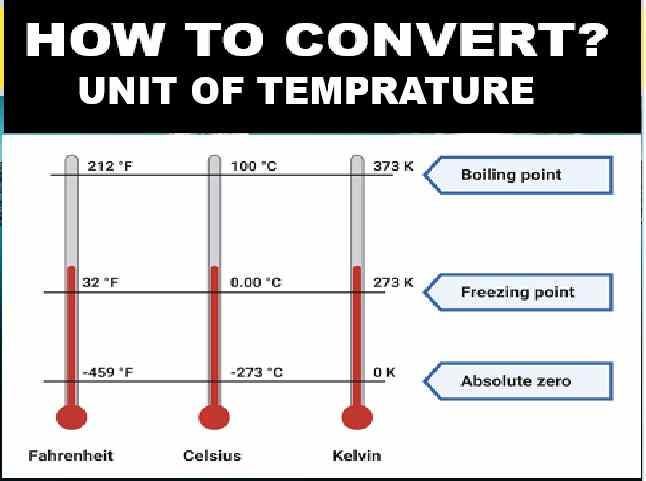
Thus, by adding 273 to the temperature in degree celsius, we get the temperature in Kelvin.
Que-9: The temperature of a body depends on the average …………… of the molecules.
(a) potential energy
(b) kinetic energy
(c) elastic energy
(d) atomic energy
Ans: (b) kinetic energy
Hint- The temperature rises when the kinetic energy of the molecules of the substance increases and vice versa. Hence, the temperature of a body depends on the average kinetic energy of the molecules.
Que-10: The temperature at which pressure and volume of a gas becomes zero is :
(a) 0° C
(b) 0 K
(c) 0° F
(d) 273 K
Ans: (b) 0 K
Hint- On Kelvin scale, 0 K is the temperature at which pressure and volume of a gas becomes zero. 0 K is called absolute zero. Thus, negative temperature is not possible on kelvin scale.
Que-11: The steam point on Fahrenheit scale is :
(a) 273° F
(b) 100° F
(c) 213° F
(d) 212° F
Ans: (d) 212° F
Hint- The steam point is 100 °C on Celsius scale, 212 on Fahrenheit scale and 373 K on Kelvin scale.
Que-12: Celsius and Fahrenheit scales are related as :
(a) C/5 = (F – 32)/9
(b) C/9 = (F + 32)/5
(c) 5C = 9(F + 32)
(d) C/5 = 9(F + 32)
Ans: (a) C/5 = (F – 32)/9
Hint- The temperature on Celsius and Fahrenheit scales are realted as : C5 = F – 329
Que-13: The increase in the length of a solid on heating is called :
(a) contraction
(b) linear expansion
(c) cubical expansion
(d) superficial expansion
Ans: (b) linear expansion
Hint- A solid has a definite shape, so when it is heated, it expands in all directions i.e., the length, area and volume all increase on heating. The increase in the length is called linear expansion.
Que-14: On heating, liquids expand …………… than solids and gases expand …………… than liquids.
(a) more, less
(b) less, more
(c) more, much more
(d) less, less
Ans: (c) more, much more
Hint- Liquids and gases do not have have a definite shape, so they have only the cubical (or volumetric expansion). On heating, liquids expand more than solids and gases expand much more than liquids.
Que-15: Water is cooled from 4°C to 0°C. It :
(a) contracts
(b) expands
(c) first contracts, then expands
(d) first expands, then contracts.
Ans: (b) expands
Hint- The expansion of water when it is cooled from 4°C to 0°C, is known as anomalous expansion of water.
Que-16: The change in volume of water when it is cooled from ……………°C to ……………°C is known as anomalous expansion of water :
(a) 0,4
(b) 4,0
(c) 1,0
(d) 0,1
Ans: (b) 4,0
Hint- The expansion of water when it is cooled from 4°C to 0°C, is known as anomalous expansion of water.
Que-17: Density of water is maximum at:
(a) 0°C
(b) 100°C
(c) 4°C
(d) 15°C
Ans: (c) 4°C
Hint- The density of water is maximum at 4°C. It’s value is 1000 kg m-3.
Que-18: The property of ice which prevents the flow of heat from water of a pond (or lake) to the atmosphere is :
(a) conduction
(b) insulation
(c) low specific heat
(d) none of the above
Ans: (b) insulation
Hint- Ice is a poor conductor of heat. Hence, it acts as an insulator and prevents the flow of heat from water of a pond (or lake) to the atmosphere.
Que-19: Identify the correct graph showing the variation in the volume of water with temperature :
(a) 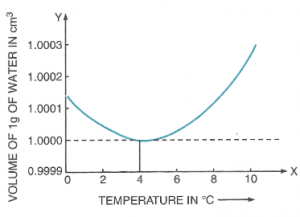
(b) 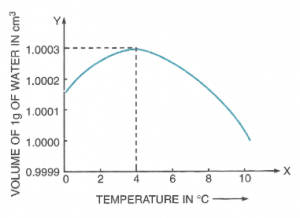
(c) 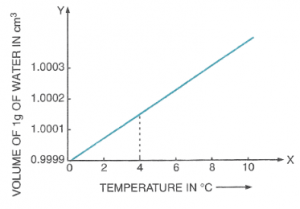
(d) 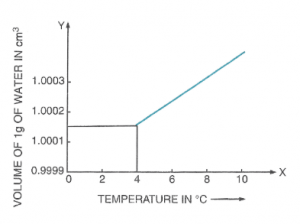
Ans: (a)
— End of Heat and Energy Exe-6A MCQs Class-9 Concise Physics ICSE Selina Solutions Ch-6 :—
Return to:– Concise Selina Physics ICSE Class-9 Solutions
Thanks