Hydrogen Chloride Short Ans Concise Class-10 ICSE Chemistry Selina Solutions Chapter-8. We Provide Step by Step Answer of Short Ans Questions of Exercise-8 for ICSE Class-10. The given Solutions is according to the Latest editions. Visit official Website CISCE for detail information about ICSE Board Class-10.
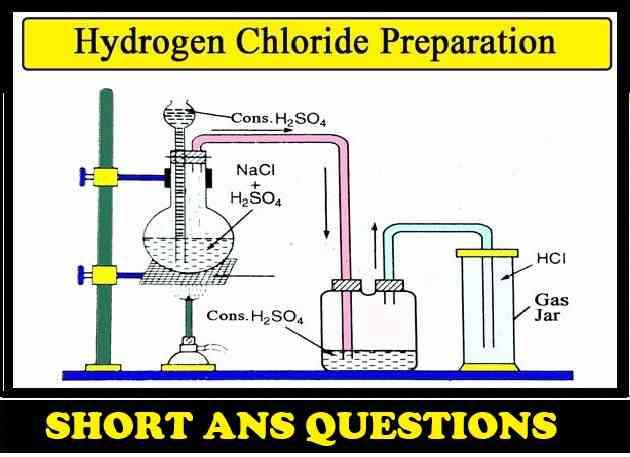
Hydrogen Chloride Short Ans Concise Class-10 ICSE Chemistry Selina Solutions Chapter-8
| Board | ICSE |
| Book / Publication | Concise / Selina |
| Subject | Chemistry |
| Class | 10th |
| Writer | Dr SP Singh |
| Chapter-8 | Study of Compounds – Hydrogen Chloride |
| Topics | Short Ans |
| Edition | 2025-2026 |
Short Ans Questions on Study of Compounds-Hydrogen Chloride
Page-151
Que-1: A solution of hydrogen chloride in water is prepared. The following substances are added to separate portions of the solution:
| S.No. | Substances added | Gas evolved | Odour |
| 1. 2. 3. 4. |
Calcium carbonate Magnesium ribbon Manganese(IV) oxide with heating Sodium sulphide |
…. ….. …… …… |
……. ….. …… ……. |
Complete the table by writing the gas evolved in each case and its odour.
Ans:
| S.No. | Substances added | Gas evolved | Odour |
| 1. 2. 3. 4. |
Calcium carbonate Magnesium ribbon Manganese(IV) oxide with heating Sodium sulphide |
Carbon dioxide Hydrogen Cl2Hydrogen sulphide |
Odourless Odourless Strong Pungent odour Rotten egg |
Que-2: Complete and balance the following reactions, state whether dilute or conc. acid is used.
(a) NH4OH + HCl →
(b) NaHSO3 + HCl →
(c) Pb(NO3)2 +HCl →
(d) Pb3O4 + HCl →
Ans:
(a) NH4OH + HCl → NH4Cl + H2O
(b) NaHSO3 + HCl → NaCl + H2O + SO2
(c) Pb(NO3)2 +2HCl → PbCl2 +2HNO3
(d) Pb3O4 + 8HCl → 3PbCl2 +4H2O +Cl2
Que-3: State the composition of aqua regia. State which component is the oxidizing agent in aqua regia.
Ans: A mixture having three parts of conc. Hydrochloric acid and one part of conc. Nitric acid is called aqua-regia.
Nitric acid acts as oxidizing agent.
Que-4: How will the action of dilute hydrochloric acid enable you to distinguish between the following:
(a) Sodium carbonate and sodium sulphite.
(b) Sodium thiosulphate and sodium sulphite.
Ans:
(a) Sodium carbonate on treating with dil.HCl results in the formation of sodium chloride with the liberation of carbon dioxide gas.
Na2CO3 + 2HCl → 2NaCl + H2O + CO2 ↑
Sodium sulphite on treating with dil.HCl results in the formation of sodium chloride with the liberation of sulphur dioxide gas.
Na2SO3 + 2HCl → 2NaCl + H2O + SO2 ↑
(b) Sodium thiosulphate reacts with dil. HCl to produce sulphur dioxide gas and precipitates yellow sulphur.
Na2S2O3 + 2HCl → 2NaCl + H2O + SO2 + S↓
Sulphur is not precipitated when sulphites are treated with dil. HCl.
Que-5: MnO2, PbO2 and red lead react with conc. HCl acid liberates Cl2.
What is the common property being shown by these metal oxides?
Ans: MnO2, PbO2 and red lead react with conc. HCl acid to liberate Cl2. This shows that hydrochloric acid is oxidized to chlorine by oxidizing agents.
Que-6: Write an equation for the reactions of hydrochloric acid on
(a) silver nitrate solution
(b) magnesium foil
(c) caustic soda solution
(d) zinc carbonate
(e) manganese (IV) oxide
(f) copper oxide
Ans: Equations for the reactions of hydrochloric acid on
(a) Silver nitrate solution
AgNO3 + HCl ⟶ AgCl (white ppt.) + HNO3
(b) Magnesium foil
Mg + 2HCl ⟶ MgCl2 + H2
(c) Caustic soda solution
NaOH + HCl ⟶ NaCl + H2O
(d) Zinc carbonate
ZnCO3 + 2HCl [dil.] ⟶ ZnCl2 + H2O + CO2 [g.]
(e) manganese (IV) oxide

(f) Copper oxide
CuO + 2HCl ⟶ CuCl2 + H2O.
Que-7: Write the balanced equations for the reaction of dilute hydrochloric acid with each of the following:
(a) Iron
(b) Sodium hydrogen carbonate
(c) Iron(II) sulphide
(d) magnesium sulphite (2018)
Ans:
(a) Fe +2HCl ⟶ FeCl2 +H2
(b) NaHCO3 + HCl ⟶ NaCl + H2O + CO2
(c) FeS + 2HCl ⟶ FeCl2 + H2S
(d) MgSO3 + 2HCl ⟶ MgCl2 + H2O + SO2 ↑
Que-8: How would you distinguish between dilute HCl and dilute HNO3, by addition of only one solution.
Ans: When silver nitrate soln. is added to dil. HCl, curdy white ppt. of silver chloride is formed whereas, there is no reaction when silver nitrate soln. is added to dil. HNO3.
AgNO3 + HCl ⟶ AgCl (white ppt.) + HNO3
AgNO3 + HNO3 ⟶ no reaction
Que-9: State one appropriate observation when :
(a) Copper sulphide is treated with dilute hydrochloric acid.
(b) A few drops of dil. HCl are added to AgNO3 solution. followed by addition of NH4OH solution.
(c) Lead nitrate solution is mixed with dilute hydrochloric acid and heated.
(d) A small piece of zinc is added to dilute hydrochloric acid.
(e) Dilute HCl is added to sodium carbonate crystals.
(f) Concentrated HCl is added to manganese dioxide.
Ans:
(a) A colourless gas having smell of rotten eggs is given off. The gas evolved is H2S
CuS + 2HCl ⟶ CuCl2 + H2S ↑
(b) Curdy white precipitate of silver chloride [AgCl] is obtained, which is soluble in excess of NH4OH.
AgNO3 + HCl ⟶ AgCl ↓ + HNO3
AgCl + 2NH4OH ⟶ [Ag(NH3)2Cl)] + 2H2O
(c) White precipitate of PbCl2 is formed which is soluble in hot water.
Pb(NO3)2 + 2HCl ⟶ PbCl2 ↓ + 2HNO3
(d) Hydrogen gas is evolved with bubbles and it burns with a pop sound
Zn + 2HCl ⟶ ZnCl2 + H2 ↑
(e) Effervescence of CO2 seen which turns lime water milky.
Na2CO3 + 2HCl ⟶ 2NaCl + H2O + CO2 ↑
(f) When concentrated hydrochloric acid is added to manganese dioxide (MnO2), a greenish-yellow gas (chlorine gas) is evolved with effervescence.
MnO2 + 4HCl (conc.) ⟶Δ MnCl2 + 2H2O + Cl2↑
Que-10: Write the balanced chemical equation.
(i) Sodium thiosulphate is reacted with dilute hydrochloric acid.
(ii) Calcium bicarbonate reacts with dilute hydrochloric acid.
(iii) Conc. hydrochloric acid and potassium permanganate solution.
(iv) Action of dilute hydrochloric acid on sodium sulphide.
(v) Action of hydrochloric acid on sodium bicarbonate.
Ans: Balanced chemical equations:
(i) Sodium thiosulphate is reacted with dilute hydrochloric acid:
Na2S2O3 + 2HCl ⟶ 2NaCl + S + H2O + SO2 ↑
(ii) Calcium bicarbonate reacts with dilute hydrochloric acid:
Ca(HCO3)2 + 2HCl ⟶ CaCl2 + 2H2O + 2CO2 ↑
(iii) Conc. hydrochloric acid and potassium permanganate solution:
2KMnO4 + 16HCl ⟶ Δ 2KCl + 2MnCl2 + 8H2O + 5Cl2↑
(iv) Action of dilute hydrochloric acid on sodium sulphide:
Na2S + 2HCl ⟶ 2NaCl + H2S [g.] ↑
(v) Action of hydrochloric acid on sodium bicarbonate:
NaHCO3 + HCl ⟶ NaCl + H2O + CO2 ↑
Que-11: Give balanced equations with conditions, if any, for the following conversions:
(a) Sodium chloride → Hydrogen chloride
(b) Hydrogen chloride → Iron (II) chloride
(c) Hydrogen chloride → Ammonium chloride
(d) Hydrogen chloride → Lead chloride
Ans: Balanced equations with conditions for the following conversions:
(i) Sodium chloride→ Hydrogen chloride

(ii) Hydrogen chloride→ Iron (II) chloride
Fe + 2HCl (dil.) ⟶ FeCl2 + H2 [g]
(iii) Hydrogen chloride → Ammonium chloride
NH4OH + HCl (dil.)⟶ NH4Cl + H2O
(iv) Hydrogen chloride→ Lead chloride

Que-12: Explain why:
(a) Anhydrous HCl is a poor conductor while aq. HCl is an excellent conductor.
(b) When the stopper of a bottle full of hydrogen chloride gas is opened there are fumes in the air.
(c) A solution of hydrogen chloride in water turns blue litmus red and conducts electricity , while a solution of the same gas in toluene:
(i) Has no effect on litmus ,and
(ii) Does not conduct electricity
(d) Thick white fumes are formed when glass rod dipped in NH4OH is brought near the mouth of bottle full of HCl gas.
(e) Dry hydrogen chloride gas does not affect a dry strip of blue litmus paper but it turns red in the presence of drop of water.
(f) Hydrogen chloride gas is not collected over water.
(g) dilute hydrochloric acid cannot be concentrated by boiling beyond 22.2%.
(h) Hydrogen chloride gas cannot be dried over quick lime.
Ans:
(a) Anhydrous HCl is poor conductor due to the absence of ions in it whereas aqueous HCl is excellent conductor since it contains ions.
(b) When the stopper is opened HCl gas comes in contact with water vapors of air and gives white fumes due to the formation of hydrochloric acid.
(c) A solution of HCl in water gives hydronium ions and conducts electricity, but HCl is also soluble in dry toluene, but in that case it neither (i) turns blue litmus red (ii) nor does conducts electricity. This indicates the absence of H+ ions in toluene showing thereby that hydrogen chloride is a covalent compound.
(d) When ammonium hydroxide is brought near the mouth of HCl, dense white fumes are formed due to the formation of ammonium chloride.
HCl + NH4OH → NH4Cl + H2O
(e) Dry hydrogen chloride is not acidic whereas moist Hydrogen chloride is acidic. In presence of a drop of water HCl gas dissolves in water and forms hydrochloric acid which turns blue litmus paper red.
(f) Hydrogen chloride is not collected over water as it is highly soluble in water.
(g) Hydrochloric acid forms a constant boiling mixture at 110°C, 22.2% by weight. On boiling further, the mixture evolves out the vapours of both acid and water in the same proportion as in the liquid.
Hence, dilute HCl cannot be concentrated beyond 22.2% by boiling.
(h) Quicklime [CaO] is alkaline in nature and it reacts with HCl forming the respective chloride. Hence, it can’t be used as a drying agent.
—: End of Study of Compounds – Hydrogen Chloride Short Ans Concise Class-10 ICSE Chemistry Selina Solutions : –
Return to:- Concise Selina Chemistry for ICSE Class-10 Solutions
Please Share with Your Friends if Helpful
Thanks