ICSE Class 10 Linear Inequalities Notes | OP Malhotra Maths (2026-27). We Provide Step by Step Answer of all the exercises with Chapter Test of S Chand OP Malhotra Maths . Visit official Website CISCE for detail information about ICSE Board Class-10.
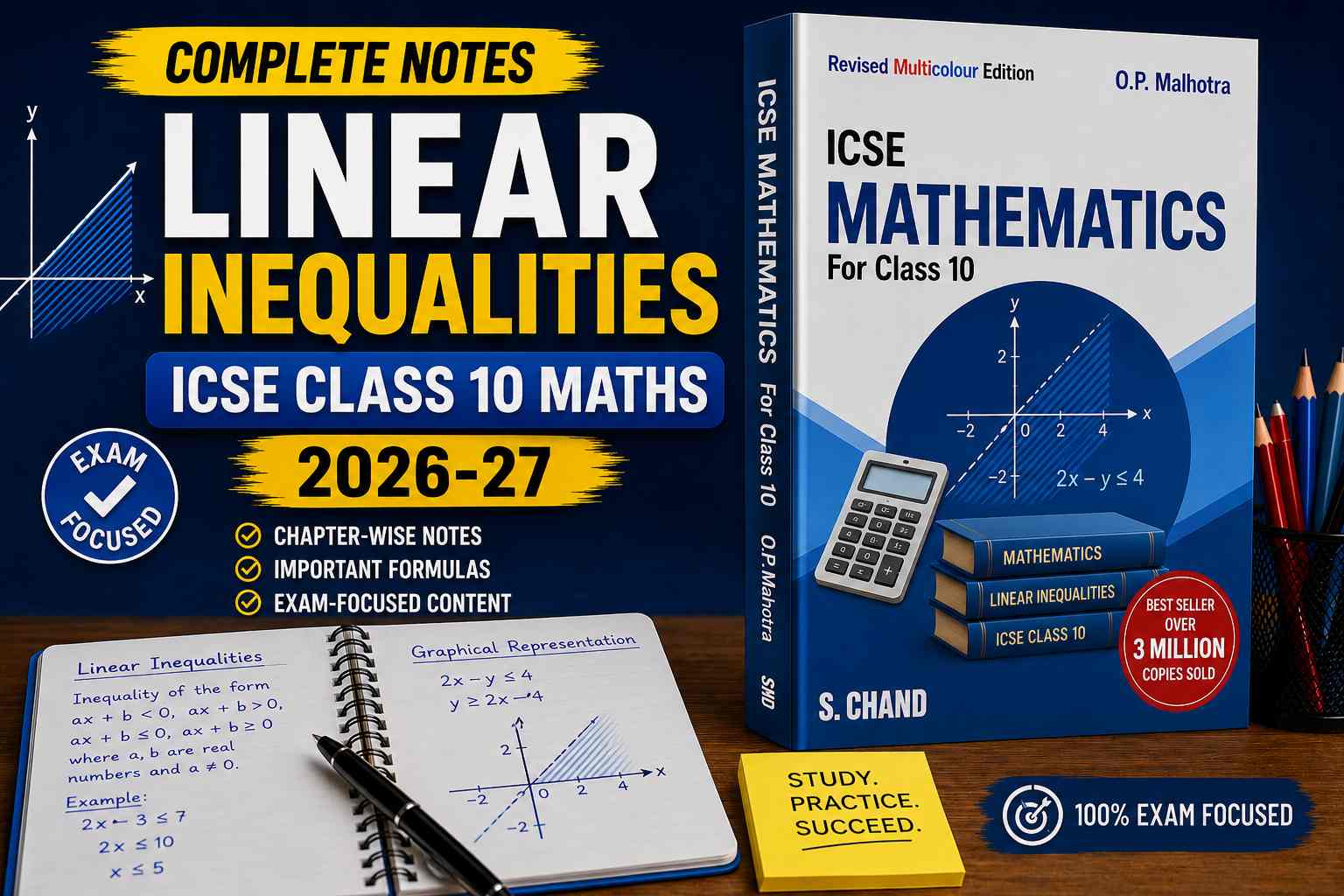
ICSE Class 10 Linear Inequalities Notes | OP Malhotra Maths (2026-27)
What Is a Linear Inequality?
A linear inequality is a mathematical statement that compares two expressions using inequality signs instead of an equals sign. The four signs you’ll work with are:
> (greater than)
< (less than)
≥ (greater than or equal to)
≤ (less than or equal to)
For example, 2x + 3 > 7 is a linear inequality in one variable.
Unlike 2x + 3 = 7, which has exactly one solution (x = 2), the inequality 2x + 3 > 7 has infinitely many solutions — any value of x greater than 2 satisfies it.
The Golden Rules of Solving Inequalities
Solving an inequality looks almost identical to solving an equation, except for one critical difference. These rules govern everything:
1. Adding or subtracting the same number from both sides does not change the direction of the inequality.
Example, If x + 3 > 5, then x +3 – 3> 2 – 3 ⇒ x > 2
2. Multiplying or dividing both sides by a positive number does not change the direction.
Example, If 2x > 6, then 2x/2 > 6/2 ⇒ x > 3
3. Multiplying or dividing both sides by a negative number REVERSES the inequality sign. This is the rule students forget most often.
Example, If −2x > 6, dividing both sides by −2 gives x < −3 (the sign flips from > to <).
4. Taking the reciprocal of both sides also reverses the inequality, provided both sides have the same sign.
Replacement Set and Solution Set
1. Replacement set is the set from which the values of the variable involved
in the inequation are chosen.
2. Solution set is the subset of the replacement set, whose elements satisfy
the given inequation.
Example: Let the given inequation be x ≤ 4, if:
-
- the replacement set = N, the set of natural numbers;
the solution set = {1, 2, 3, 4} - the replacement set = W, the set of whole numbers;
the solution set = {0, 1, 2, 3, 4} - the replacement set = Z or I, the set of integers;
the solution set = {…, -2, -1, 0, 1, 2, 3, 4} - the replacement set = R, the set of real numbers;
the solution set = { x : x ∈ R and x ≤ 4 }
- the replacement set = N, the set of natural numbers;
3. The solution set depends on the replacement set.
Worked Example 1: Basic Inequality
Solve: 3x − 5 ≤ 13, where x ∈ Z
Sol: Adding 5 to both sides:
3x ≤ 18
Dividing both sides by 3 (positive, so sign stays the same):
x ≤ 6
Since x belongs to integers,
Here , the replacement set is Z ,
and the solution set is {…, 2, 3, 4, 5, 6}
Worked Example 2: The Sign-Flip Trap
Solve: 5 − 2x > 1, where x ∈ R
Sol: Subtracting 5 from both sides:
−2x > −4
Dividing both sides by −2 (negative — sign flips):
x < 2
Worked Example 3: Combined (Double) Inequalities
Solve: −3 < 2x − 1 ≤ 5, where x ∈ R
Sol:
Add 1 to all three parts:
⇒ −3 + 1 < 2x – 1 + 1 ≤ 5 + 1
⇒ −2 < 2x ≤ 6
Divide all three parts by 2:
⇒ −2/2 < 2x/2 ≤ 6/2
⇒ −1 < x ≤ 3
Here,
the replacement set is R,
and the solution set is x∈(-1,3]
Representing Solutions on a Number Line
- The solution set of an inequation can be represented on a real number line.
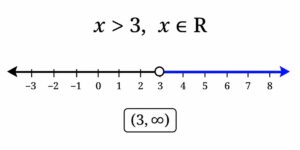
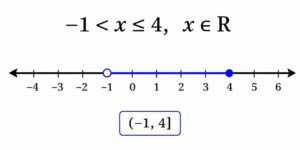
- A hollow/open circle (◦) is used when the inequality is strict (>or<) – meaning that point is excluded.
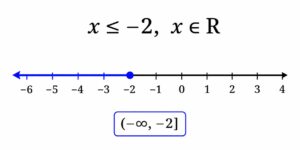
- A filled/dark circle (•) is used at a number when the inequality includes “equal to” (≥or≤) – meaning that point is included.
- A ray or line segment that extends in the direction of all valid solutions.
Some examples on Number Line ,
Example 1: x > 3 , where x ∈ R
Sol:
Example 2: x ≤ -2 , where x∈R
Sol:
Example 3: -1 < x ≤ 4 , where x∈R
Sol:
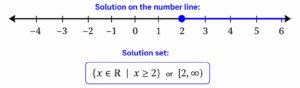
Example 4: 2x-3 ≥ 1 , where x∈R
Sol: 2x-3 ≥ 1
Adding 3 to both sides ,
⇒ 2x – 3 + 3 ≥ 1 + 3
⇒ 2x ≥ 4
Dividing by 2 on both sides ,
⇒ 2x/2 ≥ 4/2
⇒ x ≥ 2
Common Mistakes
- Forgetting that the answer must come only from the replacement set, not from all real numbers or integers in general.
- Skipping the sign-flip rule when dividing by a negative number, leading to a wrong solution set.
- Confusing roster form with set-builder form when writing the final answer — check what the question asks for.
- Including boundary values incorrectly when the inequality is strict (< or >) versus non-strict (≤ or ≥).
Practice Questions on Linear Inequalities : Exercise-4
Self Evaluation and Revision on Linear Inequalities : Self Evaluation
— : End of ICSE Class 10 Linear Inequalities Notes | OP Malhotra Maths (2026-27) :–
Return to :– OP Malhotra S Chand Solutions for ICSE Class-10 Maths
Thanks
Please Share with Your Friends