Indefinite Integrals Class 12 OP Malhotra Exe-14D ISC Maths Solutions Ch-14 Solutions. In this article you would learn about integrals of the form ∫eax cos(bx) dx or ∫eax sin(bx) dx. Step by step solutions of latest textbook has been given as latest syllabus. Visit official Website CISCE for detail information about ISC Board Class-12 Mathematics.
Indefinite Integrals Class 12 OP Malhotra Exe-14D ISC Maths Solutions Ch-14
| Board | ISC |
| Publications | S Chand |
| Subject | Maths |
| Class | 12th |
| Chapter-14 | Indefinite Integrals |
| Writer | OP Malhotra |
| Exe-14(d) | integrals of the form ∫eaxcos(bx) dx or ∫eaxsin(bx) dx |
Exercise- 14D
Indefinite Integrals Class 12 OP Malhotra Exe-14D Solutions
The integral of the form ∫e^(ax)cos(bx) dx is (e^(ax) / (a² + b²))(a cos(bx) + b sin(bx)) + C, and the integral of ∫e^(ax)sin(bx) dx is (e^(ax) / (a² + b²))(a sin(bx) – b cos(bx)) + C. Both integrals are solved using integration by parts, often applied twice in a cyclic manner, to derive a system of equations that can be solved for the original integral
How to Solve integrals of the form ∫eaxcos(bx) dx or ∫eaxsin(bx) dx
1. Set up the first integral:
Let I = ∫e^(ax)cos(bx) dx.
2. Apply integration by parts:
Let u = cos(bx) and dv = e^(ax) dx.
Then, du = -b sin(bx) dx and v = (1/a)e^(ax).
This gives I = (1/a)e^(ax)cos(bx) – ∫(1/a)e^(ax)(-b sin(bx)) dx = (1/a)e^(ax)cos(bx) + (b/a)∫e^(ax)sin(bx) dx.
3. Apply integration by parts to the new integral:
Let J = ∫e^(ax)sin(bx) dx.
Let u = sin(bx) and dv = e^(ax) dx.
Then, du = b cos(bx) dx and v = (1/a)e^(ax).
This gives J = (1/a)e^(ax)sin(bx) – ∫(1/a)e^(ax)(b cos(bx)) dx = (1/a)e^(ax)sin(bx) – (b/a)∫e^(ax)cos(bx) dx.
4. Substitute J back into the equation for I:
I = (1/a)e^(ax)cos(bx) + (b/a)[(1/a)e^(ax)sin(bx) – (b/a)I]
I = (1/a)e^(ax)cos(bx) + (b/a²)e^(ax)sin(bx) – (b²/a²)I
5. Solve for I:
I(1 + b²/a²) = e^(ax)[(1/a)cos(bx) + (b/a²)sin(bx)]
I((a² + b²)/a²) = e^(ax)[(a/a²)cos(bx) + (b/a²)sin(bx)]
I = (a² / (a² + b²)) * (e^(ax)/a²)[a cos(bx) + b sin(bx)]
I = (e^(ax) / (a² + b²)) * (a cos(bx) + b sin(bx)) + C
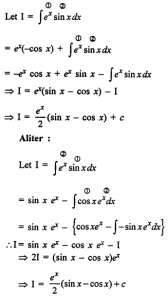
Que-1: ∫ex sinx dx
Sol:
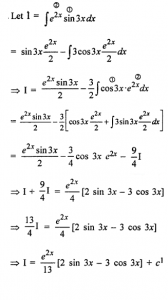
Que-2: ∫e2x sin3x dx
Sol:
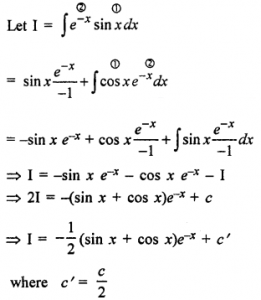
Que-3: ∫e-x sinx dx
Sol:
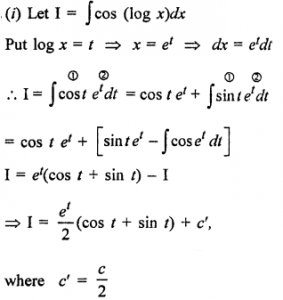
Que-4: (i)∫cos(logx) dx
(ii)∫sin(logx) dx
Sol:
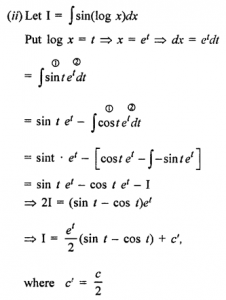
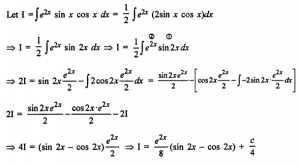
Que-5: ∫e2xsinx cos x dx
Sol:
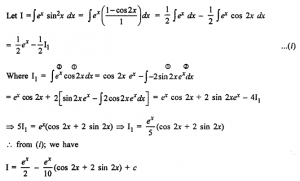
Que-6: ∫exsin²x dx
Sol:
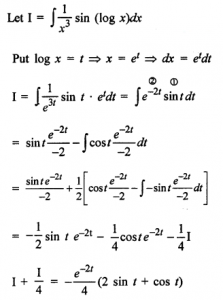
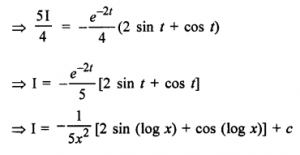
Que-7: ∫1/x³ sin(logx) dx
Sol:
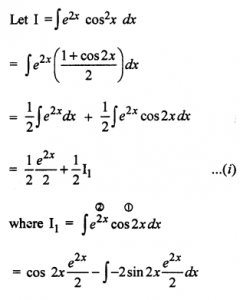
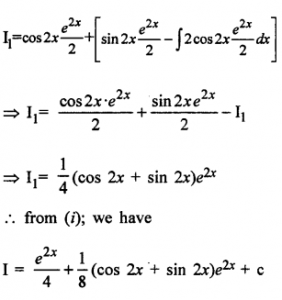
Que-8: ∫e2xcos²x dx
Sol:
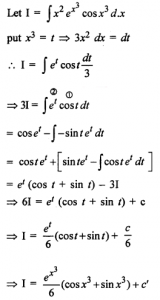
Que-9: ∫x²ex^(3)cos x³ dx
Sol:
–: End Indefinite Integrals Class 12 OP Malhotra Exe-14D ISC Math Ch-14 Solution :–
Return to :- OP Malhotra ISC Class-12 S Chand Publication Maths Solutions
Thanks
Please share with your friends