Indefinite Integrals Class 12 OP Malhotra Exe-15B ISC Maths Solutions Ch-15 Solutions. In this article you would learn about integration using partial fractions . Step by step solutions of latest textbook has been given as latest syllabus. Visit official Website CISCE for detail information about ISC Board Class-12 Mathematics.
Indefinite Integrals Class 12 OP Malhotra Exe-15B ISC Maths Solutions Ch-15
| Board | ISC |
| Publications | S Chand |
| Subject | Maths |
| Class | 12th |
| Chapter-15 | Indefinite Integrals |
| Writer | OP Malhotra |
| Exe-15(b) | integration using partial fractions |
Integration using partial fractions
Indefinite Integrals Class 12 OP Malhotra Exe-15B Solutions
Que-1: ∫x−1/(x+1)(x−2)dx
Sol: Let ∫x−1/(x+1)(x−2)dx = A/x+1 + B/x−2 …(1)
Multiplying both sides of eqn. (1) by (x + 1)(x – 2); we have
(x – 1) = A(x – 2) + B(x + 1) …(2)
putting x = -1, 2 successively in eqn. (2); we have
-2 = -3 A ⇒ A = 2/3
& 1 = 3B ⇒ B = 1/3
∴ from(1); we have
∫x−1/(x+1)(x−1)dx = 2/3∫1/x+1dx+1/3∫dx/x−2 = 2/3log|x + 1|+ 1/3log|x – 2| + C
Que-2: ∫2x−1/(x−1)(x+2)(x−3)dx
Sol: Let 2x−1/(x−1)(x+2)(x−3)dx = A/x−1+B/x+2+C/x−3 …(1)
Multiplying eqn. (1) both sides by (x – 1)(x + 2)(x – 3); we have
2x – 1 = A(x + 2)(x – 3) + B(x – 1)(x – 3) + C(x – 1)(x + 2) …(2)
putting x = 1, -2, 3 successively in eqn. (1); we have
1 = A(3)(-2) ⇒ A = -1/6
-5 =B(-3)(-5) ⇒ B = -1/3
5 = C(2)5 ⇒ C = 1/2
∴ from (1); we have
I = ∫−1/6/x−1dx + ∫−1/3/x+2dx + ∫1/2/x−3dx = –1/6log|x – 1|-1/3log|x+2|+1/2log|x-3|+C
Que-3: ∫x+7/x²+2x−8 dx
Sol: Let I = ∫x+7/x²+2x−8 dx = ∫x+7/(x−2)(x+4) dx
Let x+7/(x−2)(x+4) = A/x−2 + B/x+4 …(1)
Multiplying eqn. (1) both sides of by (x – 2)(x + 4); we have
x + 7 = A(x + 4) + B(x – 2) …(2)
putting x = 2 in eqn. (2); we have
9 = 6A ⇒ A = 3/2
putting x = -4 in eqn. (2); we have
3 = -6 ⇒ B = B = -1/2
∴ from (1); we have
I = ∫3/2/x−2dx + ∫−1/2/x+4dx = 3/2log|x-2|-1/2log|x+4|+C
Que-4: ∫x/x²−3x+2 dx
Sol: Let I = ∫x/x²−3x+2 = ∫x/(x−1)(x−2) dx
Let x/(x−1)(x−2) = A/x−1+B/x−2 …(1)
Multiplying eqn. (1) both sides by
(x – 1)(x – 2); we have
x = A(x – 2) + B(x – 1) …(2)
putting x = 1, 2 successively in eqn. (2); we have
1 = -A ⇒ A = -1 & 2 = B
∴ from (1); we have
Thus, I = ∫−1/x−1 dx+∫2/x−2 dx = -log|x – 1|+2 log|x – 2| + C
Que-5: ∫2x+7/x²−x−2 dx
Sol: Let I = ∫2x+7/x²−x−2 dx
Let 2x+7/x²−x−2 = 2x+7/(x+1)(x−2)
= A/x+1 + B/x−2 ….(1)
Multiply both sides of eqn. (1) by (x + 1)(x – 2); we have
2x +7 = A(x – 2) + B(x + 1) …(2)
putting x = 2,-1 successively in eqn. (2); we have
11 = 3 B ⇒ B = 11/3
and 5 = – 3A ⇒ A = –5/3
∴ from (1); we have
I = –5/3 ∫dx/x+1 + 11/3∫dx/x−2
= –5/3 log|x + 1| + 11/3 log| x – 2| + C
Que-6: ∫x+1/x²+4x−5 dx
Sol: Let I = ∫x+1/x²+4x−5 dx = ∫(x+1)/(x−1)(x+5) dx
Let x+1/(x−1)(x+5) = A/x−1 + B/x+5 …(1)
Multiplying eqn. (1) both sides of by (x – 1)(x + 5); we have
x + 1 = A(x + 5) + B(x – 1) …(2)
putting x = 1, in eqn. (2); we have
2 = 6A ⇒ A = 1/3
putting x = -5 in eqn. (2); we have
-4 = -6 B ⇒ B= 2/3
∴ from (1); we have
I = ∫1/3/x−1dx + ∫2/3/x+5dx
= 1/3log|x – 1|+2/3log|x + 5| + C
Que-7: ∫x²+2x+8/(x−1)(x−2) dx
Sol: Here degree of numerator of integand is equal to degree of denominator so it is an improper fraction.
Let I =x²+2x+8/(x−1)(x−2) = 1 + A/x−1 + B/x−2 …(1)
Multiplying both sides of eqn. (1) by (x – 1)(x – 2); we have
x²+2x+8 = (x – 1)(x – 2) + A(x – 2) + B(x – 1) …(2)
putting x = 1 in eqn. (2); we have
11 = -A ⇒ A = -11
putting x = 1 in eqn. (2); we have
16 = B
∴ from (1); we have
∫x²+2x+8/(x−1)(x−2) dx = ∫1dx−1/1∫dx/x−1 + 16∫dx/x−2 = x-11 log|x – 1|+ 16 log|x – 2| + C
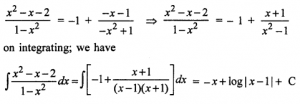
Que-8: ∫x²−x−2/1−x² dx
Sol: Since degree of numerator of integrand is equal to degree of denominator then by actual division,
Que-9: ∫x²+x+1/(x−1)³ dx
Sol: Let I = ∫x²+x+1/(x−1)³ dx
Let x²+x+1/(x−1)³ = A/x−1 + B/(x−1)²+ C/(x−1)³ …(1)
Multiplying both sides of eqn. (1) by (x – 1)3; we have
x² + x + 1 = A/(x – 1)² + B/(x – 1) + C
putting x = 1 in eqn. (2); we have 3 = C
Coeff of x²; 1 = A
Coeff of x ; 1 = -2A + B ⇒ B = 3
∴ from (1); we have
I = ∫dx/x−1 + ∫3/(x−1)²dx + ∫3/(x−1)³dx = log|x – 1|+ 3 (x-1)–2+1/(−2+1) + 3 (x-1)-3+1/(-3+1)
= log|x – 1| – 3/x−1 – 3/2 1/(x−1)² + C
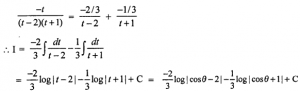
Que-10: ∫sinθcosθ/cos²θ−cosθ−2 dθ
Sol: Let I = ∫sinθcosθ/cos²θ−cosθ−2 dθ; Put cos θ = t ⇒ – sin θ dθ = dt
∴ I = ∫−t/t²−t−2 dt = ∫−t/(t−2)(t+1) dt
Let −t/(t−2)(t+1) = A/t−2 + B/t+1 ….(1)
Multiplying eqn. (1) both sides of by
(t – 2)(t + 1); we have -t = A(t + 1) + B(t – 2)
putting t = 2, in eqn. (2); we have -2 = 3 A ⇒ A = -2/3
putting t = -1 in eqn. (2); we have
1 = B(-3) ⇒ B = -1/3
∴ from (1); we have
Que-11: ∫3x−1/(x−2)² dx
Sol: Let 3x−1/(x−2)² dx = A/x−2 + B/(x−2)² …(1)
Multiplying both sides of eqn. (1) by (x – 2)²; we have
3x – 1 = A(x – 2) + B …(2)
putting x = 2 in eqn. (2); we have 5 = B
Coeff of x ; 3 = A
∴ from (1); we have
3x−1/(x−2)² = 3/x−2 + 5/(x−2)²
∴ ∫3x−1/(x−2)² dx = 3∫1/x−2 dx + 5∫dx/(x−2)²
= 3 log|x – 2| – 5/x−2 + C
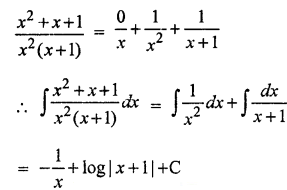
Que-12: (i) ∫x²+x+1/x²(x+1) dx
(ii) ∫2/(1−x)(1+x²) dx
Sol: (i) Let x²+x+1/x²(x+1) = A/x + B/x² + C/x+1 …(1)
Multiplying both sides of eqn. (1) by x²(x + 1); we have
x² + x + 1 = Ax(x + 1) + B(x + 1) + C x2 …(2)
putting x = 0 in eqn. (2); we have 1 = B
putting x = -1 in eqn. (2); we have 1 = C
Coeff of x²; 1 = A + C ⇒ A = 0
∴ from (1); we have
(ii) Let 2/(1−x)(1+x²) dx = A/1−x + Bx+C/(1+x2) …(1)
Multiplying both sides of eqn. (1) by (1 – x) (1 + x2); we get
2 = A(1 + x²) + (B x + C)(1 – x) …(2)
putting x = 1 in eqn. (2); we have 2 = 2 A ⇒ A = 1
Coeff of x²; 0 = A – B ⇒ B = 1; Coeff of x ; 0 = + B – C ⇒ C = 1
∴ from (1); we have
2/(1−x)(1+x²) = 1/1−x + x+1/1+x²
⇒ ∫2/(1−x)(1+x²)dx = ∫1/1−x dx +
= log|1−x|/−1 + 1/2∫2x/1+x² dx + ∫dx/1+x² = -log|1 – x|1/2log(1 + x²)+ tan-1x + C
[∵∫f′(x)/f(x) dx = log| f(x)∣&∫dx/x²+a² = 1/a tan-1x/a]
Que-13: ∫3x−2/(x+1)²(x+3) dx
Sol: Let 3x−2/(x+1)²(x+3) dx = A/x+1 + B/(x+1)² + C/x+3 …(1)
Multiplying both sides of eqn. (1) by (x + 1)²(x + 3); we get
3x – 2 = A(x + 1)(x + 3) + B(x + 3) + C(x + 1)² …(2)
putting x = -1 in eqn. (2); we have
– 5 = 2B ⇒ B = -5/2
putting x = – 3 in eqn. (2); we have
– 11 = 4C ⇒ C = −11/4
Coeff of x² ; 0 = A + C ⇒ A = 114
∴ from (1); we have
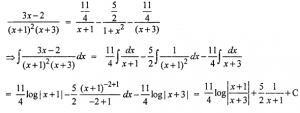
Que-14: ∫2x/(x²+1)(x²+2) dx
Sol: Let I = ∫2x/(x²+1)(x²+2) dx ; Put x² = t ⇒ 2x dx = dt
∴ I = ∫dt/(t+1)(t+2)
Let 1/(t+1)(t+2) = A/t+1 + B/t+2 …(1)
Multiplying both sides of eqn. (1) by (t + 1)(t + 2); we have
I = A(t + 2) + B(t + 1) …(2)
putting t = – 1 in eqn. (2); we have
1 = – A
putting t = – 2 in eqn. (2); we have
1 = – B ⇒ B = – 1
∴ from (1); we have
I = ∫1/t+1/dt – ∫1/t+2 = log |t + 1|- log |t + 2| + C
Thus I = log∣t+1/t+2∣ + C = log∣x²+1/x²+2∣ + C
Que-15: ∫x²+1/x²−1 dx
Sol: Let I = ∫x²+1/x²−1 dx
Here, degree of numerator of integrand is equal to degree of denominator.
Thus,x²+1/x²−1 = 1 + A/x−1 + B/(x+1) …(1)
Multiplying both sides of eqn. (1) by (x² – 1); we have
x” + 1 = x² – 1 + A/(x + 1) + B/(x – 1)
putting x = 1, -1 successively in eqn. (2); we have
2 = 0 + 2A ⇒ A = 1 & 2 = 0 – 2B ⇒ B = -1
∴ from (1); we have
I = ∫[1+1/x−1−1/x+1]dx = x + log |x – 1|- log |x + 1| + C
Que-16: ∫x²/x4+x²−2 dx
Sol: Put x = t = x²/x4+x²−2 = t/t²+t−2 = t/(t−1)(t+2) …(1)
Let t/(t−1)(t+2) = A/t−1 + B/t+2 …(2)
Multiplying both sides of eqn. (2) by (t – 1)(t + 2); we have
t = A(t + 2) + B(t – 1) …(3)
putting t = 1, – 2 successively in eqn. (3); we have
1 = 3 A ⇒ A = 1/3 & – 2 = – 3B ⇒ B = 2/3
∴ from (1) & (2); we have
x²/x4+x²−2 = 1/3/x²−1 + 2/3/x²+2
⇒ ∫x²/x4+x²−2 dx = 1/3∫dx/x²−1 + 2/3∫dx/x²+2
= 1/3∫dx/x²−1² + 2/3∫dx/x²+(√2)² = 1/3 x 1/2log∣x−1x+1∣ + 2/3 × 1/√2 tan-1(x2√) + C
= 1/6l loge∣x−1/x+1∣ + √2/3 tan-1 (x/√2)+ C
Que-17: ∫x²+x+1/(x+1)²(x+2)dx
Sol: Let x²+x+1/(x+1)²(x+2) = A/x+1 + B(/x+1)² + B/x+2 …(1)
Multiplying both sides of eqn. (1) by (x + 1)² (x + 2); we have
x² + x + 1 = A(x + 1)(x + 2) + B(x + 2) + C(x + 2)2 …(2)
putting x = -1, -2 successively in eqn. (2); we have
1 = B & 3 = C
Coeff. of x²; 1 = A + C ⇒ A = 1 – C = 1 – 3 = – 2
∴ from (1); we have
x²+x+1(x+1)2(x+2) = −2/x+1 + 1/(x+1)² + 3/x+2
∴ ∫x²+x+1/(x+1)²(x+2) dx
= – 2∫dx/x+1 + ∫dx/(x+1)² + 3∫dx/x+2 = -2 log |x + 1| + (x+1)-2+1/-2+1 + 3 log|x + 2| + C
= -2 log| x + 1| – 1/x+1 + 3 log|x + 2| + C
Que-18: ∫x²/(x²+1)(x²+4) dx
Sol: Put x² = t
x²(x²+1)(x²+4) = t/(t+1)(t+4) = A/t+1 + B/t+4 …(1)
Multiplying both sides of eqn. (2) by (t + 1)(t + 4); we have
t = A(t + 4) + B(t +1) …(2)
putting t = -1, -4 successivelyin eqn. (2); we have
-1 = 3A ⇒ A = -1/3 & – 4 = – 3B ⇒ B = 4/3
∴ from (1); we have
x²/(x²+1)(x²+4) = −1/3/x²+1 + 4/3/x²+4
∴ ∫x²/(x²+1)(x²+4) = – 1/3∫dx/x²+1 + 4/3∫dx/x²+2²
= – 1/3 tan-1x + 4/3 × 1/2 tan-1(x/2) + C = – 1/3 tan-1x + 2/3 tan-1(x/2) + C
Que-19: ∫dx/1+x+x²+x³
Sol: Let I = ∫dx/1+x+x²+x³ = ∫dx/(1+x)(1+x²)
Let 1/(1+x)(1+x²) = A/1+x + B/+C/1+x² …(1)
Multiplying both sides of eqn. (1) by (1+x)(1+x²); we have
1 = A(1 + x²) + (Bx + C)(1 + x) ….(2)
putting x = -1 in eqn. (2); we have
1 = 2 A ⇒ A = 1/2
Coeff. of x2; 0 = A + B ⇒ B = -1/2
Coeff. of x; 0 = B + C ⇒ C = + 1/2
∴ from (1); we have
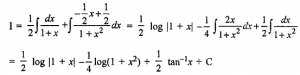
Que-20: ∫x²/(x²−1)(x²+2) dx
Sol: Put x² = t
x²(x²−1)(x²+2) = t/(t−1)(t+2) = A/t−1 + B/t+2 …(1)
Multiplying both sides of eqn. (1) by (t – 1)(t + 2); we have
t = A(t + 2) + B(t – 1) …(2)
putting t = 1, -2 successively in eqn. (2); we have
1 = 3A ⇒ A = 1/3 & – 2 = – 3B ⇒ B = 2/3
∴ from eqn. (1); we have
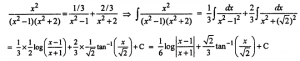
Que-21: ∫2x/x³−1 dx
Sol: Let I = ∫2x/x³−1 dx = ∫2x/(x−1)(x²+x+1) dx
Let 2x/(x−1)(x²+x+1) = A/x−1 + Bx+C/x²+x+1 …(1)
Multiplying both sides of eqn. (1) by (x – 1)(x²+x+1); we have
2x = A(x²+x+1) + (Bx + C)(x – 1)
putting x = 1 in eqn. (2); we have
2 = 3A ⇒ A = 2/3
Coeff. of x²; 0 = A + B ⇒ B = – 2/3
Coeff. of x ; 2 = A – B + C
⇒ C = 2 – 2/3 – 2/3 = 2/3
∴ from (1); we have
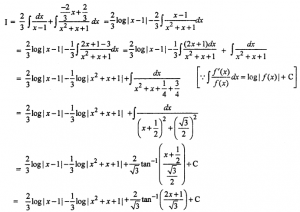
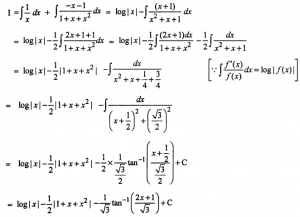
Que-22: ∫dx/x+x²+x³
Sol: Let I = ∫dx/x+x²+x³
Let 1/x(1+x+x²) = Ax + Bx+C/1+x+x²
Multiplying both sides of eqn. (1) by x(1 + x + x²); we have
1 = A(1 + x + x²) + (Bx +C) x …(2)
putting x = 0 in eqn. (2); we have
1 = A
Coeff. of x² ; 0 = A + B ⇒ B = -1
Coeff. of x ; 0 = A + C ⇒ C = – 1
∴ from (1); we have
Que-23: ∫tanθ+tan³θ/1+tan³θ dθ
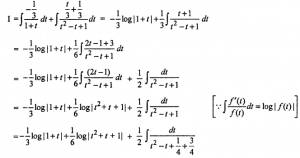
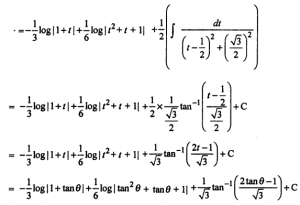
Sol: Let I = ∫tanθ+tan³θ/1+tan³θ dθ = ∫tanθ(1+tan²θ)/1+tan³θ dθ = ∫tanθsec²θ/1+tan³θ dθ
Put tan θ = t ⇒ sec²θ dθ = dt
∴ I = ∫/t1+t³ dt = ∫t(1+t)(t²−t+1) dt
Let t(1+t)/(t²−t+1) = A/1+t + Bt+C/t²−t+1 …(1)
Multiplying both sides of eqn. (1) by (1 + t)(t2 – t + 1); we have
t = A(t² – t + 1) + (Bt + C)(t + 1) ….(2)
putting t = -1 in eqn. (2); we have
-1 = A(1 + 1 + 1) ⇒ A = -1/3
Coeff. of t²; 0 = A + B ⇒ B = 1/3
Coeff. of t ; 1 = -A + B + C
Que-24: ∫sec²θ/tan³θ+4tanθ dθ
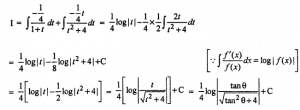
Sol: Let = ∫sec²θ/tan³θ+4tanθ; Put tan θ = t ⇒ sec²θ dθ = dt
∴ I = ∫dt/t³−4t = ∫dt/t(t²−4) …(1)
Let dt/t(t²−4) = A/t + Bt+C/t²+4
Multiplying both sides of eqn. (1) byt (t² + 4); we have
1 = A(t² + 4) + (Bt + C) t ….(2)
putting t = 0 in eqn. (2); we have
1 = 4A ⇒ A = 1/4
Coeff. of t2; 0 = A + B
⇒ B = – 1/4
Coeff. of t ; 0 = C
∴ from (1); we have
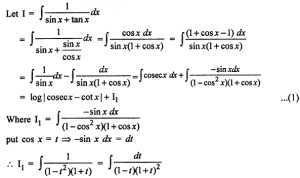
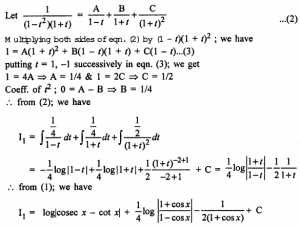
Que-25: ∫1/sinx+tanx dx
Sol:
–: End of Indefinite Integrals Class 12 OP Malhotra Exe-15B ISC Math Ch-15 Solution :–
Return to :- OP Malhotra ISC Class-12 S Chand Publication Maths Solutions
Please share with your friends
Thanks