Index Numbers Class 11 OP Malhotra Exe-30B ISC Maths Ch-30 Solutions. In this article you would learn about Weighted Average of Price Relative Method. Step by step solutions of latest textbook has been given as latest syllabus. Visit official Website CISCE for detail information about ISC Board Class-11 Mathematics.
Index Numbers Class 11 OP Malhotra Exe-30B ISC Maths Solutions Ch-30
| Board | ISC |
| Publications | S Chand |
| Subject | Maths |
| Class | 11th |
| Chapter-30 | Index Numbers |
| Writer | O.P. Malhotra |
| Exe-30(B) | Weighted Average of Price Relative Method. |
Weighted Average of Price Relative Method.
Index Numbers Class 11 OP Malhotra Exe-30B ISC Maths Ch-30 Solutions.
Que-1: Explain briefly, what is meant by a “Weighted average.”
Calculate a cost of living index from the following table of prices and weights.
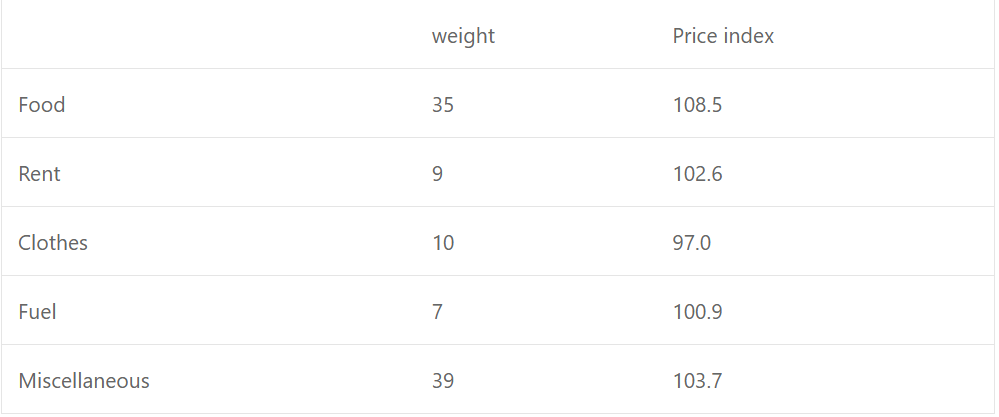
Sol: Construct the table of values as under :
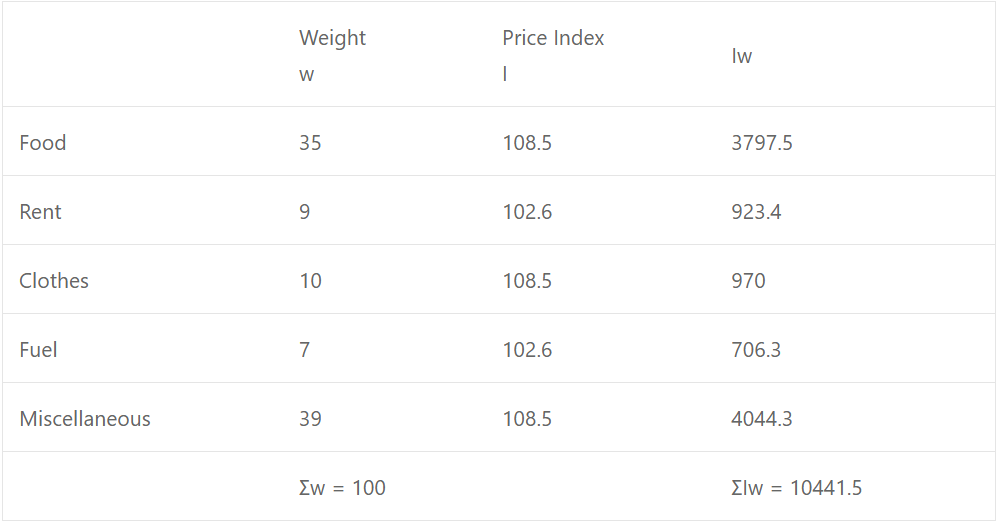
Thus, by weighted average of pure relative method,
Cost of living index = ΣIw/Σw = 10441.5/100 = 104.415
Que-2: Taking 1975 as the base year with an index number 100 , calculate an index number for 1985 based on weighted average of price relatives derived from the table given below :
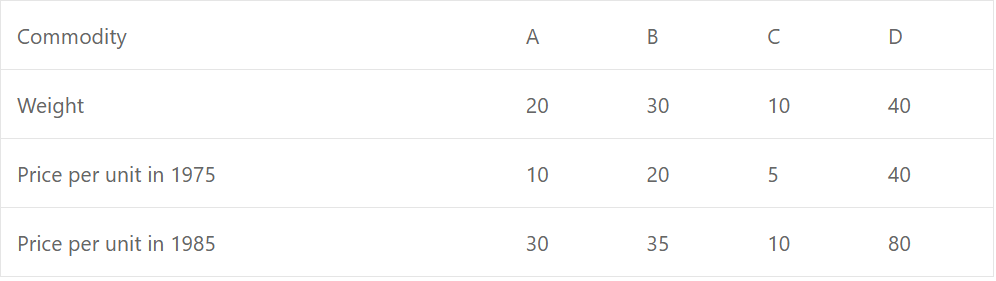
Sol: We construct table of values is given as under:
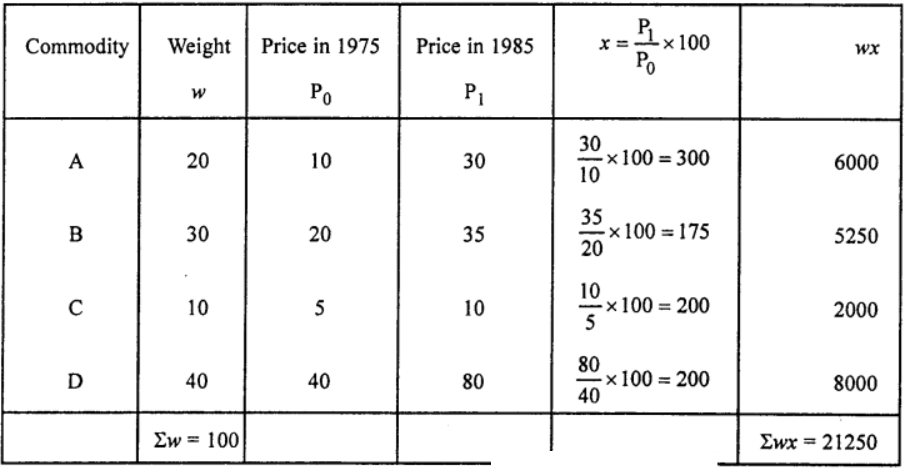
Then by weighted average of price relatives,
Price Index = Σwx/Σw = 21250/100 = 212.50
Que-3: Calculate the index number for the year 1979 with 1970 as base from the following data using weighted average of price relatives.
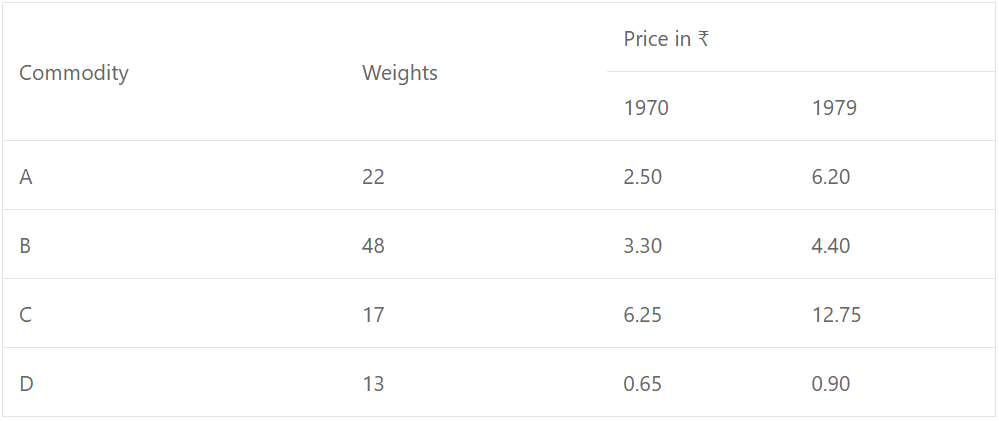
Sol: We construct the table as follows:
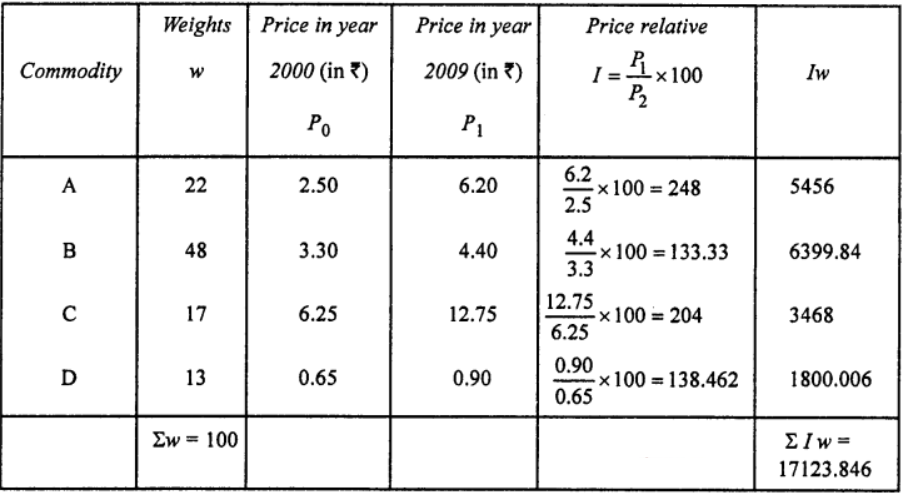
Thus by weighted average of price relative method
required index number = ΣIw/Σw = 17123.846/100 = 171.24
Que-4: Construct a composite index number, as a weighted mean from the following data :

Sol: We know that composite index number is the average of index number for different groups of variables. Construct a table of values is given as under :
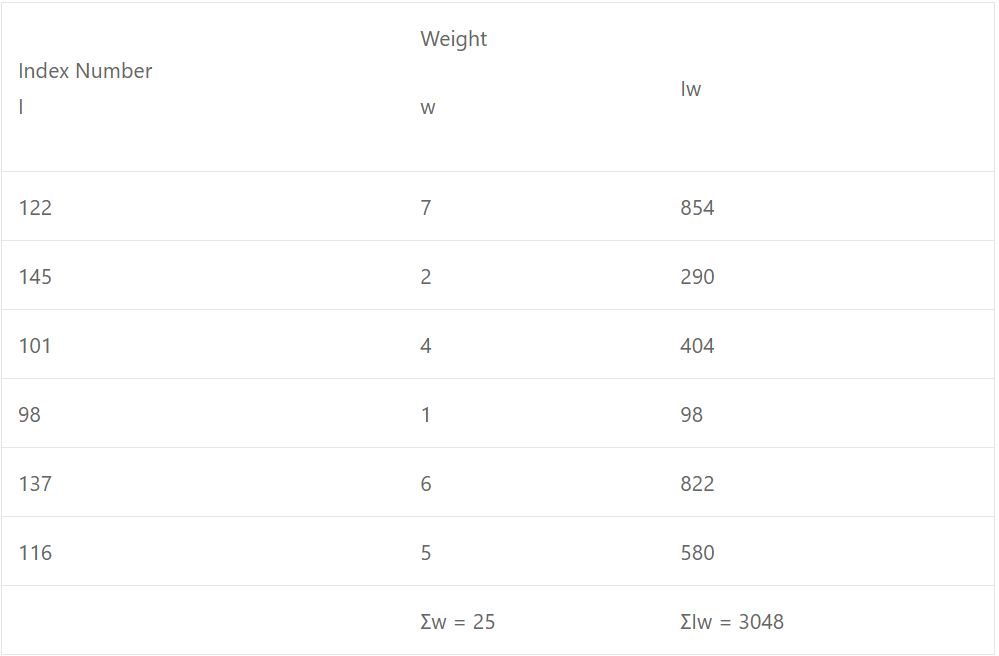
Required price index = ΣIw/Σw = 3048/25 = 121.92
Que-5: Construct a composite index number from the following index numbers and weights :

Sol: Construct a table of values is given as under :
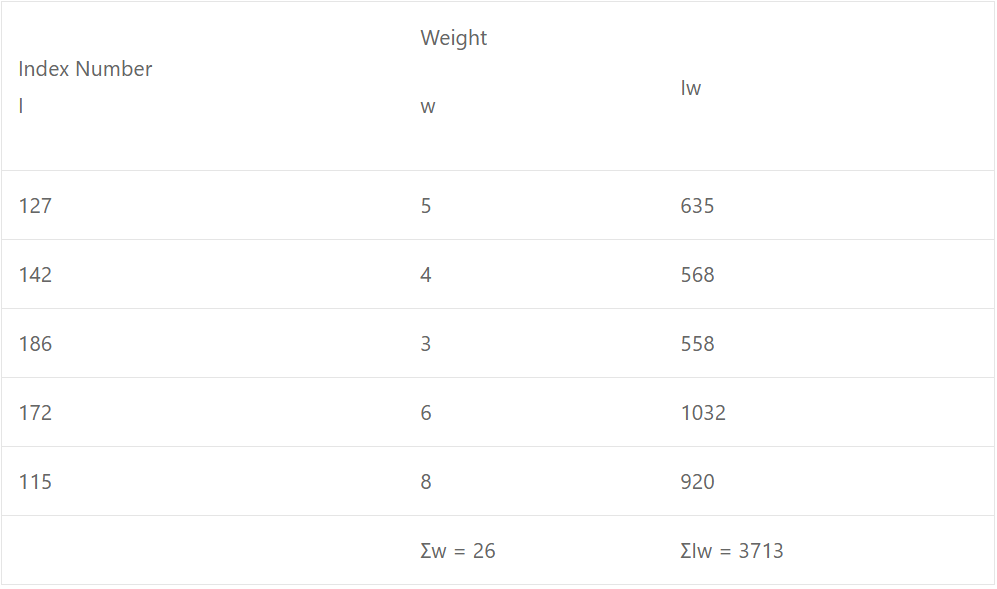
Required price Index = ΣIw/Σw = 3713/26 = 142.81
Que-6: A small industrial concern used three raw materials A, B and C in its manufacturing process. The price, in £ pe kg, of these materials are shown below :
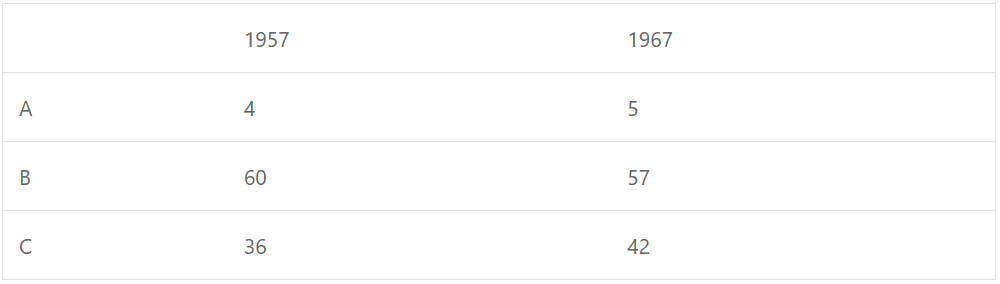
Using 1957 as the base year, calculate for 1967.
(i) a simple aggregate price index.
(ii) price relatives for the three materials and hence a simple average of relatives index. Does either index suffer from any disadvantage ? If the number of kg’s of A, B and C used per year are 30,5 and 10 respectively, calculate a weighted aggregate price index for 1967 using 1957 as the base year.
Sol: We construct the table as follows :
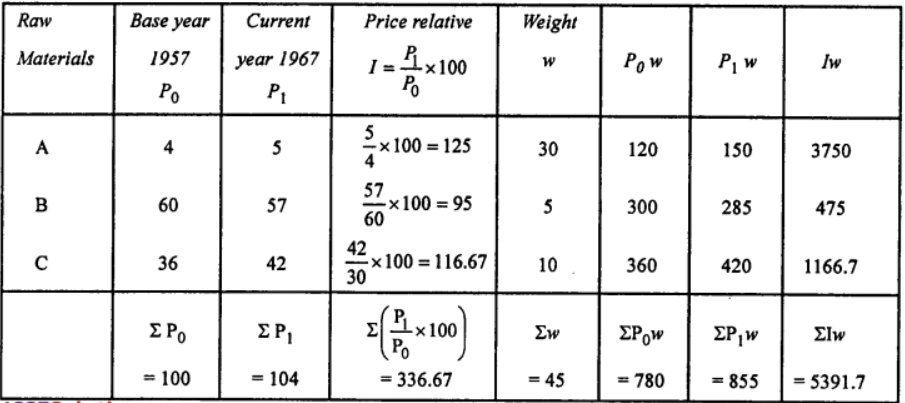
(i) By simple aggregate method, we have
required price index for 2002 = (ΣP1/ΣP0) × 100 = (104/100) × 100 = 104
(ii) By simple average of price relative method, we have
required price index for 2002 = Σ(P1/P0×100)/N = 336.67/3 = 112.22
Thus by weighted aggregate method, we have
p01 = (ΣP1w / ΣP0w) × 100 = (855/780) × 100 ≃ 109.62
Hence by weighted average of price relative, we have
required price index for 2002 = ΣIw / Σw = 5391.7/45 = 119.81
The first two indices in (i) and (ii)
suffer the disadvantage that weight are not used and these values do not reflect the true changes in the cost of production. Since 4th index number 119.81 > 100.
Hence cost of production has gone up.
Que-7: A manufacturer uses 4 raw materials A, B, C, D in the production of a certain commodity. Masses of raw materials used in manufacturing are in the ratio 2 : 3 : 4 : 1. The prices, in ₹, of the materials per kilogram in the years 1978,1980 are given in the following table :
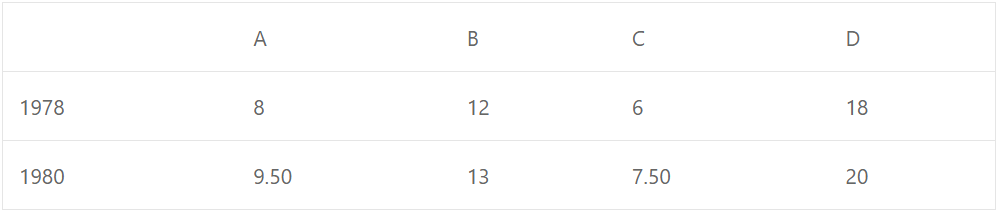
Calculate the index number for the total cost of the raw materials used for the manufacture of the commodity in 1980, using 1978 as the base year.
If the commodity is solid for ₹ 5.75 in 1978, calculate the selling price in 1980, on the assumption that selling prices are directly proportional to the cost of raw material.
Sol:
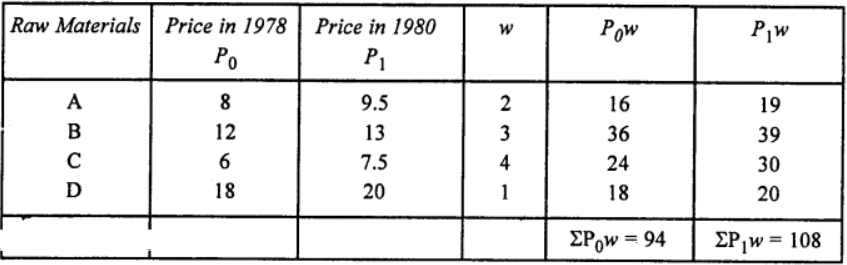 Then by weighted aggregate method, we have
Required index number = {ΣP1w / ΣP0w} × 100 = (108/94) × 100 = 104.89
given selling price of commodity in 1978 = ₹ 5.75
∴ required selling price of commodity in 1980 = {ΣP1w / ΣP0w} × 5.75
= (108×5.75)/94 = 6.61
Que-8: The table shows the averages prices of coffee, sugar and milk in 1979 and 1980 , and the weights used to calculate the cost of making a cup of coffee.
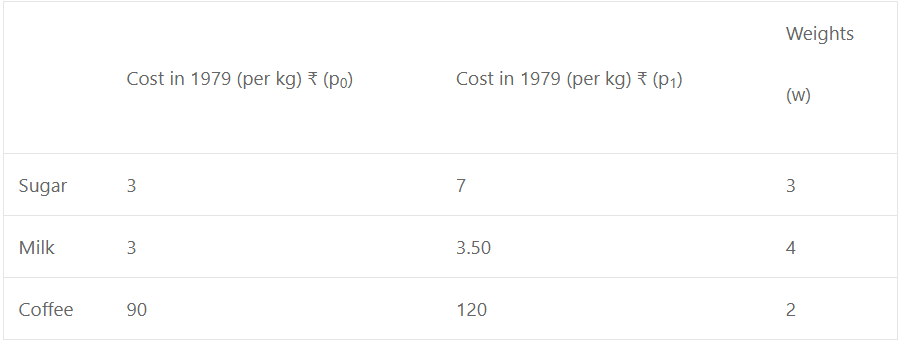
Calculate, correct to one decimal place, the index number for the cost of a cup of coffee in 1980 using :
(i) weighted price relatives,
(ii) weighted aggregates
taking the index number for 1979 as 100 in each case
Sol: We construct the table as follows :
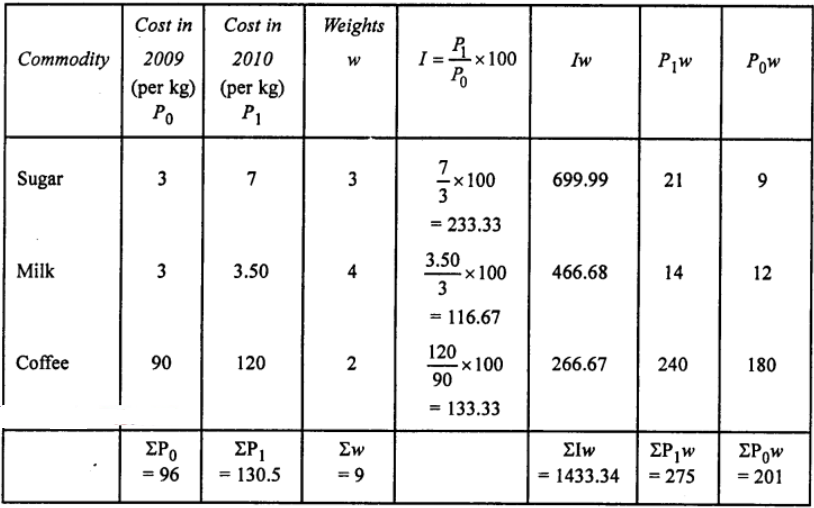
(i) By weighted price relative method, we have
required index number for 2010 = ΣIw/Σw = 1433.34/9 = 159.3
(ii) By weighted aggregated method, we have
required index no. = ΣP1w / ΣP0w × 100 = (275/201) × 100 = 136.8
Que-9: An enquiry into the budget of the middle class families in a city in England gave the following information :
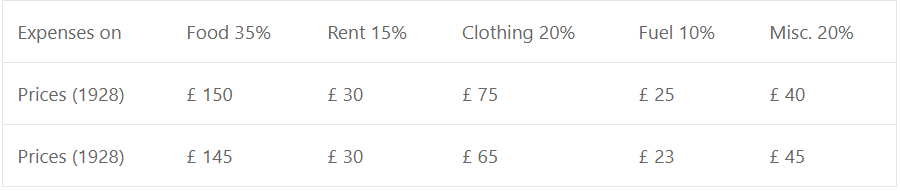 What changes in cost of living figures of 1928 as compared with that of 1929 are seen ?
Sol: We construct table of values is as under :
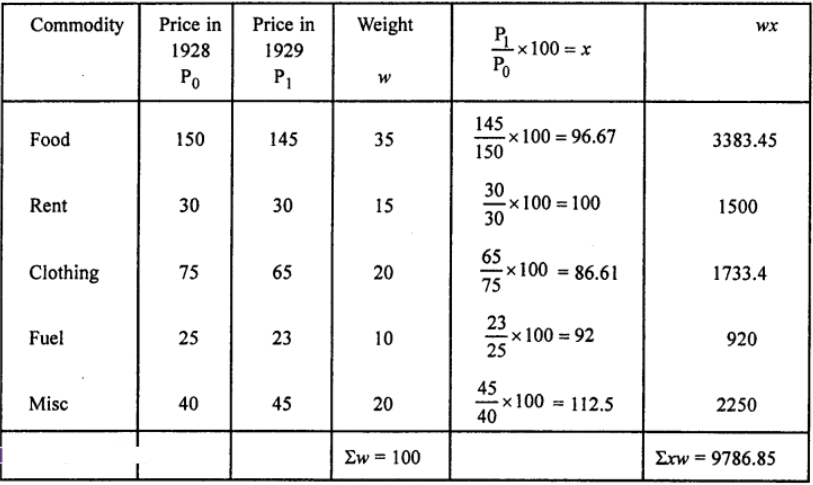
Then by weight average of price relative method, we have required index no. = Σwx/Σw = 9786.85/100 = 97.8685
Thus living in 1929 was more cheaper as compared to living in 1928.
Que-10: Calculate the cost of living index number from the following group data :
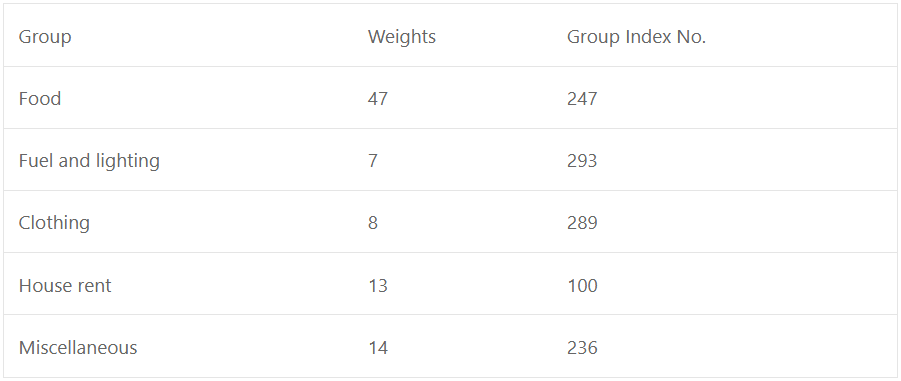
Sol: Construct table of values is given as under :
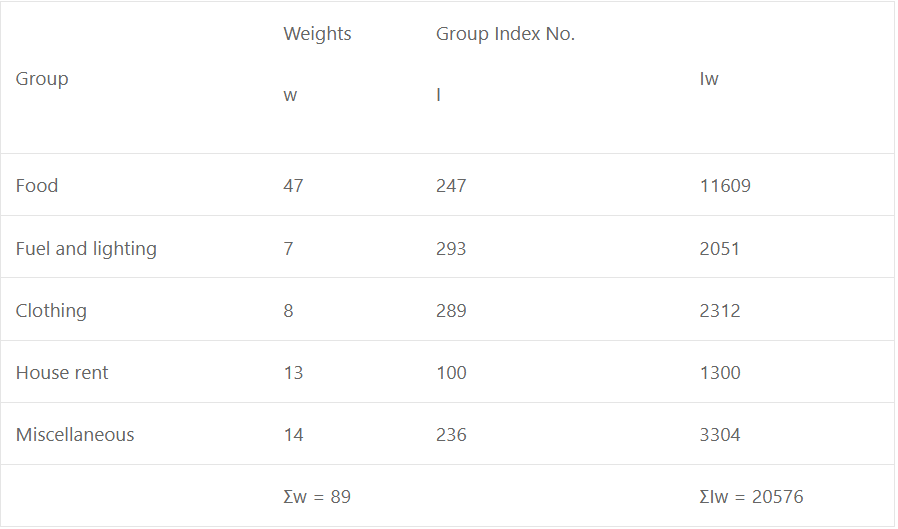
∴ cost of living Index = ΣIw/Σw = 20576/89 = 231.19
Que-11: The following commodities have the given price indices relative to a base of 100. The weights are also given.
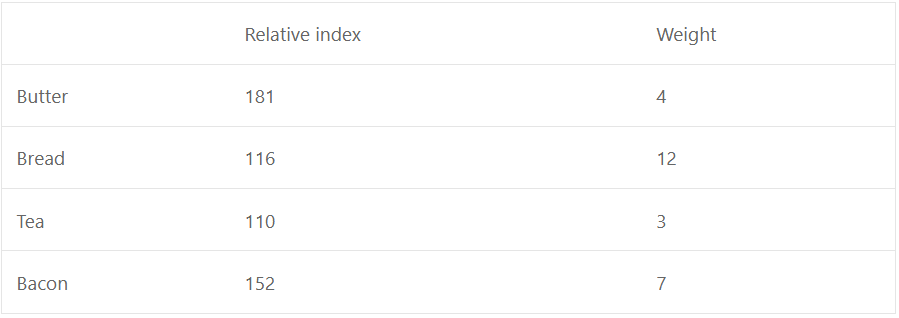
Calculate the new index for this set of commodities.
Sol: We construct the table as under :
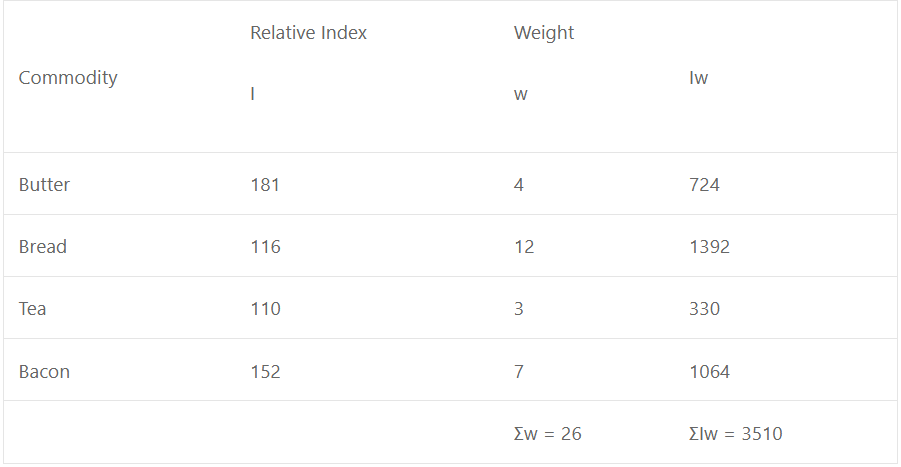
Thus by weighted average of pure relative method, we have
required Index number = ΣIw/Σw = 3510/26 = 135
Que-12: Calculate as index number for the second year, taking the first year as base, taking into account the prices of the four commodities (in ₹ per kg) and the weights given here under :
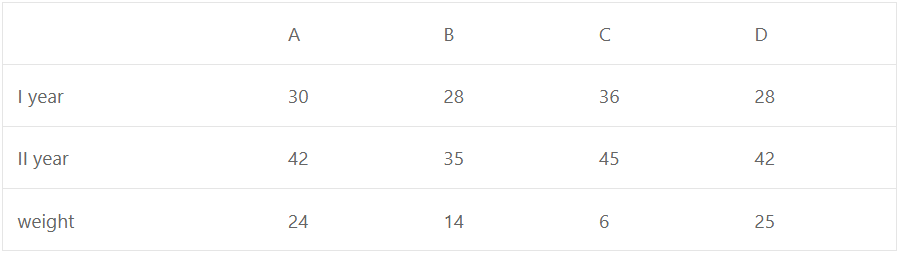
Sol: We construct table of values is given as under :
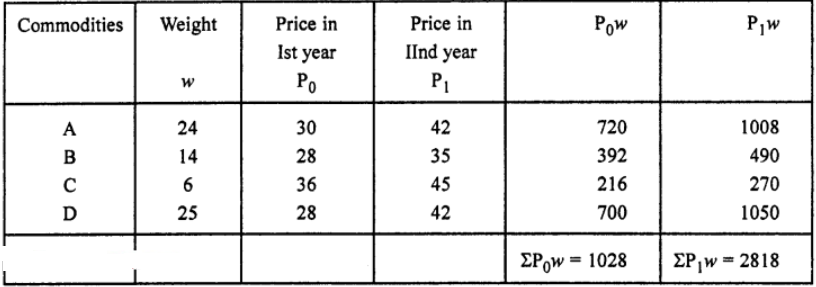
Then by weighted aggregate method,
Index no. = ΣP1w / ΣP0w × 100 = (2818/2028) × 100 = 138.95
Que-13: Construct the consumer price index number for 1988 on basis of 1998 from the following data :
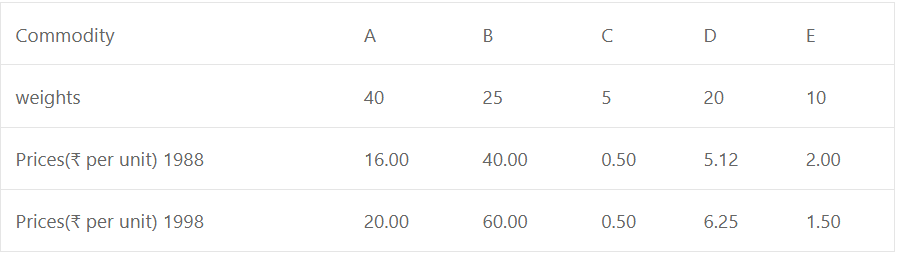
Sol: We construct table of values is given as under :
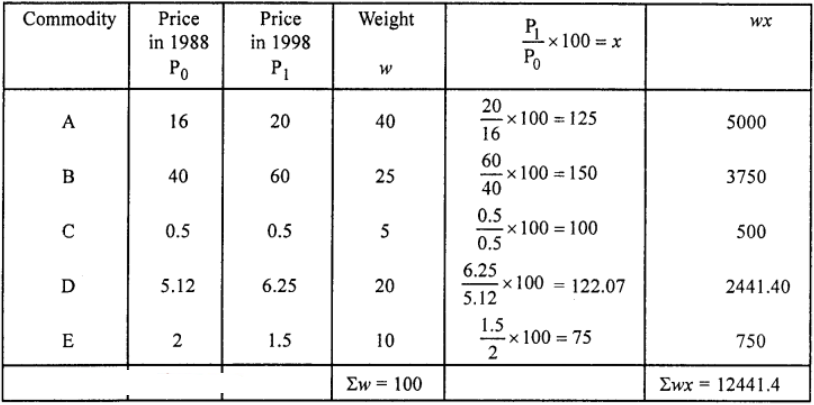
Then by weighted average method of price relatives, Index No. = Σwx/Σw = 12441.4/100 = 124.414
Que-14: Calculate the index number for the year 2006 with 1996 as the base year by the weighted average of price relatives method from the following data.
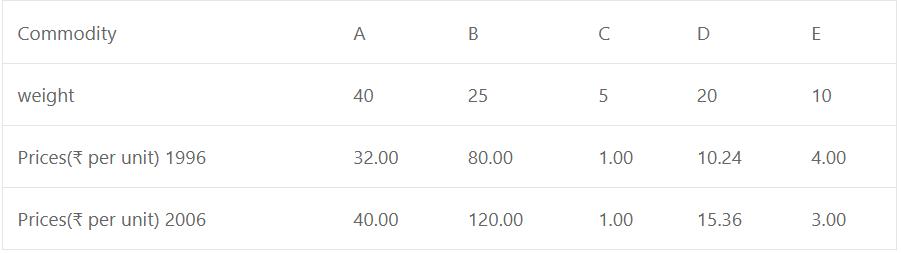
Sol:
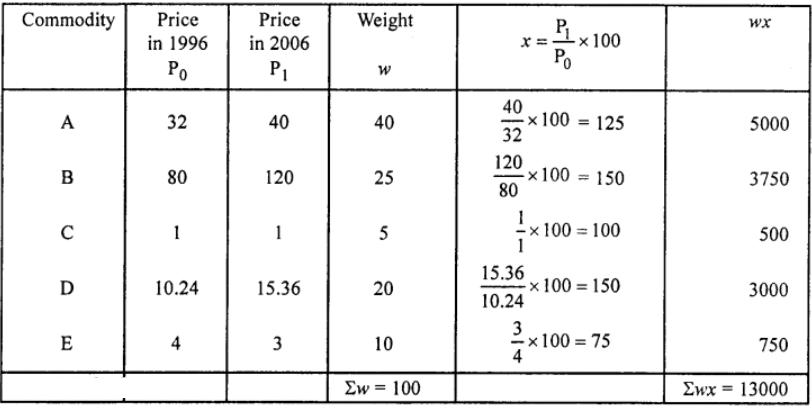 Then by weighted average method of price relative, we have
Index number = Σwx/Σw = 13000/100 = 130
Que-15: Calculate the cost of living index for the following data :
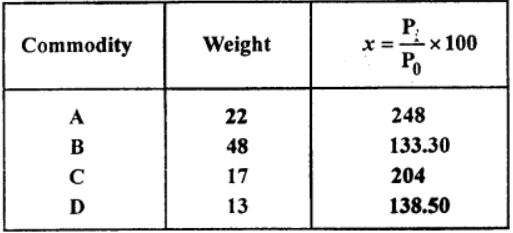
Sol: We construct the table as follows :
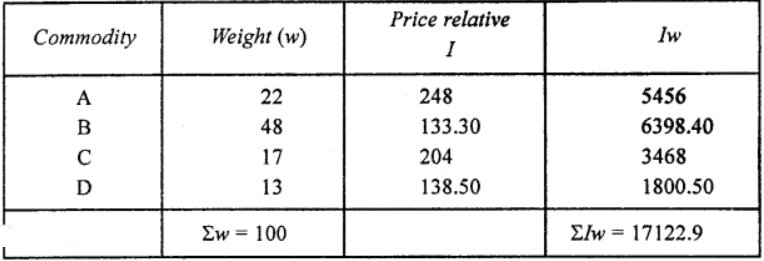
Thus required cost of living index = ΣIw/Σw = 17122.9/100 = 171.229
Que-16: Find the consumer price index number for 1991 on the base of 1990 from the following data, using the method of weighted relatives :
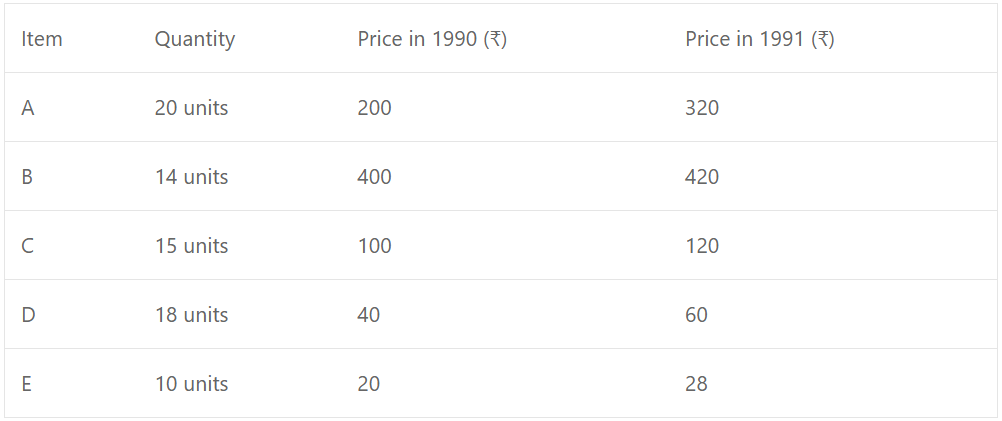
Sol: We construct the table of values as under :
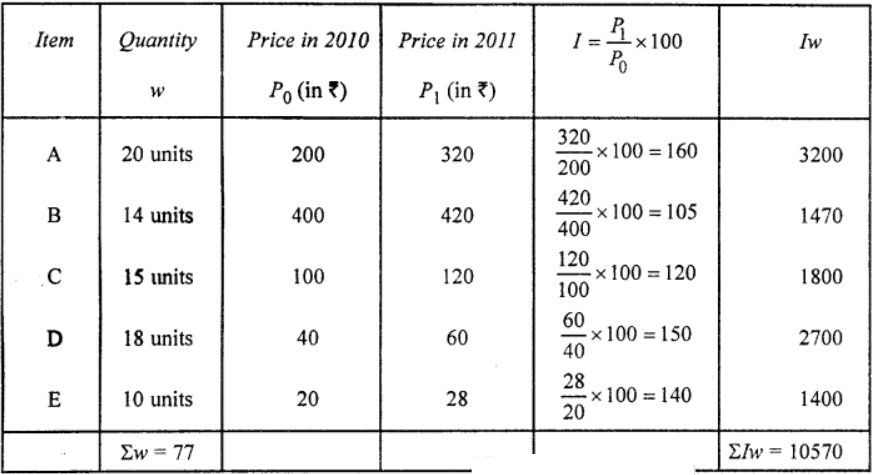
By weighted average of price relative, we have
P01 = Price Index or index number = ΣIw/Σw = 10570/77 = 137.27
Que-17: From the following data compose price index by applying weighted average of price relatives method using arithmetic means :
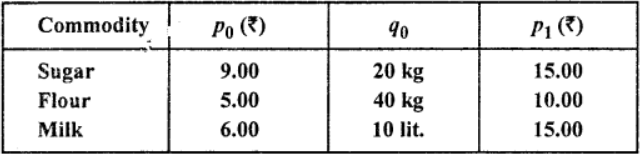
Sol: We construct the table as follows :
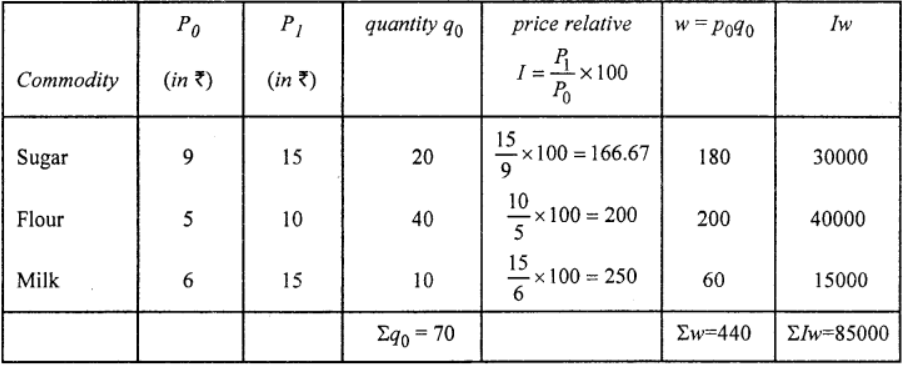
Thus by weighted average of price relative method
required price index = ΣIw/Σw = 85000/440 ≃ 193.18
Que-18: The following table shows the prices per unit in 1980 and 1984 with weights of the commodities A, B, C, D :
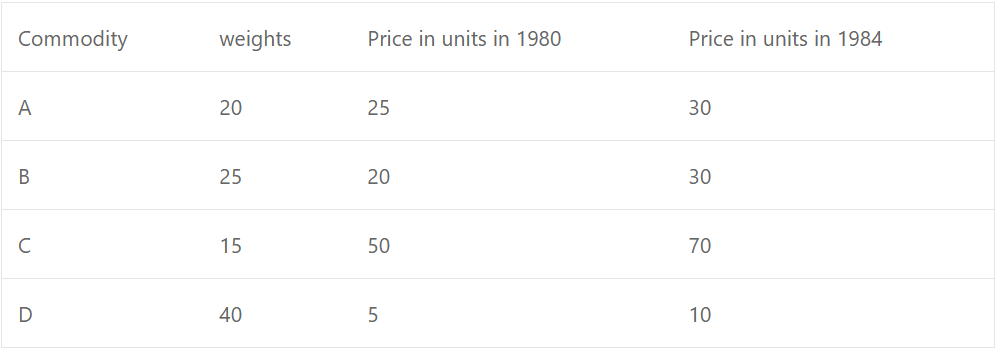
Taking 1980 as base year with an index number 100 , calculate the index number of 1984 based on weighted average of price relatives.
Sol: We construct the following table as under :
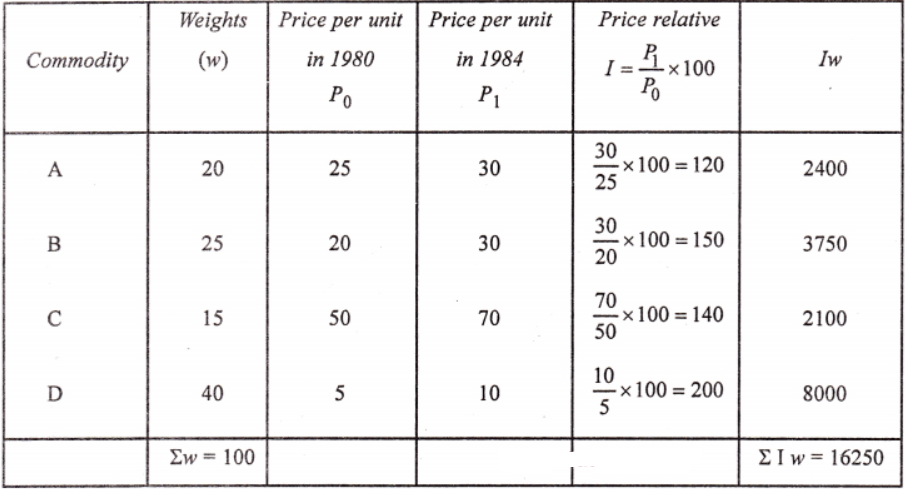
Thus by using weighted average of price relative
required index number = ΣIw/Σw = 16250/100 =162.50
Que-19: The price quotations of four different commodities for 2001 to 2009 are as given below. Calculate the index number for 2009 with 2001 as the base year by using weighted average of price relative method.
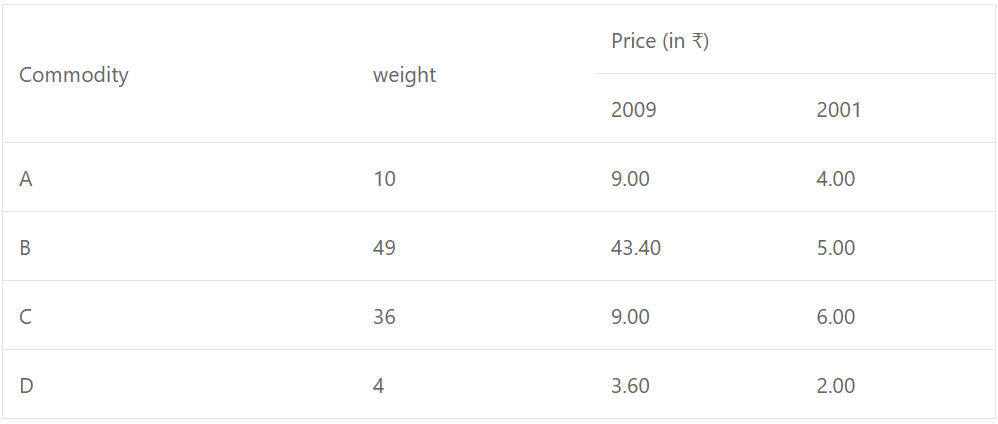
Sol: We construct the table of values is as under :
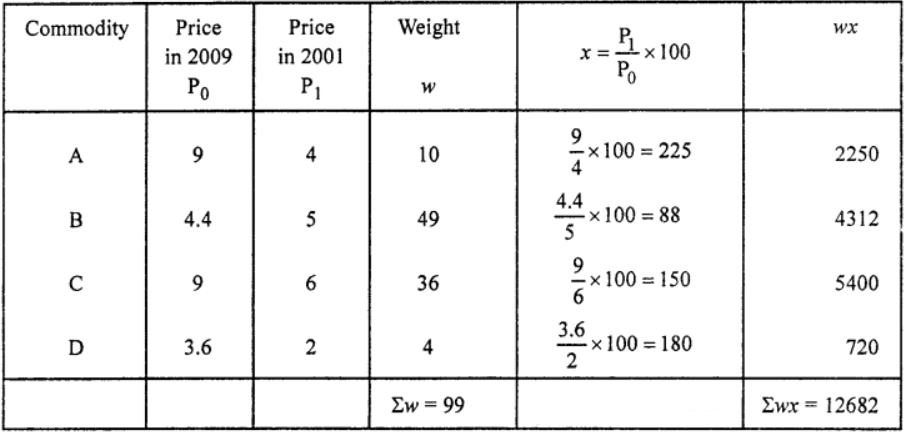
Then weighted average method of price relative,
Index number = Σwx/Σw = 12682/99 = 128.10
–: End of Index Number Class 11 OP Malhotra Exe-30B ISC Maths Ch-30 Solutions. :–
Return to :- OP Malhotra ISC Class-11 S Chand Publication Maths Solutions
Please share with your friends
Thanks