Inequalities Class 11 OP Malhotra Exe-11A ISC Maths Solutions Ch-11 Solutions. In this article you would learn about Inequality Postulates and Graph of a Number. Step by step solutions of latest textbook has been given as latest syllabus. Visit official Website CISCE for detail information about ISC Board Class-11 Mathematics.
Inequalities Class 11 OP Malhotra Exe-11A ISC Maths Solutions Ch-11
| Board | ISC |
| Publications | S Chand |
| Subject | Maths |
| Class | 11th |
| Chapter-11 | Inequalities |
| Writer | O.P. Malhotra |
| Exe-11(A) | Inequality Postulates and Graph of a Number. |
Exercise- 11A
Inequalities Class 11 OP Malhotra Exe-11A Solution.
Que-1: (i) List the solution set of 30 – 4 (2x – 1) < 30, given that x is a positive integer.
(ii) If x is a negative integers, find the solution set of (2/3)+(1/3) (x+1)>0.
Sol: (i) Given 30 – 4 (2x – 1) < 30
⇒ – 4 (2x – 1) < 0 ⇒ (2x – 1) > 0
[if a < b => – a > – b]
⇒ 2x > 1 ⇒ x > but x ∈ N
∴ x = 1, 2, 3
Thus solution set = (1, 2, 3, ……}
(ii) (2/3)+(1/3) (x+1) > 0
(x/3) + > 0
(x/3) > -1
x > (-1) × 3
x > -3
x is a negative integer
Solution set = {- 2, – 1}.
Que-2: P is the solution set of 8x – 1 > 5x + 2 and Q is the solution set of 7x – 2 ≥ 3 (x + 6), where x ∈ N. Find the set P ∩ Q.
Sol: Given 8x – 1 > 5x + 2
⇒ 8x – 5x > 1 + 2
⇒ 3x > 3 ⇒ x > 1
Also x ∈ N
∴ Solution set P = {2, 3, 4, 5, …..}
Given 7x – 2 ≥ 3 (x + 6)
⇒ 7x – 2 ≥ 3x + 18
⇒ 7x – 3x ≥ 18 + 2
⇒ 4x ≥ 20 ⇒ x ≥ 5, x ∈ N
Solution set Q = {x ≥ 5, x ∈ N}
= {5, 6, 7, 8,….}
Thus P ∩ Q = {5, 6, 7, 8, }
Que-3: Find the solution of the inequality
2 ≤ 2p – 3 ≤ 5, p ∈ R Hence, graph the solution set on the number line.
Sol: Given 2 ≤ 2p – 3 ≤ 5
⇒ 2 + 3 ≤ 2p – 3 + 3 ≤ 5 + 3
⇒ 5 ≤ 2p ≤ 8 ⇒ (5/2) ≤ p ≤ 4
∴ solution set = {(5/2) ≤ p ≤ 4, p ∈ R}
= [(5/2), 4]
Solution on real line is represented by dark line between (5/2) and 4.
Further, there are dark dots at (5/2) and 4 indicate that both points are included in solution set.

Que-4: Solve the inequality: 3 – 2x ≥ x – 12, given that x ∈ N.
Sol: Given 3 – 2x ≥ x – 12
⇒ 3 + 12 ≥ 2x + x ⇒ 15 ≥ 3x ⇒ 3x ≤ 15
⇒ x ≤ 5, Also x ∈ N
∴ x = 1, 2, 3, 4, 5
Thus solution set = {1, 2, 3, 4, 5}
Que-5: Find the range of values of x which satisfies {–2*(2/3)} ≤ x + (1/3) < {9*(1/3)}, x ∈ R. Graph these values of x on the number line.
Sol: Given {-2*(2/3)} ≤ x + (1/3) < {9*(1/3)}
⇒ (–8/3) ≤ x + (1/3) < (28/3)
⇒ (–8/3) – (1/3) ≤ x + (1/3) – (1/3) < (28/3) – (1/3)
⇒ -3 ≤ x < 9, but x ∈ R
∴ Solution set = [- 3, 9)
The solution set represented on real line is given as under. There is a dark dot at x = – 3 and hollow dot at 9 indicate that – 3 included in solution set and 9 is not included in solution set.

Que-6: A = {x: – 1 < x ≤ 5, x ∈ R},
B = {x : -4 ≤ x < 3, x ∈ R}.
Represent (i) A ∩ B (ii) A’ ∩ B, on different number lines.
Sol: Given A = {x : – 1 < x ≤ 5, x ∈ R} = (- 1, 5]
and B = {x : – 4 ≤ x < 3, x ∈ R} = [- 4, 3)
∴ A ∩ B = {x : – 1 < x < 3, x ∈ R}
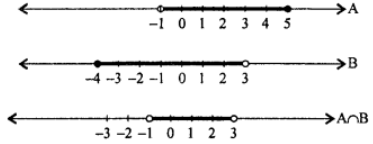
Now A’ = {x : x ≤ – 1 or x > 5, x ∈ R}
= (- ∞, – 1) ∪ (5, ∞)

Thus A’ ∩ B = {x : – 4 ≤ x ≤ -1, X ∈ R} = [-4, -1]

Que-7: Find the range of values of x, which satisfy the inequality :
(−1/5) ≤ (3x/10) + 1 < (2/5); x ∈ R Graph the solution set on the number line.
Sol: Given (–1/5) ≤ (3x/10) + 1 < (2/5)
⇒ (–1/5) – 1 ≤ (3x/10) + 1 < (2/5) – 1
⇒ (–6/5) ≤ (3x/10) < – (3/5)
⇒ (–6/5) × (10/3) ≤ x < – (3/5) × (10/3)
⇒ -4 ≤ x < – 2, x ∈ R
Thus solution set= {x : – 4 ≤ x < – 2, x ∈ R} = [- 4, – 2)
Solution set of given inequality is represented on real line is as under. There is a dark dot at – 4 which indicate that – 4 included in solution set while hollow dot at – 2 included in solution set.

Que-8: Find the range of values of x which satisfy (−1/3) ≤ (x/2) – {1*(1/3)} < (1/6); x ∈ R Graph these values of x on the real number line.
Sol: Given (−1/3) ≤ (x/2) – {1*(1/3)} < (1/6)
⇒ (−1/3) ≤ (x/2) – (4/3) < (1/6)
⇒ (−1/3) + (4/3) ≤ (x/2) – (4/3) + (4/3) < (1/6) + (4/3)
⇒ 1 ≤ (x/2) < (3/2) ⇒ 2 ≤ x < 3
∴ Solution set = {x : 2 ≤ x < 3, x ∈ R} = [2, 3)
Solution set represented on real line is given as under. There is dark dot at 2 and hollow dot at 3 indicates that 2 is included while 3 is not included in solution set.

Que-9: Solve the following inequation, and graph the solution set, on the number line.
2x – 3 < x + 2 ≤ 3x + 5, x ∈ R.
Sol: Solution:
Given 2x – 3 < x + 2 ≤ 3x + 5
Now, 2x – 3 < x + 2 ⇒ 2x – x < 3 + 2
⇒ x < 5 …(1)
and x + 2 ≤ 3x + 5 ⇒ 2 – 5 ≤ 3x – x
⇒ -3 ≤ 2x ⇒ (−3/2) ≤ x …(2)
∴ from (1) and (2) ; we have
Solution set = {x ; (−3/2) ≤ x < 5, x ∈ R}
= [(−3/2) , 5)
Solution set represented on real line is given as under:

here is a dark dot at (−3/2) which indicates that (−3/2) included in solution set whole hollow dot at 5 indicate that 5 is not included in solution set.
Que-10: Solve the inequation on : – 3 ≤ 3 – 2x < 9, x ∈ R.
Sol: Given -3 ≤ 3 – 2x < 9,x ∈ R
Now -3 ≤ 3 – 2x ⇒ 2x ≤ 6 ⇒ x ≤ 3
and 3 – 2x < 9 ⇒ 3 – 9 < 2x ⇒ – 3 < x
∴ Solution set = {x : – 3 < x ≤ 3, x ∈ R} = (-3, 3]
Thus solution set is represented on real line is given as under:

There is a dark dot at 3 indicate that 3 is included in solution set and hollow dot at – 3 indicate that – 3 is not included in solution set.
Que-11: Find the value of x which satisfies the inequation
-2 ≤ (1/2) – (2x/3) ≤ {1*(5/6)}, x ∈ N Graph the solution on a number line.
Sol: Given -2 ≤ (1/2) – (2x/3) ≤ {1*(5/6)}
Now -2 ≤ (1/2) – (2x/3) ⇒ (2x/3) ≤ (1/2) + 2
⇒ (2x/3) ≤ (5/2) ⇒ x ≤ (5/2) × (3/2) ⇒ x ≤ (15/4)
Also (1/2) – (2x/3) ≤ (15/6) ⇒ (1/2) – (2x/3) ≤ (11/6)
⇒ (1/2) – (11/6) ≤ (2x/3) ⇒ – (4/3) ≤ (2x/3)
⇒ x ≥ – (4/3) × (3/2) = -2
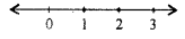
∴ Solution set = {x : -2 ≤ x ≤ 154, x ∈ N} = {1, 2, 3}
Solution set represented on real line is given as under :
Que-12: Write down the range of real values of x for which the inequation x > 3 and -2 ≤ x < 5 are both true.
Sol: The solution set of given inequality x > 3, x ∈ R is given as under :

The solution set of given inequality
-2 ≤ x < 5, x ∈ R represented on real line is given as under :
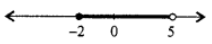
Clearly the common portion of two graphs is the set {x : 3 < x < 5, x ∈ R}
Hence the required range set = {x : x ∈ R, 3 < x < 5} = {3, 5}
Que-13: Solve and graph the solution set of 3x – 4 > 11 or 5 – 2x ≥ 7.
Sol: Given 3x – 4 > 11 ⇒ 3x > 15 ⇒ x > 5
or 5 – 2x ≥ 7 ⇒ -2x ≥ 2 ⇒ x ≤ – 1
∴ Solution set = {x > 5 or x ≤ – 1, x ∈ R}
= (-∞, – 1] ∪ (5, ∞)
This solution set is represented on real line is given as under :
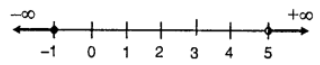
Clearly there is a dark dot at -1 and hence included in solution set while hollow dot at 5 indicates that 5 is not included in solution set.
Que-14: The following diagram represents two inequations A and B on number lines.
(i) Write down A, B and B’ in set builder form.
(ii) Represent A ∩ B and A ∩ B’ on two different number lines.
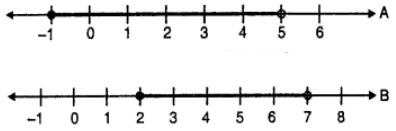
Sol: In A, there is a dark line between – 1 and 5. Here, dark dot at 1 and hollow dot at 5 which shows that – 1 included while 5 is not included in solution set.
∴ A = {x : – 1 ≤ x < 5, x ∈ R} = [- 1, 5)
In B, there is a dark line between 2 and 7. Here dark dot at 2 indicates that 2 is included in solution set while hollow dot at 7 indicates that 7 is not included in solution set.
∴ B = {x : 2 ≤ x < 7, x ∈ R} = [2, 7)
∴ A ∩ B = {x ; 2 ≤ x < 5 ; x ∈ R}
This solution set represented on real line is given as under :

Further B’ = {x ; x < 2 and x ≥ 7}
∴ A ∩ B’ = {x ; – 1 ≤ x < 2, x ∈ R}

Que-15: P is the solution set of 7x – 2 > 4x + 1 and Q is the solution set of (9x – 45) ≥ 5 (x – 5); where x ∈ R. Represent
(i) P ∩ Q
(ii) P – Q,
(iii) P ∩ Q’ on different lines.
Sol: Given inequality be
7x – 2 > 4x + 1 …(1)
⇒ 7x – 4x > 2 + 1 ⇒ 3x > 3 ⇒ x > 1
∴ Solution set of eqn. (1) = P
= {x : x > 1, x ∈ R} = (1, ∞)
Also given another inequality be
9x – 45 ≥ 5 (x – 5) …(2)
⇒ 9x – 45 ≥ 5x – 25
⇒ 9x – 5x ≥ 45 – 25
⇒ 4x ≥ 20 ⇒ x ≥ 5
∴ Solution set Q = {x ; x ≥ 5, x ∈ R}
(i) P ∩ Q = {x : x ≥ 5, x ∈ R}
This solution set represented on real line is given as under:

There is a dark dot at 5 indicates that 5 is included in solution set.
(ii) P – Q = P ∩ Q’
= {x : x > 1, x ∈ R) ∩ {x : x < 5, x ∈ R} = {x : 1 < x < 5, x ∈ R}
The solution set is represented on real line is given as under. There are hollow dots at 1 and 5 shows that 1 and 5 both are not included in solution set.

(iii) Same as (ii) [∵ P ∩ Q’ = P – Q]
Que-16: Solve the following system of inequalities (x ∈ R).
(i) (5x/4) + (3x/8) > (39/8)
{(2x–1)/12} – {(x–1)/3} < {(3x+1)/4}
(ii) 2(2x + 3) – 10 < 6 (x – 2)
{(2x−3)/4} + 6 ≥ 2 + (4x/3)
(iii) -11 ≤ 4x – 3 ≤ 13
Sol: (i) Given (5x/4) + (3x/8) > (39/8)
⇒ (10x+3x)/8 > (39/8)
⇒ 13x > 39 ⇒ x > 3 …(1)
and {(2x−1)/12} – {(x−1)/3} < {(3x+1)/4}
⇒ {2x−1−4(x−1)}/12 < {(3x+1)/4}
⇒ {2x−1−4x+4}/12 < {(3x+1)/4}
The values of x which is common to (1) and (2) be given by x > 3, x ∈ R
∴ Solution set = {x : x > 3, x ∈ R} = (3, ∞)
(ii) Given
2 (2x + 3) – 10 < 6 (x – 2)
⇒ 4x + 6 – 10 < 6x – 12
⇒ 4x – 4 < 6x – 12 ⇒ 6x – 4x > 12 – 4
⇒ 2x > 8 ⇒ x > 4 …(1)
Also, {(2x−3)/4} + 6 ≥ 2 + (4x/3);
Multiply both sides by 12 ; we have
⇒ 3 (2x – 3) + 72 ≥ 24 + 16x
⇒ 6x – 9 + 72 ≥ 24 + 16x
⇒ 63 – 24 ≥ 16x – 6x
⇒ 10x ≤ 39
⇒ x ≤ (39/10) = {3*(9/10)} …(2)
Clearly there is no value of x which is common to (1) and (2).
Hence given system of equalities has no solution.
∴ Solution set = Φ
(vii) Given – 11 ≤ 4x – 3 ≤ 13
⇒ -11 + 3 ≤ 4x – 3 + 3 ≤ 13 + 3
⇒ – 8 ≤ 4x ≤ 16
⇒ -2 ≤ x ≤ 4
⇒ x ∈ [- 2, 4]
∴ Solution set = {x ; – 2 ≤ x ≤, 4, x ∈ R} = [-2,4]
–: End of Inequalities Class 11 OP Malhotra Exe-11A ISC Maths Ch-11 Solutions. :–
Return to :- OP Malhotra ISC Class-11 S Chand Publication Maths Solutions
Thanks
Please share with your friends