Inequalities Class 11 OP Malhotra Exe-11E ISC Maths Solutions Ch-11 Solutions. In this article you would learn about Quadratic Inequalities. Step by step solutions of latest textbook has been given as latest syllabus. Visit official Website CISCE for detail information about ISC Board Class-11 Mathematics.
Inequalities Class 11 OP Malhotra Exe-11E ISC Maths Solutions Ch-11
| Board | ISC |
| Publications | S Chand |
| Subject | Maths |
| Class | 11th |
| Chapter-11 | Inequalities |
| Writer | O.P. Malhotra |
| Exe-11(E) | Quadratic Inequalities. |
Exercise- 11E
Inequalities Class 11 OP Malhotra Exe-11E Solution.
Find the range of x in each of the following inequalities.
Que-1: x² – 4x + 3 < 0.
Sol: x² – 4x + 3 < 0
⇒ (x – 1) (x – 3) < 0
Critical points are given by
x – 1 = 0 and x – 3 = 0
i.e. x = 1, 3
Then by method of intervals, we have
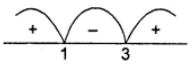
which is the required range.
Que-2: x² + 5x + 4 > 0.
Sol: x² + 5x + 4 > 0 ⇒ (x + 1) (x + 4) = 0
Critical points are given by putting
(x – 1) (x – 4) = 0
i.e. x = – 1, – 4
Then by method of intervals, we have
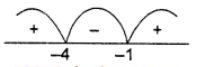
x > – 1 or x < – 4
i.e. x ∈ (- ∞, – 4) u (- 1, ∞)
which is the required range
Que-3: x² + x – 6 ≥ 0.
Sol: x² + x – 6 ≥ 0 ⇒ (x – 2) (x + 3) ≥ 0
Then critical points are given by
(x – 2) (x + 3) = 0
i.e., x = 2, – 3
Then by method of intervals, we have
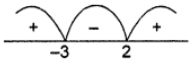
x ≥ 2 or x ≤ – 3
⇒ x ∈ (-∞, – 3] ∪ [2, ∞)
which is the required range.
Que-4: x² – 16 < 0.
Sol: Given x² – 16 < 0 ⇒ x² < 16
⇒ | x | < 4 ⇒ – 4 < x < 4
which is the required range.
[∵ | x | < l ⇒ – l < x <l]
Que-5: x² – 6x + 9 ≥ 0
Sol: x² – 6x + 9 ≥ 0
⇒ (x – 3)² ≥ 0 which is true for all real x
∴ Range = set of all reals
Que-6: – x² + 2x + 3 < 0.
Sol: -x² + 2x + 3 < 0 ⇒ x² – 2x – 3 > 0
⇒ (x + 1) (x- 3) > 0
The critical points are given by
(x + 1) (x – 3) = 0
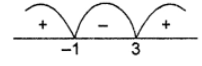
i.e. x = -1, 3
Then by method of intervals, we have
x < – 1 or x > 3
∴ required range is given by
x ∈ (- ∞, – 1) ∪ (3, ∞).
Que-7: 5x < 2 – 3x².
Sol: 5x < 2 – 3x²
⇒ 3x² + 5x – 2 < 0
⇒ (x + 2) (3x – 1) < 0
⇒ 3 (x + 2) (x – (1/3)) < 0
⇒ (x + 2) (x – 13) < 0
Critical points are given by
(x + 2) (x – 13) = 0
i.e. x = -2, 13
Then by method of intervals, we have
x < – 2 or x > 13
which is the required range.
Que-8: – x² – 4x – 5 < 0.
Sol: – x² – 4x – 5 < 0 ⇒ x² + 4x + 5 > 0 [if a < b ⇒ – a > – b]
⇒ x² + 4x + 4 + 1 > 0
⇒ (x + 1 )² + 1 > 0
which is true for all x ∈ R
Thus range = set of all real numbers
Que-9: 4x² + 1 > 4x.
Sol: Given 4x² + 1 > 4x
⇒ 4x² – 4x + 1 > 0 ⇒ (2x – 1)² > 0
which is true for all x ∈ R except x = 1/2
[∵ When x = 1/2 ⇒ 2x – 1 = 0]
∴ required range = R – {1/2}
Que-10: – x² + x > 0.
Sol: -x² + x > 0 ⇒ x² – x < 0 [if a > b ⇒ ac < bc if c < 0]
⇒ x (x – 1) < 0
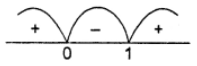
The critical points are given by x (x – 1) = 0
⇒ x = 0, 1
Then by method of intervals, we have
0 < x < 1
∴ Required range is given by x ∈ (0, 1).
Que-11: 6 + x < 2x²
Sol: Given 6 + x < 2² ⇒ 2x² – x – 6 > 0
⇒ (x – 2) (2x + 3) > 0
⇒ 2(x – 2) [x + (3/2)] > 0
Critical points are given by
x – 2 = 0 and x + 3/2 = 0
i.e. x = 2 ,-3/2
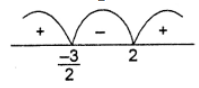
Then by method of intervals, we have
x < – 3/2 or x > 2
which is the required range.
Que-12: (i) (x – 4)(x + 6) > 0 ;
(ii) 3 – 2x² > 5x
Sol: (i) (x – 4) (x + 6) > 0
The critical points are given by
(x – 4)(x + 6) = 0
⇒ x = 4, – 6
Then by method of intervals, we have
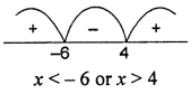
which is the required range.
(ii) Given 3 – 2x² > 5x
⇒ 2x² + 5x – 3 < 0
⇒ (x + 3) (2x – 1) < 0
The critical points are given by
(x + 3) (2x – 1) = 0
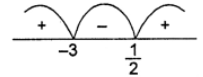
Then by method of intervals, we have
-3 < x < 1/2
Que-13: Find all real values of x which satisfy x² – 3x + 2 > 0 and x² – 3x – 4 ≤ 0.
Sol: Given x² – 3x + 2 > 0
⇒ (x – 1) (x – 2) > 0
Critical points are given by
(x – 1) (x – 2) = 0 ⇒ x = 1, 2
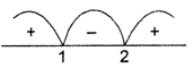
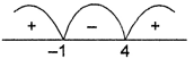
Then by method of intervals, we have
x < 1 or x > 2 …(1)
Also, x² – 3x – 4 ≤ 0
⇒ (x + 1)(x – 4) = 0
Critical points are given by
(x + 1) (x – 4) = 0
⇒ x = -1, 4
Then by method of intervals, we have -1 < x < 4 …(2)
Thus the values of x which satisfies both given inequalities are given by (x < 1 or x > 2) n (- 1 < x < 4)
⇒ – 1 < x < 1 or 2 < x < 4
Que-14: The set of values of x for which the inequalities x² – 3x – 10 < 0, 10x – x² – 16 > 0 hold simultaneously is
(a) (-2, 5)
(b) (2, 8)
(c) (-2,8)
(d) (2, 5).
Sol: Given x² – 3x – 10 < 0
⇒ (x + 2) (x – 5) < 0
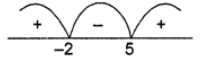
i.e. x = -2,5
Then by method of intervals, we have
– 2 < x < 5 …(1) Also, 10x – x² – 16 > 0
⇒ x² – 10x + 16 < 0
⇒(x – 2) (x – 8) = 0
Then critical points are given by
(x – 2) (x – 8) = 0 ⇒ x = 2, 8
Then by method of intervals, we have
2 < x < 8 …(2)
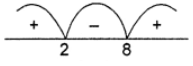
Thus the set of values of x for which the given inequalities hold simultaneously is given by (- 2 < x < 5) ∩ (2 < x < 8)
i.e. 2 < x < 5 ⇒ x ∈ (2, 5) ∴Ans. (d)
Solve the following inequalities :
Que-15: (x+3)/(x−1) > x
Sol:
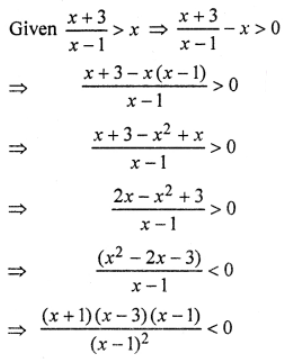
⇒ (x + 1) (x – 3) (x – 1) < 0, x ≠ 1
Critical points are given by
(x + 1)(x – 3)(x – 1) = 0
i.e. x = – 1, 3, 1
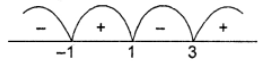
Then by method of intervals we have
x < -1 or 1 < x < 3
Que-16: x + 4 < – 2/(x+1)
Sol: Given x + 4 < – 2/(x+1)
⇒ (x + 4) + {2/(x+1)} < 0
⇒ {(x+4)(x+1)+2}/(x+1) < 0
⇒ (x²+5x+6)/(x+1) < 0
⇒ {(x+2)(x+3)(x+1)}/{(x+1)(x+1)} < 0
⇒ (x + 2)(x + 1)(x + 3) < 0, x ≠ – 1 [∵ (x + 1)² > 0]
Critical points are given by putting
(x + 2) (x + 1) (x + 3) = 0
⇒ x = – 1, – 2, – 3
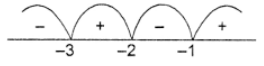
Then by method of intervals, we have
x < – 3 or – 2 < x < – 1
Que-17: (x²−2x+3)/(x²−4x+3) > – 3
Sol: Given : (x²−2x+3)/(x²−4x+3) > – 3
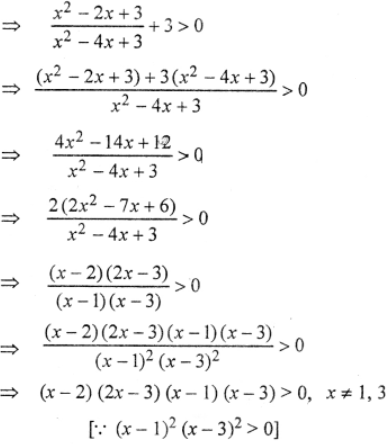
Critical points are given by putting
(x – 2) (2x – 3) (x – 1) (x – 3) = 0
⇒ x = 2, 3/2, 1, 3
Then by method of intervals, we have
x < 1 or 3/2 < x < 2 or x > 3
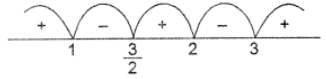
Que-18: (x²+6x−11)/(x+3) < -1.
Sol:
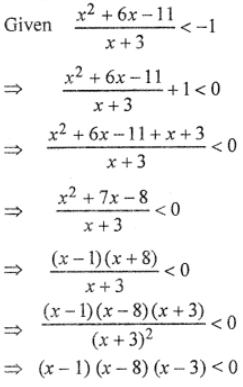
Critical points are given by putting
(x – 1)(x – 8)(x + 3) = 0
⇒ x = 1, 8, – 3
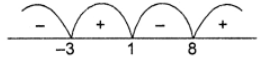
Then by method of intervals, we have
x < – 3 or 1< x < 8
Que-19: (x²−3x+24)/(x²−3x+3) < 4
Sol:
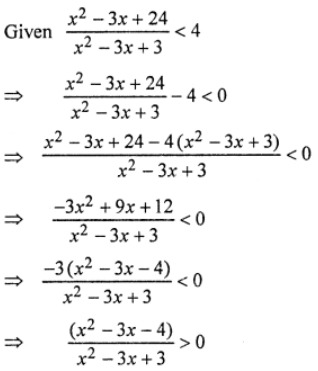
since x2 – 3x + 3 = x2 – 3x + (9/4) + (3/4)
= [x – 3/2]² + (3/4) > 0 ∀ x ∈ R
⇒ x² – 3x – 4 > 0
⇒ (x + 1)(x – 4) > 0
Critical points are given by putting
(x + 1)(x – 4) = 0 ⇒ x = -1, 4
Then by method of intervals, we have
x < – 1 or x > 4
–: End of Inequalities Class 11 OP Malhotra Exe-11E ISC Maths Ch-11 Solutions. :–
Return to :- OP Malhotra ISC Class-11 S Chand Publication Maths Solutions
Thanks
Please share with your friends