Inverse Functions and its Properties Class 12 OP Malhotra Exe-2C ISC Maths Solutions Ch-2. In this article you would learn to solve problems on Inverse Functions and its Properties with answer. Visit official Website CISCE for detail information about ISC Board Class-12 Mathematics.

Inverse Functions and its Properties Class 12 OP Malhotra Exe-2C ISC Maths Solutions Ch-2
| Board | ISC |
| Publications | S Chand |
| Subject | Maths |
| Class | 12th |
| Chapter-2 | Functions |
| Writer | OP Malhotra |
| Exe-2(C) | Inverse Functions and its Properties. |
What are Inverse Functions and its Properties Example and Solutions
Class 12 OP Malhotra Exe-2C ISC Maths Solutions Ch-2
Que-1: (i) If f : R → R is defined by f (x) = 2x + 3, then find f^-1(x).
(ii) If the function f : R → R, defined by f(x) = 3x – 4 is invertible, then find f^-1.
(iii) If f : R → R defined by f(x) = 3x+5/2 is an invertible function, then find f^-1.
Sol: (i) Given f : R → R defined by
f(x) = 2x + 3 ∀x ∈ R
Injectivity : ∀x, y ∈ R s.t f(x) = f(y)
⇒ 2x + 3 = 2y + 3
⇒ 2x = 2y ⇒ x = y
∴ f is one – one.
Surjectivity : Let y∈R be any arbitrary element Then f(x) = y
⇒ 2x + 3 = y ⇒ x = (y−3)/2
Since y ∈ R ⇒ (y−3)/2 ∈ R ⇒ x ∈ R
So ∀x ∈ R ∃ x ∈R s.t
f(x) = f(y−3/2) = 2(y−3/2) + 3 = y
∴ f is onto
Thus f is bijective and f-1 exists.
Let x∈R (codomain) and y∈R (domain)
s.t f(x) = y
⇒ 2x + 3 = y ⇒ x = (y−3)/2
⇒ f^-1(y) = y−3/2
Thus f-1 : R → R defined by
f^-1(x) = y−3/2 ∀x∈R
(ii) Given f : R → R defined by
f(x) = 3x – 4 ∀x∈R
one – one : ∀x, y∈R s.t f(x) = f(y)
⇒ 3x – 4 = 3y – 4
⇒ 3x = 3y ⇒ x = y
∴ f is one – one.
onto : Let y∈R be any arbitrary element Then f(x) = y
⇒ 3x – 4 = y ⇒ x = y+3/3
as y∈R ⇒ y+3/2 ∈ R ⇒ x ∈ R
So ∀x∈R ∃ x ∈R s.t
f(x) = f(y+4/3)=3(y+4/3) – 4 = y
∴ f is onto
Thus f is one-one, onto and hence f is bijective and thus f-1 exists.
Now, Let x∈R and y∈R (codomain)
s.t f(x) = y
⇒ 3x – 4= y ⇒ x = y+4/2
⇒ f^-1 = y+4/3
Thus, f^-1(x) = y+4/3 ∀x∈R
(iii) Given f: R → R defined by 3x + 5
f(x) = 3x+52 is mvertible
∴ f-1 exists and f is one-one onto.
∀y∈R (codomain) ∃ x ∈R (domain)
s.t y = f(x)
⇒ y = 3x+5/2 ⇒ 3x = 2y – 5
⇒ x = 2y−5/3
⇒ f^-1(y) = 2y−5/3
∴ f^-1(x) = 2y−5/3 ∀x∈R
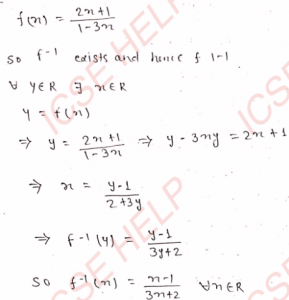
Que-2: Let the function f which is invertible be defined by f(x) = 2x+1/1−3x, then show that f-1(x) = x−1/3x+2.
Sol:
Que-3: If f : R → R is invertible and is defined as f(x) = (1 – x)^1/3, then find f-1(x).
Sol: Given f : R → R is invertible and defined as f(x) = (1 – x)^1/3
Thus, f-1 exists ⇒ f is 1-1 and onto.
∀y∈R (codomain) ∃ x∈R (domain)
s.t y = f(x)
⇒ y = (1 – x)^1/3
⇒ y³ = 1 – x ⇒ x = 1 – y³
⇒ f^-1(y) = 1 – y³
⇒ f^-1(x) = 1 – x³ ∀x ∈R
Que-4: If f(x) = [4 – (x – 7)³]1/5, is a real invertible function, then find f-1(x).
Sol: Given f(x) = [4 – (x – 7)³]^1/5 and real invertible function
∴ f^-1 exists and f is one-one and onto.
∀y∈R (codomain) ∃ x∈R (domain)
s.t y = f(x)
⇒ y = f(x) = [4 – (x – 7)³]^1/5
⇒ y^5 = 4 – (x – 7)³
⇒ (x – 7)³ = 4 – y^5
⇒ x – 7 = 3√4-y^5
⇒ x – 7 = 3√4-y^5
⇒ x = 7+3√4-x^5
⇒ x = 7+3√4-x^5
Que-5: If f : N → Y is a function defined by f(x) = 4x + 3 where
Y = {y ∈ N : y = 4x + 3 for some x∈N}, then, find the inverse of f.
Sol: Given f : N → Y be a function defined by f(x) = 4x + 3 ∀x∈R
where Y = {y ∈ N : y = 4x + 3 for some x∈N}
= {7, 11, 15, 19, …. ∞}
one – one : ∀x y ∈N s.t f(x) = f(y)
⇒ 4x + 3 = 4y + 3
⇒ x = y
∴ f is one – one.
onto : Let y∈4 be any arbitrary element then f(x) = y
4x + 3 = y ⇒ x = y−3/4
as y ∈ Y ⇒ y−34 ∈ N ⇒ x∈N
So ∀y∈Y ∃ x∈N s.t
f(x) = f(y−3/4)=4(y−3/4) + 3 = y
∴ f is onto.
H ence, f is one – one, onto and f-1 exists.
Let x∈N and y∈Y s.t. f(x) = y
⇒ 4x + 3 = y
⇒ x = y−3/4⇒f−1(y)=y−3/4
∴ f-1(x) = x−3/4
Que-6: If f : R → R is defined by f(x) = x³, then find f^-1(8).
Sol: Given f : R → R defined by f (x) = x³ ∀x∈R
one – one : ∀x y∈R s.t f(x) = f(y)
⇒ x³ = y³
⇒ (x – y) (x² + xy + y²) = 0
⇒ x – y = 0
[∵ x² + xy + y² 0 ∀x, y∈R
∴ f is one – one
onto : Let y∈R be any arbitrary element then f(x) = y
x³ = y ⇒ x = 3√y
as y∈R ⇒ 3√y ∈R ⇒ x∈R
∀y∈R ∃ x∈R
s.t f(x) = f (3√y) = (3√y)³ = y
∴ f is onto.
Thus, f is one – one, onto
∴ f-1 exists.
Let x∈R (domain) and y∈R (codomain
s.t. f(x) = y
⇒ x³ = y ⇒ x = y^1/3
⇒ f-1(y) = y^1/3
⇒ f-1(8) = 8^1/3 = 2
Que-7: If f : R → R is defined by f(x) = |x|, then
(a) f^-1(x) = – x
(b) f^-1(x) = 1/|x|
(c) f^-1(x) does not exist
(d) f^-1(x) = 1/x
Sol: Given f: R → R is defined by
f(x) = |x| ∀x∈R
Since f(1) = 1 ; f(-1) = |- 1| = 1
so elements 1 and – 1 have same image 1 under f so different elements in R (domain) has same image in R (codomain)
∴ f is many one function
∴ f is not one – one. Thus f^-1 does not exists.
Que-8: Consider f : R → R given by
f(x) = 4x + 3. Show that it is invertible. Find the inverse of f.
Sol: Given f : R → R defined by f(x) = 4x + 3 ∀x∈R
one – one : ∀x y∈R s.t f(x) = f(y)
⇒ 4x + 3 = 4y + 3
⇒ 4x = 4y ⇒ x = y
∴ f is one – one
onto : Let y∈R be any arbitraiy element then f(x) = y
4x + 3 = y ⇒ x = y−3/4
as y∈R ⇒ x = y−3/4 ∈R ⇒ x ∈ R
So ∀y∈R ∃ x∈R s.t
f(x) = f(y−3/4)=4(y−3/4) + 3 = y
∴ f is onto.
Thus, f is one – one, onto and hence, f is invertible.
Since f(x) = y
⇒ 4x + 3 = y ⇒ x = y−3/4
⇒ f-1(y) =y−3/4
⇒ f-1(x) = x−3/4
Que-9: Show that f : [- 1, 1] → R, given by f(x) = x/x+2 is one-one. Find the inverse of the function f : [- 1, 1] → Range f.
Sol: Given f : [- 1, 1] → R, defined by
f(x) = x/x+2, x ≠ – 2
∀x, y∈[-1, 1] s.t f(x) = f(y)
⇒ x/x+2=y/y+2
⇒ xy + 2x = xy + 2y ⇒ x = y
∴ f is one – one.
Now f : [- 1, 1] → Range f
Here codomain of f = Range of f
∴ f is onto
∴ f is one – one and onto
∴ f^-1 exists
Let x ∈ [-1, 1] and y∈Rf s.t. f(x) = y
⇒ x/x+2 = y ⇒ x = xy + 2y
⇒ x(1 – y)= 2y ⇒ x = 2y/1−y, y ≠ 1
⇒ f-1(y) = 2y/1−y , y ≠ 1
⇒ f-1(x) = 2x/1−x, x ≠ 1
Que-10: Let A = R – {2} and B = R – {1}. If A → B is a function defined by f(x) = x−1/x−2, then show that f is one-one and onto. Hence, find f^-1.
Sol: Given A = R – {2} and B = R – {1} and f be a function from A to B defined by f(x) = x−1/x−2, x∈R
one – one : ∀x, y∈A = R – {2} s.t f(x) = f(y)
⇒ x−1/x−2=y−1/y−2
⇒ (x – 1) (y – 2) = (y – 1) (x – 2)
⇒ xy – 2x – y + 2 = xy – 2y – x + 2
⇒ – x = – y
⇒ x = y
∴f is one – one.
onto : Let y ∈ B = R – {1} be any arbitrary element
i.e. y ≠ 1 Then f(x) = y
x-1/x-2 = y => x-1 = xy-2y
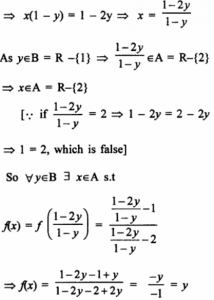
∴ f is onto.
Thus, f is one – one, onto
∴ f is invertible and f-1 exists.
Let f(x) = y
⇒ x−1/x−2 = y ⇒ x = (1−2)/y1−y
⇒ f−1(y) = (1−2y)/(1−y) = (2y−1)/(y−1)
Thus, f^-1 : B → A is defined by
f^−1(x) = (2x−1)/(x−1) ∀ x ∈ B
Que-11: Show that the function f in
A = R – {2/3} defined as f(x) = ΔL/L is one-one and onto. Hence, find f^-1..
Sol: Given f : A → R defined by
f(x) = 4x+3/6x−4∀x∈A
where A = R – {2/3}
one – one : ∀x, y∈A s.t f(x) = f(y)
⇒ 4x+3/6x−4 = 4y+3/6y−4
⇒ (4x + 3) (6y – 4) = (4y + 3)(6x – 4)
⇒ 24xy – 16x + 18y – 12 = 24xy – 16y + 18x – 12
⇒ 34y = 34x ⇒ y = x
⇒ x = y
∴ f is one – one.
onto : Let y∈R be any arbitrary element Then f(x) = y
4x+3/6x-4 = y=> 4x+3 = 6xy – 4y
x(4-6y) = -4y-3
x = 4y+3/6y-4
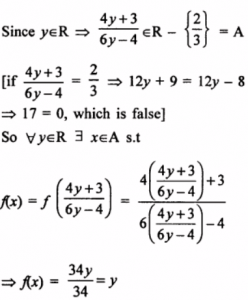
∴ f is onto.
Thus, f is one – one and onto and hence f^-1 exists.
Let f(x) = y
⇒ 4x+3/6x−4=y⇒x=4y+3/6y−4
⇒ f^-1 = 4y+3/6y−4
Thus f^-1 : R → A is defined
f^-1 = 4y+3/6y−4 ∀ x∈R
Que-12: Consider f : R+ → [4, ∞) given by f(x) = x² + 4. Show that f is invertible with the inverse f^-1 of f given by f-1(y) = √y-4, where R, is the set of all non-negative numbers.
Sol: f : R+ → [4, ∞] defined by
f(x) = x² + 4 ∀x∈R+
∀x, y∈R such that f (x) = f(y)
⇒ x² + 4 = y² + 4
⇒ x² = y²
⇒ x = y [∵ x, y∈R+]
∴ f is one-one function.
Let y ∈ [4, ∞) and y = f(x0)
then y = x0² + 4 ⇒ x0 = √y-4 (∵ x ∈ R+; x0 ≥ 0)
as y ∈ [4, ∞) ⇒ √y-4 ∈ R+ ⇒ x0 ∈ R+ [∵ y ≥ 4 ⇒ y – 4 ≥ 0]
Now f(x0) = x0² + 4 = (√y-4)² + 4 = y
∴ ∀y ∈ [4, ∞) ∃ x0 ∈ R+ s.t.f(x0) = y
∴ f is onto.
Thus f is 1-1, onto
∴ f^-1 exists.
Now x = f^-1(y) then y = f(x) = x² + 4
⇒ x = (√y-4) (∵x ∈ R+)
⇒ f^-1(y) = √y-4
⇒ f^-1(y) = √y-4, ∀y ∈ [4, ∞)
Que-13: Let f : R → R : f(x) = 10x + 7. Find the function g : R → R such that gof = fog = Ig.
Sol: Given f : R → R defined by f(x) = 10x + 7.
Since gof = fog = IR
∴ f and g are inverses of each other.
∴ f-1 = f and g-1 = f
one – one : ∀ x y∈R s.t f(x) = f(y)
⇒ 10x + 7 = 10y + 7
⇒ 10x = 10y ⇒ x = y
∴ f is one – one.
onto : Le y∈R be any arbitrary element Then
f(x) = y
⇒ 10x + 7 = y ⇒ x = y−7/10
Since y ∈ R ⇒ y−7/10 ∈R ⇒ ∈R
So ∀y∈R ∃ X∈R s.t
f(x) = f(y−7/10)=10(y−7/10) + 7 = y
∴ f is onto.
Thus, f is one – one and onto and hence f-1 exists.
Since f(x) = y ⇒ 10x + 7 = y
⇒ x = y−7/10
⇒ f-1(y) = y−7/10⇒g(y)=y−7/10
∴ g : R → R is defined by
g(x) = y−7/10 ∀x∈R
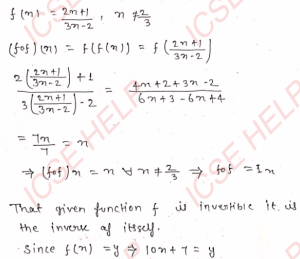
Que-14: Show that the inverse function of the function f whose rule is f(x) = 2x+1/3x−2,x≠23 is f it self.
Sol:
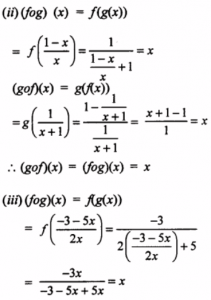
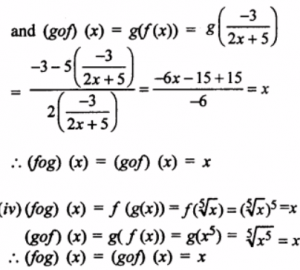
Que-15: Use composition to show that f and g are inverse of each other.
(i) f(x) = 2x – 6, g(x) = x/2 + 3
(ii) f(x) = 1/x+1, g(x) = 1−x/x
(iii) f(x) = −3/2x+5, g(x) = −3−5x/2x
(iv) f(x) = x^5, g(x) = √5x
Sol: (i) Given f(x) = 2x – 6, g(x) = x/2 + 3
Now (fog) (x) = f(g(x)) = f(x/2 + 3)
= 2(x2 + 3) – 6 = x
gof(x) = g(f(x)) = g(2x – 6) = 2x−6/2 + 3
= x – 3 + 3 = x
(fog)(x) = gof(x) = x
Hence, f and g are inverses of each other.
–: End of Inverse Functions and its Properties Class 12 OP Malhotra Exe-2C ISC Maths Solutions :–
Return to :- OP Malhotra ISC Class-12 S Chand Publication Maths Solutions
Please share with your friends
Thanks