Laws of Motion Class-9 Exe-3E MCQs Concise Physics ICSE Selina Solutions Ch-3. In this article you would learn to solve MCQs on Gravitation. Visit official Website CISCE for detail information about ICSE Board Class-9.
Laws of Motion Class-9 Exe-3E MCQs Concise Physics ICSE Selina Solutions Ch-3
| Board | ICSE |
| Class | 9th |
| Subject | Physics |
| Writer / Publication | Concise Selina Publishers |
| Chapter-3 | Laws of Motion |
| Exe – 3E | Gravitation |
| Topics | Solution of Exe-3(E) MCQs Type |
| Academic Session | 2025-2026 |
Gravitation
Laws of Motion Class-9 Exe-3E MCQs Concise Physics ICSE Selina Solutions Ch-3
Page 87 (Choose the correct answer from the options given below).
Que-1: The gravitational force between two bodies is —
(a) always repulsive
(b) always attractive
(c) attractive only at large distances
(d) repulsive only at large distances.
Ans: (b) always attractive
Hint- The force of attraction between between two particles because of their masses, is called the gravitational force of attraction. Hence, the gravitational force between two bodies is always attractive.
Que-2: The gravitational force of attraction between two particles is because of :
(a) their masses
(b) their shapes
(c) their sizes
(d) none of these
Ans: (a) their masses
Hint- Each mass particle of the universe attracts other mass particles. The force of attraction between two particles because of their masses, is called gravitational force of attraction
Que-3: The law of gravitation was given by :
(a) Thomas Alva Edison
(b) Alexander Graham Bell
(c) Sir Isaac Newton
(d) Albert Einstein
Ans: (c) Sir Isaac Newton
Hint- For the magnitude of gravitational force of attraction, Sir Isaac Newton gave a law, known as the law of gravitation.
Que-4: The forces of attraction acting between two bodies is :
(a) directly proportional to the product of their masses
(b) directly proportional to the square of the distance between them
(c) inversely proportional to the square of the distance between them
(d) both (a) and (c)
Ans: (d) both (a) and (c)
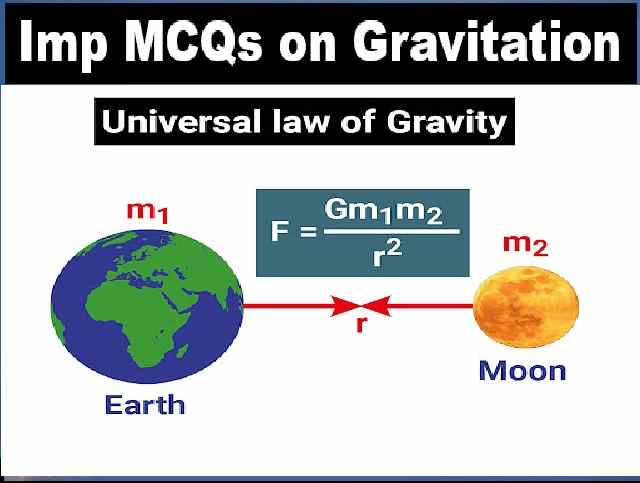
Hint- According to Newton, the force of attraction acting between two bodies is :
directly proportional to the product of their masses.
inversely proportional to the square of the distance between them.
Hence, we get, F = Gm1m2/r²
Que-5: The value of gravitational constant G depends on :
(a) the nature of the particle
(b) the temperature of the particle
(c) medium
(d) none of these
Ans: (d) none of these
Hint- The value of gravitational constant G remains same at all places, and is independent of the nature of particle, temperature, medium, etc.
Que-6: The Value of G is :
(a) 9.8 Nm² kg-²
(b) 6.7 x 10-¹¹ Nm² kg-²
(c) 6.7 x 10-¹¹ ms-²
(d) 6.7 N kg-¹
Ans: (b) 6.7 x 10-¹¹ Nm² kg-²
Page 88
Que-7: The value of gravitational constant G changes with the change in :
(a) height
(b) place
(c) distance
(d) it remains unchanged
Ans: (d) it remains unchanged
Hint- The value of gravitational constant G remains same at all places, and is independent of height, place, distance, etc.
Que-8: The gravitational force between two masses is :
(a) directly proportional to the product of the masses
(b) inversely proportional to the square of the separation between them
(c) significant between heavenly bodies, but is insignificant between atomic bodies.
(d) all of the above
Ans: (d) all of the above
Hint- The gravitational force between two masses is :
is always attractive
directly proportional to the product of the masses
inversely proportional to the square of the separation between them
significant between heavenly bodies, but is insignificant between atomic bodies because of small magnitude of G.
Que-9: The force of attraction between two masses each of 1 kg kept at a separation of 1 m is:
(a) 9.8 N
(b) 6.7 N
(c) 980 N
(d) 6.7 x 10-¹¹ N
Ans: (d) 6.7 x 10-¹¹ N
Que-10: The gravitational force of attraction between two bodies of masses 60 kg and 40 kg separated by a distance 10 m is : (where G = 6.7 x 10⁻¹¹ Nm2kg-2 )
(a) 1.60 x 10⁻⁹ N
(b) 2.8 x 10⁻¹¹ N
(c) 1.0 x 10⁻¹¹ N
(d) 1.6 x 10⁻¹¹ N
Ans: (a) 1.60 x 10⁻⁹ N
Que-11: The S.I. unit of g is :
(a) ms-1
(b) ms-2
(c) cm s-1
(d) cm s-2
Ans: (b) ms-2
Que-12: The relationship between g and G is:
(a) g = GMm/R²
(b) G = gm/R²
(c) g = GM/R²
(d) G = MR²/g
Ans: (c) g = GM/R²
Que-13: The value of g on a planet depends on :
(a) the mass of the planet
(b) the radius of the planet
(c) both (a) and (b)
(d) composition of the planet
Ans: (c) both (a) and (b)
Que-14: A body is projected vertically upward with an initial velocity u. If acceleration due to gravity is g, the time for which it remains in air, is —
(a) u/g
(b) ug
(c) 2u/g
(d) u/2g
Ans: (c) 2u/g
Que-15: An object falling freely from rest reaches ground in 2 s. If acceleration due to gravity is 9.8 m s-2 , the velocity of the object on reaching the ground will be —
(a) 9.8 m s-1
(b) 4.9 m s-1
(c) 19.6 m s-1
(d) Zero
Ans: (c) 19.6 m s-1
Hint- As we know,
Velocity of the object = g x t
Given,
u = 0,
g = 9.8 m s-2
t = 2 s
v = u + gt
Substituting the values in the formula above, we get,
Velocity of the object = 0 + 9.8 x 2 = 19.6 m s-1
Que-16: The body of mass 25 kg is taken from the earth to the moon. If the value of g on moon is 1.6 ms-2 then the weight of the body on moon is :
(a) 50 N
(b) 100 N
(c) 40 N
(d) 60 N
Ans: (c) 40 N
Hint- As we know,
Weight (W) = mass (m) x acceleration due to gravity (g)
Given,
mass = 25 kg
g on moon = 1.6 ms-2
Wm = ?
Substituting the values, we get,
Wm = 25 x 1.6 = 40 N
Hence, weight of body on moon = 40 N.
Que-17: The relationship between weight and mass is :
(a) W = m
(b) W = mG
(c) W = mg
(d) m = Wg
Ans: (c) W = mg
Hint- The weight of the body is related to the mass as follows :
Weight = mass x acceleration due to gravity or W = mg
Que-18: The S.I. unit of weight is :
(a) kg
(b) Joule
(c) Newton
(d) dyne
Ans: (c) Newton
Hint- The weight of a body is the force with which the earth attracts it. In other words, weight of a body is the force of gravity on it.
Weight is a vector quantity. It’s direction is downwards towards the centre of the earth.
S.I. unit of weight is Newton (N).
Que-19: The mass of a body :
(a) changes with a change of place
(b) changes with direction
(c) changes when the velocity of the body is close to the velocity of light
(d) none of these
Ans: (c) changes when the velocity of the body is close to the velocity of light
Hint- The mass of a body increases with its velocity but this change is perceptible only when the velocity of the body v becomes more than 106 ms-1 i.e., reaches close to the speed of light c = (3 x 10⁸ ms-1), so for a body moving with velocity less than 106 ms-1, its mass is taken to be constant.
— : End of Laws of Motion Class-9 Exe-3E MCQs Concise Physics ICSE Selina Solutions Ch-3 :–
Return to:– Concise Selina Physics ICSE Class-9 Solutions
Thanks
Please share with your friends