Laws of Motion Exe-3C MCQs Concise Physics ICSE Selina Solutions Ch-3. In this article you would learn to solve the questions on Linear Momentum Newton’s Second Law. Visit official Website CISCE for detail information about ICSE Board Class-9 Physics.
Laws of Motion Exe-3C MCQs Concise Physics ICSE Selina Solutions Ch-3
| Board | ICSE |
| Class | 9th |
| Subject | Physics |
| Writer / Publication | Concise Selina Publishers |
| Chapter-3 | Laws of Motion |
| Exe – 3C | Linear Momentum Newton’s Second Law |
| Topics | Solution of Exe-3(C) MCQs Type |
| Academic Session | 2025-2026 |
Linear Momentum Newton’s Second Law
Laws of Motion Exe-3C MCQs Concise Physics ICSE Selina Solutions Ch-3
Page 75 (Choose the correct answer from the options given below).
Que-1: The force needed to stop a moving body in a definite time depends on :
(a) mass of the body
(b) velocity of the body
(c) both (a) and (b)
(da) none of these
Ans: (c) both (a) and (b)
Hint- The force needed to stop a moving body in a definite time depends on the product of mass and velocity, which is called linear momentum of the moving body. Thus, p = mv.
Page 76
Que-2: The linear of a body of mass m moving with velocity v is :
(a) v/m
(b) m/v
(c) mv
(d) 1/mv
Ans: (c) mv
Que-3: The unit of linear momentum is :
(a) N s
(a) kg ms-²
(a) N s-¹
(a) kg² ms-¹
Ans: (a) N s
Que-4: Linear momentum is a :
(a) scalar quantity
(b) vector quantity
(c) directionless quantity
(d) none of these
Ans: (b) vector quantity
Hint- Linear momentum is a vector quantity in the direction of the motion of the body (i.e., along the velocity of the body).
Que-5: Newton’s first law of motion defines force :
(a) quantitatively
(b) qualitatively
(c) both (a) and (b)
(d) none of these
Ans: (b) qualitatively
Hint- Newton’s first law of motion defines force only qualitatively. A force is that physical cause which changes the state of motion of a body when it is applied on it. It means that force produces acceleration in the body.
Que-6: According to Newton’s second law, the acceleration produced in a body is :
(a) inversely proportional to the force applied on it
(b) directly proportional to the force applied on it
(c) not dependent on force
(d) none of these
Ans: (b) directly proportional to the force applied on it
Hint- Experimentally, Newton found that the acceleration produced in a body is directly proportional to the force applied on it.
Que-7: The correct form of Newton’s second law is —
(a) F = Δp/Δt
(b) F = m(Δv/Δt)
(c) F = v(Δm/Δt)
(d) F = mv
Ans: (a) F = Δp/Δt
Que-8: The mathematical expression of Newton’s second law of motion is :
(a) F = m x v
(b) F = m x a
(c) F = pv
(d) F = m/a
Ans: (b) F = m x a
Que-9: For a given force F, the graph plotted for acceleration against mass is:
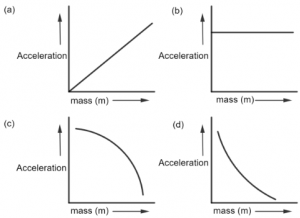
Ans: Option (d) is correct
Que-10: The acceleration produced in a body by a force of given magnitude depends on —
(a) size of the body
(b) shape of the body
(c) mass of the body
(d) None of these
Ans: (c) mass of the body
Hint- As we know,
Force (f) = mass (m) x acceleration (a)
Hence, acceleration produced in a body by a force of given magnitude depends on mass of the body.
Que-11: The S.I. unit of force is :
(a) dyne
(b) g cm s-²
(c) newton
(d) joule
Ans: (c) newton
Que-12: 1 Newton is equal to :
(a) 103 dyne
(b) 108 dyne
(c) 1010 dyne
(d) 105 dyne
Ans: (d) 105 dyne
Hint-
1 newton = 1 kg x 1 ms-2
= 1000 g x 100 cms-2
= 105 g x cms-2
= 105 dyne.
Thus, 1 N = 105 dyne.
Que-13: The force required to produce an acceleration of 5 ms-2 in a body of mass 2 kg is :
(a) 2.5 N
(b) 20 N
(c) 10 N
(d) 25 N
Ans: (c) 10 N
Hint : Given, a = 5 ms-2 and m = 2 kg
Using, F = ma
we get, F = 5 x 2 = 10 N
Hence, force required = 10 N
Que-14: According to Newton’s second law of motion, the change in momentum takes place in a direction :
(a) opposite to the direction of force applied
(b) perpendicular to the direction of the force applied
(c) similar to the direction of the force applied
(d) none of these
Ans: (c) similar to the direction of the force applied
Hint- According to Newton’s second law of motion, the rate of change of momentum of a body is directly proportional to the force applied on it and the change in momentum takes place in the direction in which the force is applied.
Que-15: For a relation F = mΔv/Δt to hold true, the condition(s) necessary is/are:
(a) velocities are equal to the velocity of light
(b) velocities are much smaller than the velocity of light
(c) mass remains constant
(d) both (b) and (c)
Ans: (d) both (b) and (c)
Que-16: Two balls of masses 4m and 8m are in motion with velocities 2v and v respectively. The ratio of their momentum would be :
(a) 2 : 1
(b) 1 : 2
(c) 1 : 1
(d) 1 : 4
Ans: (c) 1 : 1
— : End of Laws of Motion Exe-3C MCQs Concise Physics ICSE Selina Solutions Ch-3 :–
Return to:- Concise Selina Physics ICSE Class-9 Solutions
Thanks
Please share with your friends