Long Answer Questions on Light Class 6 Concise Physics ICSE Solutions Chapter-5. In this article you would learn how to solve long answer type question on Light. Visit official Website CISCE for detail information about ICSE Board Class-6.
Long Answer Questions on Light Class 6 Concise Physics ICSE Solutions
| Board | ICSE |
| Publications | Selina Publication |
| Subject | Physics |
| Class | 6th |
| Chapter-5 | Light |
| Book Name | Concise |
| Topics | Solution of Long Answer Type |
| Academic Session | 2025-2026 |
Long Answer Type Questions on Light
Que-1: Explain the difference between a transparent, a translucent and an opaque medium. Give two examples of each.
Ans-
| Transparent Medium | Translucent Medium | Opaque Medium | |
|---|---|---|---|
| (i) | A medium is said to be transparent if light passes through it easily. | A medium is said to be translucent if it allows only a part of light to pass through it. | A medium is said to be opaque if it does not allow any light to pass through it. |
| (ii) | The object can be distinctly seen across a transparent medium. | The details of an object cannot be distinctly seen through a translucent medium, but only a faint impression is seen. | The object cannot be seen through an opaque medium. |
| (iii) | Example : glass, water. | Example : ground glass, tracing paper. | Example : wooden screen, metallic sheets. |
Que-2: Describe an experiment to show that light travels in a straight line path.
Ans- Experiment : Place a lighted candle on a table. Take a drinking straw. Close one eye and look at the candle flame through the straw from the other eye. The flame is clearly visible.
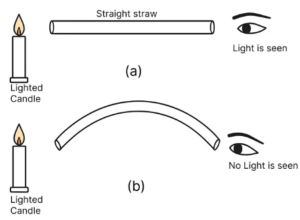
Now, bend the straw in the middle and again look at the candle flame through the straw. The flame is not visible now. The reason is that light travels in a straight line path. When the straw is bent, the light of the candle flame does not reach our eye.
Conclusion : Light travels in a straight line path.
Que-3: What is a pin hole camera? Draw a neat and labelled diagram to show the formation of image of a lighted candle by it.
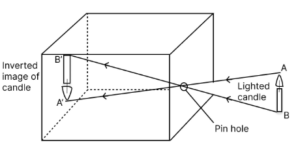
Ans- A pin hole camera is a simple camera without a lens that uses a tiny hole to project an inverted image of an object onto a screen or surface inside a dark box. It works on the principle of rectilinear propagation of light.
Below is a labelled diagram of pin hole camera to show how it works :
Que-4: Explain the formation of image of a luminous object in a pin hole camera with the aid of a neat diagram.
Ans- Working and formation of image : If a luminous object AB, such as a lighted candle, is placed in front of the pin hole, an inverted picture A’B’ of the candle is obtained on the tracing paper. This picture A’B’ is called the image. The image obtained is upside down (i.e. inverted). The reason is that light travels in a straight line path. Hence, light from the upper point A of the candle passes through the pin hole and strikes the tracing paper at A’. Similarly, light from the lower point B of the candle passes through the pin hole and strikes the tracing paper (or screen) at B’. Light rays from all the other points between A and B, on passing through the pin hole strike the tracing paper in between A’ and B’. As a result, an inverted image of the candle is seen on the tracing paper.
Below figure shows the simple ray diagram for the formation of image :
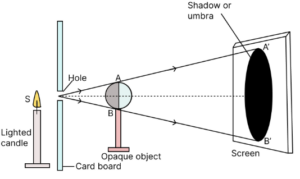
Que-5: Draw a ray diagram to show the formation of shadow of an opaque object by a point source of light. How is the size of shadow affected if the screen is moved away from the object?
Ans- Below ray diagram shows the formation of shadow of an opaque object by a point source of light :
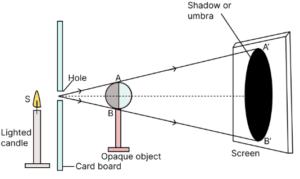
If the screen is moved away from the object the size of shadow increases, this happens because the light rays continue to diverge after passing the edges of the object.
Que-6: Draw a ray diagram to show the formation of umbra alone.
Ans- Below is the ray diagram to show the formation of umbra alone :
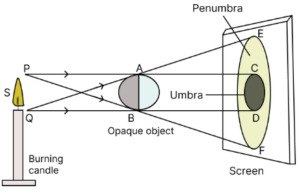
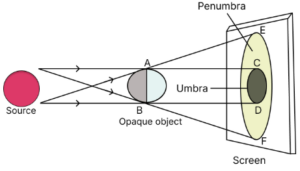
Que-7: Draw a ray diagram to show the formation of umbra and penumbra both. Label the parts umbra and penumbra in your diagram.
Ans- Below is the ray diagram to show the formation of umbra and penumbra both :
Que-8: State the conditions when only the penumbra of an opaque object is obtained on the screen.
Ans- Only the penumbra of an opaque object is obtained on the screen under the following conditions:
(i) The light source is large : When the source of light has a considerable size (not a point source), different parts of the source are partially blocked by the object. This produces only a partially shaded region.
(ii) The screen is placed in such a position that the umbra does not reach it: If the screen is kept beyond the region where the full shadow forms, only the partial shadow falls on the screen.
(iii) The opaque object is very small compared to the light source: If the object is much smaller than the extended light source, it cannot completely block the light to form an umbra, so only penumbra is formed.
In short, only penumbra is formed when light from an extended source is only partially blocked and no region receives complete obstruction of light.
Que-9: In each of the following diagrams, draw rays to form umbra and penumbra on the screen.
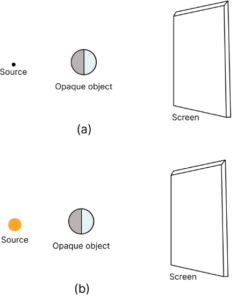
Ans- (a)
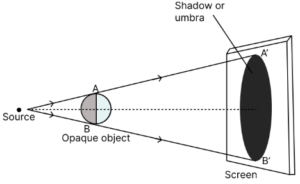
(b)
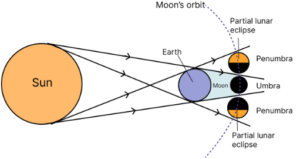
Que-10: Draw a diagram to show the formation of lunar eclipse.
Ans- Diagram showing the formation of lunar eclipse is given below:
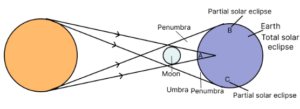
Que-11: Draw a diagram to show the formation of solar eclipse.
Ans- Diagram showing the formation of solar eclipse is given below :
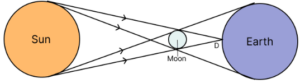
Que-12: What is annular solar eclipse? Draw a labelled diagram to show its formation.
Ans- An annular solar eclipse occurs when the Moon passes between the Sun and the Earth but the Moon is too far from Earth to completely cover the Sun. Because the Moon appears smaller at that time, it blocks only the central part of the Sun, leaving a bright circular ring of sunlight visible around it. This bright ring is called the “ring of fire.”
The formation of annular solar eclipse is shown in below figure :
— : End of Long Answer Questions on Light Class 6 Concise Physics ICSE Solutions :–
Return to:- ICSE Class-6 Concise Selina Solutions
Please, Share with your friends
thanks