Long Answer Questions on Matter Class 6 Concise Physics ICSE Solutions Ch-1. In this article you would learn how to solve Long Answer Question on Matter . Visit official Website CISCE for detail information about ICSE Board Class-6.
Long Answer Questions on Matter Class 6 Concise Physics ICSE Solutions
| Board | ICSE |
| Publications | Selina Publication |
| Subject | Physics |
| Class | 6th |
| Chapter-1 | Matter |
| Book Name | Concise |
| Topics | Solution of Long Answer Type |
| Academic Session | 2025-2026 |
Long Answer Questions on Matter
Que-1: Describe a simple experiment to illustrate the existence of inter-molecular spacing.
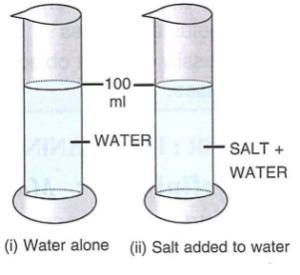
Ans- Experiment : Take 100 ml of water in a measuring cylinder. Add 20 gram of salt in water gently and stir it well so as to dissolve the salt well in water. It is noticed that the level of water does not change as it can be seen from below figure. It shows that the particles of salt have occupied the spaces between the particles of water.
Que-2: How do solids, liquids and gases differ in their following properties :
(i) Size
(ii) Shape
(iii) Density?
Ans-
| Properties | Solid | Liquid | Gas | |
|---|---|---|---|---|
| (a) | Size (volume) | Definite | Definite | Indefinite, acquires the size available |
| (b) | Shape | Definite | Indefinite, acquires the shape of the container | Indefinite, acquires the shape of the container |
| (c) | Density | Highly dense | Less dense | Least dense |
Que-3: Describe a simple experiment to illustrate that molecules are not at rest, but they constantly move.
Ans- The following experiment can be performed to illustrate that molecules are not at rest, but they constantly move :
Take a beaker. Fill it partly with water. Add some lycopodium powder in the beaker containing water. Stir the contents of the beaker with a glass rod. Take out few drops of this suspension on a glass plate. Place the plate on the table and illuminate it with a table lamp. Observe the glass plate through a microscope. It is found that the fine particles of lycopodium powder move rapidly in a random manner and their path is zig zag as shown in figure below.
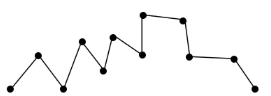
The reason is that the particles of water are in random motion which collide with the suspended fine particles of lycopodium powder and make them move in a zig zag path.
Que-4: Write down five general properties of solids, liquids and gases.
Ans- Five general properties of solids, liquids and gases are given below:
| S. No. |
Solid | Liquid | Gas |
|---|---|---|---|
| 1. | A solid has a definite shape and a definite size (i.e., length, area and volume) | A liquid has a definite volume, but not a definite shape. | A gas has neither a definite volume nor a definite shape. |
| 2. | The molecules in a solid are closely packed. | The molecules in a liquid are loosely packed. | The molecules in a gas are wide apart. |
| 3. | The molecules in a solid are fixed at their positions. They can only vibrate about their mean positions. | The molecules in a liquid can move within the boundary of the liquid. | The molecules of a gas can move freely in space. |
| 4. | The inter-molecular forces are very strong. | The inter-molecular forces are less strong (moderate). | The inter-molecular forces are weak. |
| 5. | Solids are highly rigid. | Liquids are less rigid. | Gases are non-rigid. |
Que-5: Give the molecular model for a solid and use it to explain why a solid has a definite volume and a definite shape.
Ans- Molecular Model for a Solid
(i)A solid is made up of a large number of tiny particles called molecules, which are closely packed together in a regular and fixed arrangement.
(ii)The molecules vibrate about fixed positions but do not move freely from place to place.
(iii)The intermolecular forces in solids are very strong, keeping the molecules tightly bound to one another.
(iv)The particles are so close that there is very little empty space between them.
Why a Solid Has a Definite Shape
(a)Since the molecules are in fixed positions and cannot move freely, a solid retains its own shape.
(b)It does not flow or spread out like liquids or gases.
(c)Even if the solid is placed in a container of any shape, it keeps its original shape.
Why a Solid Has a Definite Volume
(a)The molecules are packed very closely, so the solid cannot be compressed easily.
(b)The strong intermolecular forces prevent the molecules from moving apart, so the volume remains constant.
(c)This explains why solids maintain a fixed size regardless of the container.
Que-6: Describe the molecular model for a liquid. How does it explain that a liquid has no definite shape, but has a definite volume ?
Ans- Molecular Model for a Liquid
(i)A liquid consists of a large number of molecules that are close together, but not as tightly packed as in a solid.
(ii)The molecules in a liquid are in contact with each other and have less space between them compared to gases.
(iii)Unlike solids, the molecules in a liquid are not fixed in position; they can move or slide pastone another.
(iv)The movement of molecules in a liquid is slower than in gases but more free than in solids.
(v)The intermolecular forces in a liquid are strong enough to keep molecules close but weak enough to allow movement.
Why a Liquid Has No Definite Shape
(a)Because the molecules in a liquid can move past each other, a liquid does not hold a fixed shape.
(b)Instead, it takes the shape of the container it is placed in.
(c)The freedom of movement allows the liquid to flow and spread out, adapting to the shape of its container.
Why a Liquid Has a Definite Volume
(a)The molecules are still close together and attracted to each other, so the liquid cannot be easily compressed.
(b)This means the total volume occupied by the liquid remains constant under normal conditions.
(c)The intermolecular forces prevent the molecules from spreading out as far as gases do, so the volume stays definite.
Que-7: A gas has neither a definite volume nor a definite shape. Describe the molecular model to explain it.
Ans- According to the molecular model of matter, a gas consists of a large number of tiny particles called molecules, which are in constant, rapid, and random motion. These molecules have the following characteristics that explain the behavior of gases:
(i)Large Spaces Between Molecules: Gas molecules are very far apart compared to their size. The distance between molecules is much greater than in solids or liquids. This means gases have a lot of empty space between particles.
(ii)Free and Random Movement: Gas molecules move freely and randomly in all directions with high speeds. Because there are almost no forces attracting them strongly, they do not stay close together.
(iii)No Fixed Position: Unlike solids where molecules vibrate about fixed positions or liquids where they slide past each other, gas molecules move independently and spread out to fill the entire container.
Explanation of No Definite Shape
(a)Because gas molecules move randomly and are not fixed in place, they do not maintain any specific shape.
(b)Instead, the gas molecules move to occupy the shape of whatever container they are in.
(c)If you pour gas into a balloon, the gas molecules spread out evenly inside, so the gas takes the balloon’s shape.
Explanation of No Definite Volume
(a)The large spaces between molecules mean that gas can be compressed or expanded easily.
(b)When you compress a gas, the molecules are pushed closer together, reducing volume.
(c)When allowed to expand, the molecules move farther apart, increasing volume.
(d)Therefore, gas does not have a fixed volume but changes depending on the container size and pressure.
Que-8: Distinguish between the three states of matter — solid, liquid and gas on the basis of their molecular models.
Ans-
| S. No. | Properties | Solid | Liquid | Gas |
|---|---|---|---|---|
| 1. | Mass | Definite | Definite | Definite |
| 2. | Shape | Definite | Acquires the shape of the container | Acquires the shape of the container |
| 3. | Volume | Definite | Definite | Indefinite, acquires the volume available |
| 4. | Compressibility | Not compressible | Negligibly compressible | Highly compressible |
| 5. | Fluidity | Not possible | Can flow | Can flow |
| 6. | Rigidity | Highly rigid | Less rigid | Not rigid |
| 7. | Diffusion | Slow | Fast | Very fast |
| 8. | Number of free surfaces | Any number of free surfaces | Only one free surface | None |
| 9. | Packing of molecules | Very closely packed | Less closely packed | Least closely packed |
| 10. | Inter-molecular forces | Strongest | Slightly weaker than in solids | Negligible |
| 11. | Expansion on heating | Low | More than solids | More than liquids |
| 12. | Motion of constituent molecules | Only vibrate on either side of their mean positions | Move in all directions but within the boundary of the liquid | Move in a random manner in all space available |
| 13. | Pressure | Only at base downwards | At all points in all directions inside the boundary of the liquid | On the walls of the container |
| 14. | Viscosity | No | More viscous | Least viscous |
| 15. | Surface Tension | No | Due to cohesive force tends to occupy minimum surface area | No |
Que-9: Distinguish between solids, liquids and gases on the basis of their following properties:
(i) compressibility
(ii) fluidity
(iii) rigidity
(iv) expansion on heating
Ans-
| Properties | Solid | Liquid | Gas | |
|---|---|---|---|---|
| (a) | Compressibility | Not compressible | Negligibly compressible | Highly compressible |
| (b) | Fluidity | Not possible | Can flow | Can flow |
| (c) | Rigidity | Highly rigid | Less rigid | Not rigid |
| (d) | Expansion on heating | Low | More than solids | More than liquids |
Que-10: What do you mean by change of state of matter? Explain :
(i) the change of a solid into a liquid at a constant temperature, and
(ii) the change of a liquid into a gas at a constant temperature.
Ans- A change of state of matter refers to the physical transformation of a substance from one state (solid, liquid, or gas) to another due to a change in temperature.
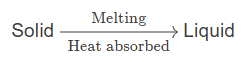
(a) The process of changing of a substance from the solid state into its liquid state on absorption of heat at a particular temperature, called the melting point, is called melting in which the heat energy absorbed by the substance increases the amplitude of vibrations of the molecules of the solid and a stage is reached at the melting point when the molecules acquire sufficient energy to overcome the force of attraction between them and they become free to move. The solid thus changes into a liquid.
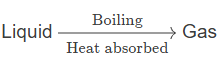
(b) The process of change of a substance from the liquid state to its gaseous state at a particular temperature, called the boiling point, is called boiling in which the heat energy absorbed by a substance in liquid state increases the energy of its molecules due to which they begin to move rapidly. Thus a liquid changes into a gas.
Que-11: Given below is a crossword puzzle based on this lesson. Read the clues across and clues downwards and fill up the blank squares.
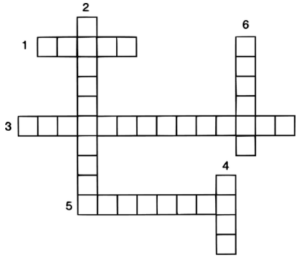
Across :
1. Matter is made up of …………… .
2. The …………… forces are less strong in liquids.
3. A solid has …………… shape.
Down :
2. A solid cannot be …………… .
3. Liquids are …………… rigid.
4. Gases are …………… compressible.
Ans-
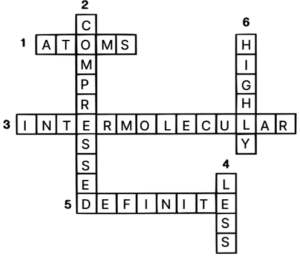
1.Matter is made up of atoms .
2.A solid cannot be compressed .
3.The intermolecular forces are less strong in liquids.
4.Liquids are less rigid.
5.A solid has definite shape.
6.Gases are highly compressible.
— : End of Long Answer Questions on Matter Class 6 Concise Physics ICSE Solutions :–
Return to:- ICSE Class-6 Concise Selina Solutions
Please, Share with your friends
thanks