Long Answer Questions on Physical Quantities and Measurement Class 6 Concise Physics ICSE Solutions Chapter-2. In this article you would learn how to solve Objective Type Questions on Physical Quantities and Measurement. Visit official Website CISCE for detail information about ICSE Board Class-6.
Long Answer Questions on Physical Quantities and Measurement Class 6 Concise Physics ICSE Solutions
| Board | ICSE |
| Publications | Selina Publication |
| Subject | Physics |
| Class | 6th |
| Chapter-2 | Physical Quantities and Measurement |
| Book Name | Concise |
| Topics | Solution of Long Answer Questions |
| Academic Session | 2025-2026 |
Long Answer Questions on Physical Quantities and Measurement
Que-1: (i) Describe in steps how would you measure the length of a pencil using a metre ruler. Draw a diagram if necessary.
(ii) Explain with an example how you will use the metre ruler in part (a) if the ends of the ruler are broken.
Ans- (i) Following are the steps to measure the length of a pencil :
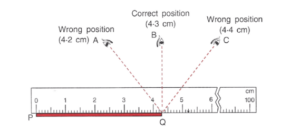
(a)To measure the length of a pencil with a metre ruler, the ruler is placed with its markings close to the object.
(b)Then the zero mark on the ruler is made to coincide with one end of the object which is point P.
(c)Now the position of the other end (which is Q) of the object is read on the ruler from vertically above position to minimize parallax error as it can be seen from figure below.
(d)This reading gives the length (PQ) of the pencil.
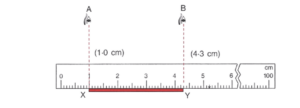
(ii) When the ends of the ruler get damaged with use and its zero mark may not be visible then to measure the length of an object with such a ruler, the object is placed close to a specific marking on the ruler and positions of both ends of the object are read on the ruler. The difference of the two readings gives the length of the object which you can see from below image.
Que-2: Name the instrument used for measuring the temperature of a person. Draw its neat labelled diagram.
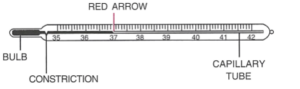
Ans- A clinical thermometer is used for measuring the temperature of a person.
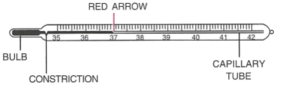
Que-3: What is a clinical thermometer? State its special features. Draw a neat labelled diagram of a clinical thermometer showing the range of temperature marked on it.
Ans- Clinical thermometer is a special thermometer used by doctors for measuring the temperature of a patient’s body.
Features of clinical thermometer :
(i)A clinical thermometer has markings from 35°C to 42°C.
(ii)It has a slight bend or kink in the stem just above the bulb which is called constriction.
(iii)The constriction prevents the mercury from falling back all by itself.
(iv)In clinical thermometer, the temperature of a healthy person (i.e., 37°C) is marked by a red arrow.
Que-4: Explain how you will measure the area of
(i) a square
(ii) a leaf?
Ans- (i) Measurement of area of a square : As the area of a regular shape can be expressed in terms of the product of it’s two measurements in length and since square has all side length equal then the area of a square can be calculated by using the following formulae :
Area of a square of side l = side x side = l × l = l2
(ii) Measurement of area of a leaf : The area of an irregular surface like a leaf can be measured using graph paper. We count the squares of each side 1 cm, the area of which is 1 cm × 1 cm = 1 cm2. This therefore gives an approximate area of the given surface.
Procedure :
(a)Place the leaf on a graph paper.
(b)Draw its outline on the paper and remove it.
(c)Now count the number of complete squares.
(d)To this add the number of incomplete squares which are half or more than half (within the outline).
(e)Ignore the squares which are less than half (within the outline).
(f)This number when multiplied by the area of one square gives the approximate area of the given surface. Thus,
Approximate area of a leaf = (No. of complete squares + No. of half or more than half of incomplete squares) × Area of one square
Que-5: Name the device which you will use to measure the perimeter of your play ground. Describe in steps how you will use it.
Ans- The device used to measure the perimeter of a playground is a measuring tape .
Choose one corner of the playground as your starting point.
Place the end of the measuring tape at this point. You can secure it with a peg, weight, or ask a helper to hold it firmly.
Stretch the tape tightly along the first side of the boundary, making sure it is straight and does not sag or twist.
When you reach the end of the side, record the measured length in your notebook.
Use chalk, a stone, or a stick to mark the spot where the tape ends.
From the marked point, measure the next side in the same way.
Continue this process until you have measured all sides of the playground.
At each corner, ensure the tape aligns properly so that no extra length or gap is included.
- Record All Measurements:
Write down the lengths of all sides clearly. - Calculate the Perimeter:
Add together the lengths of all the sides to get the total perimeter of the playground.
— : End of Long Answer Questions on Physical Quantities and Measurement Class 6 Concise Physics ICSE Solutions :–
Return to:- ICSE Class-6 Concise Selina Solutions
Please, Share with your friends
thanks