Long Answer Questions on Simple Machines Class 6 Concise Physics ICSE Solutions Ch-4. In this article you would learn how to solve Long Answer Questions on Simple Machines . Visit official Website CISCE for detail information about ICSE Board Class-6.
Long Answer Questions on Simple Machines Class 6 Concise Physics ICSE Solutions
| Board | ICSE |
| Publications | Selina Publication |
| Subject | Physics |
| Class | 6th |
| Chapter-4 | Simple Machines |
| Book Name | Concise |
| Topics | Solution of Long Answer Questions |
| Academic Session | 2025-2026 |
Long Answer Questions on Simple Machines
Que-1: Name six simple machines. Give an example of each machine.
Ans- (i) Lever : A lever is a rigid bar that rotates around a fixed point called a fulcrum. It helps lift or move heavy objects with less effort.
Example: A see-saw in a playground.
(ii) Wheel and Axle : A wheel and axle consists of a large circular wheel attached to a smaller rod (axle). When one part turns, the other turns too. It helps move or lift objects more easily.
Example: A doorknob.
(iii) Pulley : A pulley is a grooved wheel with a rope or chain around it. It helps lift heavy loads by changing the direction of the force.
Example: A flagpole pulley used to raise a flag.
(iv) Inclined Plane : An inclined plane is a flat surface set at an angle (like a ramp). It helps move heavy objects up or down with less effort.
Example: A ramp used to load goods into a truck.
(v) Wedge : A wedge is a triangular-shaped tool used to split, cut, or break objects. It is actually made of two inclined planes joined together.
Example: A knife used for cutting vegetables.
(vi) Screw : A screw is an inclined plane wrapped around a cylinder. It is used to hold things together or lift objects.
Example: A wood screw used to join two pieces of wood.
Que-2: Describe three orders of levers giving an example of each. Draw neat diagrams showing the positions of fulcrum, load and effort in each kind of lever.
Ans- (i) Lever of Class I : The lever in which the fulcrum is in between the load and the effort are called lever of class I. Generally, the effort arm of lever of class I is longer than the load arm, therefore, the mechanical advantage of a class I lever is greater than 1. However, if the effort arm is equal to the load arm, the mechanical advantage is equal to 1. But if the effort arm is shorter than the load arm, its mechanical advantage is less than 1. Thus, the mechanical advantage of a lever of class I can be greater than 1, equal to 1 or less than 1. Example : see-saw.
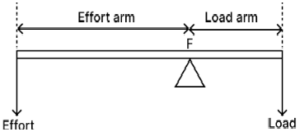
(ii) Lever of Class II : The lever in which the load is in between the fulcrum and the effort are called lever of class II. In class II lever, the fulcrum is at one end and the load is closer to the fulcrum. Thus, the effort arm is always longer than the load arm. Hence, the mechanical advantage of a class II lever is always more than 1. Example : nut cracker.
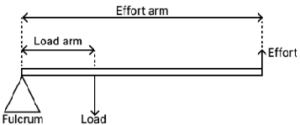
(iii) Lever of Class III : The lever in which the effort is in between the fulcrum and the load are called lever of class III. In class III lever, the fulcrum is at one end and the effort is close to the fulcrum, thus the effort arm is always shorter than the load arm. Hence, the mechanical advantage of a class III lever is always less than 1. Example : knife.
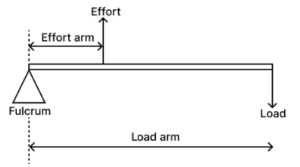
Que-3: Draw diagrams to illustrate the positions of fulcrum, load and effort, in each of the following :
(i) a see-saw
(ii) a beam balance
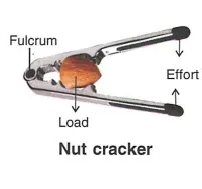
(iii) a nut cracker
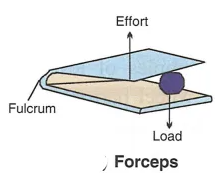
(iv) a pair of forceps
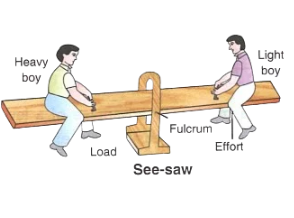
Ans- (i) See-saw is an example of class I lever in which the fulcrum is in between the load and the effort so that the effort arm is equal to the load arm.
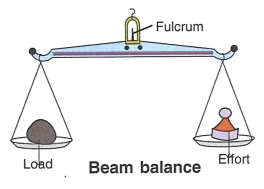
(ii) Beam balance is a type of class I lever in which the fulcrum is in between the load and the effort so that the effort arm is equal to the load arm.
(iii) Nut cracker is an example of class II lever in which the fulcrum is at one end and the load is closer to the fulcrum. Thus, the effort arm is always longer than the load arm.
(iv) Pair of forceps is a type of class III lever in which the effort is in between the fulcrum and the load so that the fulcrum is at one end and the effort is close to the fulcrum, thus the effort arm is always shorter than the load arm.
Que-4: The mechanical advantage of an actual pulley is less than 1. Give a reason. What is the justification for using the pulley then?
Ans- Mechanical Advantage of an Actual Pulley
The mechanical advantage (M.A.) of a machine is the ratio of Load (L) to Effort (E):
M.A = Load/Effort
In an actual pulley, the mechanical advantage is often less than 1, especially in the case of a single fixed pulley.
Reason Why Mechanical Advantage is Less Than 1
In theory (ideal conditions), a single fixed pulley has a mechanical advantage equal to 1.
However, in real (actual) conditions:
Friction exists between the pulley wheel and its axle.
The weight of the pulley itself adds extra load.
Some energy is lost in overcoming friction and heat.
Because of these factors:
The effort applied becomes slightly greater than the load lifted.
Therefore,
M.A = 𝐿/𝐸 < 1
This means more effort is needed than the load due to energy losses.
Justification for Using a Pulley
Even though the mechanical advantage of a single fixed pulley is less than 1, it is still very useful.
(i) Changes the Direction of Force
A single fixed pulley allows a person to:
Pull downward to lift a load upward.
This is more convenient because we can use our body weight.
For example:
Drawing water from a well.
Raising a flag on a flagpole.
(ii) Makes Work More Convenient
Pulling downward is easier and more natural than lifting upward. It gives better balance and control.
(iii) Used in Combination Systems
When pulleys are combined to form a block and tackle system, the mechanical advantage increases and becomes greater than 1. Such systems are used in:
Construction cranes
Lifting heavy machinery
Elevators.
Que-5: Draw a neat labelled diagram showing a pulley being used to lift a load. How are load and effort related in an ideal situation ?
Ans- The labelled diagram of a pulley being used to lift a load is given below :
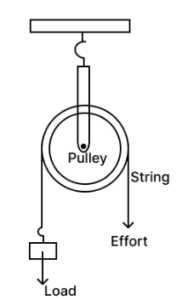
In an ideal pulley, the effort applied is equal to the load to be lifted.
Que-6: What is an inclined plane? What is its mechanical advantage? Give two examples where it is used.
Ans- An inclined plane is a simple machine consisting of a flat surface set at an angle to the horizontal. It is used to raise or lower heavy objects with less effort by moving them along the sloping surface instead of lifting them vertically.
Instead of lifting a load straight up (which requires more force), the inclined plane allows the load to be moved gradually along the slope, reducing the effort needed.
The mechanical advantage (M.A.) of an inclined plane is the ratio of the length of the slope (L) to the height of the slope (H).
M.A = Length of inclined plane/Height of inclined plane
So,
M.A = 𝐿/𝐻
Explanation:
(a) The longer the slope and the smaller the height, the greater the mechanical advantage.
(b) This means less effort is required to lift the load.
(c) In actual practice, friction reduces the mechanical advantage slightly
Two Examples of Inclined Plane
(a) Ramp
A ramp is used to load goods into a truck or to help wheelchairs move into buildings. It makes lifting easier by allowing the load to be pushed up gradually.
(b) Staircase
A staircase is also an inclined plane. It allows people to reach higher floors step by step instead of climbing vertically.
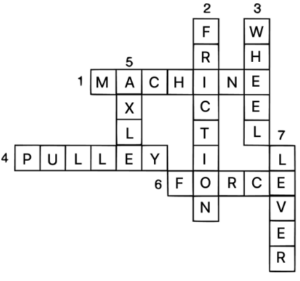
Que-7: Given below is a crossword puzzle based on this lesson. Read the clues across and clues downwards and fill up the blank squares.
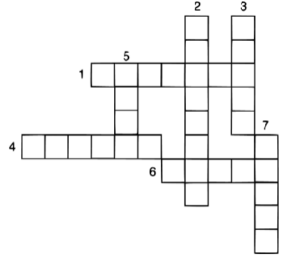
Across:
(1) It makes work easier … …… .. .
(2) A …. ….. .. is a simple machine which is used for raising a load up by applying the effort downwards.
(3) Work is said to be done when a . …….. .. applied on a body moves it.
Down:
(2) …. …. … force at the fulcrum reduces the mechanical advantage.
(3) A ….. …. .. and axle is also a simple machine.
(4) Screw driver is an example of wheel and … …… .. .
(5) .. …… … is a rod which can turn about a fixed point (fulcrum)
Ans-
— : End of Long Answer Questions on Simple Machines Class 6 Concise Physics ICSE Solutions :–
Return to:- ICSE Class-6 Concise Selina Solutions
Please, Share with your friends
thanks