Maxima And Minima Class 12 OP Malhotra Exe-12A ISC Maths Solutions Ch-12 Solutions. In this article you would learn about conditions of for maxima and minima and points of inflexion . Step by step solutions of latest textbook has been given as latest syllabus. Visit official Website CISCE for detail information about ISC Board Class-12 Mathematics.
Maxima And Minima Class 12 OP Malhotra Exe-12A ISC Maths Solutions Ch-12
| Board | ISC |
| Publications | S Chand |
| Subject | Maths |
| Class | 12th |
| Chapter-12 | Maxima And Minima |
| Writer | OP Malhotra |
| Exe-12(a) | conditions of for maxima and minima and points of inflexion |
Exercise- 12A
Maxima And Minima Class 12 OP Malhotra Exe-12A Solution.
Que-1: Find the turning values of the following functions, distinguishing in each case whether the value is a maximum, minimum, or inflexional:
(i) 4x3 + 19x2 – 14x + 3
Sol: (i) Let y = 4x3 + 19x2 – 14x + 3
∴ dy/dx = (12x2 + 38x – 14)
∴ d²y/dx² = 24x + 38
for maxima/minima, dy/dx = 0
⇒ 12x2 + 38x – 14 = 0
⇒ x = -19±√(361+168)/12
= -19±√529/12
⇒ x = -19±23/12 = 4/12 , -42/12
i.e. x = 1/3 , -7/2
when x = 1/3 ; d²y/dx² = 24 ×1/3 + 38 = 46 > 0
∴ x = 1/3 be a point of minima.
∴ min value of y = 4(1/3)³ + 19(1/3)² – 14(1/3) +3
= 4/27 + 19/9 – 14/3 +3
= 4+57 – 126 + 81/27 = 16/27
when x = -7/2 : d²y/dx² = 24(-7/2) + 38
= – 84 + 38 = -46 < 0
∴ x = -7/2 be a point of maxima
& maximum value of y
= 4(-7/2)³ + 19(-7/2)² – 14(-7/2) + 3
= -343/2 + 931/4 + 49 + 3
= -686 + 931 + 208 / 4 = 453/4 = 113 1/4
(ii) 2x3 + 3x2 – 12x + 7
(ii) Let y = 2x3 + 3x2 – 12x + 7
∴ dy/dx = 6x2 + 6x – 12
& d²y/dx² = 12x + 6
for manima/minima, dy/dx = 0
⇒ 6(x2 + x – 2) = 0
⇒ x = 1, – 2
∴ (d²y/dx²) x=1 = 12 + 6 = 18 > 0
Thus x = 1 be a point of minima
& min value = 2 + 3 – 12 + 7 = 0
& (d²y/dx²) x=2 = -24 + 6 = – 18 < 0
∴ x = -2 be a point of maxima
& Maximum value
= 2(-2)3 + 3(-2)2 – 12(-2) + 7
= -16 + 12 + 24 + 7
= 27
(iii) 3x4 + 8x3+ 6x2
(iii) Let y = 3x4 + 8x3 + 6x2
∴ dy/dx = 12x3 + 24x2 + 12x
& d²y/dx² = 36x2 + 48x + 12
for maxima/minma, dy/dx = 0
⇒ 12x(x2 + 2x + 1) = 0
⇒ x (x + 1)2 = 0
⇒ x = 0, -1
Now (d²y/dx²) x=0 =12 > 0
∴ x = 0 be a point of minima.
∴ min value = 0 + 0 + 0 = 0
& (d²y/dx²) x=-1 = 36 – 48 + 12 = 0
Now, d³y/dx³ = 72x + 48
∴ (d³y/dx³) x=-1 = -72 + 48 = -24 ≠ 0
∴ x = -1 be a point of inflexion
(iv) Let y = x3 – 2x2 – 4x – 1
∴ dy/dx = 3x2 – 4x – 4
& d²y/dx² = 6x – 4
For maxima/minima, dy/dx = 0
⇒ 3x2 – 4x – 4 = 0
⇒ (x – 2)(3x + 2) = 0
⇒ x = 2, -2/3
Now (d²y/dx²) x=2 = 6 × 2 – 4 = 8 > 0
∴ x = 2 be a point of minima & min value of f(x) = f(2)
= 23 – 2 × 22 – 4 × 2 – 1
= 8 – 8 – 8 – 1 = – 9
∴ at (d²y/dx²) x = -2/3 = 6(-2/3) – 4 = -8 < 0
∴ x = -2/3 be a point of maxima
& maximum value = – 8/27 – 8/9 +8/3 – 1
= -8-24+72-27/27 = 13/27
Que-2: If V = 2x2 (6 – x), where x is (positive, determine the greatest value of V.
Sol: Given V = 2x2(6x – x)
∴ dV/dx = 2(12x – 3x2)
& d²V/dx² = 2(12 – 6x)
for maxima/minima, dV/dx = 0
⇒ 2(12x – 3x2) = 0
⇒ 2x(12 – 3x) = 0
⇒ x = 0, 4
∴(d²y/dx²) x=0 = 2(12 – 0) = 24 > 0
∴ x = 0 be a point of minima & min value = 0
& (d²y/dx²) x=4= 2(12 – 24) = -24 < 0
∴ x = 4 be a point of maxima
& greatest value of V = 2 × 42(6 – 4) = 64
Que-3: Find the co-ordinates of the turning points on the curve y = x3 – 3x2 – 9x + 7, distinguishing between maximum and minimum points.
Sol: Given y = x3 – 3x2 – 9x + 7
∴ dy/dx = 3x2 – 6x – 9x
& d²y/dx² = 6x – 6
for maxima/minima, dV/dx = 0
⇒ 3(x2 – 2x – 3) = 0
⇒ (x + 1)(x – 3) = 0
⇒ x = -1, 3
∴ (d²y/dx²) x=-1 = – 6 – 6 = – 12 < 0 ∴ x = -1 be a point of mixima & maximum value of y = – 1 – 3 + 9 + 7 = 12 & (d²y/dx²) x=3 = 18 – 6 = 12 > 0
∴ x = 3 is a point of minima
& minimum value = 27 – 27 – 27 + 7 = -20
thus the turning point are (-1, 12) & (3, – 20).
Que-4: Find the minimum value of (x + 4/x²)
Sol: Let y = x + 4/x²
∴ dy/dx = 1 – 8/x³ & d²y/dx² = 24/x4
for maxima/minima, put dy/dx = 0
⇒ 1 – 8 x³ = 0 ⇒ x3 = 8
⇒ (x – 2) (x2 + 2x + 4) = 0
⇒ x = 2
while the other two values of x are non-real.
∴ (d²y/dx²) x=2 = 24/24 = 3/2 > 0
∴ x = 2 be a point of minima & minimum value of y = 2 + 4/2² = 3
Que-5: If y = 1/4 x4 – 2/3 x3 + 1/2 x2 + 11/2 , show that the ordinate at the point x = 1 is neither a maximum nor a minimum, though dy/dx = 0, when x = 1.
Sol: Given y = x4/4 – 2/3 x3 + 1/2 x2 + 11/2
dy/dx = x3 – 2x2 + x
& d²y/dx² = 3x2 – 4x + 1
for maxima/minima, we put dy/dx = 0
⇒ x (x2 – 2x – 1) = 0
⇒ x (x – 1)2 = 0
⇒ x = 0, 1
∴ (d²y/dx²) x=0 = 1 > 0 ∴ x = 0 be a point of minima
∴ (d²y/dx²) x=1 = 3 – 4 + 1 = 0
& d³y/dx³ = 6x – 4
∴ at x = 1, d³y/dx³ = 6 – 4 = 2 ≠ 0
Thus, x = 1, be a point of neither maxima nor minima.
Que-6: Find the points at which the function f given by f(x) = (x – 2)4 (x + 1)3 has
(i) local maxima
(ii) local minima
(iii) point of inflexion
Sol: Given, f(x) = (x – 2)4(x + 1)3 Diff. both sides w.r.t. x; we have
f ‘ (x) = (x – 2)4 3 (x + 1)2 + (x + 1)3 4(x – 2)3
= (x + 1)2 (x – 2)3 [3(x – 2)+ 4(x + 1)]
= (x + 1)2 (x – 2)3 (7x – 2)
For critical points, f ‘ (x) = 0
⇒ (x + 1)2 (x – 2)3 (7x – 2) = 0
⇒ x = -1, 2, 2/7
Case – I : at x = -1
When x slightly < – 1 ⇒ x + 1 < 0
also x < -1 < 2 ⇒ x – 2 < 0 ∴ f ‘ (x) = (+ve) (- ve)(- ve) = + ve When x slightly > – 1
⇒ x + 1 > 0, x – 2 < 0
∴ f ‘ (x) = (+ ve) (- ve) (- ve) = + ve
So f ‘ (x) does not changes its sign as we move from slightly < – 1 to slightly > – 1 .
∴ x = – 1 be a point of neither maxima nor minima.
Hence x = -1 be a point of inflexion.
Case-II : at x = 2
When x slightly < 2
⇒ x – 2 < 0 but 7x – 2 > 0
∴ f ‘ (x) = (+ Ve) (- Ve) (+ Ve) = – Ve
When x slightly > 2
⇒ x – 2 > 0 and 7x – 2 > 0
∴ f ‘ (x) = (+ Ve) (+ Ve) (+ Ve) = + Ve
Thus, f ‘ (x) changes its sign from -ve to +ve as we move from slightly <2 to slightly >2
∴ x = 2 is a point of minima.
Case-III : at x = 2/7
When x slightly < 2/7
⇒ 7x – 2 < 0 and x – 2 < 0 ∴ f ‘ (x) = (+ ve) (- ve) (- ve) = + ve ⇒ 7 x – 2 > 0 and x – 2 < 0
∴ f ‘ (x) = (+ve) (-ve) (+ve) = -ve
Thus, f ‘ (x) changes its sign from + ve to – ve as we move from slightly < 2/7 to slightly > 2/7.
∴ x = 2/7 be a point of local maxima.
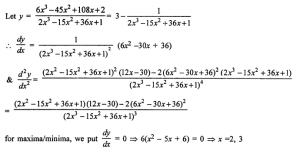
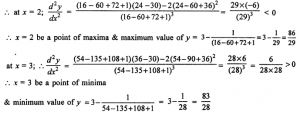
Que-7: Discuss the maxima and minima of the expression 6x³-45x²+108x+2/2x³-15x²+36x+1
Sol:
Que-8: Find the turning values of the function – x3 + 12x2 – 5, distinguishing whether the value is a maximum, minimum or inflexional.
Sol: Let y = -x3 + 12 x2 – 5
∴ dy/dx = -3x2 + 24x
& d²y/dx² = -6x + 24
for maxima minima, we put dy/dx = 0
⇒ -3x2+ 24x = 0 ⇒ -3x(x – 8) = 0
⇒ x = 0, 8
∴ (d²y/dx²) x=0 = 24 > 0
∴ x = 0 be a point of minima & minimum value of y = 0 + 0 – 5 = – 5
& (d²y/dx²) x=-8 = -6 × 8 + 24 = -24 < 0
∴ x = 8 be a point of maxima.
Thus maximum value of y
= -512 + 768 – 5 = 251
–: End Maxima And Minima Class 12 OP Malhotra Exe-12A ISC Math Ch-12 Solution :–
Return to :- OP Malhotra ISC Class-12 S Chand Publication Maths Solutions
Thanks
Please share with your friends