Maxima And Minima Class 12 OP Malhotra Exe-12C ISC Maths Solutions Ch-12 Solutions. In this article you would learn about applications of maxima and minima to practical problems . Step by step solutions of latest textbook has been given as latest syllabus. Visit official Website CISCE for detail information about ISC Board Class-12 Mathematics.
Maxima And Minima Class 12 OP Malhotra Exe-12C ISC Maths Solutions Ch-12
| Board | ISC |
| Publications | S Chand |
| Subject | Maths |
| Class | 12th |
| Chapter-12 | Maxima And Minima |
| Writer | OP Malhotra |
| Exe-12(c) | Applications of Maxima and Minima to Practical Problems |
Exercise- 12C
Maxima And Minima Class 12 OP Malhotra Exe-12C Solution.
Que-1: x3 – 9x2 + 24x – 12
Que-1: (i) Find two positive numbers whose sum is 24 and whose product is as large as possible.
(ii) Find the. maximum value of xy subject to x + y = 8.
(iii) Find two positive numbers x and y such that x + y = 60 and xy is maximum.
(iv) Let x and y be two variables such that x > 0 and xy = 1. Find the minimum value of x + y.
Sol: (i) Let the one number be x,(0 < x < 24)
∴ other number be 24 – x because sum of two numbers be 24 .
Let P = x (24 – x) …(1)
Diff. (1) w.r.t. x; we have
dp/dx = 24 – 2x
For maximum/minima, dp/dx = 0
⇒ 24 – 2x = 0 ⇒ x = 12
∴ d²P/dx² = – 2 ⇒ (d²y/dx²) x=2 = – 2 < 0
Thus, x = 12 be a point of local maxima and x = 12 be the only point of local maxima.
So the local maximum value be the absolute maximum value. Thus, required numbers are 12 and (24 – 12) i.e. 12.
(ii) Let P = xy …(i)
Also given x + y = 8
⇒ y = 8 – x
∴ from (i) ; P = x(8 – x) = 8x – x2
∴ dp/dx = 8 – 2x & (d²y/dx²) = -2
For maxima/minima, dp/dx = 0
⇒ 8 – 2x = 0 ⇒ x = 4
⇒(d²y/dx²) x=4 = – 2 < 0 Thus, x = 4 be a proint of maxima ∴ from (ii); y = 8 – 4 = 4 Thus, maximum value of P = 4 × 4 = 16
(iii) Given x + y = 60 …(1) where x, y > 0
Let P = xy3 = y3(60 – y)
∴ dp/dx = 180y2 – 4y3 = 4y2 [45 – y]
For maxima/minima, dp/dy = 0
⇒ 4y2 (45 – y) = 0
⇒ y = 0, 45
but y > 0 ∴ y = 45
and d²P/dy²= 360y – 12y2
= 12y (30 – y)
∴ at y = 45; d²P/dy² = 12 × 45 × (-15) = -8100 < 0
∴ P is maximise for y = 45
∴ from (1); x = 15
Hence the required two numbers be 15, 45.
(iv) Let S = x + y ….(i)
& given xy = 1 ⇒ y = 1/x …(ii)
∴ from (i); S = x – 1/x
∴ dS/dx = 1 – 1/x²
For maxima/minima, dS/dx = 0
⇒ 1 – 1/x² = 0 ⇒ x2 = 1
x = ±1 but x > 0 ∴ x = 1
Now d²S/dx² = 2/x³
∴ (d²S/dx²) x=1 = 2/(1)³ = 2 > 0
Thus x = 1 is a point of minima
∴ from (ii); y = 1
∴ Min. value of S = 1 + 1 = 2
Que-2: Determine two positive real numbers whose sum is 15 and the sum of whose squares is minimum.
Sol: Let required numbers be x, y s.t. x, y > 0
Given x + y = 15 …(1)
Let S = x2 + y2 = x2 + (15 – x)2 [using (1)]
∴ dS/dx = 2x – 2(15 – x) = 4x – 30
For maxima minima, dS/dx = 0
⇒ 4x – 30 = 0 ⇒ x = 15/2
∴ d²S/dx² = 4 > 0 at x = 15/2
∴ x = 15/2 is a point of minima
∴ from (1); y = 15 – 15/2 = 15/2
Hence required numbers are 15/2 and 15/2.
Que-3: Find two numbers whose sum is 15 and the square of one multiplied by the cube of the other is maximum.
Sol: Let the two numbers are x & y s.t.
x + y = 15 …(i)
Let P = x3y2 = x3(15 – x)2
Differentiate both sides sides w.r.t. +x; we have
dp/dx = 2x3(15 – x) (-1) + (15 – x)2 3x2
x2(15 – x) [-2x + 3(15 – x)]
= x2(15 – x) (45 – 5x)
For maxima/minima, we put dp/dx = 0
⇒ x2(15 – x) (45 – 5x) = 0
⇒ x = 0, 15, 9 since 0 < x, y < 15
∴ x = 9
Now d²P/dx² = (15x2 – x3)(-5) + (45 – 5x) (30x – 3x2)
∴ (d²P/dx²) x=9 = (15 – 9) (-5) × 92
= – 405 × 6 = -2430 < 0
∴ x = 9 is a point of maxima
∴ from (i); y = 15 – 9 = 6
Hence, the required numbers are 9 & 6.
Que-4: Divide 64 into two parts such that the sum of cubes of two parts is minimum.
Sol: Let x and y be two the numbers.
Given, x + y = 64 …(1)
Let S = x3 + y3 = x3 + (64 – x)3 [using (1)]
Differentiate (1) w.r.t. x, we have
dS/dx = 3x2 + 3(64 – x)2 (-1)
For maximum/minima dS/dx = 0
⇒ 3 [x2 – (64 – x)2] = 0
x2 – [x2 – 128x + (64)2] = 0
⇒ 128x = (64)2 ⇒ x = 32
Now d²S/dx² = 6x + 6(64 – x)
∴ (d²S/dx²) x=32 = 6 × 32 + 6(32) = 384 > 0
∴ S is minimise at x = 32
∴ from (1); y = 32
Que-5: The difference between two positive numbers is 10 . Find the numbers, if the square of the greater exceeds twice the square of the smaller by the maximum amount.
Sol: Let the two numbers are x & y and y > x > 0
Given y – x = 10 ….(i)
Let A = y2 – 2x2
= (10 + x)2 – 2x2
∴ dA/dx = 2(10 + x) – 4x
& d²A/dx² = 2 – 4 = -2
For maxima/minma, dA/dx = 0
⇒ 20 + 2x – 4x = 0 ⇒ 20 – 2x = 0
⇒ x = 10
∴ (d²A/dx²) x=32 = -2 < 0
Thus x = 10 is a point of maxima.
∴ from (i) ; y = 10 + x = 20
Hence the required numbers are 10 & 20.
Que-6: Divide the number 4 into two positive numbers such that the sum of the square of the one and the cube of the other is minimum.
Sol: Let the required two positive numbers be x and 4 – x since the sum of two positive numbers be 4 .
Let P = (4 – x)2 + x3;
Diff. both sides w.r.t. x, we get
dP/dx = 2 (4 – x) (-1) + 3x2
∴ d²P/dx² = 2 + 6x
For maxima/minima, dP/dx = 0
⇒ – 8 + 2x + 3x2 = 0
⇒ (x + 2) (3x – 4) = 0 ⇒ x = -2, 4/3
but x > 0 ∴ x = 4/3
Thus, (d²P/dx²) x=4/3 = 2 + 6 × 4/3 = 2 + 8 = 10 > 0
∴ x = 4/3 be a point of minima.
∴ P is minimise at x = 4/3
Hence, the required numbers are 4/3 and 4 – 4/3
i.e. 4/3 and 8/3.
Que-7: Find the shortest distance of the point (0, c) from the parabola y = x2 where 0 ≤ c ≤ 5.
Sol: Given eqn. of parabola be y = x2 …..(i)
Let P(x, y) be any point on eqn. (i)
Let z be the distance between P(x, y) and given point A(0, c).
So to minimise z; it is suffices to minimise z2.
Let v = z2 =(x – 0)2 + (y – c)2
⇒ v = y + (y – c)2 [Using (i)]
∴ dv/dy = 1 + 2 (y – c)
& d²v/dy² = 2
For maxima/minima, dv/dy = 0
⇒ 1 +2y – 2c = 0
⇒ y = (2c-1)/2
At y = (2c-1)/2; d²v/dy² = 2 > 0
Thus v is minimise when y = (2c-1)/2
∴ z is minimise when y = (2c-1)/2
∴ required shortest distance
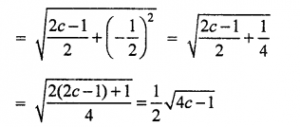
Que-8: Find the points on the curve y = 1/4 x2 + 1 which are the nearest to the point (0,6).
Sol: Given eqn. of curve be y = x²/4+1 …(i)
Let P(x, y) be any point on curve (i)
Let z be the distance between any point P(x, y) and given point A(0,6)
∴ z = |AP| = √(x-0)²+(y-6)²
= √x²+(y-6)²
Let u = z2 = x2 + (y – 6)2
= x2 + (x²/4-5)² …(ii) [Using eqn (i)]
To minimise z it is sufficient to minimise u.
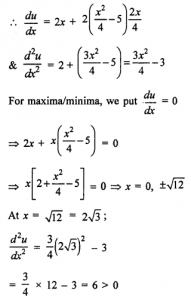
∴ u is minimise at x = 2√3
Thus z is minimise at -x = 2√3
from (i) y = 12/4 + 1 = 4
Hence the required point on curve (i) be (2√3, 4)
at x = -√12 = -2√3;
d²u/dx² = 3/4(-2√3)2 – 3 = 6 > 0
Thus u is minimise at x = 2√3
∴ z is minimise at x = -2√3
Thus the required point given curve be (-2√3, 4)
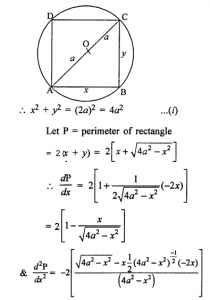
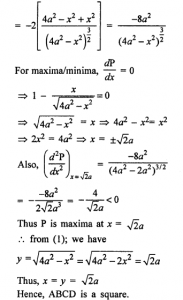
Que-9: (i) Show that the rectangle of maximum perimeter which can be inscribed in a circle of radius a is a square of side a√2.
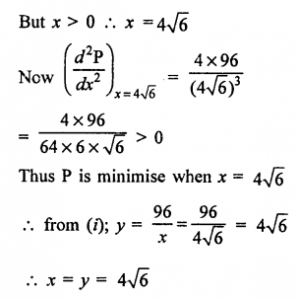
(ii) Find the dimensions of the rectangle of area 96 sq cm whose perimeter is the least. Find also its perimeter.
Sol: Let ABCD be the rectangle that is inscribed in circle of radius a s.t. AB = x and BC = y
(ii) Let x and y be the dimesions of the rectangle then area of rectangle
= xy = 96 cm2
Let P = perimeter of rectangle = 2 (x + y)
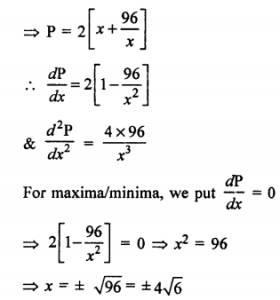
Hence the rectangle becomes square.
∴ required least perimeter
= 2[√96 + √96] = 4√96 cm = 16√6 cm
Que-10: (i) Of all the rectangles each of which has perimeter 40 cm, find the one having maximum area. Also find that area.
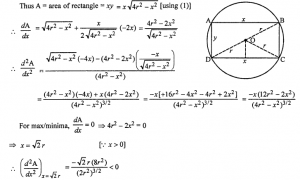
(ii) Show that the rectangle of maximum area that can be inscribed in a circle of radius r is the square of side r√2.
Sol: (i) Let x and y be the dimensions of
reactangle then perimeter of reactangle = 2(x + y)
∴ 2(x + y) = 40 ⇒ x + y = 20
Let A = area of reactangle = xy = x(20 – x) [using eqn. (i)]
∴ dA/dx = 20 – 2x & d²A/dx² = 2
∴ For maxima/minima, dA/dx = 0
⇒ 20 – 2x = 0 ⇒ x = 10
∴ (d²P/dx²) x=10 = – 2 < 0
Thus A is maximise when x = 10
∴ from (i) ; y = 20 – x = 20 – 10 = 10
Hence given rectangle is a square [∵ x = y = 10]
∴ Maximum area of rectangle or square
= xy = 10 × 10 cm2 = 100 cm2
(ii) Let x and y be the length and breadth of the rectangle respectively. Which is inscribed in a circle of radius r
∴ x2 + y2 = (2r)2 ⇒ x2 + y2 = 4r2 …(1)
∴ A is maximum for x = √2 r
∴ From (1); 2r2 + y2 = 4r2
⇒ y = √2 r
Hence A is maximise for x = y = √2 r i.e. rectangle becomes square.
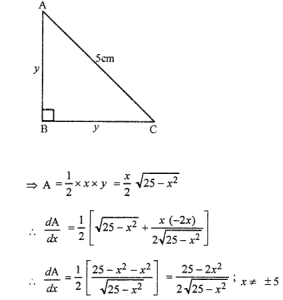
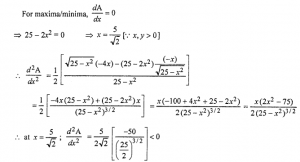
Que-11: (i) Find the largest possible area of a right angled triangle whose hypotenuse is 5 cm long.
(ii) Show that of all right triangles inscribed in a circle, the triangle with maximum perimeter is isosceles.
(iii) AB is a diameter of a circle and C is any point on the circle. Show that the area of △ABC is maximum, when it is isosceles.
Sol: (i) Let △ABC be the right angled triangle at B.
Then by Pythagoras Theorem, we have
x2 + y2 = 52 = 25 ….(1)
Let A = area of right angled △ABC
∴ A is largest for x = 5/√2
∴ from (1) ;
y = √(25-x²) = √(25 – 25/2) = 5/√2 and largest area
= 1/2 xy = 1/2 × 5/√2 × 5/√2 cm2 = 25/4 cm2
(ii) Let ABC be the right angled triangle that is inscribed in a circle of radius a such that AB = y and BC = x
Also by pyllagoras theorem
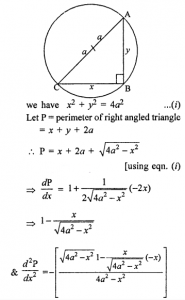
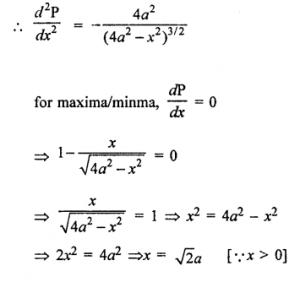
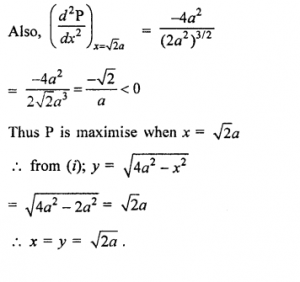
Hence the △ABC be an isosceles triangle.
(iii) Clearly △ACB = 90°
Let a be the radius of circle
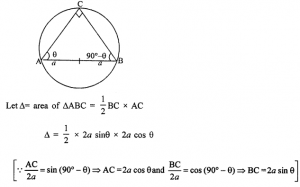
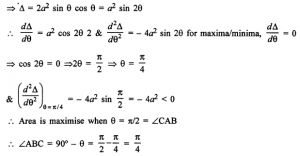
Thus A is maximum when ∠CAB = ∠ABC i.e., △ABC be an isosceles triangle.
Que-12: (i) A large window has the shape of a rectangle surmounted by an equilateral triangle. If the perimeter of the window is 12 metres find the dimensions of the rectangle that will produce the largest area of the window.
(ii) A figure consists of semicircle with a rectangle on its diameter. If its perimeter is p cm, find its dimensions so that its area is maximum.
Sol: Let x metre be the width of window and y metre be the height of window. It is given that perimeter of window be 12 metres.
3x + 2y = 12
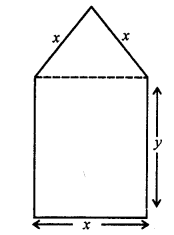
Let A = area of window = xy + √3/4 x²
⇒ A = x(12-3x)/2 + √3/4 x²
⇒ dA/dx = 1/2(12 – 6x) + √3/2 x
= 6 – 3x + √3/2 x
For maxima/minima, dA/dx = 0
⇒ 12 – 6x + √3x = 0
⇒ x = 12/(6-√3)
∴ d²A/dx² = -3 + √3/2 < 0
∴ at x = 12/(6-√3) ; d²A/dx² < 0
Hence A is maximum when x = 12/(6-√3)
∴ from (1); 2y = 12 – 3x
⇒ 2y = 12 – 36/(6-√3) = 36-12√3/(6-√3)
⇒ y = 18-6√3/(6-√3)
Hence the dimensions of window are x and y i.e. x = 12/(6-√3) and y =18-6√3/(6-√3)
(ii) A figure consists of semicircle with a rectangle on its diameter. If its perimeter is p cm, find its dimensions so that its area is maximum.
Solution:
Let r cm be the radius of semi-circle and x cm be the side BC of rectangle as shown in figure shown alongside.
Then p = perimeter of combined figure
⇒ p = πr + 2x + 2r …(1)
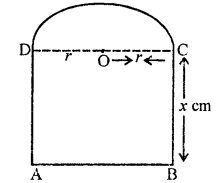
Let A = area of the window
⇒ A = 1/2 πr2 + 2rx
= πr²/2 + 2r(p-πr-2r)/2 …(2) [using (1)]
Now maximum light wil be admitted through the window if the area of the window is maximum.
For this we have to maximise A.
Diff. eqn. (2) both sides w.r.t. r, we have
dA/dr = π r + (p – 2πr – 4r)
∴ d²A/dr² = π + (-2π – 4) = – π – 4 = – (π + 4)
For maxima/minima, dA/dr = 0
⇒ πr + p – 2πr – 4r = 0
⇒ p – πr – 4r = 0 ⇒ r = p/π+4
∴ at r = p/π+4 , d²A/dr² = – (π – 4) < 0
Thus A is least for r = p/π+4
Thus, from eqn. (1) ; we have
2x = p – (π+2)p/π+4 = pπ+4p-πp-2p/π+4
⇒ x = p/π+4
Hence, maximum light is admitted when radius of semi-circle be r = p/π+4 cm.
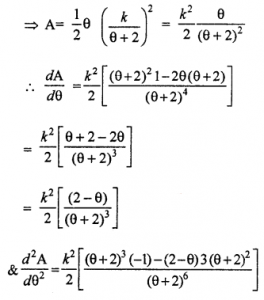
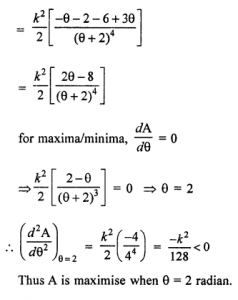
Que-13: The perimeter of a sector of a circle is constant. What will be the angle of the sector, if the area of the sector were to be maximum?
Sol: Let AOB be the sector of circle of radius r
then perimeter of sector of circle = l + 2r
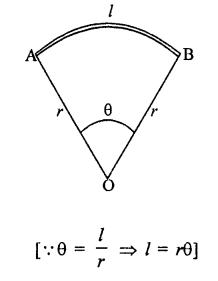
also given perimeter of sector of circle is constant say k
∴ rθ + 2r = k ⇒ r (θ + 2) = k …(i)
Let A = area of sector of circle = 1/2 r2θ
Que-14: Show that the surface area of a closed cuboid with square base and given volume is minimum when it is a cube.
Sol: Let x, x, y are the length, breadth and height of closed cuboid.
∴ area of base square = x2;
area of four walls = 4xy
Let S = area of cuboid = 2x2 + 4xy …(1)
Further, V = volume of cuboid = x2y …(2)
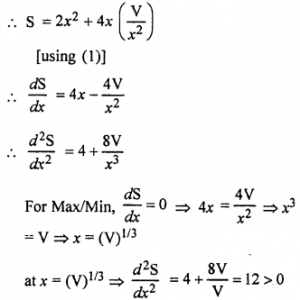
∴ S is minimise for x = ³√v
∴ y = V/x² = V/V2/3 = V1/3
Hence all the dimensions of cuboid are equal.
∴ Cuboid because cube.
Hence the surface area of a closed cuboid with square base and given volume is minimum when it is a cube.
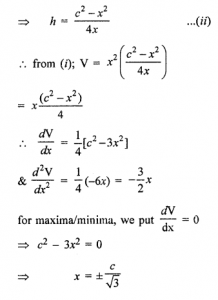
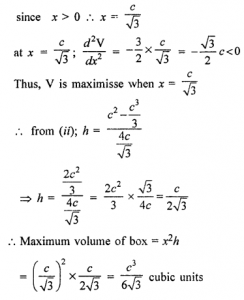
Que-15: An open box with a square base is to be made out of a given quantity of cardboard of area c2 square units. Show that the maximum volume of the box is c²/6√3 cubic units.
Sol: Let x be the side of square box and h be the height of open box
Then V = volume of box = x2 h ….(i)
and area of box = c2 = x2 + 4xh
Que-16: A cylinder is such that sum of its height and the circumference of its base is 10 metres. Find the greatest volume of the cylinder.
Sol: Let h metres be the height and r metres be the radius of cylinder.
Then h + 2πr = 10
Let V = volume of cylinder = πr2h
⇒ V =πr2 (10 – 2πr)
Diff. both sides w.r.t. r, we have
dv√dr = π(20r – 6 π r2)
∴ d²V/dr² = π(20 – 12πr)
For maxima/minima, dv√dr = 0
⇒ π(20r – 6πr2) = 0 ⇒ (20 – 6πr) r = 0
⇒ r = 0 , 10/3π
since r > 0 ∴ r = 10/3π m.
∴ d²V/dr² = π (20-12π×10/3π) = -20π < 0
Thus, V is maximise at r = 10/3π metre
and h = 10 – 20π/3π = 10/3 m
and Maximum volume of cylinder =πr2h
= π × (10/3π)² × 10/3π m3 = 1000/27π m3
Que-17: A right circular cylinder is to be made so that the sum of its radius and its height is 6 metres. Find the maximum volume of the cylinder.
Sol: Let r be the radius and h be the height of right circular cylinder such that h + r = 6 …(i)
Let V = Volume of cylinder = πr2h
⇒ V = πr2 (6 – r) [using eqn (i)]
∴ dV/dr = π [12r – 3r2]
∴ d²V/dr = π [12 – 6r]
For maxima/minima, we put dV/dr = 0
⇒ 12r – 3r2 = 0
⇒ 3r(4 – r) = 0 ⇒ r = 0, 4
Since r ≠ 0 ∴ r = 4
& (d²V/dx²) r=4 = π[12 – 24] = -12π < 0
Thus V is maximise when r = 4
∴ from (i); h = 6 – 4 = 2
∴ Maximum volume of cylinder
= π × 42 × 2 = 32πm3
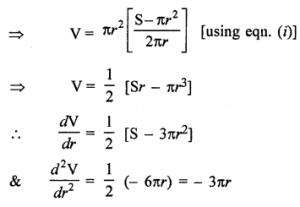
Que-18: Show that the height of an open cylinder of given surface and the greatest volume is equal to the radius of the base.
Sol: Let r be the radius and h be the height of open cylinder
Then surface area of cylinder = S =2πrh + πr2
Let V = Volume of cylinder =πr2h
For maxima/minima, we put dV/dr = 0
⇒ S = 3πr2
⇒ 2πrh + πr2 = 3πr2 ⇒ 2πrh = 2πr2
⇒ h = r
Now d²V/dr² = -3πr < 0
Thus volume V is maximise when h = r Hence the height of an open cylinder of given surface area and greatest volume is equal to the radius of cylinder.
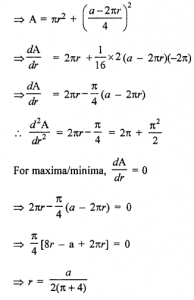
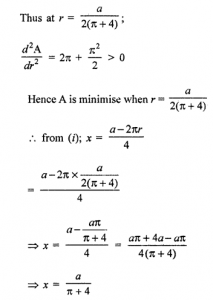
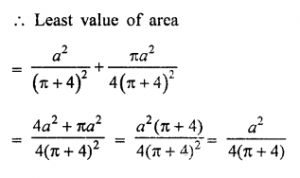
Que-19: A wire of length V is cut into two parts which are bent respectively in the form of a square and a circle. Show that the least value of the sum of the areas so formed is a2/4(π+4).
Sol: Since it is given that, a wire of length ‘a’ is cut into two parts which are bent in the form of square and circle. Let r the radius of circle and x be the side of square.
Then circumference of circle = 2πr
& perimeter of square = 4x
∴ a = 2πr + 4x ….(i)
Let A1 = area of square formed = x2
& A2 = area of circle formed = πr2
Let A = combined area of square & circle = A1 + A2
i.e. A = x2 + πr2
Que-20: Given the total surface of a cone, show that when the volume of the cone is maximum, the semi-vertical angle will be sin-1(1/3).
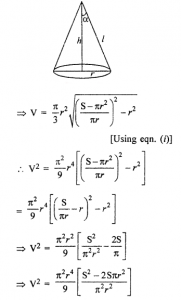
Sol: Let r be the radius & h be the height of cone respectively and let α the semivertical angle of cone.
Let S = total surface area of cone = πr2 + πrl …(i)
Also h2 + r2 = l2 …(ii)
Let V = volume of cone = π/3 r²h
V = π/3 h(l²-r²) [Using (ii)]
⇒ V = π/3 r² √l²-r²
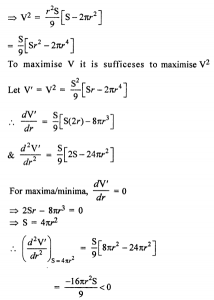
Thus V’ is maximise and hence V is maximise.
when S = 4πr2 ⇒ πr2 + πrl = 4πr2
⇒ πrl = 3πr2 ⇒ l = 3r
⇒ r/l = 1/3 ⇒ sin α = 1/3
⇒ α = sin-1(1/3)
Que-21: An enemy vehicle is moving along the curve y = x2 + 2. Find the shortest distance between the vehicle and our artillery located at (3, 2). Find the coordinates of the vehicle when the distance is shortest.
Sol: The given eqn. of curve be y = x2 + 2 ….(i)
Let P(x, y) be any point on vehicle.
Let z be the distance between the vehicle & our artillery located at A(3, 2)
∴ z = |AP| = √(x-3)²+(y-2)²
u = z2 = (x – 3)2 + (y – 2)2
⇒ u = (x – 3)2 + x4 [using (1)]
To minimize z it is sufficient to minimize u.
⇒ du/dx = 2(x – 3) + 4x3
& d²u/dx² = 2 + 12x2
For maxima/minima, du/dx = 0
⇒ 2x3 + x – 3 = 0
⇒ (x – 1) (2x2 + 2x + 3) = 0
⇒ x = 1
Since 2x2 + 2x + 3 = 0 does not gives real values of x.
At x = 1 ; d²u/dx² = 2 + 12 = 14 > 0
Thus u is minimise i.e. z is minimise when x = 1
∴ from (i); y = 12 + 2 = 3
Hence the requied coordinates of the vehicle be (1, 3).
& shortest distance = √(1-3)²+(3-2)²
= √4+1 = √5 units.
Que-22: A box is to be constructed from a square metal sheet of side 60 cm by cutting out identical squares from the four corners and turning up the sides. Find the length of the side of the square to be cut out so that the box has maximum volume.
Sol: Let x cm be the each side of square that is cut from each corner of the square sheet. Then length of of box = (60 – 2x) cm
breadth of box = (60 – 2x) cm
& height of box = x cm
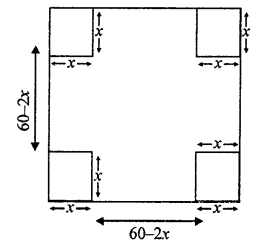
Let V = volume of box = (60 – 2x)2x
Since 60 – 2x > 0 ⇒ 2x < 60
⇒ 0 < x < 30
∴ dV/dx = 2x(60 – 2x) (-2) + (60 – 2x)2.1
∴ dV/dx = (60 – 2x) [-4x + 60 – 2x]
= (60 – 2x) (60 – 6x)
∴ d²V/dx² = (60 – 2x) (-6) + (60 – 6x) (-2)
= -360 + 12x – 120 + 12x
= – 480 + 24x
For maxima/minima, we put dV/dx = 0
⇒ (60 – 2x) (60 – 6x) = 0
⇒ x = 30 , 10
Since 0 < x < 30
∴ x = 10
∴ (d²V/dx²) x=10 = – 480 + 240 = – 240 < 0
Thus V is maximise when x = 10
Hence the required length of the side of square be 10 cm
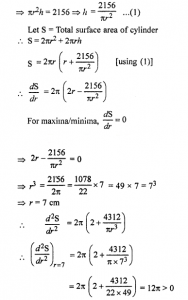
Que-23: A closed right circular cylinderfhas volume 2156 cubic units. What should be the radius of the base so that the total surface area may be minimum ? (Use π = 22/7).
Sol: Let r be the radius of the base of cylinder and h be the height of cylinder.
Then volume of cylinder = 2156 cm3
Que-24: A rectangular sheet of tin 45 cm by 24 cm is to be made into box without top, by cutting off squares from the corners and folding up the flaps. What should be the side of the square to be cut off so that the volume of the box is maximum possible ?
Sol: Let x be the side of the square that is cut off from each corner of the plate. Then sides of the base are 45 – 2x, 24 – 2x, x cm.
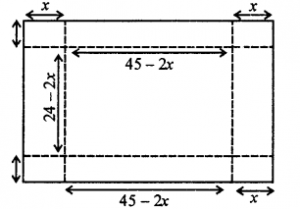
∴ Volume of the box = V =(45 – 2x)(24 – 2x) x
∴ V = (45 – 2x) (24x – 2x2) = 2x(12 – x)(45 – 2x)
∴ V = 2x[540 – 24x – 45x + 2x2] = 2x [2x2 – 69x + 540]
∴ dV/dx = 2[6x2 – 138x + 540] = 4 [3x2 – 69x + 270]
For max/minima, dV/dx = 0
⇒ 3x2 – 69x + 270 = 0
∴ x = 69±39/6 = 5, 18
But x ≠ 18. Thus, x = 5, d²V/dx² = 4[6x-69]
∴ (d²V/dx²) x=5 = 4(- 39) = -156 < 0
∴ V is maximise for x = 5.
Hence the volume of the box is maximum when the side of square is 5 cm and max. volume = 35 × 14 × 5 = 2450 cm3.
Que-25: Prove that the right circular cone of maximum volume which can be inscribed in a sphere of radius a has its altitude equal to 4a/3.
Sol: Let R be the radius of circumscribed sphere. Let OP = x
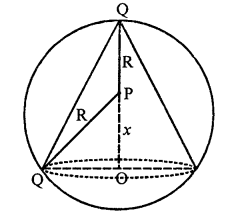
It is obvious for maximum volume, the axis of cone must along the diameter of sphere.
∴ height of cone = OQ = R + x
radius of cone = OQ = √R²-x²
Let V = volume of cone
= π/3(√R²-x²)²(R+x)
⇒ V = π/3 (R2 – x2) (R + x)
∴ dV/dx = π/3 [R2 – 2Rx – 3x2]
For maxima/minima, dV/dx = 0
⇒ R2 – 2Rx – 3x2 = 0
⇒ 3x2 + 2Rx – R2 = 0
⇒ (x + R) (3x – R) = 0
⇒ x = -R, R/3
[since x ≠ – R if x = – R then height of cone = x + R = 0]
∴ x = R/3
Hence volume of cone V is maximum when x = R/3
and height of cone = x + R
= R/3+R = 4R/3
= 2/3 × diameter of sphere
Hence volume of cone is maximum when height of cone is equal to 2/3 of the diameter of sphere.
Que-26: Find the volume of the largest right circular cylinder that can be inscribed in a sphere of radius α.
Sol: Let OP = OQ = x
Let R be the radius of sphere in which cylinder is inscribed.
From △OPS, we have
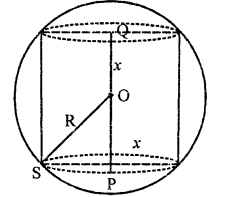
SP = √R²-x²
∴ radius of cylinder = √R²-x²
and height of cylinder = PQ = 2x
Let V = volume of cylinder = π
⇒ V = π (R2 – x2)2x
∴ dV/dx = 2π [R2 – 3x2]
For maxima/minima, dV/dx = 0
⇒ R2 – 3x2 = 0 ⇒ x = R/√3 [∵ x > 0]
Now d²V/dx² = 2π (-6x)
at x = R√3 ; d²V/dx² = -12π × R√3 < 0
Hence volume V is maximum when x = R√3 and height of cylinder = 2x = 2R√3
Que-27: Assuming that the stiffness of a beam of rectangular cross-section varies as the breadth and as the cube of the depth, what must be the breadth of the stiffest beam that can be cut from a log of diameter a.
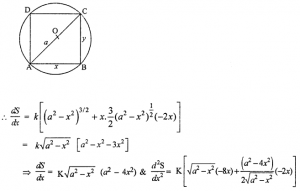
Sol: Let ABCD be the cross-sectional area of beam that cut from a log of diameter a
∴ AC = a = diameter of circle.
Let x be the breadth of log and y be the depth of log respectively. In right angled △ABC, by pythagoras therorem, we have
x2 + y2 = a2
Let S = strength of beam α xy3
⇒ S = kx y3 where k be the constant of proportionality
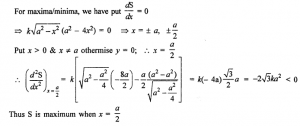
⇒ S = kx (a2 – x2)3/2
Que-28: Show that the radius of the right circular cylinder of greatest curved surface which can be inscribed in a givn right cricular cone is half that of the cone.
Sol: Let OC = r be the radius of cone and OA = h be the height of cone.
Let ON = x be the radius of cylinder that is inscribed in cone.
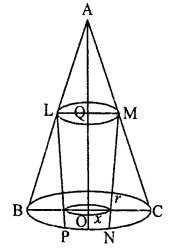
So △AOC ~ △MNC (by AA axiom of similarity)
∴ AO/MN = OC/NC = h/MN = r/r-x
∴ MN = h/r(r – x) = height of cylinder
Let S = curved surface area of cylinder = 2πx (MN)
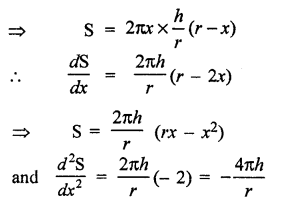
for maxima/minima, dS/dx = 0
⇒ 2πh/r (r – 2x) = 0 ⇒ x = r²
at x = r/2; d²S/dx²= -4πh/r < 0
Thus S is maximise when x = r/2
i.e. the radius of right circular cylinder of greatest curved surface area which can be inscribed in given right circular cone is half that of the cone.
–: End Maxima And Minima Class 12 OP Malhotra Exe-12C ISC Maths Ch-12 Solution :–
Return to :- OP Malhotra ISC Class-12 S Chand Publication Maths Solutions
Thanks
Please share with your friends