Maximization and Minimization of Total Revenue Class 12 OP Malhotra Exe-26D ISC Maths Solutions Ch-26 Application of Calculus in Commerce and Economics. In this article you would learn how to solve problems on Maximization and Minimization of Total Revenue with answer and example. Visit official Website CISCE for detail information about ISC Board Class-12 Mathematics.
Maximization and Minimization of Total Revenue Class 12 OP Malhotra Exe-26D ISC Maths Solutions Ch-26 Application of Calculus in Commerce and Economics
| Board | ISC |
| Publications | S Chand |
| Subject | Maths |
| Class | 12th |
| Chapter-26 | Application of Calculus in Commerce and Economics |
| Writer | OP Malhotra |
| Exe-26(d) | Maximization and Minimization of Total Revenue |
Questions on Maximization and Minimization of Total Revenue with Solutions
Application of Calculus in Commerce and Economics Class 12 OP Malhotra Exe-26D Solutions
Que-1: The demand function for a manu- facturers product is p = 20 – x/4, where x is the number of units and p is the price per unit. At what value of x will there be revenue? What is the maximum revenue?
Sol: Given demand function is given by p = 20 – x/4
∴ Revenue function = R(x) = px = (20−x/4)x x = 20x – x²/4
Now d/x R(x) = 20 – 2x/4 and d²/dx² R(x) = –2/4 = – 1/2
For maxima/minima, d/dx R(x) = 0 ⇒ 20 – x/2 = 0 ⇒ x = 40
at x = 40; d²/dx² R(x) = – 1/2 < 0
Hence Revenue is maximise when x = 40 units
∴ Maximum revenue function = 20 × 40 – (40)²/4 = 800 – 400 = 400
Que-2: The unit dem and function is x = 1/4 (24 – 2p), where x is the number of units demanded and p is the price per unit. Find (i) the revenue function R in terms of price p. (ii) the price and number of units demanded for which the revenue is maximum.
Sol: Given demand function is x = 1/3(24 – 2p) ⇒ 3x = 24 – 2p ⇒ p = (24−3x)/2 …(1)
Thus, revenue function R(x) = px = (12−3/2x)x
∴ d/dx R(x) = 12 – 3x and d²/dx² R(x) = – 3
For maxima/minima, we put d/dx R(x) = 0 ⇒ 12 – 3x = 0 ⇒ x = 4
∴ [d²/dx² R(x)]x=4 = -3 < 0
Thus Revenue function R is maximise when x = 4 units
∴ from (1); p = 24–12/2 = ₹ 6 and Revenue function = px = 1/3 (24p – 2p²)
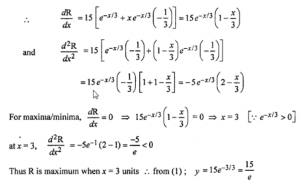
Que-3: The demand function for a particular commodity is y = 15 e-x / 3 for 0 ≤ x ≤ 8, where p is the price per unit and x is the number of units demanded. Determine the price and quantity for which total revenue is maximum.
Sol: Given demand function is y = 15 e-x / 3 for 0 ≤ x ≤ 8
∴ revenue function R(x) = yx = 15 e-x / 3 . x
Que-4: A club has 1000 menbers who are each paying ₹ 100 per month. The club proposes to increase the monthly membership fee and it is expected that for every increase of ₹ 1, five members will discontinue the service. Find what increase will yield maximum revenue and what will this revenue be?
Sol: Let ₹ x be the required increase in monthly fee.
Since it is given that for each increase of ₹ 1, 5 persons will discontinue the membership.
Thus new no. of members = (1000 – 5x) and new rate of membership = (100 + x)
∴ revenue function = R(x) = (100 + x)(1000 – 5x)
∴ dR/dx = (100 + x)(- 5) + (1000 – 5x) = 500 – 10x and d²R/dx² = – 10
For maxima/minima, we put dRdx = 0 ⇒ 500 – 10x = 0 ⇒ x = 50
∴ (d²R/dx²)x=50 = 10 < 0
Thus, R is maximum when x = 50
∴ Required increase in monthly for be ₹ 50.
and Max. Revenue = (100 + 50)(1000 – 250) = 150 × 750 = 1,12,500
Que-5: A company charges ? 550 for a transister set on orders of 50 or less sets. The charge is reduced by ₹ 5 per set for each set ordered in excess of 50. Find the largest size order company should allow so as to receive maximum revenue.
Sol: Let x be the required excess of transistor sets.
Since it is given that the charge is reduced by ₹ 5 per set for each set ordered in excess of 50 .
Then new no. of sets = (50 + x)
new price of transistor = (550 – 5x)
∴ revenue function R(x) = (50 + x)(550 – 5x)
∴ dR/dx = (50 + x) (-5) + (550 – 5x) . 1 = 300 – 10x and d²R/dx² = – 10
For maxima/minima, we put dRdx = 0 ⇒ 300 – 10x = 0 ⇒ x = 30
at x = 30; d²R/dx² = 10 < 0
Thus R is maximum when x =30
∴ required largest size order that the company should allow so as to receive maximum revenue will be (50 + 30) i.e. 80 sets.
Que-6: A steel plant is capable of producing x tonnes per day of a low grade steel and y tonnes per day of a nigh grade steel, where y = (42−5x)/(10−x). If the fixed market price of low grade steel is half of high grade steel, show that 6 tonnes of low grade steel are produced per day for maximum total revenue.
Sol: Given y = (42−5x)/(10−x) where x tonnes of low grade steel and y tonnes of high grade steel.
∴ revenue function R(x) = yx = ((42−5x)/(10−x))x
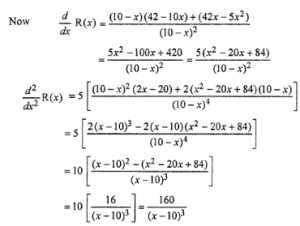
For maxima/minima, dRdx = 0 ⇒ x² – 20x + 84 = 0 ⇒ (x – 6) (x – 14) = 0 ⇒ x = 16, 14
at x = 6; d²R/dx² = 160/(6−10)³ = –160/64 = –5/2 < 0
Thus R is maximum when x = 6 Hence 6 tonnes of low grade steel are produced per day for maximum total revenue.
Que-7: A tour operator engages a bus of seating capacity of 50 for taking children on an excursion and charges ₹ 100 per child with an additional charge of ₹ 2.50 for each subsequent cancellation. Determine the total revenue R(x), as a function of x, the number of cancellation received prior to the departure date. What is the value of x for which R(x) maximum.
Sol: Let x be the number of cancellations received prior to the departure date.
Since it is given that a tour operator engages a bus of seating capacity of 50 children and charges ₹ 100 per child with an additional charge of ₹ 2.50 for each subsequent cancellation.
∴ new no. of children =50 – x and new charge = ₹ (100 + 2.5x)
Thus, total revenue function R(x) = (50 – x)(100 + 2.5x)
⇒ R(x) = 5000 + 25x – (5/2)x² ∴ dR/dx = 25 – 5x and d²R/dx² = -5
For maxima/minima, dR/dx = 0 ⇒ 25 – 5x = 0 ⇒ x = 5 and (d²R/dx²)x=5 = -5 < 0
Thus R is maximise when x = 5
∴ required no. of cancellations = 5
Que-8: The revenue function of a product is given by the relation y = 4000000 – (x – 2000)2, where y is the total revenue and x is the number of units sold. Find (i) the number of units sold which maximizes total revenue, (ii) the amount of maximum revenue.
Sol: Given total revenue function y = 4000000 – (x – 2000)²
∴ dy/dx = -2(x – 2000) and d²y/dx² = -2
For maxima/minima, dy/dx = 0 ⇒ x – 2000 = 0 ⇒ x = 2000
at x = 2000; d²y/dx² = -2 < 0
Thus y is maximise when x = 2000
Thus total revenue is maximise when x = 2000
and Maximum revenue = R(2000) = 4000000 – (2000-2000)² = ₹ 4000000
Que-9: The total cost and demand functions of an item are given by C(x) = x³/3 – 7x² + 111x + 50 and p = 100 – x respectively. Write the total revenue function and the profit function. Find the profit maximizing level of output x and the maximum profit.
Sol: Given cost function C(x) = x³/3 – 7x² + 111x + 50 and demand function p = 100 – x
∴ Total revenue function = R(x) = px = (100 – x)x
and profit function = P(x) = R(x) – C(x)
∴ P(x) = 100x – x² – x³/3 + 7x² – 111x – 50 = –x³/3 + 6x² – 11x = 50
d/dx P(x) = -x² + 12x – 11 and d²P/dx² P(x) = -2x + 12
For maxima/minima, dP/dx = 0 ⇒ -x² + 12x – 11 = 0 ⇒ x² – 12x + 11 = 0
⇒ (x – 1)(x – 11) = 0 ⇒ x = 1, 11
and ((d²/dx²)P(x))x=11 = – 22 + 12 = – 10 < 0
Thus profit function P(x) is maximum when x = 11
and Maximum profit = P (11) = –11³/3 + 6 × 112 – 121 – 50
= –1331/3 + 726 – 171 = (−1331+2178−513)/3 = 343/3
Que-10: A company has produced x items and the total cost C and total revenue R are given by the equation C = 100 + 0.05 x2 and R = 3x. Find how many items should be produced to maximize the profit. What is this profit?
Sol: Given cost function C(x) = 100 + 0.015x² and Revenue function R = 3x
Let P(x) = profit function = R(x) – C(x) = 3x – 100 – 0.015x²
∴d/dx P(x) = 3 – 0.03x and (d²/dx²)P(x) = -0.03
For maxima/minima, (d/dx)P(x) = 0 ⇒ 3 – 0.03x = 0 ⇒ x = 3/0.03 = 100
∴ at x = 100; (d²/dx²)P(x) = -0.03 < 0
Thus, profit P is maximum when x = 100
and hence required no. of items to get maximum profit be 10 .
Also maximum profit =P(100) = 300 – 100 – 0.015 × 10000 = 300 – 100 – 150 = 50
Que-11: A radio manufacturer finds that he can sell x radios per week at ₹ p each, where p = 2(100−x/4). His cost of production of x radios per week is ₹ (120x+x²/2). Show that his profit is maximum when the production is 40 radios per week. Find also the maximum profit per week.
Sol: Given p = 2(100−x/4)
∴ Revenue function R(x) = px = 2(100−x/4)x
and cost function C(x) = ₹(120x+x²/2)
Let P(x) be the profit function
Then P(x) = R(x) – C(x) = 200x – x²/2 – 120x – x²/2 = 80x – x²
∴ (d/dx)P(x) = 80 – 2x and (d²/dx²)P(x) = -2
For maxima/minima, (d/dx)P(x) = 0 ⇒ 80 – 2x = 0 ⇒ x = 40
at x = 40; (d²/dx²)P(x) = – 2 < 0
Thus P(x) is maximise when x = 40
Hence profit is maximum when the production is 40 radios per week.
∴ Max. profit per week = P(40) = 80 × 40 – 402 = 3200 – 1600 = ₹ 1600
Que-12: (i) Find the profit maximizing output level given x = 200 – 10p and AC = 10 + x/25, where x represents the units of output, p represents price, and AC represents average cost.
(ii) The demand function of an output is x = 106 – 2p, where x is the number of units of output and; the price per unit output. If the total revenue be px, determine the number of units for maximum profit.
Sol: (i) Given x = 200 – 10p ⇒10p = 200 – x ⇒ p = 20 – x/10
∴ Revenue function R(x) = px = (20−x/10)x
given AC = 10 + x/25, Also AC = C(x)/x
∴ C(x) = AC × x = (10+x/25)x
Thus profit function P(x) = R(x) – C(x) = (20−x/10)x – (10+x/25)x
= 10x – x²/10 – x²/25 = 10x – 7x²/50
∴ d/dxP(x) = 10 – 14x/50 and (d²/dx²)P(x) = – 14/50
For maxima/minima, we put ddxP(x) = 0 ⇒ 10 – 14x/50 = 0 ⇒ x = 250/7
and (d²/dx²)P(x) = – 7/25 < 0 at x = 250/7
Thus profit P(x) is maximise when x = 250/7
(ii) Given demand function is given by x = 106 – 2p ⇒ p = (106−x)/2 = 53 – x/2
∴ Revenue function R(x) = px = (53−x/2)x and C(x) = 7x
∴ profit function P(x) = R(x) – C(x) = 53x – x²/2 – 7x = 46x – x²/2
∴ (d/dx)P(x) = 46 – x and (d²/dx²)P(x) = -1
For maxima/minima, we put (d/dx)P(x) = 0 ⇒ 46 – x = 0 ⇒ x = 46
and (d²/dx²)P(x) = – 1 < 0
Thus P(x) is maximise when x = 46 units
and maximum profit = 46 × 46 – (46)²/2 = 46 × 23 = ₹ 1058
Que-13: The cost function C(x) for producing x units of a commodity is given by
C(x) = 1/3 x3 – 5x2 + 75x + 10 .
At what level of output the marginal cost (i.e dC/dx) attains its mininum? What is the marginal cost at this level of production?
Sol: Given cost function C(x) = x³/3 – 5x² + 75x + 10
∴ Marginal cost function MC = dC/dx = x2 – 10x + 75
Now (d/dx)(MC) = 2x – 10 and (d²/dx²)(MC) = 2
For maxima/minima, (d/dx)(MC) = 0 ⇒ 2x – 10 = 0 ⇒ x = 5
at x = 5; (d²/dx²)(MC) = 2 > 0
Thus marginal cost function is minimise when x = 5
∴ Minimum marginal cost = 5² – 50 + 75 = 50
Que-14: The total cost function of producing and marketing x units of a commodity is given by C = 16 – 12x + 2x2. Find the level of output at which it is minimum.
Sol: Given cost function C = 16 – 12x + 2x²
∴ dC/dx = – 12 + 4x and (d²C/dx²) = 4
For maxima/minima, dCdx = 0 ⇒ – 12 + 4x = 0 ⇒ x = 3
and (d²C/dx²)x=3 = 4 > 0
Thus C(x) is minimise when x = 3
Hence the required level of output be 3 units.
Que-15: The total cost function of a product is given by C(x) = x3 – 315x2 + 27,000x + 20,000 where x is the number of units produced. Determine the number of units that should be produced to minimize the total cost.
Sol: Given total cost function C(x) = x³ – 315x² + 27000x + 20000
∴ d/dx C(x) = 3x² – 630x + 27000 and (d²/dx²)C(x) = 6x – 630
For maxima/minima, (d/dx)C(x) = 0 ⇒ 3(x² – 210x + 9000) = 0
⇒ (x – 150)(x – 60) = 0 ⇒ x= 150, 60
at x = 150; (d²/dx²)C(x) = 900 – 630 = 270 > 0
Thus cost is minimise when x = 150 units.
Hence the required no. of units that should be produced to minimize the total cost be 150 units.
Que-16: The manufacturing cost of an item consists of ₹ 1000 as overheads, material cost ₹ 2 per unit x² and the labour cost ₹x²/90 for x units produced. Find how many units of the item should be produced so that the average cost is minimum.
Sol: Total fixed cost = TFC = ₹ 1000
given material cost per unit = ₹ 2
∴ material cost for x units = ₹ 2x
Total labour cost =₹ (2x+x²/70)
Thus, total cost function C(x) = TFC + TVC = 1000 + 2x + x²/90
∴ Average cost (AC) = C(x)/x = 1000/x + 2 + x9/0
∴ d/dx (AC) = – 1000/x² + 1/90 and (d²/dx²)(AC) = 2000/x³
For maxima/minima, (d/dx)(AC) = 0
⇒ −1000/x²+1/90 = 0 ⇒ x² = 9000 = (300)² ⇒ x = 300 (∵ x > 0)
at x = 300; (d/dx)(AC) = 2000/(300)³ > 0
Thus AC i.e. average cost is minimum when x = 300 units
Que-17: The cost function of a firm is C = 5x2 + 28x + 5, where C is the cost and $x$ is level of output. A tax at the rate of ₹ 2 per unit of output is imposed and the producer adds it to his cost. Find the minimum value of the average cost.
Sol: Given cost function C = 5x² + 28x + 5
∴ Total tax imposed on x unit of output = ₹ 2x
∴ Total cost function = C(x) = 5x² + 30x + 5
∴ Average cost function (AC) = C(x)/x = 5x + 30 + 5/x
∴ (d/dx)(AC) = 5 – 5/x² and (d²/dx²)(AC) = 10/x³
For maxima/minima, (d/dx)(AC) = 0 ⇒ 5 – 5/x² = 0 ⇒ x = 1 (∵ x > 0)
∴(d²/dx²)(AC) = 10/1³ = 10 > 0
Thus average cost is minimise when x = 1 unit and min average cost = 5 + 30 + 5 = 40
Que-18: The manufacturing cost of an article involves a fixed overhead of ₹ 100 per day ₹ 0.50 for x² material and x²/100 per day for labour and machinery to produce x articles. How many articles should be produced per day to minimize the average cost per article.
Sol: Given TFC = fixed overhead cost = ₹ 100
TVC = 0.50 × x + x²/100
Thus average cost (AC) = TC/x = 100/x + 1/2 + x/100
∴ (d/dx)(AC) = – 100/x² + 1/100
∴(d²/dx²)(AC) = 200/x³
For maxima/minima, (d/dx)AC = 0 ⇒ −100/x² + 1/100 = 0 ⇒ x = 100
and (d²/dx²)(AC) = 200/(100)³ = 2/10000 > 0
Thus AC is minimise when x = 100 units
Que-19: (i) A firm produces x units of output per week at a total cost of ₹ x³/3 – x² + 5x + 3, find the output levels at which the marginal cost and average variable cost attain their respective minima.
(ii) The cost function of a firm is given by C = (1/3)x³ – 5x + 30x + 10, where C is the total cost for x items. Determine x at which the marginal cost is minimum.
Sol: (i) Given total cost function C(x) = x³/3 – x² + 5x + 3
∴ Marginal cost function (MC) = dC/dx = x² – 2x + 5
and (d/dx)(MC) = 2x – 2 and (d²/dx²)(MC) = 2
For maxima/minima, (d/dx)(MC) = 0 ⇒ 2x – 2 = 0 ⇒ x = 1
and [(d²/dx²)(MC)]x=1 = 2 > 0
Thus marginal cost (MC) is minimise when x = 1
Hence the required output level at which MC is minimum be 1 unit.
From eqn. (1); we have
Total variable cost = x³/3 – x² + 5x and TFC = c(0) = 3
Thus, AVC = TVC/x = x²/3 – x + 5
∴ (d/dx)(AVC) = 2x/3 – 1 and (d²/dx²)(AVC) = 2/3
For maxima/minima, (d/dx)(AVC) = 0 ⇒ 2x/3 = 1 ⇒ x = 3/2
and x = 3/2; (d²/dx²)(AVC) = 2/3 > 0
Thus AVC is minimise when x = 3/2 units
(ii) Given C(x) = x³/3 – 5x² + 30x + 10
∴ Marginal cost function (MC) = dC/dx = x² – 10x + 30
∴ d/dx(MC) = 2x – 10 and (d²/dx²)(MC) = 2
For maxima/minima, we put (d/dx)(MC) = 0 ⇒ 2x – 10 = 0 ⇒ x = 5
∴ at x = 5; (d²/dx²)(MC) = 2 > 0
This MC is minimise when x = 5 units
Que-20: Given a quadratic cost function C(x) = ax2 + bx + c, minimize the average cost and show that the average cost is equal to marginal cost at that value.
Sol: Given cost function C(x) = ax² + bx + c
∴ average cost (AC) = C(x)/x = ax + b + c/x
Now (d/dx)(AC) = a – c/x² and (d²/dx²)(AC) = 2c/x³
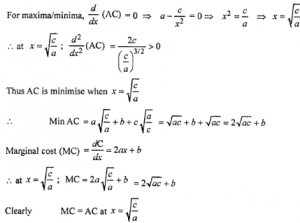
Hence the average cost is equal to marginal cost at the point of minimum average cost.
–: End of Maximization and Minimization of Total Revenue Class 12 OP Malhotra Exe-26D ISC Maths Solutions :–
Return to :- OP Malhotra ISC Class-12 S Chand Publication Maths Solutions
Please share with your friends
Thanks