MCQs on Organic Chemistry Class-10 Concise ICSE Selina Solutions Chapter-12. We Provide Answer of MCQs Questions of Miscellaneous Exercise-12 for ICSE Class-10 concise . The given Solutions is according to the Latest editions. Visit official Website CISCE for detail information about ICSE Board Class-10.
MCQs on Organic Chemistry Class-10 Concise ICSE Selina Solutions Chapter-12
| Board | ICSE |
| Book / Publication | Concise / Selina |
| Subject | Chemistry |
| Class | 10th |
| Writer | Dr SP Singh |
| Chapter-12 | Organic Chemistry |
| Topics | MCQs |
| Edition | 2025-2026 |
Imp MCQs on Organic Chemistry with Answer
Page-224
Que-1: Which of the following statements is wrong about alkanes?
(a) They are all saturated hydrocarbon.
(b) They can undergo addition as well as substitution reaction.
(c) They are almost non polar in nature.
(d) On complete combustion give out carbon dioxide and water.
Ans: (b) They can undergo addition as well as substitution reaction.
Hint: The non-availability of electrons in the single covalent bond makes them less reactive and therefore undergo characteristic substitution reaction only.
Que-2: The organic compound obtained as the end product of the fermentation of sugar solution is :
(a) Methanol
(b) Ethanol
(c) Ethane
(d) Methanoic acid
Ans:
(b) Ethanol
Que-3: An organic compound undergoes addition reactions and gives a red colour precipitate with ammoniacal cuprous chloride. Therefore, the organic compound could be :
(a) Ethane
(b) Ethene
(c) Ethyne
(d) Ethanol
Ans: (c) Ethyne
Hint: When few drops of ammoniacal cuprous chloride is added to ethyne, red precipitate of copper acetylide is foamed.
Que-4: An organic weak acid is :
(a) Formic acid
(b) Sulphuric acid
(c) Nitric acid
(d) Hydrochloric acid
Ans: (a) Formic acid
Hint: Formic acid is the organic weak acid.
Que-5: The organic compound mixed with ethanol to make it spurious is:
(a) Methanol
(b) Methanoic acid
(c) Methanal
(d) Ethanoic acid
Ans: (c) Methanol
Hint: Methanol is mixed with ethanol by improper distillation. This illicit liqueur is referred as spurious alcohol. This contains large proportion of methanol and it is fatal for human consumption.
Que-6: The functional group present in acetic acid is:
(a) Ketonic >C=O
(b) Hydroxyl -OH
(c) Aldehydic -CHO
(d) Carboxyl -COOH
Ans: (d) Carboxyl -COOH
Hint: Formula of acetic acid is CH3-COOH. Hence, we can see that Carboxyl -COOH is present.
Que-7: The unsaturated hydrocarbons undergo:
(a) a substitution reaction
(b) an oxidation reaction
(c) an addition reaction
(d) none of the above
Ans: (c) Addition reaction
Hint: The availability of electrons in the double or triple bond makes them more reactive and therefore they undergo characteristic addition reactions only.
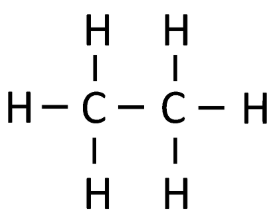
Que-8: The number of C-H bonds in ethane molecule are:
(a) Four
(b) Six
(c) Eight
(d) Ten
Ans: (b) Six
Hint: Below is the structural formula of Ethane:
Que-9: Hydrocarbon which is a greenhouse gas is:
(a) Butane
(b) Ethylene
(c) Ethane
(d) Methane
Ans: (d) Methane
Hint: Methane absorbs outgoing heat radiation from the earth. It is twenty times more effective in trapping heat in comparison to carbon dioxide. Hence, it contributes to green house effect.
Que-10: The IUPAC name of acetylene is:
(a) Propane
(b) Propyne
(c) ethene
(d) ethyne
Ans: (d) Ethyne
Hint: The IUPAC name of acetylene is ethyne (C2H2).
Que-11: The organic compound having a double carbon-carbon bond is :
(a) C4H10
(b) C5H10
(c) C3H4
(d) C3H8
Ans: (b) C5H10
Hint: Carbon-carbon double bond is present in alkenes. Their general formula is CnH2n. Out of the given options only C5H10 follows this formula. Hence, it contains a carbon-carbon double bond.
Que-12: An example of a cyclic organic compound is:
(a) Pentene
(b) Butene
(c) Benzene
(d) Propene
Ans: (c) Benzene
Hint: In benzene, six carbon atoms form a ring structure and there are three single and three double bonds between the carbon atoms. Hence, benzene is a cyclic compound.
Que-13: The IUPAC name of methyl acetylene is:
(a) Propyne
(b) Ethene
(c) Propane
(d) Ethyne
Ans: (a) Propyne
Que-14: The structures of four hydrocarbons are shown below:
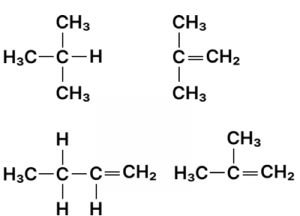
How many isomers of butene are there?
(a) 1
(b) 2
(c) 3
(d) 4
Ans: (b) 2
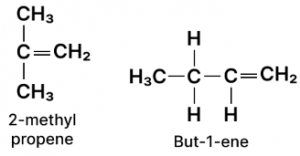
Hint: 2-methyl propene and But-1-ene are two isomers of butene present in the four hydrocarbons shown above.
Que-15: Which of the following is the best reagent to distinguish between ethylene and acetylene ?
P: Bromine water
Q: Ammoniacal silver nitrate solution
R: Acidified potassium dichromate solution
(a) Only P
(b) Only Q
(c) Both P and Q
(d) Both Q and R
Ans: (b) Only Q
Hint: Acetylene reacts with ammoniacal silver nitrate solution to give white precipitate of silver acetylide. Whereas, ethylene gives no reaction with ammoniacal silver nitrate solution.
Que-16: Which of the following molecule contains C=C bond between adjacent carbon atoms ?
P: C4H8
Q: C3H4
R: C3H6
(a) Only P
(b) Only R
(c) Both P and R
(d) Both P and Q
Ans: (c) Both P and R
Hint: Carbon-carbon double bond is present in alkenes. Their general formula is CnH2n. Out of the given options both C4H8 and C3H6 follow this formula. Hence, they contain C=C bond between adjacent carbon atoms.
The following questions are Assertion-Reason based questions. Choose the answer based on the codes given below.
1. Both A and R are true and R is the correct explanation of A.
2. Both A and R are true but R is not the correct explanation of A.
3. A is true but R is false.
4. A is false but R is true.
Que-17:
Assertion (A): Carbon shows catenation.
Reason (R): Catenation is the property of self linking by covalent bonds.
(a) (1)
(b) (2)
(c) (3)
(d) (4)
Ans: (b) (2) Both A and R are true but R is not the correct explanation of A.
Explain Why: Carbon has a strong tendency to form bonds with other carbon atoms, resulting in long chains, branched chains, and rings. This is called catenation. Hence, the assertion is true.
Catenation means the ability of atoms to link with themselves via covalent bonds. Hence, the reason is true.
However, the reason explains what is catenation, but it doesn’t explain why carbon shows catenation property. The actual reason why carbon shows strong catenation is due to its small atomic size and the strength of the C–C bond, which makes these chains stable. Hence, reason is not the correct explanation of assertion.
Que-18:
Assertion (A): Alkynes show addition reactions.
Reason (R): Alkanes show substitution reactions.
(a) (1)
(b) (2)
(c) (3)
(d) (4)
Ans: (b) (2) Both A and R are true but R is not the correct explanation of A.
Explain Why: Alkynes contain a carbon–carbon triple bond, making them highly unsaturated; therefore they readily take part in addition reactions with hydrogen, halogens, etc. Hence, the assertion is true.
Alkanes, being saturated hydrocarbons, usually react by substitution, for example, the replacement of a hydrogen atom by chlorine in the presence of ultraviolet light. Hence, the reason is true.
While both statements are correct, the fact that alkanes undergo substitution does not explain why alkynes undergo addition, hence, reason is not the correct explanation of assertion.
Que-19:
Assertion (A): The members of a homologous series can be prepared by using the same general method.
Reason (R): The members of a homologous series have the same physical properties.
(a) (1)
(b) (2)
(c) (3)
(d) (4)
Ans: (c) (3) A is true but R is false.
Explain why: All the members of a homologous series can be prepared by using the same general method of preparation. For example: Alcohols are prepared by alkyl halides. Hence, the assertion is true.
However, the physical properties of the members are not identical; they change progressively with increasing molecular mass. For instance, melting points and boiling points rise steadily as the number of carbon atoms increases. Hence, the reason is false.
Que-20:
Assertion (A): The brown colour of bromine fades when it is added to ethylene.
Reason (R): Ethylene shows substitution reactions.
(a) (1)
(b) (2)
(c) (3)
(d) (4)
Ans: (c) (3) A is true but R is false.
Explain Why: When a few drops of a bromine solution in carbon tetrachloride are added to ethylene (ethene), the reddish-brown colour of bromine disappears because bromine adds across the carbon–carbon double bond. Hence, the assertion is true.
Ethylene is an alkene and characteristically undergoes addition reactions, not substitution reactions. Hence, the reason is false.
Que-21:
Assertion (A): Acetylene burns with a sooty flame.
Reason (R): Acetylene contains a greater carbon content.
(a) (1)
(b) (2)
(c) (3)
(d) (4)
Ans: (a) (1) Both A and R are true and R is the correct explanation of A.
Explain Why: Acetylene (ethyne, C₂H₂) contains a higher proportion of carbon relative to hydrogen than compounds such as ethane (C₂H₆) or ethene (C₂H₄). During ordinary combustion, this excess carbon is not completely oxidised, so glowing carbon particles are produced, giving a luminous, sooty flame. Therefore both statements are correct, and the higher carbon content Reason directly explains why acetylene burns with a sooty flame Assertion.
Que-22:
Assertion (A): On adding ammoniacal silver nitrate to ethyne, it gives a white precipitate.
Reason (R): The above reaction forms silver acetylide.
(a) (1)
(b) (2)
(c) (3)
(d) (4)
Ans: (a) (1) Both A and R are true and R is the correct explanation of A.
Explain Why: Ethyne (HC≡CH) reacts with ammoniacal silver nitrate to give a white precipitate of silver acetylide (AgC≡CAg). Thus Assertion is correct. The precipitate’s identity—silver acetylide—explains why the white solid appears, so Reason is also true and provides the correct explanation for the assertion.
Que-23:
Assertion (A): Carboxylic acids react with alcohol in presence of concentrated H2SO4 to produce a fruity smell.
Reason (R): It is due to the formation of an aldehyde.
(a) (1)
(b) (2)
(c) (3)
(d) (4)
Ans: (c) (3) A is true but R is false.
Explain Why: Carboxylic acids like ethanoic acid react with alcohol in presence of dehydrating agent, concentrated H2SO4 to produce a ester with pleasant fruity smell. This reaction is know as reaction of esterification. Hence, the assertion is true.
—: End of MCQs on Organic Chemistry Class-10 Concise ICSE Selina Solutions : –
Return to:- Concise Selina Chemistry for ICSE Class-10 Solutions
Please Share with Your Friends if Helpful
Thanks