MCQs on Practical Work Class-10 Concise Chemistry ICSE Selina Solutions Chapter-13. All questions solved and explain with balance reaction. Assertion and reason type questions are also added to understand the topic more clearly. Visit the official Website CISCE for detail information about the ICSE Board Class-10.


MCQs on Practical Work Class-10 Concise Chemistry ICSE Selina Solutions Chapter-13
| Board | ICSE |
| Book / Publication | Concise / Selina |
| Subject | Chemistry |
| Class | 10th |
| Writer | Dr SP Singh |
| Chapter-13 | Practical Work |
| Topics | MCQs |
| Edition | 2025-2026 |
MCQs on Practical Work Chemistry with Answer
Page-235
Que-1: Carbon dioxide and Sulphur dioxide gas can be distinguished by using
(a) moist blue litmus paper(b) lime water
(c) acidified potassium dichromate paper
(d) none of the above.
Ans: (c) acidified potassium dichromate paper
Hint: There is no effect of CO2 gas on potassium dichromate whereas SO2 turns acidified potassium dichromate from orange to clear green.
K2Cr2O7 + H2SO4 + 3SO2 ⟶ K2SO4 + Cr2(SO4)3 + H2O
Que-2: The salt which in solution gives a pale green precipitate with sodium hydroxide solution and a white precipitate with barium chloride solution is :
(a) Iron (III) sulphate
(b) Iron (II) sulphate
(c) Iron (II) chloride
(d) Iron (III) chloride
Ans: (b) Iron (II) sulphate
Que-3: A compound P is heated in a test tube with sodium hydroxide solution. A red litmus paper held at the mouth of the test tube turns blue. Which of the following could compound P be?
(a) Zinc sulphate
(b) Copper sulphate
(c) Ferrous sulphate
(d) Ammonium sulphate
Ans: (d) Ammonium sulphate
Hint: Ammonium sulphate reacts with sodium hydroxide to produce sodium sulphate, ammonia gas, and water. The red litmus turns blue due to the basic ammonia gas.
Que-4: Aqueous lead (II) nitrate can be distinguished from aqueous zinc nitrate by adding any of the following solution in excess, except:
(a) aqueous potassium chloride
(b) aqueous sodium sulphate
(c) dilute sulphuric acid
(d) sodium hydroxide solution
Ans: (d) sodium hydroxide solution
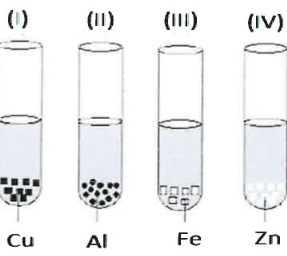
Que-5: A student takes Cu, Al, Fe and Zn strips, separately in four test tubes labeled as I, II, III and IV respectively. He adds 10 ml of freshly prepared ferrous sulphate solution to each test tube and observes the colour of the metal residue in each case.
(a) (I) and (II)
(b) (I) and (III)
(c) (II) and (III)
(d) (II) and (IV)
Ans: (d) (II) and (IV)
Hint: Zinc and aluminium are more reactive than iron. Therefore they will displace iron which will be seen as black residue.
Que-6: A nitrate which forms a precipitate with ammonium hydroxide and is also soluble in excess of it:
(a) ferrous nitrate
(b) ferric nitrate
(c) lead nitrate
(d) copper nitrate
Ans: (d) copper nitrate
Hint: When copper nitrate reacts with ammonium hydroxide NH4OH, it initially forms a light blue precipitate of copper(II) hydroxide (Cu(OH)2).
This precipitate is soluble in excess ammonium hydroxide due to the formation of a deep blue complex, tetraamminecopper(II) ([Cu(NH3)4]2+), making it soluble.
Que-7: Dilute sulphuric acid is added to sodium sulphite. The following observations are noticed:
P- A gas with a suffocating smell is evolved which turns lime water milky.
Q- A foul smelling gas is evolved which turns lead acetate solution black.
R- A gas is evolved which decolourises pink KMnO4
Which of the following is true?
(a) Only P
(b) Only Q
(c) Only R
(d) Both P and R
Ans: (d) Both P and R
Hint: When dilute sulphuric acid is added to sodium sulphite, a colourless gas with a smell of burning sulphur i.e., suffocating odour is evolved.
Na2SO3 + H2SO4 ⟶ Na2SO4 + H2O + SO2
This gas turns lime water milky.
Ca(OH)2 + SO2 ⟶ CaSO3↓ + H2O
This gas also decolourises pink KMnO4.
2KMnO4 + 2H2O + 5SO2 ⟶ K2SO4 + 2MnSO4 + 2H2SO4
Que-8: A compound X consists of molecules. Which of the following properties will be shown by X?
P- The boiling point of X is low.
Q- The compound X is soluble in water.
R- The aqueous solution of X does not conduct electricity.
(a) Only P
(b) Only Q
(c) Only R
(d) Both P and R
Ans: (d) Both P and R
Hint: Molecular compounds usually have weak intermolecular forces, leading to low boiling points. Molecular compounds typically do not form ions in solution (unless they’re acids or bases). So their solutions are usually non-conducting. Most covalent compounds are insoluble in water, unless they are polar.
The following questions are Assertion-Reason based questions. Choose the answer based on the codes given below.
1. Both A and R are true and R is the correct explanation of A.
2. Both A and R are true but R is not the correct explanation of A.
3. A is true but R is false.
4. A is false but R is true.
Que-9:
Assertion (A): HCl can be tested by AgNO3 solution.
Reason (R): White precipitate of AgCl is formed when AgNO3 is added to HCl.
(a) (1)
(b) (2)
(c) (3)
(d) (4)
Ans: (a) (1) Both A and R are true and R is the correct explanation of A.
Explain Why: HCl can be tested by AgNO3 solution. When, HCl gas is passed through Silver nitrate solution white precipitate of AgCl is formed.
AgNO3(aq) + HCl ⟶ AgCl↓ + HNO3
Hence, both assertion and reason are true and reason is the correct explanation of assertion.
Que-10:
Assertion (A): SO2 and CO2 can be distinguished by lime water.
Reason (R): Both turn lime water milky.
(a) (1)
(b) (2)
(c) (3)
(d) (4)
Ans: (d) (4) A is false but R is true.
Explain Why: SO2 and CO2 cannot be distinguished by lime water, because both turn lime water milky. Hence, the assertion is false.
Ca(OH)2 + SO2 ⟶ CaSO3↓ + H2O
Ca(OH)2 + CO2 ⟶ CaCO3↓ + H2O
SO2 and CO2 turn lime water milky. Hence, the reason is true.
Que-11:
Assertion (A): On passing H2S through lead nitrate solution, a black precipitate is formed.
Reason (R): Lead nitrate reacts with H2S to form a black precipitate of PbS.
(a) (1)
(b) (2)
(c) (3)
(d) (4)
Ans: (a) (1) Both A and R are true and R is the correct explanation of A.
Explain Why: H2S is colourless gas having a foul smell of rotten eggs. When H2S is passed through lead nitrate solution, a black precipitate of PbS is formed.
Pb(NO3)2 + H2S ⟶ PbS ↓ + 2HNO3
Hence, both assertion and reason are true and reason is the correct explanation of assertion.
Que-12:
Assertion (A): Chloride can be tested by adding concentrated sulphuric acid to it. A colourless gas with a pungent odour is evolved.
Reason (R): The gas formed is chlorine.
(a) (1)
(b) (2)
(c) (3)
(d) (4)
Ans: (c) (3) A is true but R is false.
Explain Why: The presence of chloride ion can be tested by adding concentrated sulphuric acid. It is observed that the colourless HCl gas of pungent odour is evolved. Hence, the assertion is true.
The colourless gas evolved in the above reaction is HCl. Hence, the reason is false.
Que-13:
Assertion (A): If barium nitrate solution is added to sodium sulphate solution, a white precipitate is formed.
Reason (R): Sodium sulphate solution is white in colour.
(a) (1)
(b) (2)
(c) (3)
(d) (4)
Ans: (c) (3) A is true but R is false.
Explain Why: When barium nitrate solution is added to sodium sulphate salt solution, white precipitate which is insoluble in water is formed. White precipitate is soluble in dil. HCl. Hence, the assertion (A) is true.
Sodium sulphate solution is a colorless solution. Hence, the reason is false.
—: End of MCQs on Practical Work Class-10 Concise Chemistry ICSE Selina Solutions : –
Return to:- Concise Selina Chemistry for ICSE Class-10 Solutions
Please Share with Your Friends if Helpful
Thanks