Mean Value Theorems Class 12 OP Malhotra Exe-10B ISC Maths Solutions Ch-10 Solutions. In this article you would learn about Lagrange’s Mean Value Theorem. Step by step solutions of latest textbook has been given as latest syllabus. Visit official Website CISCE for detail information about ISC Board Class-12 Mathematics.
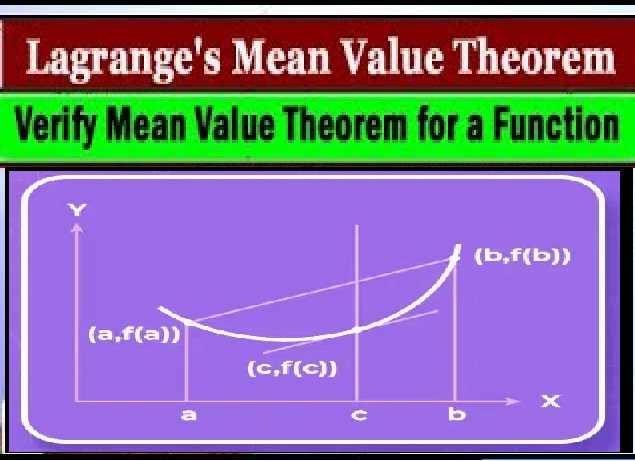
Mean Value Theorems Class 12 OP Malhotra Exe-10B ISC Maths Solutions Ch-10
| Board | ISC |
| Publications | S Chand |
| Subject | Maths |
| Class | 12th |
| Chapter-10 | Mean Value Theorems |
| Writer | OP Malhotra |
| Exe-10(B) | Lagrange’s Mean Value Theorem |
Lagrange’s Mean Value Theorem
Mean Value Theorems Class 12 OP Malhotra Exe-10B ISC Maths Solutions Ch-10 Solutions
Que-1: (i) f(x) = x(x – 2) in [1, 2]
(ii) f(x) = x² – 2x + 4 in [1, 5].
Sol: (i) Given f(x) = x (x – 2) in [1, 2]
since f(x) be polynomial in x and hence continuous on [1, 2]
Now f'(x) = 2x – 2 which exists for all x ∈ (1, 2)
∴ f(x) be derivable on (1, 2)
Thus by Lagrange’s mean value theorem ∃ atleast one real number c∈(l, 2)
s.t. f(2) – f(1)/2-1 = f(c)
⇒ f(2) – f(1) = f(c) … (i)
Now f(1) = 1 (1 -2) = – 1;
f(2) = 0 & f(x) = 2x – 2
∴ from (i); 0 – (-1) = 2c -2
⇒ 2c = 3 ⇒ c = 3/2 ∈(1, 2)
∴ L.M.V. is verified.
(ii) Given f(x) = x² – 2x + 4
since polynomial function is everywhere continuous and differentiable. Thus f(x) is continuous on [1, 5] and differentiable on (1,5). So both conditions of L.M.V theorem are satisfied.
So ∃ atleast one real number c ∈ (1, 5) such that
f'(c) = f(5) – f(1)/5-1… (1)
since f(x) = x² – 2x + 4
∴ f (x) = 2x – 2
f(1) = 1 – 2 + 4 = 3;
f(5) = 25 – 10 + 4 = 19
∴ from (1); 2c – 2 =19 – 3/4 = 4
⇒ c = 3
Thus c = 3 ∈ (1, 5) s.t.
f'(c) = f(5) – f(1)/5-1
Thus, L.M.V Theorem is verified.
Que-2: f(x) = x² + x – 1 in the interval [0, 4].
Sol: Given f (x) = x² + x – 1
since f (x) be polynomial function in x and hence everywhere continuous and differentiable. Thus f (x) is continuous on [0, 4] and differentiable on (0, 4).
Hence both conditions of L.M.V theorem are satisfied. So ∃ atleast one real number c ∈ (0, 4) such that
f’ (c) = f(4) – f(0)/4-0…(1)
We have f (x) = x² + x – 1
∴ f’ (x) = 2x + 1
f(0) = 0 + 0 – 1 = – 1 ;
f(4) = 16 + 4- 1 = 19
∴ from (1) ; 2c + 1 = 19 -(-1)/4-0 = 5
⇒ 2c = 4 ⇒ c = 2 ∈ (0, 4)
s.t. f'(c) = f(4) – f(0)/4-0
Hence L.M.V theorem is verified.
Que-3: f(x) = 2x² – 10x + 29 in [2, 7].
Sol: Given fix) = 2x² – 10x + 29 in [2, 7]
since f(x) is polynomial in x and hence continuous on [2, 7]
Now f'(x) = 4x – 10 which exists for all x ∈ (2, 7)
Here, f(2) = 8 – 20 + 29 = 17;
f(7) = 98 – 70 + 29 = 57
Thus both conditions of L.M.V. are satisfied so 3 atleast one real no. c ∈ (2, 7)
s.t. f(7) – f(2)/7-2 = f'(c)
⇒ 57 – 17/7-2 = 4c – 10 ⇒ 40/5 = 4c – 10
⇒ 4c = 18 ⇒ c = 9/2 ∈ (2, 7)
Thus, L.M.V. is verified.
Que-4: f(x) = x – 1/x ; x ∈ [1, 3].
Sol: Given f(x) = x – 1/x ; x ∈ [1, 3]
∴ f(x) = x² – 1/x which is a rational function and hence continuous on [1, 3] since x ≠ 0.
Now f'(x) = 1 + 1/x² which exists for all x∈(1, 3)
Thus, f(x) is derivable on (1, 3).
Now f(3) = 3 – 1/3 = 8/3 ; f(1) = 1 – 1/1 = 0
Thus both conditions of L.M.V. are satisfied so ∃ atleast one real number c ∈ (1, 3) such that
![Que-4: f(x) = x - 1/x ; x ∈ [1, 3].](https://icsehelp.com/wp-content/uploads/2025/07/Untitled3-2-300x227.png)
Thus L.M.V. is verified.
Que-5: f(x) = (x – 1)(x – 2)(x – 3) in [1, 4].
Sol: Given f(x) = (x – 1) (x – 2) (x – 3) in [1, 2]
⇒ f(x) = (x + 1) (x² – 5x + 6)
= x³ – 6x² + 11x – 6
Which is polynomial in x and hence continuous on [1, 2]
further f'(x) = 3x² – 12x + 11
which exists for all x∈(1, 4)
∴ f(x) is derivable on (1, 4).
further, f(4) = 3.2.1. = 6 & f(1) = 0
so both conditions of L.M.V. theorem are satisfied so ∃atleast one real no c∈ (1, 4)
![Que-5: f(x) = (x – 1)(x – 2)(x – 3) in [1, 4].](https://icsehelp.com/wp-content/uploads/2025/07/Untitled4-2-191x300.png)
Clearly c = 3 ∈(1, 4) [Here c = 1 ∉ (1, 4)
Thus, L.M.V. Theorem is verified.
Que-6: f(x) = logx in [1, e].
Sol: Given f(x) = logx in [i.e.]
Clearly logrithmic function is continuous in its domain.
∴ f(x) is continuous on [1, e].
Now, f'(x) = 1/x which is exists for all x ∈ (1, e)
∴ f(x) is derivable on (1, e.).
Further, f(e) = loge = 1;
f(l) = log 1 = 0
Thus, both conditions of L.M.V. theorem are satisfied so ∃ atleast one real number c∈(1, e)
s.t. f(e) – f(1)/e-1 = f'(c)
⇒ 1 – 0/e-1 = 1/e ⇒ c = e – 1 ∈(1, e.) [∵ e > 2 ⇒ e – 1 > 1]
Thus Lagrange’s mean value theorem is verified.
Que-7: f(x) = ex in [0, 1].
Sol: Given f(x) = ex in [0, 1]
Clearly exponential function is continuous and differentiable every where in R.
Thus f (x) is continuous on [0, 1] and derivable on (0, 1).
Now f'(x) = ex ; f(1) = e;
f(0) = e0 = 1
Thus both conditions of Rolle’s theorem are satisfied.
So ∃ atleast one real no. c∈(0, 1)
s.t. f(1) – f(0)/1-0 = f'(c)
⇒ e – 1/1 = ec ⇒ c = log (e – 1)∈(0, 1)
[∵ 1 < e – 1 < e ⇒ 0 < log (e – 1) < 1]
Thus L.M.V. theorem is verified.
Que-8: f(x) = [x] in [-1, 1],
Sol: Given f (x) = [x] in [-1, 1]
Clearly, we know that inegral part function is discontinous for all integral values.
∴ f(x) is discontinous at x = – 1, 0, 1
Thus f is not continuous on [-1, 1]
Therefore L.M.V. theorem is not applicable.
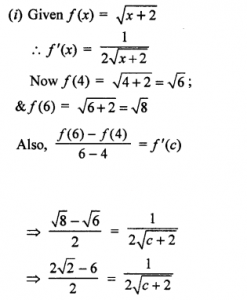
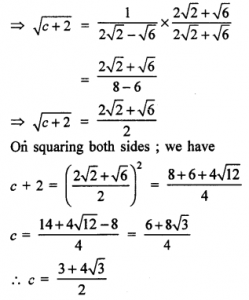
Que-9: (i) Find c so that f'(c) = f(6) – f(4)/6-4 , where f(x) = √(x+2) and c ∈ (4, 6).
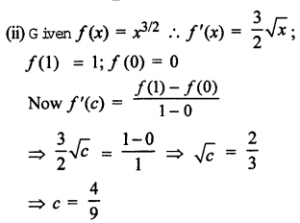
(ii) Given f(x) = x3/2 , find the value of c ∈ (0,1) such that f'(c) = f(1) – f(0)/1-0.
Sol:
Que-10: (i) Find a point on the graph of y = x³, where tangent is parallel to the chord joining (1, 1) and (3, 27).
(ii) Use L.M.V. to determine the point on the curve y = x³ – 3x, where the tangent to the curve is parallel to the chord joining (1, -2) and (2, 2).
Sol: (i) Given y = f(x) = x³
Since f(x) be polynomial in x so it continuous in [1, 3].
Also f'(x) = 3x² which is exists for all x∈(1, 3)
∴ f(x) is derivable on (1, 3).
Now f(1) = 1; f(3) = 3³ = 27
Thus both conditions of Lagrange’s mean value theorem are satisfied so ∃ atleast one real no. c∈(1, 3)
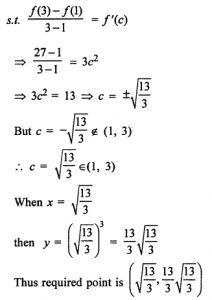
Thus, there exists a point (√13/3 , 13/3 √13/3) on given curve where the tangent is parallel to the chord joining the points (1, 1) and (3, 27).
(ii) Let y = f (x) = x³ – 3x
Here we discuss the applicability of L.M.V. theorem in [1, 2].
Since f (x) is polynomial in x
∴ f (x) is continuous in [1, 2]
Further, f(x) = 3x² – 3 exists ∀ x ∈ (1, 2).
∴ f(x) is derivable in (1, 2)
and f(1) = 1 – 3 = – 2 and f(2) = 8 – 6 = 2
Thus all the two conditions of L.M.V. theorem are satisfied.
∴ ∃ atleast one real number c ∈ (1,2) s.t.
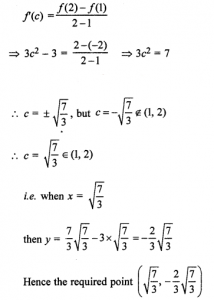
at which tangents is parallel to the chord joining (1, -2) and (2, 2) by using geometrical interpretation of L.M.V. Theorem.
Que-11: Explain why Lagrange’s Mean Value theorem is not applicable to the following functions:
(i) f(x) = {|x| if x ≠ 0
{0 if x=0
(ii) f(x) = |x| in [- 1, 2]
Sol: (i) Given f(x) ={|x| if x ≠ 0
{0 if x=0
Lf'(0) = Lt(x→0–)(f(x) – f(0)/x-0)
= Lt(x→0–)(-x-0/x-0)
& Rf'(0) = Lt(x→0+)(x-0/x-0) = 1
∴ Lf'(0) ≠ Rf'(0)
Thus f is not differentiable at x = 0 ∈ (-1, 1)
Thus f is not derivable on (-1, 1).
∴ L.M.V. theorem is not applicable.
(ii) Given f (x) = | x | in [- 1, 1]
![Que-11: Explain why Lagrange’s Mean Value theorem is not applicable to the following functions: (i) f(x) = {|x| if x ≠ 0 {0 if x=0 (ii) f(x) = |x| in [- 1, 2]](https://icsehelp.com/wp-content/uploads/2025/07/Untitled10-1-300x151.png)
∴ f'(x) does not exists at x = 0 ∈ (-1, 1)
Hence f is not derivable in (-1, 1)
∴ L.M.V. theorem is not applicable.
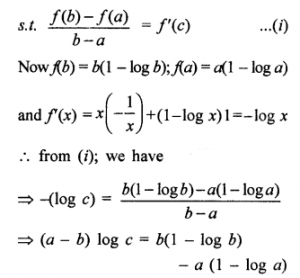
Que-12: f(x) = x(1 – logx); x > 0, show that (a-b)logc = b(1-logb)-a(1-loga); 0 < a < b.
Sol: Given f(x) = x( 1 – log x) ; x > 0 in [a, b] where 0 < a<b.
Since polynomial function is continuous & differentiable everywhere while logarithmic function is continuous & differentiable in its domain.
Thus f(x) is continuous in [a, b] & differentiable for all x > 0 and in [a, b] where 0 < a < b
Thus both conditions of L.M.V. theorem are satisfied so ∃ atleast one real no c ∈ (a, b)
–: End Mean Value Theorems Class 12 OP Malhotra Exe-10B ISC Math Ch-10 Solution :–
Return to :- OP Malhotra ISC Class-12 S Chand Publication Maths Solutions
Thanks
Please share with your friends