Measurements and Experimentation Class-9 Exe-1C MCQs Concise Physics ICSE Selina Solutions. Measurement of Time and simple Pendulum MCQs Type for Class-9 ICSE Concise Physics applicable in 2025-26 academic session. Visit official Website CISCE for detail information about ICSE Board Class-9.
Measurements and Experimentation Class-9 Exe-1C MCQs Concise Physics ICSE Selina Solutions
| Board | ICSE |
| Class | 9 |
| Subject | Physics |
| Writer / Publication | Concise selina Publishers |
| Chapter-1 | Measurements and Experimentation |
| Exe – 1 C | Measurement of Time and Simple Pendulum |
| Topics | Solution of Exe-1(C) MCQs Type |
| Academic Session | 2025-2026 |
Measurement of Time and Simple Pendulum
Measurements and Experimentation Class-9 Exe-1C MCQs Concise Physics ICSE Selina Solutions
Page 26 (Choose the correct answer from the option given below )
Que-1: The pendulum used in a clock is:
(a) Simple pendulum
(b) Compound pendulum
(c) Second pendulum
(d) None of these
Ans: (b) Compound pendulum
Hint- Compound pendulums have a more constant period of oscillation over a wider range of amplitudes, making them suitable for use in clocks.
Que-2: The time taken to complete one oscillation is called
(a) Frequency
(b) Amplitude
(c) Time period
(d) Acceleration
Ans: (c) Time period
Hint- The time taken to complete one oscillation is called Time period
Que-3: The number of oscillations made in the second is called:
(a) Amplitude
(b) Time period
(c) Frequency
(d) None of these
Ans: (c) Frequency
Hint- Frequency is the number of oscillations made in the second
Page 27
Que-4: The unit of the period is:
(a) Hertz
(b) Nanometer
(c) Second
(d) Centimetre
Ans: (c) Second
Hint- Second is the unit of the period
Que-5: The relationship between time period and frequency is :
(a) f = T
(b) f = 1/T
(c) f = √T
(d) None of these
Ans: (b) f = 1/T
Hint- The relationship between time period and frequency is f = 1/T
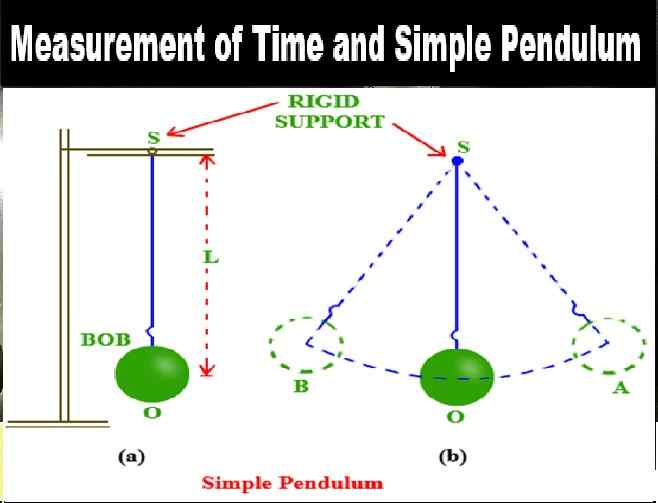
Que-6: The maximum displacement of bob from its mean position on either side is called :
(a) Period of oscillation
(b) Frequency of oscillation
(c) Amplitude
(d) Oscillation
Ans: (c) Amplitude
Hint- Amplitude is the maximum displacement of bob from its mean position on either side
Que-7: The effective length of a pendulum is related with time period as :
(a) T² ∝ l²
(b) T³ ∝ l
(c) T² ∝ l
(d) T ∝ l³
Ans: (c) T² ∝ l
Hint- The time period of oscillation is directly proportional to the square root of its effective length i.e., T ∝ √1 or in other words, the square of time period of oscillation (T2) is directly proportional to its effective length (l) i.e., T² ∝ l.
Que-8: A simple pendulum is made by suspending a bob of mass 1 kg by a string of length l. Now if the length of this pendulum is increased to 4l, then its time period T will :
(a) remain the same
(b) become twice
(c) become four times
(d) become half
Ans: (b) become twice
Reason — As T ∝ √1
When l2 = 4l then,
T2 ∝ √4l = 2√l = 2T ,
Hence, time period T will become twice.
Que-9: The time period of a seconds’ pendulum clock is —
(a) 1 s
(b) 2 s
(c) 1 min
(d) 12 h
Ans: (b) 2 s
Hint- A seconds’ pendulum clock takes 1 second in moving from one extreme to the other extreme, so the time taken for one complete oscillation is 2 seconds. Hence, its time period is 2s.
Que-10: Time period of a simple pendulum is given by :
(a) T = 2π √g/l
(b) T= 2π √l/g
(c) T= 4π √l/g
(d) T= 4π √g/l
Ans: (b) T= 2π √l/g
Hint- Time period of a simple pendulum is given by T= 2π √l/g
where:
T = time period
l = effective length of pendulum
g = acceleration due to gravity.
Que-11: The time period of a simple pendulum depends on :
(a) Length of pendulum
(b) Amplitude of oscillation
(c) Mass of bob
(d) All of the above
Ans: (a) Length of pendulum
Hint- The time period of oscillation is directly proportional to the square root of its effective length i.e., T ∝ √l or in other words, the square of time period of oscillation (T²) is directly proportional to its effective length (l) i.e., T² ∝ l. Hence, we can say that, time period of a simple pendulum depends on length of pendulum.
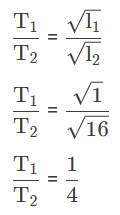
Que-12: The time period of two pendulums of length 1 m and 16 m are in ratio :
(a) 1 : 16
(b) 1 : 4
(c) 16 : 1
(d) 4 : 1
Ans: (b) 1 : 4
Hint- As, T ∝ √l
Que-13: The length of a simple pendulum is made one-fourth. Its time period becomes —
(a) four times
(b) one-fourth
(c) double
(d) half
Ans: (c) half
Que-14: The length of a seconds’ pendulum is nearly —
(a) 0.5 m
(b) 9.8 m
(c) 1.0 m
(d) 2.0 m
Ans: (c) 1.0 m
Hint- The effective length of a seconds’ pendulum, at a place where g = 9.8 ms-2 is nearly 1 meter.
— : End of Measurements and Experimentation Class-9 Exe-1C MCQs Concise Physics ICSE Selina Solutions. :–
Return to Concise Selina Physics ICSE Class-9 Solutions
Thanks
Please share with your friends