
Measures of Central Tendency RS Aggarwal Exe-25 Class-10 ICSE Maths Solutions Ch-25. In this article you will get the solved practice questions / problems on Measures of Central Tendency. Visit official website CISCE for detail information about ICSE Board Class-10.
Measures of Central Tendency RS Aggarwal Exe-25 Class-10
| Board | ICSE |
| Publications | Goyal Brothers Prakashan |
| Subject | Maths |
| Class | 10th |
| Chapter-25 | Measures of central tendency (mean) |
| Writer | RS Aggarwal |
| Book Name | Foundation |
| Topics | Mean of a grouped data |
Questions / Problems on Mean of a Grouped Data with Solutions / Answer
RS Aggarwal Exe-25 Class-10 ICSE Maths Solutions Ch-25 Measures of Central Tendency
Que-1: Find the mean of each of the following sets of numbers :
(i) 10 ,4 ,6 ,12 ,9 (ii) 0.2, 0.02, 2, 2.02, 1.22, 1.02
Sol: Sum of the given number = 10 + 4+ 6+12+ 9 = 41
Number of these numbers = 5
Therefore mean = ∑xi/n
Mean of the given number 41/5
Hence, the mean is 18.5 .
(ii) Sum of the given number = 0·2 +0.02 +21+2·02+1·22+1·02 = 6.48
Number of these numbers = 6
therefore mean = ∑xi/n
mean of the given numbers
= 6.48 6
Hence, The mean is
=
1.08 Answer.
Que-2: Find the arithmetic mean of :
(i) first eight natural numbers ;
(ii) first five prime numbers ;
(iii) first six positive even integers ;
(iv) all factors of 20
Sol: (i) the first eight natural numbers are 1,2,3,4,5,6,7,8
sum of these observations = 1+2+3+4+5+6+7+8+9 = 36
and the number of these observations are 8
the arithmetic mean of first eight natural numbers = 36/8 = 4.5
(ii) the first five prime numbers are 2,3,5,7,11
sum of these observations are 2+3+5+7+11 = 28
and the number of these observations are 5
the arithmetic mean of first prime numbers = 28/5 = 5.6
(iii) the first eight natural numbers are 2,4,6,8,10,12
sum of these observations = 2+4+6+8+10+12 = 42
and the number of these observations are 6
the arithmetic mean of first eight natural numbers = 42/6 = 7
(iv) all factors of 20 are 2,2,5
sum of these observations = 2+2+5
and the number of these observations are 3
the arithmetic mean of all factors of 20 = 9/3 = 3
Que-3: The daily minimum temperature recorded (in degrees F) at a place during a week was as under :
Monday |
Tuesday |
Wednesday |
Thursday |
Friday |
Saturday |
Sunday |
35.5 |
30.8 |
28.3 |
31.1 |
23.8 |
29.9 |
32.7 |
Find the mean temperature of the week.
Sol: The mean temperature of the week is 30.4°F.
The mean (average) temperature is calculated by summing all the daily temperature readings and dividing by the total number of days.
Calculation Steps
List the temperatures for each day:
Monday: 35.5°F
Tuesday: 30.8°F
Wednesday: 28.3°F
Thursday: 31.1°F
Friday: 23.8°F
Saturday: 29.9°F
Sunday: 32.7°F
Calculate the sum of all the temperatures:
Sum = 35.5 + 30.8 + 28.3 + 31.1 + 23.8 + 29.9 + 32.7 = 212.1°F
Count the number of days, which is 7.
Divide the sum by the number of days to find the mean temperature:
Mean temperature = Sum of temperatures / Number of days
Mean temperature = 212.1 / 7 = 30.3°F
Que-4: The marks obtained by 10 students in a class-test were as follows :
38,41,36,31,45,38,27,32,29,39
Find (i) the mean of their marks ;
(ii) the mean of their marks , when the marks of eaach student are increased by 2 ;
(iii) the mean of their marks , when 1 mark is deducted from the marks of each student ;
(iv) the mean of their marks , when the marks of each students are halved.
Sol: (i) The mean (x) of the marks is calculated as the sum of all marks (∑xi) divided by the number of students (N).
x = ∑ xi/N
The sum of the marks is 38+41+36+31+45+38+27+32+29+39=356 .The number of students is 10.
x = 356/10 = 35.6
(ii) When a constant value (c=2) is added to each observation, the new mean (xnew) is the original mean plus the constant.
xnew = x + c
xnew = 35.6 + 2 = 37.6
(iii) When a constant value (c=1) is deducted from (subtracted from) each observation, the new mean (xnew) is the original mean minus the constant.
xnew = x – c = 34.6
(iv) When each observation is halved (divided by a constant c=2), the new mean (xnew) is the original mean divided by the constant.
xnew = x/c = 35.6/2 = 17.8
Que-5: If the mean of 11 , 8 , 13 , 10 , x and 9 is 9.5 , find the value of x .
Sol: The mean of a data set is calculated by summing all the values and dividing by the number of values. We are given the mean (9.5), the values (11, 8, 13, 10, x, 9), and the count (6). The equation for the mean is:
Mean = ∑xi/n
Substituting the given values into the formula:
9.5 = 11+8+13+10+x+9/6
9.5 = 51+x/6
9.5 × 6 = 51+x
57 = 51+x
x = 57-51
x = 6
Que-6: Find the mean of 25 numbers , it being given that the mean of 15 of them is 18 and the mean of remaining ones is 13 .
Sol: The mean (x) is calculated as the sum of observations (∑xi) divided by the number of observations (n). To find the sum of the first 15 numbers, we use the formula rearranged as (∑xi = x × n ).
The sum of the first 15 numbers is:
Sum1 = 18 × 15 = 270
The remaining numbers are 25 – 15 =10
The sum of the remaining ten numbers are :
Sum2 = 13 × 10 = 130
Total sum of 25 numbers is :
Sum = Sum1 + Sum2 = 270+130 = 400
Mean = 400/25 = 16
Que-7: The mean weight of 60 students of a class is 52.75 kg . If the mean weight of 25 of them is 51 kg , find the mean weight of the remaining students .
Sol: Mean weight of 60 students is 52.75
their total weight = 52.75 × 60 = 3165 kg
Mean weight of 25 students = 51
their total weight = 25 × 51 = 1275 kg
remaining students = 60-25 = 35
weight of remaining students = 3165 – 1275 = 1890
mean weight = 1890/35 = 54 kg
∴ Mean weight of remaining students is 54 kg.
Que-8: The mean of five numbers is 18 . On excluding one number , the mean becomes 16 . Find the excluded number .
Sol: Mean of five numbers = 18
Total sum = 18 × 5 =90
Similarly , the mean of 4 excluding 1 = 16
and the total sum = 16 × 4 = 64
So, the excluded number = 90-64 = 26
∴ The excluded number is 26.
Que-9: The ages of 40 students of a group are given below :
Age (in years) |
12 |
13 |
14 |
15 |
16 |
17 |
Number of students |
6 |
8 |
5 |
7 |
9 |
5 |
Find the mean age of the group .
Sol:
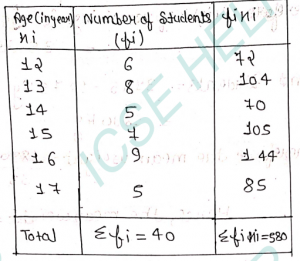
Mean = ∑fi.xi/∑fi = 580/40 = 14.5
∴ Mean age of the group is 14.5 years.
Que-10: Find the mean of the following frequency distribution :
Variate |
5 |
6 |
7 |
8 |
9 |
17 |
Frequency |
7 |
8 |
14 |
11 |
10 |
5 |
Sol:
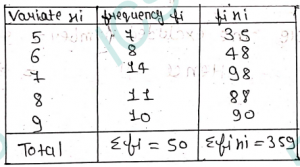
therefore mean = ∑fi.xi/∑fi = 359/50
∴ Hence mean = 7.18
Que-11: In a book of 300 pages , the distribution of misprints is shown below :
Number of misprints per page |
0 |
1 |
2 |
3 |
4 |
5 |
Number of pages |
154 |
95 |
36 |
7 |
6 |
2 |
Find the average number of misprints per page .
Sol:
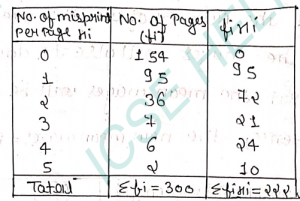
therefore the mean misprints = ∑fi.xi/∑fi = 222/300
∴ Hence mean misprints = 0.74
Que-12: The following table gives the wages of different categories of workers in a factory :
Category |
A |
B |
C |
D |
E |
F |
G |
Wages in rupee/day |
250 |
300 |
350 |
400 |
450 |
500 |
550 |
Number of workers |
2 |
4 |
8 |
12 |
10 |
6 |
8 |
(i) Calculate the mean wage .
(ii) If the number of workers in each category is doubled , what would be the new mean wage ?
Sol:
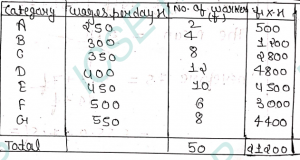
Mean wages = ∑fx/∑f =21200/50
Hence the mean wages = ₹424
If the number of workers are doubled
∴The wages will also be doubled
but the mean wages will be same
∴Hence , the new mean wages = ₹424
Que-13: If the mean of the following distribution is 7.5 , find the missing frequency f :
Variable |
5 |
6 |
7 |
8 |
9 |
10 |
11 |
12 |
Frequency |
20 |
17 |
f |
10 |
8 |
6 |
7 |
6 |
Sol:
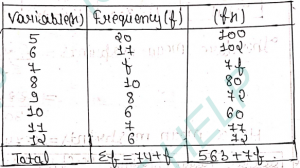
The mean = ∑fx/∑f
∴ 7.5 = 563+5f/74+f =
555 + 7.5f = 563+7f
0.5f = 8
f = 16
Que-14: If the mean of the following observations is 16.6 , find the numerical value of p .
Variate (xi) |
8 |
12 |
15 |
18 |
20 |
25 |
30 |
Frequency (fi) |
12 |
16 |
20 |
p |
16 |
8 |
4 |
Sol:
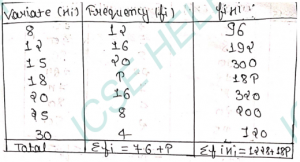
Therefore mean = ∑fi.xi/∑fi
= 1228+18p/76+p
By given mean = 16.6
1228+18p/76+p = 16.6/1
1288+18p = 16.6×(76+p)
1228+18p = 1261.6 + 16.6p
1.4p = 33.6
p = 33.6/1.4
p = 24
Que-15: Find the numerical value of x , if the mean of the following frequency distribution is 12.58 .
Variate |
5 |
8 |
10 |
12 |
x |
20 |
25 |
Frequency |
2 |
5 |
8 |
22 |
7 |
4 |
2 |
Sol:
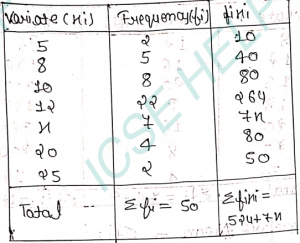
Since mean = ∑fi.xi/∑fi = 524+7x/50
We know that mean = 12.58
Therefore 524+7x/50 = 12.58
524+7x = 12.58×50
524+7x = 629
7x = 105
x = 105/7
x = 15
Que-16: Using short cut method , compute the mean of the following frequency distribution :
Height(in cm) |
58 |
60 |
62 |
65 |
66 |
68 |
Number of plants |
15 |
14 |
20 |
18 |
8 |
5 |
Sol: Suppose A = 65 , then :
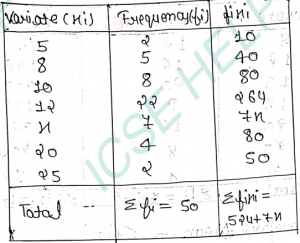
Therefore mean = A + ∑fi.di/∑fi
= 65 + (-212/80)
= 65 – 212/80
= 5200-212/80
= 4988/80
= 62.35
∴ The mean is 62.35
Que-17: The number of match sticks contained in 50 match boxes is given below :
Number of Match sticks |
40 |
42 |
43 |
44 |
45 |
48 |
Number of boxes |
6 |
7 |
12 |
9 |
10 |
6 |
(i) Using short cut method , find the mean number of match sticks per box .
(ii) How many extra sticks are to be added to all the contents of 50 match boxes to bring the mean exactly equal to 45 match sticks per box ?
Sol: Suppose , A = 44 , Then
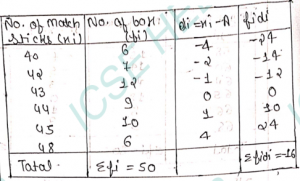
Mean = A + ∑fi.di/∑fi
= 44 + (-16/50)
= 44 -16/50
= 2200-16/50
= 2184/50
= 43.68
Que-18: The following table gives the marks scored by a set of students in an examination .
Calculate the mean of the distribution by using the short cut method .
Marks |
0-10 |
10-20 |
20-30 |
30-40 |
40-50 |
50-60 |
Number of students |
3 |
8 |
12 |
9 |
4 |
2 |
Sol:
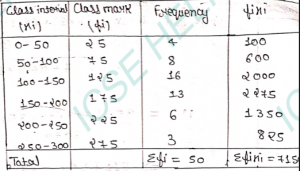
Mean = ∑fi.xi/∑fi
= 7150/50
= 143
∴Hence the mean is 143
Que-19: Given below are the daily wages of 200 workers in a factory :
Daily Wages (in rupees) |
240-300 |
300-360 |
360-420 |
420-480 |
480-540 |
Number of Workers |
20 |
30 |
20 |
40 |
90 |
Sol:
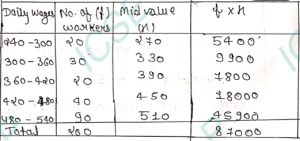
Mean = ∑fx/∑fi = 87000/200
∴ Hence the mean wages is ₹435
Que-20: If the mean of the following distribution is 24 , find the value of a.
Daily Wages (in rupees) |
0-10 |
10-20 |
20-30 |
30-40 |
40-50 |
Number of Workers |
7 |
a |
8 |
10 |
5 |
Sol: mean = (7×5) + (8×25) + (10×35) + (5×45)/7+a+8+10+5
= 35+15a+200+350+225/30+a = 24
= 810+15a = 24(30+a)
= 810+15a = 720+24a
= 9a = 90
a = 10
∴ The value of a is 10
Que-21: Calculate the mean of the following distribution using step deviation mehod .
Marks |
0-10 |
10-20 |
20-30 |
30-40 |
40-50 |
50-60 |
Number of students |
10 |
9 |
25 |
30 |
16 |
10 |
Sol:
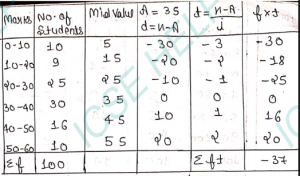
Mean = A + ∑ft/∑f× i
= 35 +(-37/100×10)
= 35 – 37/10
= (350-37)/10
= 31.3
∴ The mean is 31.3
Que-22: Using step deviation mehod , calculate the mean of the following frequency distribution :
Class-interval |
50-60 |
60-70 |
70-80 |
80-90 |
90-100 |
100-110 |
110-120 |
Frequency |
9 |
11 |
10 |
14 |
8 |
12 |
11 |
Sol:
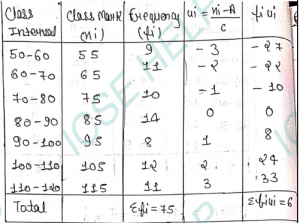
Suppose A = 85 and c = 10
Therefore , mean = A + C × ∑fi.ui/∑fi = 85 × 10 × 6/75
= 728.57
∴ The mean is 728.57
Que-23: The weights of 50 apples were recorded as given below . Calculate the mean weight , to the nearest gram , by the step deviation method .
Weight (in grams) |
80-85 |
85-90 |
90-95 |
95-100 |
100-105 |
105-110 |
110-115 |
No. of apples |
5 |
8 |
10 |
12 |
8 |
4 |
3 |
Sol:
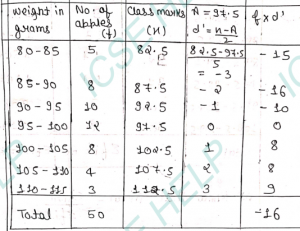
mean = A + ∑f×d’/∑f1 × i
= 97.5 +(-16/50)×5
= 97.5 -16/10
= 97.5 -1.6
= 95.9
∴ The mean is 95.9
Que-24: Weights of 60 eggs were recorded as given below :
Weight (in grams) |
75-79 |
80-84 |
85-89 |
90-94 |
95-99 |
100-104 |
105-110 |
Number of eggs |
4 |
9 |
13 |
17 |
12 |
3 |
2 |
Sol:
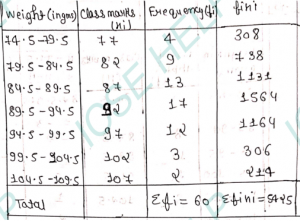
We know that the mean = ∑fi.xi/∑fi
= 5425/60
= 90.41
∴The mean is 90.41
Que-25: The following table gives marks scored bu students to an examination :
Marks |
less than 5 |
less than 10 |
less than 15 |
less than 20 |
less than 25 |
less than 30 |
less than 35 |
less than 40 |
Number of students |
3 |
10 |
25 |
49 |
65 |
73 |
78 |
80 |
Sol: Suppose that A = 17.5
and C = 5
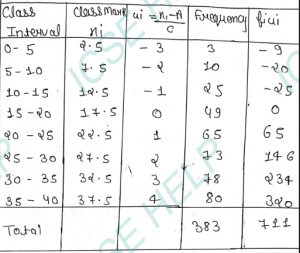
mean = A + C × ∑fi.xi/∑fi
= 17.5 + 5 × 711/383
= 17.5 + 9.28
= 26.78
∴ The mean is 26.78
Que-26: The data on the number of patients attending the hospital in a month by using the shortcut method . Take the assumed mean is 45 . Give your answer correct to 2 decimal places .
Number of patients |
10-20 |
20-30 |
30-40 |
40-50 |
50-60 |
60-70 |
Number of days |
5 |
2 |
7 |
9 |
2 |
5 |
Sol:
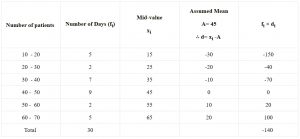
Mean = A + ∑fi.di/∑fi = 45 + (-140/30) = 45 – 140/30
= 45 – 14/3
= (135 – 14)/3
= 121/3
= 40.33
∴ The mean is 40.33
Que-27: Calculate the mean of the following frequency distribution .
Class-interval |
5-15 |
15-25 |
25-35 |
35-45 |
45-55 |
Frequency |
2 |
6 |
4 |
8 |
4 |
Sol:
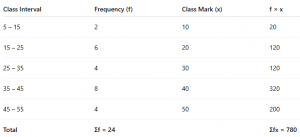
Mean = ∑fi.xi/∑fi = 780/24
= 32.5
∴ The mean is 32.5
— : Measures of Central Tendency RS Aggarwal Exe-25 Class-10 ICSE Maths Solutions :-
Return to :– RS Aggarwal ICSE Class 10 Solutions Goyal Brothers
Please, Share with your friends
Thanks




24 thoughts on “Measures of Central Tendency RS Aggarwal Exe-25 Class-10 ICSE Maths Solutions”
There is an extension of sums in the latest textbook to 26, 27. Can I get the answers of that?
update soon
I would like to know if the site will have the problems as in the previous comments in the near future? cuz I have to plan ahead..
ups and downs are the part of life
Answers of the questions are not given please give it very urgent. Thank you
yes we will upload it soon
work is in progress
The answers are still not visible…
visible fully now
cant see the solutions
upload soon
Sir I am not able to see the answers
uploaded again soon if unavailable
Sir , please upload the solutions as soon as possible.
fully visible
Still not visible
Measures of Central Tendency RS Aggarwal Chapter-25 Class-10 ICSE fully visible and working smoothly
q26 and q27 from 2025 textbook is not there pls keep up
update soon
There is some problem as I am not able to see the solution alltvall
soon uploaded again
Even after so many comments you have still not uploaded the solutions
DISAPPOINTMENT!!
very soon
work in progress
The last sum u don’t do it the way u have done. It is in cumulative frequency. I have to convert it to class intervals and then do it. Can u please chech?
we will soon look into matter