Metallurgy Exe-7(B) Concise Class-10 ICSE Chemistry Selina Solutions Chapter-7. We Provide Step by Step Answer of Exe-7(B) Questions of Exercise-7 for ICSE Class-10. The given Solutions are according to the Latest editions. Visit the official Website CISCE for detail information about ICSE Board Class-10.
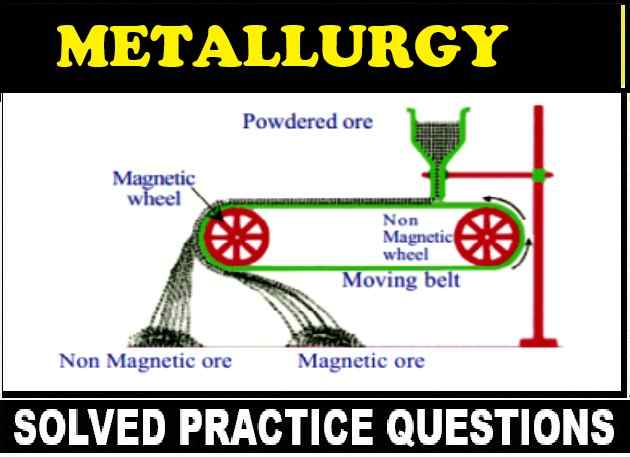
Metallurgy Exe-7(B) Concise Class-10 ICSE Chemistry Selina Solutions Chapter-7
| Board | ICSE |
| Book / Publication | Concise / Selina |
| Subject | Chemistry |
| Class | 10th |
| Writer | Dr SP Singh |
| Chapter-7 | Metallurgy |
| Topics | Exe-7(B) |
| Edition | 2025-2026 |
Exe-7(B) Questions on Metallurgy
Page-132
Que-1: Give the principles of:
(a) Hydraulic washing
(b) Forth floatation process,
(c) Electromagnetic separation
Ans:
(a) Hydraulic washing:- The difference in the densities of the ore and the gangue is the main criterion.
(b) Forth floatation:- This process depends on the preferential wettability of the ore with oil and the gangue particles by water.
(c) Electromagnetic separation:- Magnetic properties of the ores.
Que-2:
(a) Name the methods by which concentrated ore is converted to metallic oxide.
(b) State three objectives achieved during the roasting of ores.
Ans:
(a) Roasting and calcinations
(b) (i) It removes moisture from the ore. (ii) It expels oxide. (iii) It oxidises sulphide ores to oxide ores.
Que-3: Name:
(a) The processes involved in (i) Concentration (ii) Refining of ores
(b) Two metallic oxides which cannot be reduced by carbon, carbon monoxide or hydrogen.
Ans:
(a) The processes involved in
(i) Processes involved in concentration are:
1. Hydrolytic method
2. Magnetic Separation
3. Froth floatation
4. Leaching
(ii) Processes involved in Refining of ores are:
1. Distillation
2. Liquation
3. Oxidation
4. Electro- refining
(b) Potassium and sodium oxides cannot be reduced by carbon, carbon monoxide and hydrogen.
Que-4: Why does iron or zinc not occur free in nature?
Ans: Iron and zinc are quite reactive and hence they do not occur in the free state. The compounds of metals found in nature are their oxides, carbonate and sulphides.
Que-5: What do you observe when hydrogen is passed over heated copper oxide?
Ans: Black copper oxide is reduced to brown/red.
CuO + H2 –> Cu + H2O
Que-6: Compare roasting and calcination.
Ans: Comparison of roasting and calcinations:
| Roasting | Calcination |
| (i) The ore is heated in the excess of air. (ii) Generally, sulphide ores are roasted, so SO2 is given off (iii) Volatile impurities are removed as oxides and the ore becomes porous and more reactive. |
(i) The ore is heated in the absence of air (ii) Carbonate and hydrated ores are calcined and so,CO2 and water vapours are given off. (iii) Moisture and organic impurities are removed and the ore becomes porous and more reactive. |
Que-7:
(a) Name an ore of Zinc.
(b) Which process is applied to concentrate it?
(c) How is concentrated ore changed to oxide?
Ans:
(a) Ore of zinc is zinc blende (ZnS).
(b) It is concentrated by Froth floatation process.
(c) Concentrated ore is changed into oxide by heating ZnS in excess of air.
2ZnS + 3O2 → (800°C) 2ZnO + 2SO2
Que-8:
(a) Some metallic oxides can be reduced by hydrogen, carbon and carbon monoxide and some cannot. Explain.
(b) Write balance equation for reduction of copper(II) oxide by Hydrogen (2019)
Ans:
(a) Oxides of highly active metals like potassium, sodium, calcium, magnesium and aluminium have great affinity towards oxygen and so cannot be reduced by carbon or carbon monoxide or hydrogen.
Metals in the middle of activity series (iron, zinc, lead, copper) are moderately reactive and are not found in oxide form. These are found in nature as sulphides or carbonate. These are first converted into oxides and can be reduced by C, CO or H2.
ZnO + C → (400°C) Zn + CO
PbO + CO → Pb + CO2
Metals low in the activity series is very less reactive and oxides of these metals are reduced to metals by heating alone.
(b) Balance equation: CuO + H2 → Cu + H2O
Que-9: How are the following metallic oxides reduced? Write equations:
(a) Iron(II) oxide
(b) Zinc oxide
Ans:
(a) Iron(II) oxide:
4FeO + O2 → 2Fe2O3
Fe2O3 + 3CO → (600°C – 400°C) 2Fe +3CO2
(b) Zinc oxide is reduced by coke.
Zn O + C → Zn + CO
Que-10: State why aluminium is extracted from its oxide by electrolysis while copper, lead, iron by reducing agents and mercury and silver by thermal decomposition.
Ans: Aluminium has a great affinity towards oxygen and so cannot be reduced by carbon or carbon monoxide. So it is extracted from its oxide by electrolysis. Metals like copper, lead and iron are placed in the middle of the activity series and re moderately reactive and their oxides can be reduced by carbon, CO and hydrogen. Mercury and silver are less reactive and are placed lower in the reactivity series. The oxides of these metals are reduced to metals by heating their oxides.
Que-11: An ore on being heated in air forms sulphurous anhydride. Write the process used for the concentration of this ore.
Ans: The process used for the concentration of the ore is froth floatation process.
Que-12:
(a) Define roasting. Name an ore on which roasting is done. Give balanced equation.
(b) Define calcination. Give example and equation for calcination.
Ans:
(a) Roasting-is the process of heating concentrated ore to a high temperature in the presence of air. The ore zinc blende is roasted in order to get zinc oxide. Example: Zinc sulphides are oxidised to zinc oxide.
2ZnS + 3O2 → 2ZnO + 2SO2
(b) Calcination is the process of heating the concentrated ore such as carbonate or hydrated oxide to a high temperature in the absence of air. Example: Metal carbonates get decomposed to produce metal oxides.
ZnCO3 → ZnO + CO2
CaCO3 → CaO + CO2
Que-13: How are the metals like sodium, potassium and calcium obtained? Give equations.
Ans: Sodium, potassium and calcium metals are obtained by electrolytic reduction of fused metallic salts.
Que-14: Give equation for the reduction of
(a) Iron (II) oxide
(b) Iron (III) oxide
(c) Lead (II) oxide
(d) Zinc oxide
Ans:
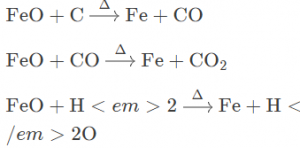
(a) Reduction of Iron (II) oxide
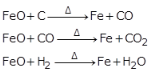
(b) Reduction of iron (III) oxide:
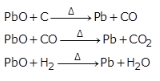
(c) Reduction of lead (II) oxide:
(d) Reduction of zinc oxide:
Zn + C → (1400°C) Zn + CO
Que-15:
(a) On which factors does purification of metals depend?
(b) Name the methods used for purification?
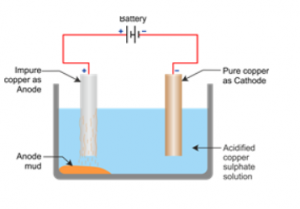
(c) With labelled diagram explain electro-refining of a particular metal
Ans:
(a) The purification depends upon:
1. Nature of metal.
2. Nature of impurities present in the metal.
3. Purpose for which metal is to be used
(b) Methods used for purification are:
1. Distillation
2. Liquation
3. Oxidation
4. Electro-refining
(c)
Que-16: Choose the correct option:
(a) The metal other than aluminium, which has a strong affinity for oxygen is: (A) Copper (B) Magnesium (C) Silver (D) Gold
(b) A metallic oxide which cannot reduced by normal reducing agents: (A) Zinc oxide (B) Magnesium oxide (C) Copper(II) oxide (D) Iron(III) oxide
Ans:
(a) Option B
The metal other than aluminium which has a strong affinity for oxygen is magnesium.
(b) Option A
A metallic oxide which cannot be reduced by normal reducing agents is zinc oxide.
Que-17: Fill in the blanks:
(a) Usually …………. (sulphide/carbonate) ores are subjected to ……………. (calcination/roasting) which is done in the absence of air.
(b) Zinc blend is converted to oxide by ……… (roasting /calcination) process.
(c) Froth floatation process is generally used to concentrate ………… ores (sulphide/carbonate).
Ans:
(a) Usually carbonate ores are subjected to calcination which is done in the absence of air.
(b) Zinc blende is converted to oxide by roasting process.
(c) Froth flotation process is generally used to concentrate sulphide ores.
—: End of Metallurgy Exe-7(B) Concise Class-10 ICSE Chemistry Selina Solutions : –
Return to:- Concise Selina Chemistry for ICSE Class-10 Solutions
Please Share with Your Friends if Helpful
Thanks