Metallurgy Exe-7(C) Concise Class-10 ICSE Chemistry Selina Solutions Chapter-7. We Provide Step by Step Answer of Exe-7(C) Questions of Exercise-7 for ICSE Class-10. The given Solutions are according to the Latest editions. Visit the official Website CISCE for detail information about ICSE Board Class-10.
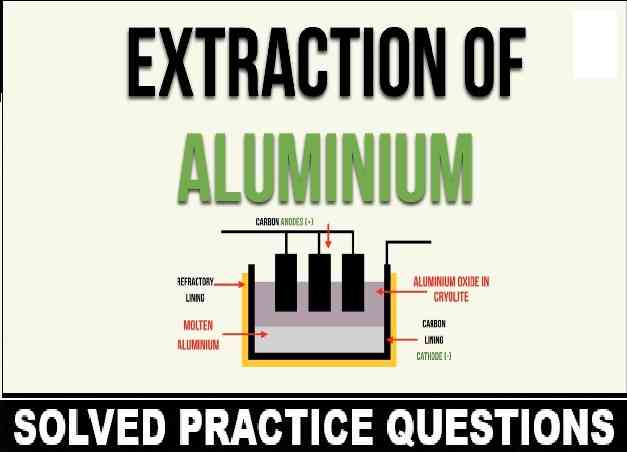
Metallurgy Exe-7(C) Concise Class-10 ICSE Chemistry Selina Solutions Chapter-7
| Board | ICSE |
| Book / Publication | Concise / Selina |
| Subject | Chemistry |
| Class | 10th |
| Writer | Dr SP Singh |
| Chapter-7 | Metallurgy |
| Topics | Exe-7(C) |
| Edition | 2025-2026 |
Exe-7(C) Questions Extraction of Aluminium
Page-135
Que-1: State the position of aluminium in the periodic table.
Ans: Position in the Periodic Table: Period 3,Group IIIA(13)
Que-2:
(a) Give the chemical names and formulae of the main ores of (i) aluminium, (ii) iron and (iii) zinc.
(b) Which impurities are present in bauxite?
(c) What is red mud, how is it removed?
Ans:
(a) (i) Ores of aluminium
| Name | Chemical name | Formula |
| Bauxite | Hydrated aluminium oxide | Al3O32H2O |
| Cryolite | Sodium aluminium oxide | Na3AlF6 |
(ii) Ores of iron
| Name | Chemical name | Formula |
| Red haematite | Anhydrous ferric oxide | Fe2O3 |
| Brown haematite | Hydrated ferric oxide | 2Fe2O3.3H2O |
(b) Bauxite ore contains approximately 60% aluminium oxide. The rest being sand, ferric oxide and titanium oxide.
(c) Red mud consists of ferric oxide, sand etc. left after bauxite dissolves in NaOH forming sodium aluminate and is removed by filtration.
(i)Ores of aluminium
Que-3: In order to obtain 1 tone of aluminium, the following inputs are required: 4 tonnes of bauxite, 150 kg of sodium hydroxide and 600 kg of graphite. The aluminium compound in bauxite is aluminium oxide and the main impurity is iron (III) oxide. Aluminium is obtained by the electrolysis of aluminium oxide dissolved in cryolite.
(a) When bauxite is treated with sodium hydroxide solution, what happens to
(i) the aluminium oxide
(ii) the iron (III) oxide
(b) (i) Name the process used for the purification of bauxite.
(ii) Write the equation for the action of heat on aluminium hydroxide
(c) (i) Write the formula of cryolite.
(ii) Write down the word which correctly completes the following sentence. By dissolving aluminium oxide in cryolite a (conducting/non-conducting) solution is produced.
(iii) Why is so much graphite required for the electrolytic process?
(iv) Write the equation for the reaction which takes place at the cathode.
(v) What is cathode made up of?
Ans:
(a) (i) Aluminium oxide dissolves in sodium hydroxide and forms sodium meta aluminate leaving behind insoluble impurities consisting of ferric oxide which is removed by filtration.
Al2O3.2H2O + 2NaOH ⟶ 2NaAlO2 + 3H2O
(b) (i) The process used for the purification of bauxite is Baeyer’s process.
(ii) Action of heat on aluminium hydroxide:
2Al(OH)3 ⟶ (heat 1000°C) Al2O3 + 3H2O
(c) (i) Formula of cryolite is Na3AlF6
(ii) By dissolving aluminium oxide in cryolite, a conducting solution is produced.
(iii). Thick graphite rods are used as the anode. The anode has to be replaced from time to time, as it gets oxidised by evolved oxygen.
(iv) Reaction at the cathode:
4Al3+ + 12e– ⟶ 4Al
(v) The cathode is made of carbon.
Que-4: Aluminium is extracted from its chief ore, bauxite. The ore is first purified and then the metal is extracted from it by electrolytic reduction.
(a) Write three balanced equations for the purification of bauxite.
(b) Name a chemical used for dissolving aluminium oxide. In which state of subdivision is the chemical used?
(c) Write an equation for the reaction which takes place at the anode during the extraction of aluminium by the electrolytic process.
Ans:
(a) Balanced equations for the purification of bauxite:
Al2O3.2H2O + 2NaOH ⟶ 2NaAlO2 + 3H2O
NaAlO2 + 2H2O ⟶ NaOH + Al(OH)3↓
2Al(OH)3 ⟶ (heat 1000°C) Al2O3 + 3H2O
(b) Chemicals used for dissolving aluminium oxide: Fluorspar and cryolite Alumina 20%, cryolite 60%, fluorspar 20%
(c) At anode:
6O2- – 12e- ⟶ 6[O]
3[O] + 3[O] ⟶ 3O2
Anode is oxidised to carbon monoxide which further forms carbon dioxide
2C + O2 ⟶ 2CO
2CO + O2 ⟶ 2CO2
Que-5:
(a) A to F below relate to the source and extraction of either zinc or aluminium:
A. Bauxite
B. Coke
C. Cryolite
D. Froth floatation
E. Sodium hydroxide solution
F. Zinc blende
(i) Write down the three letters each from the above list which are relevant to
1. Zinc
2. Aluminium
(ii) Fill in the blanks using the most appropriate words from A to F.
1. The ore from which aluminium is extracted must first be treated with ………………. so that pure aluminium oxide can be obtained.
2. Pure aluminium oxide is dissolved in ….. to make a conducting solution.
(iii). Write the formula of cryolite.
Ans:
(a) (i)
1. Zinc
Zinc blende, Froth flotation, Coke
2. Aluminium
Cryolite, Bauxite, Sodium hydroxide solution
(b) (ii)
1. The ore from which aluminium is extracted must first be treated with sodium hydroxide solution so that pure aluminium oxide can be obtained.
2. Pure aluminium oxide is dissolved in cryolite to make a conducting solution.
(iii). Formula of cryolite is Na3AlF6.
Que-6: Explain with reasons:
(a) In the electrolytic reduction of alumina, the graphite anode is gradually consumed.
or
Why the anode has to be replaced in this process?
(b) Roasting is carried out on sulphide ores and not on carbonates ores.
(c) Carbon can reduce lead oxide but not aluminium oxide.
(d) Electrolytic reduction is done to obtain aluminium.
(e) Why ‘food containing iron salts’ should not be cooked in aluminium utensils?
(f) A neutral gas other than oxygen is formed at the anode during electrolysis of fused alumina.
(g) why powder coke sprinkled on the top of electrolyte
Ans:
(a) In the electrolytic reduction of alumina, the graphite (anode) is oxidized by oxygen to CO and further forms CO2, so it is consumed and has to be replaced from time to time.
2C + O2 ⟶ 2CO
2CO + O2 ⟶ 2CO2
(b) Roasting provides oxygen to convert metallic sulphides into metallic oxide and SO2 which takes place when heated in excess of air.
Carbonate is converted into oxide by loss of CO2 which takes place in the absence of air and when heated strongly.
(c) Aluminium has a great affinity towards oxygen and so cannot be reduced by carbon or carbon monoxide or hydrogen whereas lead oxide can be easily reduced to metal lead by carbon.
PbO + C ⟶ Pb + CO
(d) Aluminium oxide is a very stable compound because of its great affinity for oxygen. It is not reduced easily by common reducing agents such as carbon or hydrogen. Hence, electrolytic reduction is done to obtain aluminium.
(e) Aluminium comes before iron in the metal activity series so it can displace iron from iron salts; thus, food containing iron salts should not be cooked in aluminium utensils.
(f) An anode is made of carbon which gets oxidised in the presence of oxygen to form carbon monoxide which is a neutral gas.
2C + O2 → 2CO
An anode is made of carbon which gets oxidised in the presence of oxygen to form carbon monoxide which is a neutral gas.
2C + O2 → 2CO
(g) Powdered coke is sprinkled over the surface of the electrolytic mixture for the following reasons:
- To reduce heat loss by radiation
- To prevent burning of the anode
Que-7: For each substance listed below, explain its significance in the extraction of aluminium:
(a) Bauxite
(b) Sodium hydroxide
(c) Cryolite
(d) Graphite (2015)
Ans:
(a) Bauxite Aluminium is extracted from bauxite ore. It contains 60% Al2O3
(b) Sodium hydroxide The ore from which aluminium is extracted must first be treated with sodium hydroxide solution so that pure aluminium oxide can be obtained.
(c) Cryolite It lowers the fusion temperature and enhances conductivity.
(d) Graphite Thick graphite rods are used as the anode in electrolytic reduction.
Que-8: Distinguish between electrolytic methods of reduction and refining.
Ans: Electrolytic Reduction
(i) It is removal of oxide or halide from a metal.
(ii) Oxides of highly active metals like Na, K, Ca, Mg, Al are reduced by electrolytic reduction of their fused salts.
(iii) Oxides of these metals have great affinity for oxygen than carbon and cannot be reduced by carbon or CO or hydrogen.
Electrolytic refining of metals is the separation of residual impurities like Si and phosphorus.
(i) Presence of other metals and non-metals like Si and phosphorus.
(ii) Unreduced oxides and sulphides of metals.
It depends upon:
(i) Nature of metal
(ii) Purpose for which metal is to be obtained.
(iii) Nature of impurities present.
Impure metal is made anode while a thin sheet of pure metal is made cathode and electrolyte used is a salt of solution of a metal to be refined.
Que-9: Give three ways in which the metal zinc differs from the non-metal carbon. At least one of the differences must be a chemical difference.
Ans: The three ways in which metal zinc differs from the non-metal carbon is:
- Zinc has a valency2 and carbon has valency 4.
- Zinc does not form hydride but carbon does (CH4).
- Oxides of zinc areamphoteric (ZnO) whereas oxides of carbon are acidic (CO2) and neutral (CO).
Que-10:
(a) Aluminium is a more active metal than iron but suffers less corrosion. Why?
(b) Explain and give reasons why aluminium vessels should not be cleaned with powders containing alkalis.
Ans:
(a) When aluminium is exposed to the atmospheric air, it combines with oxygen and a film of aluminium oxide (Al2O3) is formed at the surface. This hard, tightly adhering film of aluminium oxide prevents corrosion.
(b) Aluminium vessels should not be cleaned with powders containing alkalis because aluminium reacts with alkalis to produce meta aluminate.
Que-11: Given below in column A is a schematic diagram of the electrolytic reduction of alumina. Identify the parts labelled as A, B and C with the correct options from the column B.
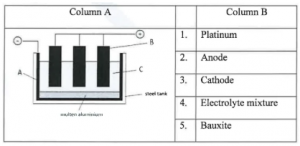
Ans: From the above table:
A ⟶ 3. Cathode
B ⟶ 2. Anode
C ⟶ 4. Electrolytic mixture
Que-12: Fill in the blanks:
(a) During the concentration of bauxite ore, aluminium goes in ………. (soluble/insoluble) part because of its …………… (acidic/basic/amphoteric) nature.
(b) In Hoope’s process, pure aluminium is collected at the …………… (top/bottom) of the electrolytic cell.
Ans:
(a) During the concentration of bauxite ore, aluminium goes in the soluble part because of its amphoteric nature.
(b) In Hoope’s process, pure aluminium is collected at the top of the electrolytic cell.
—: End of Metallurgy Exe-7(C) Concise Class-10 ICSE Chemistry Selina Solutions : –
Return to:- Concise Selina Chemistry for ICSE Class-10 Solutions
Please Share with Your Friends if Helpful
Thanks