Metallurgy Exe-7(D) Concise Class-10 ICSE Chemistry Selina Solutions Chapter-7. We Provide Step by Step Answer of Exe-7(D) Questions of Exercise-7 for ICSE Class-10. The given Solutions are according to the Latest editions. Visit the official Website CISCE for detail information about ICSE Board Class-10.
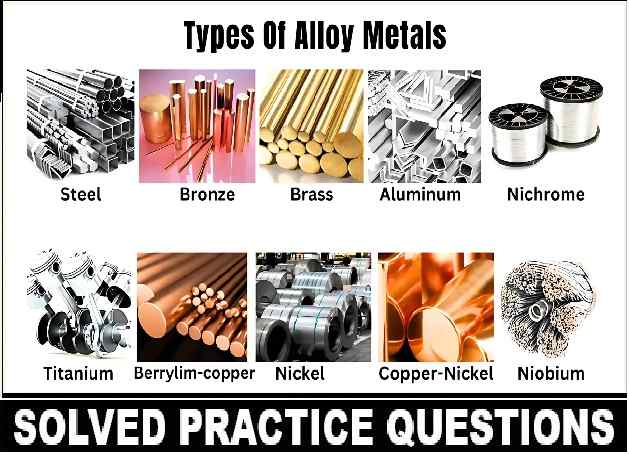
Metallurgy Exe-7(D) Concise Class-10 ICSE Chemistry Selina Solutions Chapter-7
| Board | ICSE |
| Book / Publication | Concise / Selina |
| Subject | Chemistry |
| Class | 10th |
| Writer | Dr SP Singh |
| Chapter-7 | Metallurgy |
| Topics | Exe-7(D) |
| Edition | 2025-2026 |
Exe-7(D) Questions on ALLOY
Page-139
Que-1: Explain the following:
(a) Zinc is used to cover iron so as to prevent rusting of iron. Why?
(b) In construction work, why is the alloy of aluminium–duralumin used rather than pure aluminium?
Ans:
(a) Zinc is electropositive metal than iron, gets oxidized and saves iron. Also zinc forms protective layer of ZnO on iron. This layer is sticky and impervious in nature and protects the iron metal underneath from rusting.
(b) In construction work, the alloy of aluminium–duralumin is used rather than pure aluminium because of the following reasons:
The Duralumin is lighter and strong, but aluminium is light and not strong.
A Duralumin is unaffected by moist air, while aluminium gets affected by moist air.
Duralumin is corrosion-resistant, while aluminium can undergo corrosion.
Que-2: What is an alloy? How do properties of an alloy differ from its constituents?
Ans:
Alloy is a homogeneous mixture of two or more metals or of one or more metals with certain non-metallic elements.
The properties of alloys are often greatly different from those of the components.
For example: Gold is too soft to be used without small percentage of copper.
- A low percentage of molybdenum improves the toughness and wear resistance of steel.
- Bell metal is more sonorous than copper or tin.
- Alnico an alloy of aluminium, nickel and cobalt can lift 60 times its own mass.
- These added elements improve hardness, wear resistance, toughness and other properties.
Que-3: Both Brass and bronze contain copper as major constituents. Name other elements in these alloys.
Ans:
The other element in Brass is Zinc.
The other elements in Bronze are Tin and Zinc.
Que-4: Name an alloy of :
(a) Aluminium used in aircraft construction.
(b) Lead used in electrical wiring or electrical work in joining metals.
(c) Copper in electrical appliances or household vessels.
(d) Zinc used in simple voltaic cells.
Ans:
(a) Duralumin
(b) Solder
(c) Brass
(d) Zinc amalgam
Que-5: What is amalgam? State its use with an example.
Ans:
A mixture or an alloy of mercury with a number of metals or an alloy such as sodium, zinc, gold and silver as well as with some non-metals is known as amalgam.
Dental amalgam is a mixture of mercury and a silver tin alloy.
Que-6:
(a) State two properties of brass that render it more useful for some purposes than its components.
(b) A metal which forms a liquid alloy at ordinary temperature.
Ans:
(a) Two properties of brass that make it more useful than its components are:
(i) It is malleable and ductile.
(ii) It resists corrosion.
(iii) Can be easily cast.
(b) A metal which forms a liquid alloy at ordinary temperature is sodium.
Que-7: Name the constituents of:
(a) Duralumin
(b) Solder
(c) Bronze
(d) Brass
Ans:
The constituents of
(a) Duralumin are aluminium (95%), copper (4%), magnesium (0.5%) and manganese (0.5%).
(b) Solder are lead (50%) and tin (50%).
(c) Bronze are copper (80%), tin (18%) and zinc (2%).
(d) Constituents of brass: 60–70% Cu and 40–30% Zn
Que-8: Name the following:
(a) A metal which is liquid at room temperature.
(b) A metal which is always present in the amalgam.
(c) The process of heating an ore to high temperature in the presence of air
(d)The compound formed by the reaction between calcium oxide and silica.
(e) A compound which is added to lower the fusion temperature of the electrolytic bath in the extraction of aluminium.
(f) Name an allotrope of a non-metal that allows electricity to pass through it.
Ans:
(a) Mercury
(b) Mercury metal is always present in the amalgam.
(c) Roasting
(d)Slag
(e) Cryolite
(f) Graphite
Que-9: Name the alloy used for the following purposes.
(a) Making electric circuits
(b) Making medals
(c) Making parts of watches
(d) Surgical instruments
(e) Aircraft
Ans:
(a) Making electric circuits: Nichrome
(b) Making medals: Bronze
(c) Making parts of watches: Brass
(d) Surgical instruments: Stainless steel
(e) Aircraft: Duralumin and magnalium
Que-10: Using the information in the table below, complete the following :
(a) …………… is the metallic element.
(b) Metal atoms tend to have a maximum of …………… electrons in the outermost energy level.
(c) Non-metallic elements tend to form …………… oxides while metals tend to form …………… oxides.
(d) Non-metallic elements tend to be …………… conductors of heat and electricity.
(e) Metals tend to …………… electrons and act as …………… agents in their reactions with elements and compounds.
| X | Y | |
|---|---|---|
| Normal electronic configuration | 2, 8, 7 | 2, 8, 2 |
| Nature of oxide | Dissolves in water and turns blue litmus red | Very low solubility in water. Dissolves in hydrochloric acid |
| Tendency for oxidizing and reducing reactions | Tends to oxidise elements and compounds | Tends to act as a reducing agent |
| Electrical and thermal conductivity | Very poor electrical conductor and poor thermal conductivity | Good electrical conductor and good thermal conductor |
| Tendency to form alloys and amalgams | No tendency to form alloys | Forms alloys |
Ans:
(a) Y is the metallic element.
(b) Metal atoms tend to have a maximum of three electrons in the outermost energy level.
(c) Non-metallic elements tend to form acidic oxides while metals tend to form basic oxides.
(d) Non-metallic elements tend to be poor conductors of heat and electricity.
(e) Metals tend to lose electrons and act as reducing agents in their reactions with elements and compounds.
—: End of Metallurgy Exe-7(D) Concise Class-10 ICSE Chemistry Selina Solutions : –
Return to:- Concise Selina Chemistry for ICSE Class-10 Solutions
Please Share with Your Friends if Helpful
Thanks