ML Aggarwal Arithmetic and Geometric Progression Exe-9.4 Class 10 ICSE Maths Solutions. We Provide Step by Step Solutions on questions to find n Term of GP as council prescribe guideline for upcoming board exam. Visit official Website CISCE for detail information about ICSE Board Class-10.
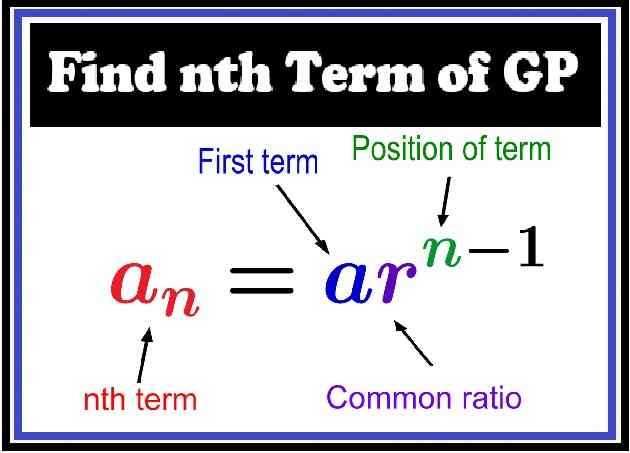


Find nth Term of GP
ML Aggarwal Arithmetic and Geometric Progression Exe-9.4 Class 10 ICSE Maths Solutions
| Board | ICSE |
| Subject | Maths |
| Class | 10th |
| Chapter-9 | Arithmetic and Geometric Progression |
| Writer / Book | Understanding |
| Topics | Find nth Terms of GP |
| Academic Session | 2025-2026 |
Sum of n Term of GP
ML Aggarwal Arithmetic and Geometric Progression Exe-9.4 Class 10 ICSE Maths Solutions
Que-1: (i) Find the next term of the list of numbers 1/6, 1/3, 2/3, …
Ans: First term a = 1/6
Then, r = (1/3) ÷ (1/6)
r = (1/3) × (6/1)
r = 6/3
r = 2
Therefore, next term = 2/3 × 2 = 4/3
(ii) Find the next term of the list of numbers 3/16, -3/8, ¾, -3/2,…
Ans: First term a = 3/16
Then, r = (-3/8) ÷ (3/16)
r = (-3/8) × (16/3)
r = (-3 × 16)/(8 × 3)
r = (-1 × 2)/ (1 × 1)
r = -2
Therefore, next term = -3/2 × (-2) = 6/2 = 3
(iii) Find the 15th term of the series √3 + 1/√3 + 1/3√3 + …
Ans: First term a = √3
Then, r = (1/√3) ÷ (√3)
r = (1/√3) × (1/√3)
r = (1 × 1)/( √3 × √3)
r = 1/(√3)2
r = 1/3
So, a15 = arn – 1
= √3(1/3)15 – 1
= √3(1/3)14
= √3 × (1/314)
Therefore, a15 = √3 × (1/314)
(iv) Find the nth term of the list of numbers 1/√2, -2, 4√2, – 16,…
Ans: First term a = 1/√2
Then, r = -2 ÷ (1/√2)
r = (-2/1) × (√2/1)
r = (-2 × √2)/(1 × 1)
r = -2√2
So, an = arn – 1
= (1/√2)(-2√2)n – 1
= (1/√2) × (-1)n – 1 × [(√2)2 × √2]n – 1
= (-1)n – 1 × 1/√2 × [(√2)3]n – 1
= (-1)n – 1 × 1/√2 × (√2)3n – 3
= (-1)n – 1 (√2)3n – 3 – 1
= (-1)n – 1 (√2)3n – 4
= (-1)n – 1 × 2(3n – 4)/2
Therefore, an = (-1)n – 1 × 2(3n – 4)/2
(v) Find the 10th and nth terms of the list of numbers 5, 25, 125, …
Ans: First term a = 5,
Then, r = (25) ÷ (5)
r = (25) × (1/5)
r = 5
So, a10 = arn – 1
= 5 × (5)10 – 1
= 5 × 5 9
= 59 + 1 … [by am × an = am + n]
= 510
Therefore, an = arn – 1
= 5 × 5n – 1
= 5n – 1 + 1
= 5n
(vi) Find the 6th and the nth terms of the list of numbers 3/2, ¾, 3/8,…
Ans: First term a = 3/2,
Then, r = (3/4) ÷ (3/2)
r = (3/4) × (2/3)
r = (3 × 2)/(4 × 3)
r = (1 × 1)/(2 × 1)
r = ½
So, an = arn – 1
= (3/2) × (1/2)n – 1
= 3 × ½ × (½)n – 1
= 3 × (½)n – 1 + 1
= 3 × (½)n
= 3/2n
Therefore, a6 = 3/2n
= 3/26
= 3/64
(vii) Find the 6th term from the end of the list of numbers 3, – 6, 12, – 24, …, 12288.
Ans: Last term = 12288
First term a = 3,
Then, r = (-6) ÷ (3)
r = (-6) × (1/3)
r = (-6 × 1)/(1 × 3)
r = (-2 × 1)/(1 × 1)
r = -2
Then, 6th term from the end,
a6 = l × (1/r)n – 1
= 12288 × (1/-2)6 – 1
= 12288 × (1/-25)
= 12288/-32
= – 384
Que-2: Which term of the G.P.
(i) 2, 2√2, 4, … is 128?
Ans: Last term = 128
First term a = 2,
Then, r = (2√2) ÷ (2)
r = (2√2)/2
r = √2
Then, an = arn – 1
So, 128 = 2(√2)n – 1
27 = 2(√2)n – 1
27/2 = (√2)n – 1
27 – 1 = (√2)n – 1
26 = (√2)n – 1
(√2)n -1 = (√2)12
Now, comparing the powers
n – 1 = 12
n = 12 + 1
n = 13
Therefore, 128 is the 13th term.
(ii) 1, 1/3, 1/9, … is 1/243
Ans: Last term (an) = 1/243
First term a = 1,
Then, r = (1/3) ÷ (1)
r = (1/3) × (1/1)
r = 1/3
Then, an = arn – 1
1/243 = 1 × (1/3)n – 1
(1/3)5 = (1/3)n – 1
By comparing both left hand side and right hand side,
5 = n – 1
n = 5 + 1
n = 6
Therefore, 1/243 is 6th term.
Que-3: Determine the 12th term of a G.P. whose 8th term is 192 and common ratio is 2.
Ans: a8 = 192 and r = 2
Then, by the formula an = arn – 1
a8 = ar8 – 1
192 = a(2)8 – 1
192 = a(2)7
a = 192/27
a = 192/128
a = 3/2
Now, a12 = (3/2)(2)12 – 1
= (3/2) × (2)11
= (3/2) × 2048
= 3072
a8 = 3072
Que-4: In a GP., the third term is 24 and 6th term is 192. Find the 10th term.
Ans: a3 = 24
a6 = 192
Then, by the formula an = arn – 1
a6 = ar6 – 1
192 = ar6 – 1
192 = ar5 … [equation (i)]
Now, a3 = arn – 1
24 = ar3 – 1
24 = ar2 … [equation (ii)]
By dividing equation (i) by equation (ii)
ar5/ar2 = 192/24
r5 – 2 = 8
r3 = 8
r3 = 23
r = 2
Now, substitute the value r in equation (i),
192 = ar5
192 = a (2)5
a = 192/32
a = 6
So, a10 = ar10 – 1
= ar9
= 6(2)9
= 6 (512)
= 3072
Que-5: Find the number of terms of a G.P. whose first term is ¾, common ratio is 2 and the last term is 384.
Ans: First term of G.P. a = ¾
Common ratio (r) = 2
Last term = 384
Then, by the formula an = arn – 1
384 = (3/4) (2)n – 1
(384 × 4)/3 = (2)n – 1
(1536)/3 = (2)n – 1
512 = 2n – 1
29 = 2n – 1
By comparing both left hand side and right hand side,
9 = n – 1
n = 9 + 1
n = 10
The number of terms of a G.P. is 10.
Que-6: Find the value of x such that,
(i) -2/7, x, -7/2 are three consecutive terms of a G.P.
Ans: x2 = -2/7 × -7/2
x2 = 1
x = ± 1
Therefore, x = 1 or x = – 1
(ii) x + 9, x – 6 and 4 are three consecutive terms of a G.P.
Ans: (x – 6)2 = (x + 9) × 4
x2 – 12x + 36 = 4x + 36
x2 – 12x – 4x + 36 – 36 = 0
x2 – 16x = 0
x(x – 16) = 0
Either let us take x – 16 = 16
Or x = 0
So, x = 0, 16
(iii) x, x + 3, x + 9 are first three terms of a G.P. Find the value of x.
Ans: (x + 3)2 = x(x + 9)
x2 + 6x + 9 = x2 + 9x
9 = 9x – 6x
9 = 3x
X = 9/3
X = 3
Que-7: If the fourth, seventh and tenth terms of a G.P. are x, y, z respectively, prove that x, y, z are in G.P.
Ans: a4 = x
a7 = y
a10 = z
Now we have to prove that, x, y, z are in G.P.
Then, by the formula an = arn – 1
a4 = ar4 – 1
a4 = a3
a4 = x
So, a7 = a7 – 1
a7 = a6
a7 = y
a10 = a10 -1
a10 = a9
a10 = z
x, y, z are in G.P. then,
y2 = xz
Then, xz = ar3 × ar9
= a2r3 + 9
= a2r12
y2 = (ar6)2
y2 = a2r12
By comparing left hand side and right hand side
LHS = RHS
Therefore, x, y and z are in G.P.
Que-8: The 5th, 8th and 11th terms of a G.P. are p, q and s, respectively. Show that q² = ps.
Ans: a5 = p
a8 = q
a11 = s
Now we have to prove that, q² = ps
Then, by the formula an = arn – 1
a5 = ar5 – 1
a5 = a4
a5 = p
So, a8 = a8 – 1
a8 = a7
a8 = q
a11 = a11 -1
a11 = a10
a11 = s
p, q, s are in G.P. then,
q2 = (ar7)2
= ar14
Then, px = ar4 × ar10
= a2r4 + 10
= a2r14
Therefore, q2 = ps
Que-9: If a, a2+ 2 and a3 + 10 are in G.P., then find the values(s) of a.
Ans: (a2 + 2)2 = a(a3 + 10)
a4 + 4 = a4 + 10a
4a2 – 10a + 4 = 0
2a2 – 5a + 2 = 0
2a2 – a – 4a + 2 = 0
a(2a – 1) – 2(2a – 1) = 0
(2a – 1) (a – 2) = 0
Then, 2a – 1 = 0
a = ½
a – 2 = 0
a = 2
Therefore, a = 2 or a= ½
Que-10: Find the geometric progression whose 4th term is 54 and the 7th term is 1458.
Ans: 4th term a4 = 54
7th term a7 = 1458
ar3 = 54
ar6 = 1458
Now dividing we get,
ar6/ar3 = (1458/54)
r6 – 3 = 27
r3 = 33
r = 3
Then, ar3 = 54
a × 27 = 54
a = 54/27
a = 2
Therefore G.P. is 2, 6, 18, 54, …
Que-11: The sum of first three terms of a G.P. is 39/10 and their product is 1. Find the common ratio and the terms.
Ans: The sum of first three terms of a G.P. is 39/10
The product of first three terms of a G.P. is 1
Let us assume that a be the first term and ‘r’ be the common ratio,
And also assume that, three terms of the G.P. is a/r, a, ar,
The sum of three terms = (a/r) + a + ar = 39/10
Take out ‘a’ as common then, we get
a(1/r + 1 + r) = 39/10 … [equation (i)]
Now, product of three terms = (a/r) × a × ar = 1
a3r/r = 1
a3= 1
a3 = 13
a = 1
Substitute the value of ‘a’ in equation (i),
1(1/r + 1 + r) = 39/10
(1 + r + r2)/r = 39/10
By cross multiplication we get,
10(1 + r + r2)/r = 39r
10 + 10r + 10r2 = 39r
Transposing 39r from right hand side to left hand side it becomes – 39r,
10 + 10r + 10r2 – 39r = 0
10r2 – 29r + 10 = 0
10r2 – 25r – 4r + 10 = 0
5r(2r – 5) – 2(2r – 5) = 0
(2r – 5) (5r – 2) = 0
So, 2r – 5 = 0
r = 5/2
5r – 2 = 0
r = 2/5
Therefore, r = 5/2 or 2/5
Then the terms if r = 5/2 are, 1, 5/2, 25/4, …
The terms if r = 2/5 are, 1, 2/5, 4/25, …
Que-12: Three numbers are in A.P. and their sum is 15. If 1, 4 and 19 are added to these numbers respectively, the resulting numbers are in G.P. Find the numbers.
Ans: The sum of first three terms of a A.P. is 15
Let us assume three numbers are a – d, a, a + d.
The sum of three terms = a – d + a + a + d = 15
a = 15/3
a = 5
Then, adding 1, 4, 19 in the terms
The numbers become, a – d + 1, a + 4, a + d + 19
Therefore, b2 = ac
(a + 4)2 = (a – d + 1) (a + d + 19)
Simplify the above terms,
a2 + 8a + 16 = a2 + ad + 19a – ad – a2 – 19d + a + d + 19
a2 + 8a + 16 = a2 – d2 – 18d + 20a + 19
8a + 16 = 20a – 18d – d2 + 19
8a + 16 – 20a + 18d + d2 – 19 = 0
d2 + 18d – 12a – 3 = 0
d2 + 18d – (12 × 5) – 3 = 0
d2 + 18d – 60 – 3= 0
d2 + 18d – 63 = 0
d2 + 21d – 3d – 63 = 0
d(d + 21) – 3(d + 21) = 0
(d + 21) (d – 3) = 0
So, d + 21 = 0
d = – 21
d – 3 = 0
d = 3
Then the terms if d = 3 and a = 5,
Then G.P. 5 – 3 = 2, 5, 5 + 3 = 8
The terms if d = – 21 are 5 – (-21) = 5 + 21 = 26, 5, 5 – 21 = – 16
— : End of ML Aggarwal Arithmetic and Geometric Progression Exe-9.4 Class 10 ICSE Maths Solutions Find nth Term of GP for upcoming exam. : –
Return to :- ML Aggarwal Solutions for ICSE Class-10
Please Share with Your Friends
Thanks