Mole Concept And Stoichiometry Exe-5(D) Concise Class-10 ICSE Chemistry Selina Solutions Chapter-5. We Provide Step by Step Answer of Exe-5(D) Questions of Exercise-5 for ICSE Class-10. The given Solutions is according to the Latest editions. Visit official Website CISCE for detail information about ICSE Board Class-10.
Mole Concept And Stoichiometry Exe-5(D) Concise Class-10 ICSE Chemistry Selina Solutions Chapter-5
| Board | ICSE |
| Book / Publication | Concise / Selina |
| Subject | Chemistry |
| Class | 10th |
| Writer | Dr SP Singh |
| Chapter-5 | Acids Bases and Salts |
| Topics | Exe-5(D) |
| Edition | 2025-2026 |
Exe-5(D) Questions on Stoichiometry
Page-94
Que-1: The reaction between 15 g of marble and nitric acid is given by the following equation:
CaCO3 + 2HNO3  Ca(NO3)2+ H2O + CO2
Calculate: (a) the mass of anhydrous calcium nitrate formed, (b) the volume of carbon dioxide evolved at S.T.P.
Ans:
(a) 100 g of CaCO3 produces = 164 g of Ca(NO3)2
So, 15 g CaCO3 will produce = 164  15/100 = 24.6 g Ca(NO3)2
(b) 1 V of CaCO3 produces 1 V of CO2
100 g of CaCO3 has volume = 22.4 litres
So, 15 g will have volume = 22.4 15/100 = 3.36 litres CO2
Que-2: 66g of ammonium sulphate is produced by the action of ammonia on sulphuric acid.
Write a balanced equation and calculate:
(a) Mass of ammonia required.
(b) The volume of the gas used at the S.T.P.
(c) The mass of acid required.
Ans:
2NH3 + H2SO4  (NH4)2SO4
66 g
(a) 2NH3 + H2SO4 (NH4)2SO4
34 g98 g132 g
For 132 g (NH4)2SO4 = 34 g of NH3 is required
So, for 66 g (NH4)2SO4 = 66 32/132 = 17 g of NH3 is required
(b) 17g of NH3 requires volume = 22.4 litres
(c) Mass of acid required, for producing 132g (NH4)2SO4 = 98g
So, Mass of acid required, for 66g (NH4)2SO4 = 66 98/132 = 49g
Que-3: The reaction between red lead and hydrochloric acid is given below:
Pb3O4 + 8HCl  3PbCl2 + 4H2O + Cl2
Calculate:
(a) the mass of lead chloride formed by the action of the 6.85 g of red lead,
(b) the mass of the chlorine and
(c) the volume of the chlorine evolved at S.T.P.
Ans:
(a) Molecular mass of Pb3O4 = 3  207.2 + 4 16 = 685 g
685 g of Pb3O4 gives = 834 g of PbCl2
Hence, 6.85 g of Pb3O4 will give = 6.85 834/685 = 8.34 g
(b) 685g of Pb3O4 gives = 71g of Cl2
Hence, 6.85 g of Pb3O4 will give = 6.85 71/685 = 0.71 g Cl2
(c) 1 V Pb3O4 produces 1 V Cl2
685g of Pb3O4has volume = 22.4 litres = volume of Cl2 produced
So, 6.85 Pb3O4 will produce = 6.85 22.4/685 = 0.224 litres of Cl2
Que-4: Find the mass of KNO3 required to produce 126 kg of nitric acid. Find whether a larger or smaller mass of NaNO3 is required for the same purpose.
KNO3+ H2SO4  KHSO4 + HNO3
NaNO3 + H2SO4 NaHSO4 + HNO3
Ans:
Molecular mass of KNO3 = 101 g
63 g of HNO3 is formed by = 101 g of KNO3
So, 126000 g of HNO3 is formed by = 126000  101/63 = 202 kg
Similarly,126 g of HNO3 is formed by 170 kg of NaNO3
So, smaller mass of NaNO3 is required.
Que-5: Pure calcium carbonate and dilute hydrochloric acid are reacted and 2 litres of carbon dioxide was collected at 27oC and normal pressure.
Calculate :
(a) The mass of salt required.
(b) The mass of the acid required to prepare the 2 litres of CO2 at 27 C and normal pressure.
CaCO3 + 2HCl  CaCl2 + H2O + CO2
Ans:
CaCO3 + 2HCl CaCl2 + H2O + CO2
100g73g22.4L
(a) V1 =2 litresV2 =?
T1 = (273+27)=300KT2=273K
V1/T1=V2/T2
V2=V1T2/T1= [(2 x 273)/300]L
Now at STP 22.4 litres of CO2 are produced using CaCO3 =100g
So, [(2 x 273)/300] litres are produced by =100/22.4 2274/300 =.125g
(b) 22.4 litres are CO2 are prepared from acid =73g
[(2 x 273)/300] litres are prepared from = 73/22.4 2273/300=5.9g
Que-6: Calculate the mass and volume of oxygen at S.T.P., which will be evolved on electrolysis of 1 mole (18g) of water.
Ans:
2H2O –> 2H2 + O2
2 V2 V1 V
2 moles of H2O gives = 1 mole of O2
So, 1 mole of H2O will give = 0.5 moles of O2
so, mass of O2 = no. of moles x molecular mass
= 0.5  32 = 16 g of O2
and 1 mole of O2 occupies volume =22.4 litre
so, 0.5 moles will occupy = 22.4 0.5 = 11.2 litres at S.T.P.
Que-7: 1.56 g of sodium peroxide reacts with water according to the following equation:
2Na2O2 + 2H2O  4NaOH + O2
Calculate:
(a) mass of sodium hydroxide formed,
(b) Volume of oxygen liberated at S.T.P.
(c) Mass of oxygen liberated.
Ans:
2Na2O2 + 2H2O 4NaOH + O2
2 V4 V1 V
(a) Mol. Mass of Na2O2 = 2  23 + 2 16 = 78 g
Mass of 2Na2O2= 156 g
156 g Na2O2 gives = 160 g of NaOH (4 40 g)
So, 1.56 Na2O2 will give = 160 1.56/156 = 1.6 g
(b) 156 g Na2O2 gives = 22.4 litres of oxygen
So, 1.56 g will give = 22.4 1.56/156 = 0.224 litres
= 224 cm3
(c)156 g Na2O2 gives = 32 g O2
So, 1.56 g Na2O2 will give = 32 1.56/156
= 32/100 = 0.32 g
Que-8:
(a) Calculate the mass of ammonia that can be obtained from 21.4 g of NH4Cl by the reaction:
2NH4Cl + Ca(OH)2  CaCl2 +2H2O + 2NH3
(b) What will be the volume of ammonia when measured at S.T.P?
The molar volume of a gas = 22.4 litres at STP.
Ans:
2NH4Cl + Ca(OH)2 CaCl2+2H2O + 2NH3
2 V1 V1 V2 V
Mol. Mass of 2NH4Cl = 2[14 + (1 4) + 35.5] = 2[53.5] = 107 g
(a) 107 g NH4Cl gives = 34 g NH3
So, 21.4 g NH4Cl will give = 21.4 34/107 = 6.8 g NH3
(b) The volume of 17 g NH3 is 22.4 litre
So, volume of 6.8 g will be = 6.8 22.4/17 = 8.96 litre
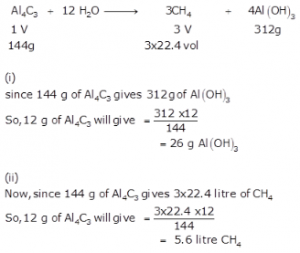
Que-9: Aluminium carbide reacts with water according to the following equation.
Al4C3 + 12H2O → 4Al(OH)3 + 3CH4
(a) What mass of aluminium hydroxide is formed from 12g of aluminium carbide?
(b) What volume of methane s.t.p. is obtained from 12g of aluminium carbide? (2018)
Ans:
Que-10: MnO2 + 4HCl  MnCl2 + 2H2O +Cl2
0.02 moles of pure MnO2is heated strongly with conc. HCl. Calculate:
(a) mass of MnO2 used
(b) moles of salt formed,
(c) mass of salt formed,
(d) moles of chlorine gas formed,
(e) mass of chlorine gas formed,
(f) volume of chlorine gas formed at S.T.P.,
(g) moles of acid required,
(h) Mass of acid required.
Ans:
MnO2 + 4HCl MnCl2 + 2H2O +Cl2
1 V4 V1 V1 V
(a) 1 mole of MnO2 weighs = 87 g (mol. Mass)
So, 0.02 mole will weigh = 87 0.02 = 1.74 g MnO2
(b) 1 mole MnO2 gives = 1 mole of MnCl2
So, 0.02 mole MnO2will give =0.02 mole of MnCl2
(c) 1 mole MnCl2 weighs = 126 g(mol mass)
So, 0.02 mole MnCl2 will weigh = 126 0.02 g = 2.52 g
(d) 0.02 mole MnO2will form =0.02 mole of Cl2
(e) 1 mole of Cl2 weighs = 35.5 g
So, 0.02 mole will weigh = 71 0.02 = 1.42 g of Cl2
(f) 1 mole of chlorine gas has volume = 22.4 litres
So, 0.02 mole will have volume = 22.4 0.02 = 0.448 litre
(g) 1 mole MnO2requires HCl = 4 mole
So, 0.02 mole MnO2 will require =4 0.02 = 0.08 mole
(h) For 1 mole MnO2 , acid required = 4 mole of HCl
So, for 0.02 mole, acid required = 4 0.02 =0.08 mole
Mass of HCl = 0.08 x 36.5 = 2.92 g
Que-11: Nitrogen and hydrogen react to form ammonia.
N2 (g) + 3H2 (g)  2NH3 (g)
If 1000g H2 react with 2000g of N2:
(a) Will any of the two reactants remain unreacted? If yes, which one and what will be its mass?
(b) Calculate the mass of ammonia(NH3) that will be formed?
Ans:
N2 + 3H2 2NH3
28g6g34g
28g of nitrogen requires hydrogen = 6g
2000g of nitrogen requires hydrogen = 6/28  2000=3000/7g
So mass of hydrogen left unreacted =1000-3000/7=571.4g of H2
(b) 28g of nitrogen forms NH3 = 34g
2000g of N2 forms NH3
= 34/28 2000
=2428.6g
—: End of Mole Concept And Stoichiometry Exe-5(D) Concise Class-10 ICSE Chemistry Selina Solutions : –
Return to:- Concise Selina Chemistry for ICSE Class-10 Solutions
Please Share with Your Friends if Helpful
Thanks