Motion in One Dimension Class-9 Exe-2A MCQs Concise Physics ICSE Selina Solutions. Some Terms Related to Motion MCQs Type for Class-9 ICSE Concise Physics. of your latest textbook which is applicable in 2025-26 academic session. Visit official Website CISCE for detail information about ICSE Board Class-9.
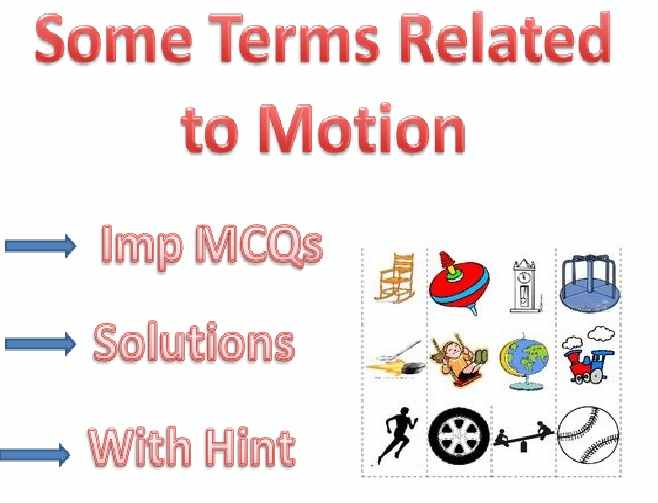
Motion in One Dimension Class-9 Exe-2A MCQs Concise Physics ICSE Selina Solutions
| Board | ICSE |
| Class | 9 |
| Subject | Physics |
| Writer / Publication | Concise selina Publishers |
| Chapter-2 | Motion in One Dimension |
| Exe – 2 A | Some Terms Related to Motion |
| Topics | Solution of Exe-2(A) MCQs Type |
| Academic Session | 2025-2026 |
Some Terms Related to Motion
Motion in One Dimension Class-9 Exe-2A MCQs Concise Physics ICSE Selina Solutions.
Page 37 (Choose the correct answer from the options given below.)
Que-1: Physical quantities which are expressed only by their magnitude are :
(a) Scalar quantities
(b) Vector quantities
(c) Tensor quantities
(d) None of these.
Ans: (a) Scalar quantities
Hint- Physical quantities are classified into two broad categories:
Scalar quantities – having only magnitude.
Vector quantities – having both magnitude and direction.
Que-2: Which of the following is a scalar quantity?
(a) Force
(b) Time
(c) Acceleration
(d) Displacement
Ans: (b) Time
Hint- Time has only magnitude, whereas force, acceleration and displacement all have magnitude as well as direction.
Que-3: A vector quantity possesses:
(a) Direction
(b) Magnitude
(c) Both (a) and (b)
(d) None of these
Ans: (c) Both (a) and (b)
Hint- Vector quantities have both magnitude and direction.
Que-4: A vector quantity is —
(a) Work
(b) Pressure
(c) Distance
(d) Velocity
Ans: (d) Velocity
Hint- A vector quantity has both magnitude and direction. Velocity has both magnitude and direction, so it is a vector quantity.
Que-5: The motion of a train on a straight track is an example of …………… motion.
(a) Two dimensional
(b) Three dimensional
(c) One dimensional
(d) All of these
Ans: (c) One dimensional
Hint- As the train is moving on a straight track and there is no lateral movement (sideways), hence it is a one dimensional motion.
Que-6: The S.I. unit of displacement is:
(a) Centimetre
(b) Millimetre
(c) Decimetre
(d) Metre
Ans: (d) Metre
Hint- The shortest distance from the initial to the final position of the body, is the magnitude of displacement and its direction is from initial position to the final position. It is a vector quantity and its S.I. unit is metre.
Que-7: If a body starts its motion from point A to B and comes back to the same point after a certain time interval, the displacement is:

(a) 10
(b) 20
(c) 0
(d) 15
Ans: (c) 0
Hint- If a body starts its motion from point A to B and comes back to the same point after a certain time interval, the displacement is 0. For example: In a circular motion, the body comes back to the starting point after completing the circle, then displacement is zero but distance covered is not zero.
Que-8: Motion of a car in a crowded street is an example of:
(a) Uniform speed
(b) Uniform velocity
(c) Variable acceleration
(d) Uniform acceleration
Ans: (c) Variable acceleration
Hint- As the change in velocity of the car in not same in same interval of time, the acceleration is said to be variable.
Que-9: The distance travelled by a body in 10 s when it travels with a uniform speed of 10 ms-1 is:
(a) 100 m
(b) 1 m
(c) 20 m
(d) 50 m
Ans: (a) 100 m
Hint- As the body is moving with uniform speed, equal distance is covered in equal intervals of time.
Distance covered in 1 s is 10 m, hence distance covered in 10 s is 10 x 10 = 100 m.
Que-10: For a particle in motion, which of the following quantity can be zero at any given instant?
(a) Displacement
(b) Distance
(c) Speed
(d) None of these
Ans: (a) Displacement
Hint- If a body starts its motion from point A to B and comes back to the same after a certain time interval, the displacement is 0. Whereas, distance covered and speed will not be zero.
Que-11: The S.I. unit of velocity is —
(a) km h-¹
(b) m min-¹
(c) km min-¹
(d) m s-¹
Ans: (d) m s-¹
Hint- Velocity is the rate of change of displacement (m) of a body with time (s) so its unit is m s-1.
Que-12: The unit of retardation is :
(a) m s-¹
(b) m s-²
(c) m
(d) m s²
Ans: (b) m s-²
Hint- Retardation is decline in velocity (ms-1) of a body with time (s), so its unit is ms-2. Retardation is negative value of acceleration and has same unit as acceleration.
Que-13: 18 km h-¹ is equal to —
(a) 10 m s-¹
(b) 5 m s-¹
(c) 18 m s-¹
(d) 1.8 m s-¹
Ans: (b) 5 m s-¹
Que-14: The value of g does not depend on the:
(a) Height of the body
(b) Mass of the body
(c) Shape of the body
(d) All of these
Ans: (d) All of these
Hint- The value of g does not depend on height, mass or shape of the body. On the earth’s surface, g is maximum at the poles and minium at the equator. The value of g decreases with altitude and also with depth from the earth’s surface.
Page 38
Que-15: Free fall of a body near earth’s surface is an example of:
(a) Uniform acceleration
(b) Uniform velocity
(c) Variable acceleration
(d) None of these
Ans: (a) Uniform acceleration
Hint- When a body is falling freely, the acceleration is said to be uniform as equal changes in velocity takes place in equal intervals of time.
Que-16: The value of g is maximum at:
(a) Tropic of capricorn
(b) Equator
(c) Tropic of cancer
(d) Poles
Ans: (d) Poles
Hint- On the earth’s surface, g is maximum at the poles and minium at the equator. The value of g decreases with altitude and also with depth from the earth’s surface.
Que- 17: A body when projected up with an initial velocity u goes to a maximum height h in time t and then comes back at the point of projection. The correct statement is —
(a) The average velocity is 2h/t
(b) The acceleration is zero
(c) The final velocity on reaching the point of projection is 2u
(d) The displacement is zero
Ans: (d) The displacement is zero
Hint- The displacement is zero because the initial and the final position of the body is same.
— : End of Motion in One Dimension Class-9 Exe-2A MCQs Concise Physics ICSE Selina Solutions :–
Return to: – Concise Selina Physics ICSE Class-9 Solutions
Thanks
Please share with your friends