Motion in One Dimension Class-9 Exe-2B MCQs Concise Physics ICSE Selina Solutions. In this article you would learn MCQs on Graphical Representation of Linear Motions. Visit official Website CISCE for detail information about ICSE Board Class-9.
Motion in One Dimension Class-9 Exe-2B MCQs Concise Physics ICSE Selina Solutions
| Board | ICSE |
| Class | 9 |
| Subject | Physics |
| Writer / Publication | Concise Selina Publishers |
| Chapter-2 | Motion in One Dimension |
| Exe – 2 B | Graphical Representation of Linear Motions |
| Topics | Solution of Exe-2(B) MCQs Type |
| Academic Session | 2025-2026 |
Graphical Representation of Linear Motions
Motion in One Dimension Class-9 Exe-2B MCQs Concise Physics ICSE Selina Solutions
Page 51 (Choose the correct answer from the option given below).
Que-1: The slope of displacement-time graph gives:
(a) Velocity
(b) Acceleration
(c) Speed
(d) Displacement
Ans:(a) Velocity
Hint- As, velocity is the ratio of displacement and time, therefore, the slope of displacement-time graph gives the velocity.
Que-2: From the given displacement-time graph, answer the following questions:
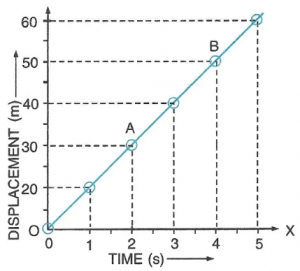
(i) The kind of motion depicted in this graph is :
(a) uniform
(b) non-uniform
(c) retardation
(d) all of the above
(ii) The velocity between point A and C is:
(a) 20 ms-1
(b) 5 ms-1
(c) 10 ms-1
(d) 15 ms-1
(iii) The displacement at t = 3s is:
(a) 15 m/s2
(b) 12.5 m/s2
(c) 40 m
(d) 30 m
Ans:
(i) (a) uniform
Hint- As the graph shows the linear relationship between displacement and time i.e., the car travels equal distance in equal intervals of time in a certain direction. Thus, it is moving with uniform motion.
(ii) (c) 10 ms-1
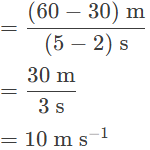
Hint- As, velocity is the ratio of displacement and time, therefore,
Velocity = Slope of straight line AC
(iii) (c) 40 m
Hint- When we observe the graph, we notice that at t = 3 s, the displacement axis shows 40 m, hence, displacement at t = 3 s is 40 m
Que-3: Out of the following, the correct displacement-time graph for uniform motion is:
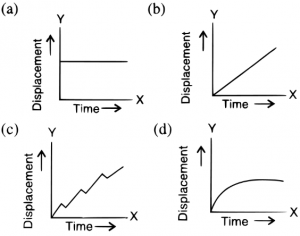
Ans: The correct displacement-time graph for uniform motion is: Option (b)
Hint- When the displacement-time graph is a straight line inclined to the time axis, then the body covers equal distances in equal intervals of time and shows uniform motion.
Que-4: From the velocity-time graph, we can determine :
(a) The displacement of the body in a certain time interval.
(b) The acceleration of the body at any instance.
(c) Both (a) and (b)
(d) None of these
Ans: (c) Both (a) and (b)
Hint- (i) Since, velocity x time = displacement, the area enclosed between the velocity-time sketch and X-axis (i.e., the time axis) gives the displacement of the body.
(ii) Since, acceleration is equal to the ratio of change in velocity and time taken, therefore the slope (or gradient) of the velocity-time sketch gives the acceleration.
Que-5: Velocity x time = :
(a) Average velocity
(b) Displacement
(c) Acceleration
(d) Speed
Ans: (b) Displacement
Hint- Velocity x time = displacement.
Que-6: The velocity-time graph of a body in motion is a straight line inclined to the time axis. The correct statement is :
(a) velocity is uniform
(b) acceleration is uniform
(c) both velocity and acceleration are uniform
(d) neither velocity nor acceleration is uniform.
Ans: (b) acceleration is uniform
Hint- When the velocity-time graph of a body in motion is a straight line inclined to the time axis then there are equal changes in velocity in equal intervals of time and hence, the movement is with uniform acceleration.
Que-7: For a uniformly retarded motion, the velocity-time graph is:
(a) a curve
(b) a straight line parallel to the time axis
(c) a straight line perpendicular to the time axis
(d) a straight line inclined to the time axis.
Ans: (d) a straight line inclined to the time axis
Hint- If the motion is uniformly retarded (i.e., its velocity decreases by an equal amount in each second), the velocity-time graph will be a straight line inclined to the time axis with a negative slope.
Que-8: Study the velocity-time graph shown below and answer the questions that follow:
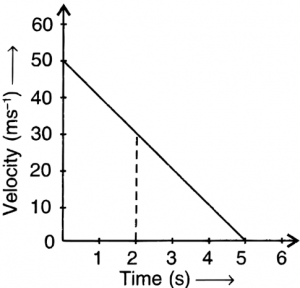
(i) The distance travelled in 5s:
(a) 10 m
(b) 50 m
(c) 125 m
(d) 250 m
(ii) The retardation of the body as calculated from the graph is:
(a) 12 ms-2
(b) 15 ms-2
(c) 10 ms-2
(d) 20 ms-2
Ans:
(i) 125 m
Hint- As distance = velocity x time
So, (50 – 0) x (5 – 0) = 50 x 5 = 125 m
Hence, distance travelled in 5s = 125 m
(ii) 10 ms-2
Hint- Retardation = Slope of straight line
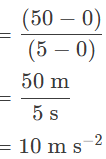
Hence, retardation = 10 ms-2
Page 52
Que-9: The graph representing the state of rest of an object is :
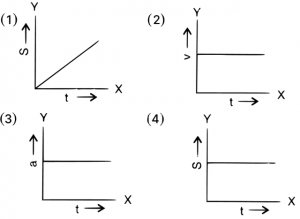
Ans: The graph representing the state of rest of an object is : Option (4)
Hint- As distance is not changing in distance-time graph hence, the state of rest of an object is shown.
Que-10: Which of the following graphs shown below represents the uniform motion of an object?
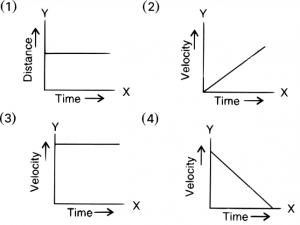
Ans: The graph representing the uniform motion of an object is: Option (3)
Hint- As in velocity-time graph, velocity of the body is not changing, therefore, the body is covering equal distance in equal intervals of time and is in uniform motion.
Que-11: The velocity-time graph given below shows:
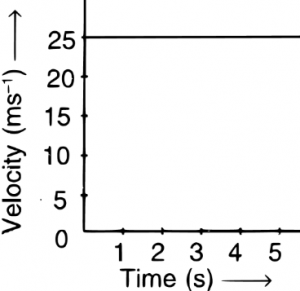
(a) Uniform acceleration
(b) Average speed
(c) Uniform velocity
(d) All of these
Ans: (a) Uniform velocity
Hint- As in velocity-time graph, velocity of the body is not changing, therefore, the body is covering equal distance in equal intervals of time and is in uniform motion.
Que-12: The slope of the velocity-tme graph gives :
(a) Displacement
(b) Speed
(c) Distance
(d) Acceleration
Ans: (d) Acceleration
Hint- As, acceleration is the ratio of velocity and time, therefore, the slope gives the acceleration.
Que-13: In the velocity-time graph shown below, the ratio of the distance travelled by the object in the last 2 s and the distance travelled in 7 s is :
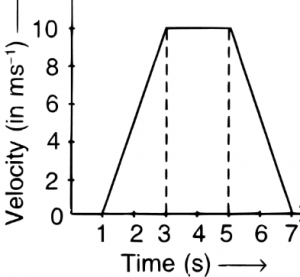
(a) 1/2
(b) 1/4
(c) 1/3
(d) 2/3
Ans: (b) 1/4
Hint- Distance covered in last 2 s = area of triangle = 1/2 x 2 x 10 = 10 m
Distance covered in last 7 s = area of trapezium = 1/2 x 10 x (2 + 6) = 40 m
Hence, ratio of of the distance travelled by the object in the last 2 s and the distance travelled in 7 s is = 10/40 = 1/4
Que-14: The velocity-time graph given below shows an object moving in a straight line. The displacement and the distance travelled by the object in 6 s will respectively be :
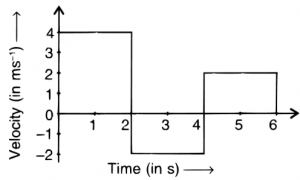
(a) 8 m, 16 m
(b) 16 m, 8 m
(c) 16 m, 16 m
(d) 8 m, 8 m
Ans: (a) 8 m, 16 m
Hint- Displacement = area of 1st rectangle – area of 2nd rectangle + area of third rectangle
= [4 x 2] – [2 x 2] + [2 x 2] = 8 m
Distance = area of 1st rectangle + area of 2nd rectangle + area of third rectangle
= [4 x 2] + [2 x 2] + [2 x 2] = 16 m
— : End of Motion in One Dimension Class-9 Exe-2B MCQs Concise Physics ICSE Selina Solutions :–
Return to:- Concise Selina Physics ICSE Class-9 Solutions
Thanks
Please share with your friends