Multiplication Theorem of Probability Class 12 OP Malhotra Exe-18C ISC Maths Solutions Ch-18. In this article you would learn about multiplication theorem of probability. Step by step solutions of latest textbook has been given as latest syllabus. Visit official Website CISCE for detail information about ISC Board Class-12 Mathematics.
Multiplication Theorem of Probability Class 12 OP Malhotra Exe-18C ISC Maths Solutions Ch-18
| Board | ISC |
| Publications | S Chand |
| Subject | Maths |
| Class | 12th |
| Chapter-18 | Probability |
| Writer | OP Malhotra |
| Exe-18(c) | Multiplication Theorem of Probability |
Multiplication Theorem of Probability
Probability Class 12 OP Malhotra Exe-18C Solutions
Que-1: A coin is tossed thrice and all eight outcomes are equally likely, E : “the first throw results in head” F: “the last throw results in tail”. Prove that events E and F are independent.
Sol: When a coin is tossed thrice
Then sample space S = {HHH, HHT, HTH, HTT, THH, THT, TTH, TTT}
∴ n (S) = 8
E : The first throw results in head = {HHH, HHT, HTH, HTT}
∴ n (E) = 4
F : The last throw results in tail = {HHT, HTT, THT, TTT}
∴ n (F) = 4
Thus P(E) = 4/8 = 1/2 ; P(F) = 4/8 = 1/2
∴ E ∩ F = {HHT, HTT} = 2 ⇒ P(E ∩F) = 2/8 = 1/4
Thus, P(E ∩ F) = 1/4 = 1/2 . 1/2 = P(E) P(F)
∴ E and F are independent events.
Que-2: A card drawn from a well shuffled deck of 52 cards. The events A and B are A : getting a card of spade, B: getting an ace. Determine whether the events A and B are independent or not.
Sol: Here n (S) = 5/2
Given A : getting a card of spade
∴ P(A) = 13/52 = 1/4
B : getting an ace card
∴ P(B) = 4/52 = 1/13
A ∩ B : getting a ace card of spade
∴ P (A ∩ B) = 1/52
∴ P(A ∩ B) = 1/52 = 1/4. 1/13 = P(A) . P(B)
Thus A and B are independent events.
Que-3: A bag contains 7 green, 4 white and 5 red balls. If four balls are drawn one by one with replacement, what is the probability that none is red.
Sol: Given no. of green balls = 7 ; no. of red balls = 5
No. of white balls = 4
∴ Total no. of balls = 7 + 4 + 5 = 16
∴ no. of non red balls = 11
Thus probability of drawing non red ball = p = 11/6
∴ required probability = P4 = 11/16×11/16×11/16×11/16=(11/16)4
Que-4: (i) A and B are two independent events such that P (A ∪ B) 0.5 and P (A) = 0.2, find P(B).
(ii) If A and B are two independent events such that P (A) = 0.3 and P (B) = 0.6, then find P(A or B).
Sol: (i) Given P (A ∪ B) = 0.5 ; P (A) = 0.2
We know that P(A ∪ B) = P(A) + P(B) – P(A ∩ B) … (1)
since A and B are independent events
∴ P (A ∩ B) = P (A) P (B)
∴ from (1) ; P (A ∪ B) = P (A)’ + P (B) – P (A) P (B)
⇒ 0.5 = 0.2 + P (B)(1 – 0.2) ⇒ 0.3 = P(B) 0.8 ⇒ P(B) = 3/8
(ii) Given P (A) = 0.3 ; P (B) = 0.6
We know that P (A or B) = P (A ∪ B) = P (A) + P (B) – P (A ∩ B) …(1)
since A and B are independent events
∴ P (A ∩ B) = P (A)
∴ P (B) from (1); we have
P(A ∪ B) = P (A) + P(B) – P (A) P(B)
= 0.3 + 0.6 – 0.3 x 0.6
= 0.9 – 0.18
= 0.72
Que-5: A bag contains 19 tickets, numbered from 1 to 19. A ticket is drawn and then another ticket is drawn without replacement. Find the probability that both the tickets will show even number.
Sol: Here total no. of tickets in a bag = 19
prob. of drawing a ticket that shows an even number = 9/19 {2, 4, 6, 8, 10, 12, 14, 16, 18}
∴ prob. of drawing a ticket that shows an even number in second draw = 8/18
since tickets are drawn without replacement.
Thus required probability = 9/19 x 8/18 = 4/19
Que-6: An unbiased die is tossed twice. Find the probability of getting a 4,5,6 on the first toss and a 1, 2,3, or 4 on the second toss.
Sol: p1 = prob. of drawing a 4, 5, 6 on first toss = 3/6
p2 = prob. of drawing 1, 2, 3 or 4 on second toss = 4/6
∴ required probability = P1/P2 = 3/6 x 4/6 = 12/36 = 1/3
Que-7: (i) Find the probability of getting head in both trials, when a balanced coin is tossed twice.
(ii) Two cards are drawn successively with replacement from a well shuffled pack of 52 cards. Find the probability of drawing two aces.
(iii) A die is thrown three times. Getting a 5 or 6 is considered a success. Find the probability of getting (a) 3 successes; (b) exactly 2 successes; (c) at most 2 successes, (d) at least 2 successes.
(iv) A die is thrown 3 times. Getting a multiple of 3 is considered a success. Find the probability of at least 2 successes.
Sol: (i) Let p = prob. of getting a head in a single toss of a coin = 12,
∴ q = 1 – p = 1 – 1/2 = 1/2
∴ required probability = p . p = 1/2 x 1/2 = 1/4
(ii) p = prob. of drawing an ace card from 52 cards = 4/52 = 1/13
∴ required probability of drawing two aces = p . p = 1/13⋅1/13=1/169
(iii) Let p = prob. of getting 5 or 6 in a single toss of a die = 2/6 = 1/3
∴ q = 1 – p = 1 – 1/3 = 2/3
(a) required probability of getting 3 successes = p . p . p = (1/3)²=1/27
(b) required probability of getting exactly 2 successes =p . pq + pqp + qpp
= 1/3×1/3×2/3+1/3×2/3×1/3+2/3×1/3×1/3=6/27=2/9
(c) required probability of getting atmost 2 successes = 1 – p (of getting 3 successes)
= 1 – ppp = 1 – 1/3×1/3×1/3=1−1/27=26/27
(d) required probability of getting atleast 2 successes = ppq + pqp + qpp + ppp
= 1/3×1/3×2/3+1/3×23/×1/3+2/3×1/3×1/3+1/3×1/3×1/3=7/27
(iv) p = prob. of getting a multiple of 3 in single toss of a die = 26 = 13
∴ q = 1 – p = 1 – 1/3 = 2/3
∴ required probability of getting atleast 2 successes = ppq + pqp + qpp + ppp
= 1/3×1/3×2/3+1/3×2/3×1/3+2/3×1/3×1/3+1/3×1/3×1/3=7/27
Que-8: Four cards are drawn successively one after the other from a well shuffled pack of 52 cards. If the cards are not replaced, find the probability that all of them are aces.
Sol: Let E, F, G and H denote the drawing of the ace at first, second, third and fourth draw respectively.
Then P(E) = 4/52 ; P(F) = 3/51 ; P(G) = 20/50 ; P(H) = 1/49
Thus required probability of getting all ace cards = 4/52×3/51×2/50×1/49=1/270725
Que-9: A and B are two candidates seeking admission in IIT. The probability that A is selected is 0.5 and the probability that both 4 and B are selected is at most 0.3. Is it possible that the probability of B getting selected is 0.9?
Sol: Given P (A) = 0.5 and P (A ∩ B) ≤ 0.3
since A and B are independent events.
∴ P (A) P (B) ≤ 0.3 ⇒ 0.5
P (B) ≤ 0.3 ⇒ P (B) ≤ 0.6
Hence P (B) i.e. the probability of B getting selected cannot be 0.9.
Que-10: Given P (A) = 1/4, P (B/A) = 1/2 and P {A/B) – 1/4. Find, if
(i) A and B are mutually exclusive,
(ii) 4 and B are independent.
Sol: Given P (A) = 1/4 ; P (B/A) = 1/2 and P (A/B) = 1/4
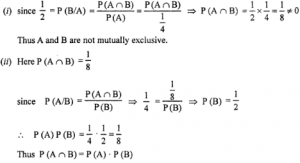
∴ A and B are independent events.
Que-11: (i) An anti-aircraft gun can take a maximum of four shots at an enemy plane moving away from it. The probabilities of hitting the plane at the first, second, third and fourth shot are 0.4,0.3,0.2 and 0.1 respectively. What is the probability that the gun hits the plane?
(ii) The probability that an event& happens in one trial of an experiment is 0.4. Three independent trials of the experiment are performed. Find the probability that the event A happens at least once.
(iii) A man can kill a bird once in three shots. On the assumption that he fires three shots, what is the chance that a bird is killed?
(iv) A piece of equipment will function only wheh all three parts A, B, C are working. The
probability of part A failing during one year is 1/6, that of B failing is 1/20 and that of C failing is 1/10. What is the probability that the equipment will fail before the end of the year?
(v) The probability that A hits a target is 1/3 and the probability that B hits it is 2/5. What is the probability that the target will be hit, if each one oM and B shoots at the target?
Sol: (i) Let E1, E2, E3, E4 are the events of hitting the target in first, second, third and fourth shot.
∴ P (E1) = 0.4, P (E2) = 0.3, P (E3) = 0.2, P (E4) = 0.1
Thus P(E¯1) = 1 – P (E1) = 1 – 0.4 = 0.6 ; P(E¯2) = 1 – P (E2) = 1 – 0.3 = 0.7 ;
P(E¯3) = 1 – P(E3) = 1 – 0.2 = 0.8 ; P(E4) = 1 – P(E¯4) = 1 – 0.1 = 0.9
∴ required probability that the gun hits the plane = 1 – P (E¯1)P(E¯2)P(E¯3)P(E¯4)
= 1 – (0.6) (0.7) (0.8) (0.9)
= 1 – 0.3020 = 0.6980
(ii) Let E be the event that event A happens in one trial of an experiment.
∴ P (E) = 0.4
Thus, P(E¯1) = 1 – 0.4 = 0.6
∴ required probability = 1 – P(E¯)P(E¯)P(E¯) = 1 – (0.6) (0.6) (0.6) = 1 – 0.216 = 0.7840
(iii) p = prob. that a man kill a bird = 1/3
∴ q = prob. that a bird is not killed by man’s shot = 1 – p = 1 – 1/3 = 2/3
since the man fires three shots
∴ required probability that a bird is killed = 1 – qqq = 1 – 2/3×2/3×2/3=1−8/27=19/27
(iv) Given P (of part A failing during one year) = 1/6 = P (A)
∴ P (A¯) = 1 – P (A) = 1 – 1/6 = 5/6 also P (B) = 1/20
⇒ P(B¯) = 1 – P(B) = 1 – 1/20 = 19/20 and P(C) = 110
⇒ P(C¯) = 1 – P(C) = 1 – 1/10 = 9/10
∴ required prob. that the equipment will fail before the end of the year
= 1 – P(A¯)P(B¯)P(C¯)=1−5/6×19/20×9/10=1−57/80=23/80
(v) prob. that A hits the taget = P (A) = 1/3
∴ P(A¯)=1−P(A)=1−1/3 =2/3
prob. that B hits the target P (B) = 25
∴ P(B¯)=1−P(B)=1−2/5 = 3/5
∴ required probability = P (A hits the target) + P (B hits the target)
= 1 – P(A¯)P(B¯)=1−2/3×3/5 = 3/5
Que-12: (i) Probability that man will be alive 25 years hence is 0.3 and the probability that his wife will be alive 25 years hence is 0.4. Find the probability that 25 years hence (a) both will be alive (b) only the man will be alive (c) only the woman will be alive (d) at least one of them will be alive.
(ii) The probability that Krishna will be alive 10 years hence is 7/15 and Hari will be alive is 7/10.
Find the probability that both Krishna and Hari will be dead 10 years hence.
Sol: (i) Let us define the events are as follows :
A : event that the man will be alive 25 years hence
B : event that the man’s wife will be alive 25 years hence.
∴ P (A) = 0.3 ; P (B) = 0.4
Thus, p(A¯) = 1 – P(A) = 1 – 0.3 = 0.7 and P(B¯) = 1 – P (B) = 1 – 0.4 = 0.6
(a) prob. that both will be alive = P (A) P (B) = 0.3 x 0.4 = 0.12
(b) prob. that only the man will be alive 25 years hence p (A) P (B¯) = 0.3 x 0.6 = 0.18
(c) prob. that only the woman will be alive 25 years hence = P (A¯) P (B) = 0.7 x 0.4 = 0.28
(d) prob. that atleast one of them will be alive 25 years hence = 1 – P(A¯) P(A¯)
= 1 – 0.7 x 0.6 = 1 – 0.42 = 0.58
(ii) Let A : event that Krishna will be alive 10 years hence
B : event that Hari will be alive 10 years hence
∴ P (A) = 7/15 ; P (B) = 7/10
Thus P (A¯) = prob. that Krishna will be dead 10 years hence = 1 – P (A) = 1 – 7/15 = 8/15
P(A¯) = prob. that Hari will be dead 10 years hence = 1 – P (B) = 1 – 7/10 = 3/10
Since A and B are independent events. So is A¯ and B¯.
∴ required probability = 8/15×3/10 = 24/150 = 4/25
Que-13: A bag contains 3 white, 2 black and 4 red balls. Find the probability of drawing a white, a black and a red ball in succession in that order.
Sol: Total no. of balls in a bag = 3 + 2 + 4 = 9
when balls are drawing with replacement.
∴ required probability of drawing a white, a black and a red ball in succession in that order
= 3/9×2/9×4/9=8/243
When balls are drawing without replacement
Then required probability = 3/9×2/8×4/7=1/21
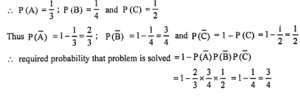
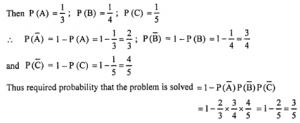
Que-14: (i) A problem in physics is given to three students A, B, C whose chances of Solving it are 1/3, 1/4, 1/2 respectively. Find the probability that the problem will be Solved. (ii) Three persons A, B, C can Solve a problem independently with probabilities 1/3, 1/4 and 1/5. Find the probability that problem is Solved.
Sol: (i) Let us define the events are as follows :
A : event that problem is Solved by A
B : event that problem is Solved by B
C : event that problem is Solved by C
(ii) Let us define the events are as follows :
A : event that problem is Solved by A
B : event that problem is Solved by B
C : event that problem is Solved by C
–: End of Multiplication Theorem of Probability Class 12 OP Malhotra Exe-18C ISC Maths Solutions :–
Return to :- OP Malhotra ISC Class-12 S Chand Publication Maths Solutions
Please share with your friends
Thanks