Nitric Acid Long Ans Concise Class-10 ICSE Chemistry Selina Solutions Chapter-10. We Provide Step by Step Answer of Long Ans Questions of Exercise-10 for ICSE Class-10. The given Solutions is according to the Latest editions. Visit official Website CISCE for detail information about ICSE Board Class-10.
Nitric Acid Long Ans Concise Class-10 ICSE Chemistry Selina Solutions Chapter-10
| Board | ICSE |
| Book / Publication | Concise / Selina |
| Subject | Chemistry |
| Class | 10th |
| Writer | Dr SP Singh |
| Chapter-10 | Study of Compounds – Nitric Acid |
| Topics | Long Ans |
| Edition | 2025-2026 |
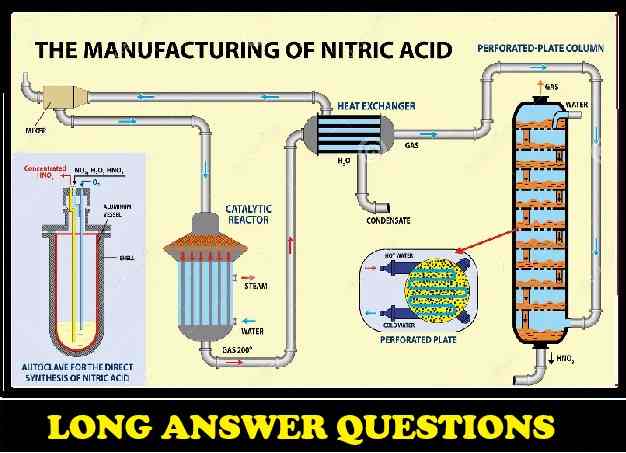
Long Ans Questions on Study of Compounds-Nitric Acid
Page-176
Que-1: X, Y and Z are three crystalline solids which are soluble in water and have common anion.
To help you to identify X, Y and Z you are provided with the following experimental observations. Copy and complete the corresponding inferences in (a) to (e).
(a) A reddish -brown gas is obtained when X, Y and Z are separately warmed with concentrated sulphuric acid and copper turning added to the mixture.
INFERENCE 1: The common anion is the _____ion.
(b) When X is heated, it melts and gives off only one gas which re-lights a glowing splint.
INFERENCE 2: The cation in X is either _____ or _____.
(c) The action of heat on Y produces a reddish brown gas and yellow residue which fuses with glass of the test tube.
INFERENCE 3: The metal ion present in Y is the____ ion.
(d) When Z is heated, it leaves no residue. Warming Z with sodium hydroxide solution liberates a gas which turns moist red litmus paper blue.
INFERENCE 4: Z contains the ____ cation.
(e) Write the equations for the following reactions:
(1) X and concentrated sulphuric acid (below 200oC). (One equation only for either of the cations given in INFERENCE 2)
(2) Action of heat on Y.
(3) Concentrated nitric acid is added to copper turnings kept in a beaker.
Ans:
(a) Nitrate.
(b) Sodium or potassium
(c) Lead
(d) Ammonia
(e) (1) KNO3 + H2SO4 → KHSO4 + HNO3
(2) 2Pb(NO3)2 → 2PbO + 4NO2 +O2
(3) Cu +4HNO3 → Cu(NO3)2 +H2O +2NO2
Que-2: The diagram given below is a representation of the Industrial preparation of Nitric acid by Ostwald’s process. With respect to the process, answer the following questions :
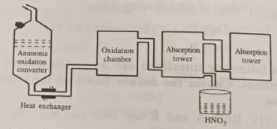
(a) Write the temperature and the catalyst required during the catalytic oxidation of ammonia.
(b) Give balanced chemical equation for the reaction occurring during the conversion of nitrogen dioxide to nitric acid.
Ans:
(a) In the catalytic oxidation of ammonia by Ostwald’s process, the temperature should be 800° C and catalyst used is platinum.
4NH3 + 5O2 (800°C) → 4NO+6H2O + Heat
(b) 4NO2 + 2H2O + O2 ⟶ 4HNO3
Que-3:
(a) Mention three important uses of nitric acid. Give the property of nitric acid involved in the use.
(b) Explain with the help of a balanced equation, the brown ring test for nitric acid.
(c) Why is freshly prepared ferrous sulphate solution used for testing the nitrate radical in the brown ring test?
Ans: (a) Three important uses of Nitric acid and the property of nitric acid involved is:
| S.NO. | Use | Property |
| 1. | To etch designs on copper and brassware. | Nitric acid act as solvent for large number of metals. |
| 2. | To purify gold. | Impurities like Cu, Ag, Zn, etc. dissolve in nitric acid. |
| 3. | Preparation of aqua regia. | Dissolves noble metals. |
(b) Brown ring test
Procedure:
(i) Add freshly prepared saturated solution of iron (II)sulphate to the aq. solution of nitric acid.
(ii) Now add conc. Sulphuric acid carefully from the sides of the test tube, so that it should not fall drop wise in the test tube.
(iii) Cool the test tube in water.
(iv) A brown ring appears at the junction of the two liquids.
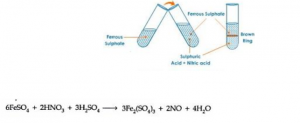
6FeSO4 + 3H2SO4 + 2HNO3 ⟶ 3Fe2(SO4)3 + 4H2O +2NO
FeSO4 + NO ⟶ FeSO4.NO
[Nitroso Ferrous sulphate, a brown compound]
(c) A freshly prepared ferrous sulphate solution is used because on exposure to the atmosphere, it is oxidized to ferric sulphate which will not give the brown ring.
Que-4: The action of heat on the blue crystalline solid X gives a reddish brown gas Y, a gas which re-lights a glowing splint and leaves a black residue. When gas Z, which has a rotten egg smell, is passed through a solution of X, a black ppt. is formed.
(a) Identify X, Y and Z.
(b) Write the equation for action of heat on X.
(c) Write the equation between solution X and gas Z.
Ans:
(a) X is copper nitrate.
Y is nitrogen dioxide.
Z is hydrogen sulphate.
(b) 2Cu(NO3)2 → 2CuO + 4NO2 + O2
(c) Cu(NO3)2 + H2S → CuS + 2HNO3
Que-5:
(a) Dilute nitric acid is generally considered a typical acid except for its reaction with metals. In what way is dilute nitric acid different from other acids when it reacts with metals?
(b) Write the equation for the reaction of dilute nitric acid and conc. nitric acid with copper.
Ans:
(a) Dilute nitric acid is generally considered a typical acid except for its reaction with metals because it does not liberate hydrogen. It is a powerful oxidising agent, and nascent oxygen formed oxidises hydrogen in water.
(b) (i) Reaction of dilute nitric acid with copper:
3Cu + 8HNO3→ 3Cu(NO3) + 4H2O + 2NO
(ii) Reaction of conc. nitric acid with copper:
Cu + 4HNO3→ Cu(NO3) + 2H2O + 2NO2
Que-6: The figure given below illustrates the apparatus used in the laboratory preparation of nitric acid.
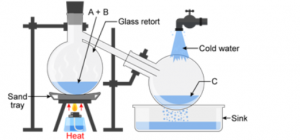
(a) Name A (a liquid), B (a solid) and C (a liquid). (Do not give the formulae).
(b) Write an equation to show how nitric acid undergoes decomposition.
(c) Write the equation for the reaction in which copper is oxidised by concentrated nitric acid.
Ans:
(a) A (a liquid): Conc. sulphuric acid
B (a solid): Sodium nitrate
C (a liquid): Nitric acid
(b) 4HNO3 → 4NO2 + 2H2O + O2
(c) (i) Reaction of dilute nitric acid with copper:
3Cu + 8HNO3→ 3Cu(NO3) + 4H2O + 2NO
(ii) Reaction of conc. nitric acid with copper:
Cu + 4HNO3→ Cu(NO3) + 2H2O + 2NO2
Que-7: With respect to the brown ring test for nitrates, explain :
(a) Freshly prepared ferrous sulphate is used.
(b) Brown ring disappear if the test tube is disturbed.
(c) Lead nitrate does not respond properly to the brown ring test.
Hint – Salt solution forming insoluble sulphates interfere with the result of the brown ring test.
(d) What is the name and formula of the brown ring formed ?
Ans:
(a) Freshly prepared FeSO4 is used in the brown ring test, because upon exposure to the atmosphere, it is oxidised to ferric sulphate which will not give brown ring.
(b) The brown ring of nitroso ferrous sulphate decomposes on disturbing the test tube. The heat evolved decomposes the unstable brown ring.
(c) Lead nitrate contains Pb2+ ions, which can form an insoluble precipitate of PbSO4 when H2SO4 is added.
This precipitate interferes with the formation of the necessary layers and prevents proper diffusion and interaction with Fe2+, thus suppressing the brown ring formation.
(d) Nitroso ferrous sulphate – (FeSO4.NO)
—: End of Study of Compounds – Nitric Acid Long Ans Concise Class-10 ICSE Chemistry Selina Solutions : –
Return to:- Concise Selina Chemistry for ICSE Class-10 Solutions
Please Share with Your Friends if Helpful
Thanks