Nitric Acid MCQs Concise Class-10 ICSE Chemistry Selina Solutions Chapter-10. We Provide Step by Step Answer of MCQs Questions of Exercise-10 for ICSE Class-10. The given Solutions is according to the Latest editions. Visit official Website CISCE for detail information about ICSE Board Class-10.
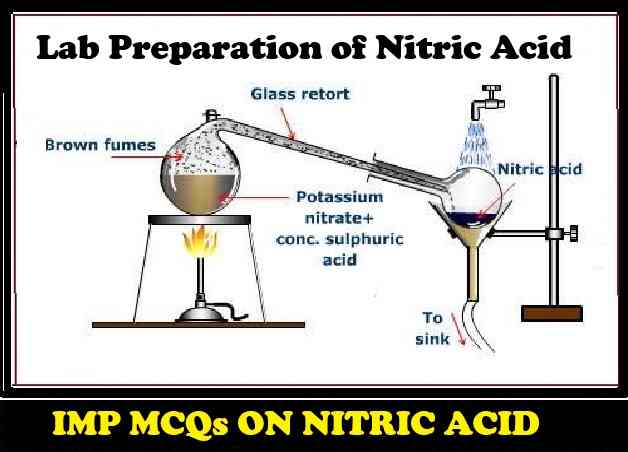
Nitric Acid MCQs Concise Class-10 ICSE Chemistry Selina Solutions Chapter-10
| Board | ICSE |
| Book / Publication | Concise / Selina |
| Subject | Chemistry |
| Class | 10th |
| Writer | Dr SP Singh |
| Chapter-10 | Study of Compounds – Nitric Acid |
| Topics | MCQs |
| Edition | 2025-2026 |
Solved MCQs on Nitric Acid
Page-174 (Choose the correct answer from the options given below).
Que-1: The nitrate salt which does not give a mixture of NO2 and O2 on heating is:
(a) AgNO3
(b) KNO3
(c) Cu(NO3)2
(d) Zn(NO3)2
Ans: (b) KNO3
Hint: The alkali metal nitrates such as sodium or potassium nitrates when heated melts into colourless liquids which decompose on heating to give oxygen gas.
2KNO3 → Δ 2KNO3 + O2 ↑
Que-2: The chemical used in the brown ring test is:
(a) CuSO4
(b) FeSO4
(c) Fe2(SO4)3
(d) ZnSO4
Ans: (b) FeSO4
Hint: In the brown ring test the conc. sulphuric acid being heavier settles down and the iron [II] sulphate layer remains above it resulting in formation of the brown ring at the junction.
6FeSO4 + 3H2SO4 + 2HNO3 (dil. ) ⟶ 3Fe2(SO4)3 + 4H2O +2NO
FeSO4 + NO ⟶ FeSO4.NO
[Nitroso Ferrous sulphate, a brown compound]
Que-3: Lead nitrate decomposes on heating to give:
(a) NO
(b) N2O
(c) NO2
(d) N2O5
Ans: (b) NO2
Hint: Lead nitrate decomposes on heating to give lead oxide, nitrogen dioxide and oxygen.
2Pb(NO3)2 → Δ 2PbO + 4NO2 + O2
Que-4 In the laboratory preparation of nitric acid, nitre is heated with :
(a) conc. HCl
(b) conc. H2SO4
(c) dil. H2SO4
(d) conc. H3PO4
Ans: (b) conc. H2SO4
Hint: In the laboratory preparation of Nitric acid by distillation process, potassium nitrate (nitre) is heated with conc. sulphuric acid (H2SO4).
KNO3[conc.] + H2SO4[conc.] → (<200°C) KHSO4[acid salt] + HNO3
Que-5: Nitric acid is manufactured by :
(a) Bayer’s process
(b) Haber’s process
(c) Ostwald process
(d) Contact process
Ans: (c) Ostwald process
Hint: Nitric acid is manufactured by Ostwald process developed by a german chemist Ostwald, in 1914.
Que-6: The catalyst used in the manufacture of HNO3 is :
(a) Pt
(b) V2O5
(c) Fe
(d) Pd
Ans: (d) Pt
Hint: The catalyst used in the manufacture of HNO3 by Ostwald’s process is Platinum.
Que-7: Cold and dilute HNO3 reacts with Cu to give :
(a) NO2
(b) NO
(c) N2
(d) O2
Ans: (b) NO
Hint: Cold and dilute HNO3 reacts with Copper and oxidises it to give Nitric oxide
3Cu + 8HNO3 ⟶ 3Cu(NO3)2 + 4H2O + 2NO
Que-8: The brown ring test is used for the detection of :
(a) CO32-
(b) Cl–
(c) NO3–
(d) SO32-
Ans: (c) NO3–
Hint: The brown ring test is a qualitative test used to detect the presence of nitrate ions (NO3–) in a solution. A brown ring forms at the junction of the two liquids if nitrate ions are present.
Que-9: Sulphur reacts with conc. HNO3 to give :
(a) SO2
(b) H2
(c) H2SO4
(d) H2S
Ans: (c) H2SO4
Hint: Conc. Nitric acid reacts with non-metals like sulphur to give sulphuric acid and nitrogen dioxide.
S + 6HNO3 ⟶ H2SO4 + 2H2O + 6NO2
Que-10: The solvent for NO is :
(a) Freshly prepared FeSO4
(b) Fe2(SO4)3
(c) FeCl3
(d) FeCl2
Ans: (a) Freshly prepared FeSO4
Hint: The solvent for NO is freshly prepared FeSO4, because upon exposure to the atmosphere, it is oxidised to ferric sulphate which will not give brown ring.
Que-11: The acid which can be used to etch designs on brassware is :
(a) HCl
(b) HNO3
(c) H2SO4
(d) H2CO3
Ans: (b) HNO3
Hint: Nitric acid (HNO3) is used to etch designs on brassware because it acts as solvent for a large number of metals except noble metals.
Que-12: HNO3 is kept in reagent bottles because it is :
(a) an oxidising agent
(b) a reducing agent
(c) hygroscopic in nature
(d) decompose in the presence of light
Ans: (d) decompose in the presence of light
Hint: HNO3 decomposes in presence of sunlight even at room temperature and turn into yellow colour solution. To avoid the decomposition, nitric acid is normally stored in reagent bottles.
Que-13: The nitrate which does not leave any residue behind on heating is :
(a) NaNO3
(b) NH4NO3
(c) AgNO3
(d) Ca(NO3)2
Ans: (b) NH4NO3
Hint: Ammonium nitrate decomposes explosively leaving behind no residue.
Que-14: On heating zinc nitrate, the products formed are zinc oxide, nitrogen dioxide and oxygen. Zinc oxide is :
P – a black solid
Q – brown when hot, yellow when cold
R – yellow when hot, white when cold
Which of the following is true ?
(a) Only P
(b) Only Q
(c) Only R
(d) Both Q and R
Ans: (c) Only R
The following questions are Assertion-Reason based questions. Choose the answer based on the codes given below.
1. Both A and R are true and R is the correct explanation of A.
2. Both A and R are true but R is not the correct explanation of A.
3. A is true but R is false.
4. A is false but R is true.
Que-15:
Assertion (A): KNO3 and conc. H2SO4 are the reactants for the preparation of nitric acid.
Reason (R): Conc. H2SO4 being a non volatile acid is required to prepare volatile acids.
(a) (1)
(b) (2)
(c) (3)
(d) (4)
Ans: (a) (1) Both A and R are true and R is the correct explanation of A.
Explain Why: In the laboratory preparation of Nitric acid, nitric acid is obtained by distilling the reactants, conc. sulphuric acid and potassium nitrate. Hence, the assertion is true.
Sulphuric acid is a non-volatile acid and produces volatile nitric acid on reacting with potassium nitrate or sodium nitrate. Hence, the reason is true.
Reason (R) explains why conc. sulphuric acid and potassium nitrate are used as reactants for the preparation of nitric acid. Hence, reason is a correct explanation of assertion.
Que-16:
Assertion (A): Nitric acid prepared in the laboratory is yellow in colour.
Reason (R): Brown gas is used in its preparation.
(a) (1)
(b) (2)
(c) (3)
(d) (4)
Ans: (c) (3) A is true but R is false.
Explain Why: Pure nitric acid is colourless but the acid obtained in the laboratory is slightly yellow. The yellow colour is due to dissolution of reddish brown coloured nitrogen dioxide gas in the acid. This gas is produced due to the thermal decomposition of a portion of nitric acid. Hence, the assertion is true.
Brown gas is not used in nitric acid preparation but brown coloured nitrogen dioxide gas is produced due to the thermal decomposition of portion of nitric acid. Hence, the reason is false.
Que-17:
Assertion (A): Catalytic oxidation of Ammonia does not require any external heat in Ostwald process.
Reason (R): Catalytic oxidation of ammonia is an endothermic process.
(a) (1)
(b) (2)
(c) (3)
(d) (4)
Ans: (c) (3) A is true but R is false.
Explain Why: Catalytic oxidation of Ammonia by Ostwald’s process does not require any external heat because the reaction itself is exothermic and the heat evolved maintains the temperature of the catalytic chamber. Hence, the assertion is true.
Catalytic oxidation of ammonia is an exothermic process. Therefore, the reason is false.
Que-18:
Assertion (A): The yellow colour of nitric acid is removed by using carbon dioxide gas or dry air.
Reason (R): Carbon dioxide gas or dry air drives away NO2 gas from the warm nitric acid.
(a) (1)
(b) (2)
(c) (3)
(d) (4)
Ans: (a) (1) Both A and R are true and R is the correct explanation of A.
Explain Why: The yellow colour of nitric acid is removed by bubbling carbon dioxide gas or dry air into it. Hence, the assertion is true.
The yellow colour will disappear because carbon dioxide gas or dry air drive out NO2 gas from the warm nitric acid. Hence, the reason is true.
Reason explains how the use of carbon dioxide and dry air turn yellow colour nitric acid into a colourless compound. Hence, reason is a correct explanation of assertion.
Que-19:
Assertion (A): Nitric acid reacts with NaOH/KOH to form salt and water.
Reason (R): Alkalies react with acids to form salt and water.
(a) (1)
(b) (2)
(c) (3)
(d) (4)
Ans: (a) (1) Both A and R are true and R is the correct explanation of A.
Explain Why: Nitric acid reacts with alkalies like NaOH/KOH and neutralises it to form salt and water. Hence, the assertion is true.
NaOH + HNO3 ⟶ NaNO3 + 2H2O
Alkalies react with acids to form salt and water. Such type of reactions are called as neutralisation reaction. Hence, the reason is true.
So, reason depicts the neutralisation reaction that takes place between Nitric acid and NaOH/KOH, it is the correct explanation of assertion.
Que-20:
Assertion (A): Cold and dilute nitric acid oxidise metals to their nitrates and nitric oxide.
Reason (R): Hot and concentrated nitric acid liberates nitrogen dioxide.
(a) (1)
(b) (2)
(c) (3)
(d) (4)
Ans: (b) (2) Both A and R are true but R is not the correct explanation of A.
Explain Why: Cold and dilute nitric acid oxidises metals to their nitrates and nitric oxide. Hence, the assertion is true.
3Cu + 8HNO3 ⟶ 3Cu(NO3)2 + 4H2O + 2NO
Hot dilute nitric acid or concentrated nitric acid liberates nitrogen dioxide. Hence, the reason is true.
Cu + 4HNO3 ⟶ Cu(NO3)2 + 2H2O + 2NO2
Whenever, reason doesn’t explain the action of Cold and dilute nitric acid on metals. So, it is not the correct explanation of assertion.
—: End of Study of Compounds – Nitric Acid MCQs Concise Class-10 ICSE Chemistry Selina Solutions : –
Return to:- Concise Selina Chemistry for ICSE Class-10 Solutions
Please Share with Your Friends if Helpful
Thanks