Nitric Acid Short Ans Concise Class-10 ICSE Chemistry Selina Solutions Chapter-10. We Provide Step by Step Answer of Short Ans Questions of Exercise-10 for ICSE Class-10. The given Solutions is according to the Latest editions. Visit official Website CISCE for detail information about ICSE Board Class-10.
Nitric Acid Short Ans Concise Class-10 ICSE Chemistry Selina Solutions Chapter-10
| Board | ICSE |
| Book / Publication | Concise / Selina |
| Subject | Chemistry |
| Class | 10th |
| Writer | Dr SP Singh |
| Chapter-10 | Study of Compounds – Nitric Acid |
| Topics | Short Ans |
| Edition | 2025-2026 |
Short Ans Questions on Study of Compounds-Nitric Acid
Page-176
Que-1: Explain why:
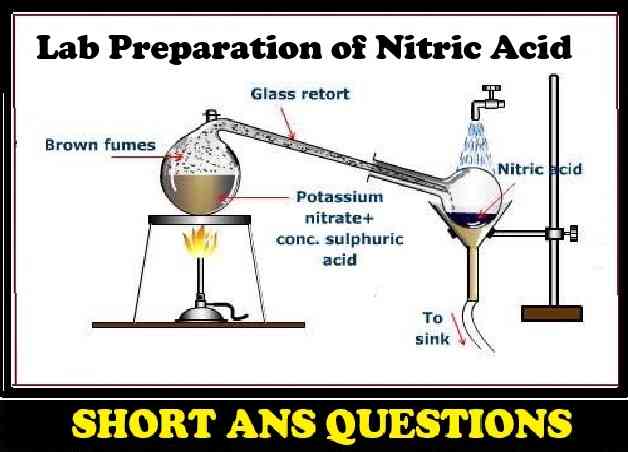
(a) Only all-glass apparatus should be used for the preparation of nitric acid by heating concentrated sulphuric acid and potassium nitrate.
(b) Nitric acid is kept in a reagent bottle for a long time.
(c) Iron is rendered passive with fuming HNO3. Give reason.
(d) Dil. HNO3 is generally considered a typical acid but not so in it’s reaction with metals.
(e) When it is left standing in a glass bottle, concentrated nitric acid appears yellow.
Ans:
(a) The glass apparatus is purposely used because nitric acid vapors are highly corrosive in nature and corrode cork, rubber etc. if used as a stopper.
(b) Pure nitric acid is unstable to heat or sunlight. In the presence of sunlight, it decomposes even at room temperature.
4HNO3 → O2 + 2H2O + 2NO2
Nitric acid stored in a bottle turns yellow. This colour is due to dissolved NO2 in HNO3. To avoid decomposition, nitric acid is normally stored in coloured bottles.
(c) Iron or aluminium are rendered passive on reaction with fuming HNO3 due to formation of a thin oxide coating on the surface of the metal which prevents further reaction
(d) Dilute nitric acid is generally considered a typical acid except for it’s reaction with metals since it generally does not liberate hydrogen on reaction with metals. Nitric oxide on decomposition forms nascent oxygen which oxidizes the hydrogen to water.
(e) Pure nitric acid is colourless and unstable and decomposes slightly even at ordinary temperatures and in the presence of sunlight.
The decomposition results in formation of reddish brown nitrogen dioxide which remains dissolved in the acid thus imparting a slight yellowish brown colour.
Que-2: A dilute acid B does not normally give hydrogen when reacted with metals but does give a gas when reacts with copper. Identify B. Write the equation with copper.
Ans: The dilute acid is nitric acid.
Reaction of dilute nitric acid with copper:
3Cu + 8HNO3 →3Cu(NO3) + 4H2O + 2NO
Que-3: State one observation for each of the following:
(a) Concentrated nitric acid is reacted with Sulphur.
(b) Lead nitrate is heated strongly in a test tube.
(c) Zinc nitrate crystals are strongly heated.
(d) when crystals of copper nitrate are heated in a test tube.
Ans: Observations:
(a) Reddish-brown gas of NO2 is observed.
(b) Yellow Solid is formed which fuses with glass.
(c) Reddish brown nitrogen dioxide gas is evolved on heating zinc nitrate crystals.
(d) Reddish brown nitrogen dioxide gas is evolved.
Que-4: What is the property of nitric acid which allows it to react with copper?
Ans: It is oxidizing property allows it to react with copper.
Que-5: Give balanced equations for the following:
(a) dilute nitric acid and copper carbonate.
(b) oxidation of carbon with conc. HNO3.
(c) Laboratory preparation of nitric acid.
(d) Action of heat on a mixture of copper and nitric acid.
Ans:
(a) CuCO3 + 2HNO3 [dil.] ⟶ Cu(NO3)2 + H2O + CO2
(b) C + 4HNO3 ⟶ CO2 + 2H2O + 4NO2
(c) KNO3 + H2SO4 (>200°C) ⟶ KHSO4 + HNO3
(d) Reaction of dilute nitric acid with copper:
3Cu + 8HNO3→ 3Cu(NO3) + 4H2O + 2NO Reaction of conc. nitric acid with copper:
Cu + 4HNO3→ Cu(NO3) + 2H2O + 2NO2
—: End of Study of Compounds – Nitric Acid Short Ans Concise Class-10 ICSE Chemistry Selina Solutions : –
Return to:- Concise Selina Chemistry for ICSE Class-10 Solutions
Please Share with Your Friends if Helpful
Thanks