Number of Binary Operation and Properties Class 12 OP Malhotra Exe-3B ISC Maths Solutions Ch-3. In this article you would learn to solve problems / Questions on Properties of Binary Operation with example and answer. Visit official Website CISCE for detail information about ISC Board Class-12 Mathematics.
Number of Binary Operation and Properties Class 12 OP Malhotra Exe-3B ISC Maths Solutions Ch-3
| Board | ISC |
| Publications | S Chand |
| Subject | Maths |
| Class | 12th |
| Chapter-3 | Binary Operations |
| Writer | OP Malhotra |
| Exe-3(B) | Number of Binary Operation and Properties. |
Number of Binary Operation and Properties Questions and Answers
Que-1: Show that the binary operation * defined by a * b = ab + 1 on Q is
(i) commutative
(ii) not associative
Sol: ∀ a, b∈Q, a*b = ab + 1 = ba + 1 = b * a
[Since commutative law holds under multiplication on set of rationals Q]
Thus * be commutative on Q.
(ii) ∀ a,b, c∈Q, a * (b * c) = a * (bc + 1)
= a(bc + 1) + 1 = abc + a + 1
(a * b) * c = (ab + 1) * c
= (ab + l)c + 1 = abc + c + 1
Thus,
a * (b * c) * (a * b) * c ∀ a, b, c∈Q
e.g: 2, 3, 4∈Q,
2* (3 * 4) = 2 * (3 x 4 + 1)
= 2 * 13 = 2 x 13 + 1 = 27
and (2* 3) * 4 = (2 x 3 + 1) * 4 = 7 *4
= 7 x 4 + 1 = 29
2* (3*4)* (2* 3) * 4
∴ Hence * is not associative on Q.
Que-2: Let * be the binary operation on N given by a * b = LCM of a and b.
(i) Find the values of 5 * 7 and 20 * 16.
(ii) Is * commutative
(iii) Is * associative ?
(iv) Find the identity of * in N.
(v) Which elements of N are invertible for the operation * ?
Sol: Given * be the binary operation on N
given by a * b = LCM of a and b.
(i) 5 * 7 = LCM of 5 & 7
= 5 x 7 = 35
and 20 * 16 = LCM of 20 & 16 = 80
(ii) ∀a, b∈N, a * b = LCM of a and b
= LCM of b and a = b * a
Thus * is commutative on N
(iii) ∀ a, b, c∈N, a * (b * c) = a * d
where d = b * c = LCM of b and c
= LCM of a and d
= LCM of a, b and c
Further (a * b) * c = d1 * c
where d1 = (a * b) = LCM of a and b
= LCM of d1 & c
= LCM of a, b & c
= LCM of a, b, c
Thus a * (b * c)
= (a * b) * c ∀a, b, c∈N
Hence * is associative on N under operation *
(iv) Since LCM of 1 & a = a = LCM of a & 1
∴ a * 1 = a = 1 * a ∀ a∈N
Thus 1 behave as the identity element in N under operation *.
(v) Let a∈N be any arbitrary element and let x (if it exists)∈N be the inverse of a.
Then x * a = e = a * x
⇒ x * a = 1 = a * x
⇒ L.C.M. of x & a = 1
= LCM of a & x
Which is only possible when a = x = 1.
Thus, 1 be the only element of N which is invertible w..r.t. to operation *.
Que-3: Determine whether the binary operation * on R defined by a * b = a+b/2 is
(i) commutative and
(ii) associative.
Sol: (i) Given binary operation * defined on a + b
N by a * b = a+b/2 ∀a, b∈Q
∀a, b∈Q,
a * b = a+b2 = b+a/2 = b * a
Thus * is commutative on N.
[Since commutative law holds under addition on N]
(ii) ∀ a, b, c∈Q,
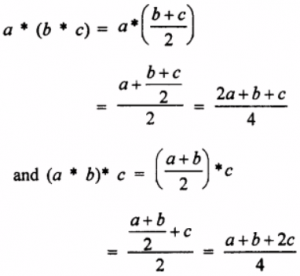
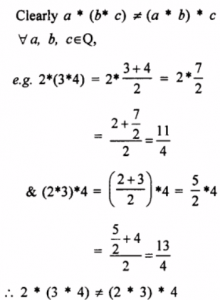
Hence * is not associative on Q
Que-4: Examine whether the operation * defined on R by a * b – ab + 1 is (i) a binary operation or not, (ii) if a binary operation, then it is commutative and associative or not.
Sol: (i) Given operation * on R defined by
a * b = ab + 1
∀ a, b∈R, a * b = ab + 1 ∈R [∵ a, b ∈ R ⇒ ab ∈ R]
∴ * be a binary operation on R.
(ii) ∀a, b ∈R, a* b = ab + 1 = ba + 1 = b * a
* is commutative on R.
∀ a, b, c ∈ R
(a * b) * c = (ab + 1) * c = (ab + 1) c + 1
= abc + c + 1
a * (b * c) = a * (bc + 1) = a (bc + 1) + 1
= abc + a + 1
∴ (a * b) * c ≠ a * (b * c)
e.g. : 2, 3, 4, ∈ R
(2 * 3) * 4 = (2 x 3 + 1) * 4 = 7 * 4
= 7 x 4 + 1 = 29
2 * (3 * 4) = 2 * (3 x 4 + 1) = 2 * 13
= 2 x 13+ 1 = 27
Clearly (2 * 3) * 4 ≠ 2 * (3 * 4)
Thus, * is not associative on R.
Que-5: Examine whether the operation * defined on R by a * b – ab + 1 is (i) a binary operation or not, (ii) if a binary operation, then it is commutative and associative or not. a* b defined on R * R → R as a * b = 2a + b, a, b ∈ R.
Sol: Given operation * on R defined by
a * b = 2a + b ∀ a, b ∈ R
∀a, b ∈R, a * b = 2a + b ∈ R
∴ * is binary operation on R.
∀a, b ∈ R, a * b = 2a + b
b* a = 2b + a
∴ a * b ≠ b * a( in general)
2, 3 ∈ R
∴ 2 * 3 = 2 x 2 + 3 = 7
3 * 2 = 2 x 3 + 2 = 8
∴ 2 * 3 ≠ 3 * 2
Thus * is not commutative on R
Now 2, 3, 4 ∈ R,
(2 * 3) * 4 = (2 x 2 + 3) * 4 = 7 * 4
= 2 x 7 + 4 = 18
and 2 * (3 * 4) = 2 * (2 x 3 < 4)
= 2 * 10
= 2 x 2 + 10 = 14
∴ * is not associative on R.
Que-6: (i) Examine whether the operation * defined on R by a * b – ab + 1 is (i) a binary operation or not, (ii) if a binary operation, then it is commutative and associative or not.
* : N x N → N defined as a * b = a + ab.
(ii) Find the identity element for all the invertible elements (if any) and their inverses.
Sol: (i) Given operation * : N x N → N defined
as a * b = a + ab
∀ a, b ∈ N, ab ∈ N
∴ a + ab ∈ N ⇒ a * b ∈ N
Thus, * is a binary operation on N.
2, 3 ∈N, 2 * 3 = 2 + 2 x 3 = 8
and 3 * 2 = 3 + 3 x 2 = 9
∴ 2 * 3 ≠ 3 * 2
Thus * is not commutative on N.
2, 3, 4 ∈ N, (2 * 3) * 4 = (2 + 2 x 3) * 4 = 8 * 4
= 8 + 8 x 4 = 40
and 2 * (3 * 4) = 2 * (3 + 3 x 4) = 2 * 15
= 2 + 2 x 15 = 32
∴ (2 * 3) * 4 ≠ 2 * (3 * 4)
Thus * is not associative.
(ii) Let e ∈ N be the identity element for every a ≠ 0 ∈ W
Then e * a = a = a * e
⇒ e + ae = a and a = a + ae
⇒ e = a1+a and e = 0 [a ≠ 0]
Since identity element if it exists it is unique.
Thus * does not have identity element on N.
So * has no inverses in N.
Que-7: Determine whether the binary operation defined by a * b = a³ + b³ is commutative and associative.
Sol: Given binary operation * defined by
a * b = a³ + b³
a * b = a³ + b³ = b³ + a³ = b * a
Thus * is commutative.
(a * b) * c = (a³ + b³) * c = (a³ + b³)³ + c³
a* (b * c) = a * (b³ + c³)
= a³ + (b³ + c³)³
Thus, (a * b) * c ≠ a * (b * c)
* is not associative.
Que-8: * is a binary operation defined on Question Find which of the following binary operations are commutative and which of them are associative?
(i) a * b = a – b
(ii) a * b = ab4
(iii) a* b = a + b + ab
(iv) a * b = (a – b)²
Sol: (i) Operation * on Q defined by
a * b = a – b ∀a, b ∈ Q
Commutativity :
∀a, b∈Q, a * b = a – b
and b * a = b – a
∴ a * b ≠ b * a
Thus, * is not commutative on Q.
∀a, b, c∈Q
a * (b * c) = a * (b – c)
= a – (b – c) = a – b + c
(a * b) * c = (a – b) * c = a – b – c
clearly a * (b * c) ≠ (a * b) * c
Thus, * is not associative on Q.
(ii) Operation * on Q defined by
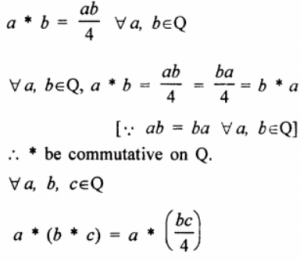
= abc/4 / 4 = abc/16
(a*b)*c = ab/4 * c= (ab/4)c / 4 = abc/16
[Since associative law holds under multiplication on set of rationals]
Thus, a * (b * c) = (a * b) * c
∀a, b, c ∈Q,
Thus, * be associative on Q.
(iii) operation * on Q defined by
a * b = a + b + ab ∀a, b∈Q,
∀a, b∈Q, a * b = a + b + ab
= b + a + ba = b * a
[Since commutative laws holds under addition and multiplication on Q]
∀ a, b, c∈Q,
a * (b * c) = a * (b + c + bc)
= a + b + c + bc + a(b + c + bc)
= a + b + c + ab + bc + ac + abc
(a*b)*c = (a + b + ab)*c
= a + b + ab + c + (a + b + ab)c
= a + b + c + ab + ac + bc + abc
Thus, a * (b * c) = (a * b) * c
∀a, b, c ∈Q,
Hence * is associative on Q.
(iv) The operation * on Q defined by
a * b = (a – b)² ∀ a, b∈Q
∀ a, b∈Q, a * b = (a – b)² – (b – a)² = (b * a)
Thus * commutative on Q.
∀ a, b, c∈Q,
a*(b*c) = a*(b – c)²
= [a -(b- c)²]²
& (a*b)*c = (a – b)²*c
= [(a – b)² – c)]²
∴ a*(b*c) * (a*b)*c ∀a, b, c ∈ Q
Since 2, 3, 4∈Q,
2 * (3 * 4) = 2 * (3 – 4)² = 2 * 1 = (2 – 1)² = 1
& (2 * 3) * 4 = (2 – 3)² * 4 = 1 * 4 = (1 – 4)² = 9
Clearly 2 * (3 * 4) ≠ (2 * 3) * 4
Thus, * is not associative on Q.
Que-9: Show that the binary operation * on A = R – {1} defined on a *b : R-{1} as a * b = a + b + ab for all a, b ∈ A is commutative and associative on A. Also, find the identity element of * in A and prove that every element on A is invertible.
Sol: Given a binary operation * on A = R- {1} defined by a * b = a + b + ab ∀a, b ∈ A
Commutativity:
∀ a, b ∈ A, a * b = a + b + ab
b * a = b + a + ba
a * b = b * a [∵ ab = ba ∀a, b∈N]
Thus * is commutative on N.
Associativity:
∀ a, b ∈ A, (a * b) * c = (a + b + ab) * c
= a + b + ab + c + (a + b + ab) c
= a + b + c + ab + ac +be + abc
and a * (b * c) = a* (b + c + bc)
= a + b + c + bc + a(b + c + bc)
= a + b + c + bc + ab + ac + abc
∴ (a * b) * c = a * (b * c)
Thus * is associative on A.
Let e be an identity element for every element a ∈ R
Then e * a = a – a* e
⇒ e + a + ea = a = a + e + ae
⇒ e (1 + a) = 0 and 0 = e (1 + a)
⇒ e = 0 be the identity element for *.
existence of inverse : Let b ∈ R be the
inverse of a ≠ 0 ∈ R s.t a * b = 0
⇒ a + b + ab = 0 ⇒ b = −a/1+a , a ≠ -1
Thus −a/1+a be the inverse of a ∈ A.
Que-10: The identity element for the binary operation * defined on Q – {0}
as a * b = ab/2, ∀ a, b ∈ Q – {0} is
(a) 1
(b) 0
(c) 2
(d) None of these
Sol: Let e be an identity element for every a ∈ Q – {0}
e * a = a = a* e
⇒ ea/2 = a = ae/2 ⇒ e = 2 [∵ a ≠ 0]
–: End of Number of Binary Operation and Properties Class 12 OP Malhotra Exe-3B ISC Maths Solutions :–
Return to :- OP Malhotra ISC Class-12 S Chand Publication Maths Solutions
Please share with your friends
Thanks