Objective Type Questions on Matter Class 6 Concise Physics ICSE Solutions Ch-1. In this article you would learn how to solve Objective Type Questions on Matter with hint and reason . Visit official Website CISCE for detail information about ICSE Board Class-6.
Objective Type Questions on Matter Class 6 Concise Physics ICSE Solutions
| Board | ICSE |
| Publications | Selina Publication |
| Subject | Physics |
| Class | 6th |
| Chapter-1 | Matter |
| Book Name | Concise |
| Topics | Solution of Objective Type Questions |
| Academic Session | 2025-2026 |
Objective Type Questions on Matter
Exercise – 1.1
1. Objective Type Questions
Que-1: The diameter of a molecule is approximately :
- 1 cm
- 10 cm
- 10-10 m
- 1 m
Ans- 10-10 m
Reason — A molecule is very small in size which is about 10-10 m to 10-9 m.
Que-2: The inter-molecular forces are strongest in :
- solids
- liquids
- gases
- both (i) and (ii)
Ans– solids
Reason — The inter-molecular force of attraction between the particles is more in solids, less in liquids and least in gases.
Que-3: The molecules :
- in solid, liquid and gas, move freely anywhere.
- in a solid, move freely within its boundary.
- in a liquid, move within its boundary.
- in a gas, move only within its boundary.
Ans- in a liquid, move within its boundary.
Reason — The molecules in a solid are fixed at their positions and can only vibrate about their mean positions while in a liquid they can move within the boundary and moves freely in space in gas.
Que-4: Solids are :
- more dense
- less dense
- least dense
- highly compressible
Ans- more dense
Reason — Solids have strong force of attraction (inter-molecular force) and least inter-molecular spaces between it’s molecules which makes them more closely packed state and thus are more dense than liquids and gases.
Que-5: The inter-molecular forces in liquids are :
1. as strong as in solids
2. stronger than in solids
3. weaker than in solids
4. weaker than in gases
Ans- weaker than in solids
Reason — Solids : Molecules are tightly packed, and intermolecular forces are strongest, giving them a fixed shape and volume.
Liquids : Molecules are less tightly packed compared to solids, so the intermolecular forces are weaker — allowing them to flow but still maintain a definite volume.
Gases : Molecules are far apart, and intermolecular forces are negligible — they can expand to fill any container.
Que-6: The diagram below shows the arrangement of molecules in three states of matter.
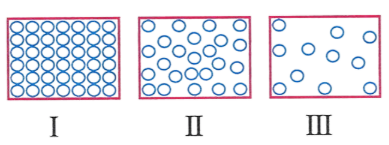
The arrangement of molecules in drinking water would look like.
- I
- II
- III
- all of these
Ans- II
Reason — As drinking water belongs to liquid state which is less closely packed than solid and more packed than gas.
2. Fill in the blanks :
Que-1: All the molecules of a substance are …………… .
Ans: All the molecules of a substance are identical.
Que-2: The inter-molecular spacing is …………… in solids …………… in liquids and …………… in gases.
Ans: The inter-molecular spacing is least in solids more in liquids and still more in gases
Que-3: The molecular motion in liquid and gas is in …………… path.
Ans: The molecular motion in liquid and gas is in zig-zag path.
Que-4: In a solid, the molecules …………… but they remain at their fixed positions.
Ans: In a solid, the molecules vibrate on either side but they remain at their fixed positions.
Que-5: The inter-molecular forces are the weakest in …………… .
Ans: The inter-molecular forces are the weakest in gases.
Que-6: A solid exerts pressure …………… .
Ans: A solid exerts pressure downwards on its base.
Que-7: Gases are …………… dense.
Ans: Gases are least dense.
Que-8: Solids are …………… rigid.
Ans: Solids are most rigid.
3. Write true or false for each statement :
(a) The molecules of each substance are identical.
Ans- False because different substances (e.g. air, water etc.) contain different types of molecules, so they are not identical
(b) The inter-molecular forces are effective at all distances between the two molecules.
Ans- False as intermolecular forces act only at very short distances (a few nanometers). At large distances, they become negligible.
(c) The molecules in a substance are in random motion.
Ans- True since the particles of matter are not at rest, but they move randomly in all possible directions in a zig zag path
(d) In a gas, the molecules can move anywhere in space.
Ans- True as the inter-molecular forces are very weak in a gas which makes the molecules wide apart and hence, they can move freely in space.
(e) Liquids are less viscous than gases.
Ans- False because liquids are generally more viscous than gases because their molecules are closer together, leading to more friction between different layers.
4. Match the following columns :
(a) |
A molecule is composed of |
(i) |
does not exist free in nature. |
(b) |
Ice, water and water vapour |
(ii) |
can vibrate only up to about 10-10 m from their mean positions. |
(c) |
An atom |
(iii) |
atoms. |
(d) |
Gases |
(iv) |
are the three states of water. |
(e) |
The molecules of a solid |
(v) |
occupy space |
Ans-
| Column A | Column B | ||
|---|---|---|---|
| (a) | A molecule is composed of | (iii) | atoms. |
| (b) | Ice, water and water vapour | (iv) | are the three states of water. |
| (c) | An atom | (i) | does not exist free in nature. |
| (d) | Gases | (v) | occupy space |
| (e) | The molecules of a solid | (ii) | can vibrate only up to about 10-10 m from their mean positions. |
— : End of Objective Type Questions on Matter Class 6 Concise Physics ICSE Solutions :–
Return to:- ICSE Class-6 Concise Selina Solutions
Please, Share with your friends
thanks