Parabola Class 11 OP Malhotra Exe-23A ISC Maths Ch-23 Solutions. In this article you would learn about General Equation of Parabola and Length of Latus Rectum. Step by step solutions of latest textbook has been given as latest syllabus. Visit official Website CISCE for detail information about ISC Board Class-11 Mathematics.
Parabola Class 11 OP Malhotra Exe-23A ISC Maths Solutions Ch-23
| Board | ISC |
| Publications | S Chand |
| Subject | Maths |
| Class | 11th |
| Chapter-23 | Parabola |
| Writer | O.P. Malhotra |
| Exe-23(A) | General Equation of Parabola and Length of Latus Rectum. |
General Equation of Parabola and Length of Latus Rectum.
Parabola Class 11 OP Malhotra Exe-23A ISC Maths Ch-23 Solutions.
Que-1: Find each of the parabolas whose equations are given, find the coordinates of the focus, axis of the parabola, the equation of the directrix and the length of the latus rectum.
(i) y² = 12x (ii) x² = 6y (iii) y² = -8x (iv) x² = -16y (v) y² = 10x (vi) x²=-9y
Sol: (i) The given equation is y2 = 12x.
Here, the coefficient of x is positive. Hence, the parabola opens towards the right.
On comparing this equation with y2 = –4ax, we obtain
–4a = 12 ⇒ a = -3
∴ Coordinates of the focus = (-a, 0) = (3, 0)
Since the given equation involves y2, the axis of the parabola is the x-axis.
Equation of directrix, x = a i.e., x = -3
Length of latus rectum = 4a = 12
(ii) The given equation is x2 = 6y.
Here, the coefficient of y is positive. Hence, the parabola opens towards the right.
On comparing this equation with y2 = –4ax, we obtain
–4a = 6 ⇒ a = -3/2
∴ Coordinates of the focus = (0, -a) = (0, 3/2)
Since the given equation involves x2, the axis of the parabola is the y-axis.
Equation of directrix, x = a i.e., y = -3/2
Length of latus rectum = 4a = 6
(iii) The given equation is y2 = –8x.
Here, the coefficient of x is negative. Hence, the parabola opens towards the left.
On comparing this equation with y2 = –4ax, we obtain
–4a = –8 ⇒ a = 2
∴ Coordinates of the focus = (–a, 0) = (–2, 0)
Since the given equation involves y2, the axis of the parabola is the x-axis.
Equation of directrix, x = a i.e., x = 2
Length of latus rectum = 4a = 8
(iv) The given equation is x2 = -16y.
Here, the coefficient of y is negative. Hence, the parabola opens towards the left.
On comparing this equation with x2 = –4ay, we obtain
–4a = -16 ⇒ a = 4
∴ Coordinates of the focus = (0, -a) = (0, -4)
Since the given equation involves x2, the axis of the parabola is the y-axis.
Equation of directrix, x = a i.e., y = 4
Length of latus rectum = 4a = 16
(v) The given equation is y2 = 10x.
Here, the coefficient of x is positive. Hence, the parabola opens towards the right.
On comparing this equation with y2 = –4ax, we obtain
–4a = 10 ⇒ a = -5/2
∴ Coordinates of the focus = (–a, 0) = (5/2, 0)
Since the given equation involves y2, the axis of the parabola is the x-axis.
Equation of directrix, x = a i.e., x = -5/2
Length of latus rectum = 4a = 10
(vi) x² = -9y
The given equation is x2 = -9y.
Here, the coefficient of y is negative. Hence, the parabola opens towards the left.
On comparing this equation with x2 = –4ay, we obtain
–4a = -9 ⇒ a = 9/4
∴ Coordinates of the focus = (0, -a) = (0, -9/4)
Since the given equation involves x2, the axis of the parabola is the y-axis.
Equation of directrix, x = a i.e., y = 9/4
Length of latus rectum = 4a = 9
Find the equation of the parabola in problems 2 through 13.
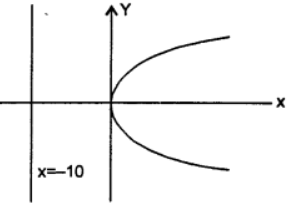
Que-2: The focus at (10, 0) the directrix x = -10.
Sol: Given focus is at (10, 0)
∴ axis of parabola along x-axis and its eqn. can be taken as y2 = 4ax [Here a = 10]
∴ y2 = 40x be the required eqn. of parabola.
Que-3: The focus at (0, 5), the directrix y = – 5.
Sol: Given focus is at (0, 5), on comparing with (0, a) ∴ a = 5
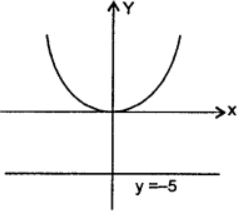
Thus axis of parabola is along y-axis.
Hence required eqn. of parabola be x2 = (4 × 5)y i.e. x2 = 20y
Que-4: The focus at (- 3,0), the directrix x + 5 = 0.
Sol: Let P (x, y) be any point on the parabola.
Then by definition, we have
| PF | = | PM |
√{(x−2)²+(y+3)²} = |x+5|/1
On squaring both sides ; we have
(x + 3)2 + y2 = (x + 5)2
⇒ x2 + 6x + 9 + y2 = x2 + 10x + 25
⇒ y2 = 4x + 16 = 4 (x + 4)
Que-5: The focus at (2, – 3), the directrix x + 5 = 0.
Sol: Given focus be F (2, – 3) and eqn. of directrix be x + 5 = 0
Let P (x, y) be any point on parabola
√{(x−2)²+(y+3)²} = |x+5|/1
On squaring both sides ; we have
(x – 2)2 + (y + 3)2 = (x + 5)2
⇒ x2 – 4x + 4 + y2 + 6y + 9 = x2 + 10x + 25
⇒ y2 – 14x + 6y – 12 = 0,
which is the required eqn. of parabola.
Que-6: The focus at (1, 1), the directrix x – y = 3.
Sol: Given focus be F (1, 1) and eqn. of given
directrix be x-y -3 = 0
Let P (x, y) be any point on parabola
then by def. | PF | = | PM |
√{(x−1)²+(y−1)²} = |x−y−3| / √{1²+(-1)²}
On squaring both sides ; we have
(x – 1)² + (y – 1)² = |x−y−3|² / 2
⇒ 2 [(x – 1)2 + (y – 1)2] = (x – y – 3)2
⇒ 2x2 + 2y2 – 4x – 4y + 4 = x2 – y2 + 9 – 2xy + 6y – 6x
⇒ x2 + y2 + 2xy + 2x – 10y – 5 = 0
which is the required eqn. of parabola.
Que-7: The vertex at the origin, the axis along the x-axis, and passes through (- 3, 6).
Sol: Let the eqn. of parabola whose vertex is at (0,0) and axis along x-axis be given by
y2 = 4ax …(1)
eqn. (1) passes through the point (-3,6)
∴ 36 = 4a (- 3) ⇒ a = – 3
Thus eqn. (1) reduces to ; y2 = – 12x be the required eqn. of parabola.
Que-8: The focus at (- 2, -1) and the latus rectum joins the points (- 2, 2) and (- 2, – 4).
Sol: Given focus of required parabola be (- 2, -1) and end points of latus rectum are (- 2, 2) and (- 2, – 4)
since x-coordinates of both end points be same.
∴ axis of the parabola be parallel to x-axis Let the eqn. of parabola be taken as :
(y – α)2 = ± 4a (x – β) …(1)
length of latus rectum = 4a
= √{(−2+2)²+(−4−2)²} = 6
Thus eqn. (1) reduces to ;
(y – α)2 = ± 6 (x – β) …(2)
The points (- 2, 2) and (- 2, – 4) lies on eqn. (2); we get
(2 – α)2 = ± 6 (- 2 – β) …(3)
(- 4 – α)2 = ± 6 (- 2 – β) …(4)
On dividing (3) by (4); we have
(2 – α)2 = (a + 4)2
⇒ α2 – 4α + 4 = α2 + 8α + 16
⇒ α = – 1
∴ from (3); 9 = ± 6 (- 2 – α)
⇒ 3/2 = ± (- 2 – β)
Case-I. 3/2 = (- 2 – β)
⇒ β = – 2 – (3/2) = –7/2
Case-II. 3/2 = – (- 2 – β)
⇒ 3/2 = 2 + β ⇒ β = – 1/2
∴ from (1); we have
(y + 1)² = + 6(x+(7/2))
⇒ y² + 2y – 6x – 20 = 0
and (y + 1)² = – 6(x+(1/2))
⇒ y² + 2y – 6x + 4 = 0
Que-9: The vertex at (- 2,3) and the focus at (1,3).
Sol: Clearly the axis of the parabola be parallel to x-axis and its eqn. can be taken as,
(y – β)2 = 4a (x – α) …(1)
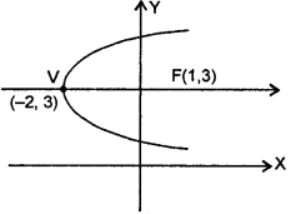
given vertex of parabola be (- 2, 3).
∴ eqn. (1) reduces to
(y – 3)2 = 4a (x + 2) …(2)
a – distance between focus and vertex
= 1 – (- 2) = 3
∴ eqn. (2) reduces to ;
(y – 3)2 = 12 (x + 2)
⇒ y2 – 6y – 12x – 15 = 0
which is the required eqn. of parabola.
Que-10: The vertex at (0, 0) and the focus at (0, 1).
Sol: Given vertex of parabola be V (0, 0) and focus be F (0, 1).
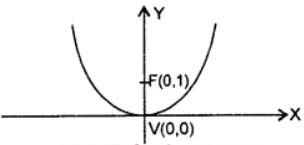
Thus the required eqn. of parabola be
x2 = 4ay …(1)
since axis of parabola bey-axis, distance between focus and vertex = a = 1 – 0 = 1
∴ eqn, (1) reduces to ;
x2 = 4y be the required eqn. of parabola.
Que-11: The vertex at (0, a) and the focus at (0,0).
Sol: Given vertex of parabola be V (0, a) and Focus F (0, 0).
Thus y-axis be the axis of downward parabola.
Hence required eqn. of parabola having vertex (0, a) be given by
(x – 0)2 = – 4a (y – a)
⇒ x2 = 4a(a – y)
Que-12: The axis parallel to the x-axis, and the parabola passes through (3, 3), (6, 5) and (6, – 3).
Sol: Let the eqn. of parabola having axis parallel to x-axis be given by
x = ay2, + by + c …(1)
where a, b, c are constants,
eqn. (1) passes through the points (3, 3), (6, 5) and (6, – 3).
3 = 9a + 3b + c …(2)
6 = 25a + 5 b + c …(3)
6 = 9a – 3b + c …(4)
eqn. (2) – eqn. (4) gives ;
– 3 = 6b ⇒ b = –1/2
∴ from (2); 9/2 = 9a + c …(5)
17/2 = 25a + c …(6)
eqn. (6) – (5) gives;
(17/2) – (9/2) = 16 a
⇒ a = 1/4
∴ from (5); c = (9/2) – (9/4) = 9/4
∴ from (1); x = (1/4) y² – (1/2)y + (9/4)
⇒ y² – 2y – 4x + 9 = 0
which is the required eqn. of Parabola.
Que-13: The axis parallel to the y-axis and the parabola passes through the points (4, 5), (-2, 11) and (-4, 21).
Sol: The equation of the parabola whose axis is parallel to y-axis can be taken as
y = Ax2 + Bx + C …(1)
where A, B and C are arbitrary constants. Since the parabola (1) passes through the point A (4, 5).
5 = 16A + 4B + C …(2)
Clearly the points (-2, 11) and (-4, 21) lies on eqn. (1).
11 = 4A – 2B + C …(3)
21 = 16A – 4B + C …(4)
eqn. (4) – eqn. (2); we have
16 = – 8B ⇒ B = – 2
eqn. (2) – eqn. (3) gives ;
– 6 = 12A + 6B ⇒ – 6 = 12A – 12
⇒ A = 1/2
∴ from (2); 5 = 8 – 8 + C ⇒ C = 5
putting the values of A, B and C in eqn. (1); we have
y = x²/2 – 2x + 5
⇒ x² – 4x – 2y + 10 = 0
be the required eqn. of parabola.
Que-14: The parabola y2 = 4px passes through the point (3, – 2). Obtain the length of the latus rectum and the coordinates of the focus.
Sol: Given eqn. be parabola be
y² = 4px …(1)
since eqn. (1) passes through the point (3, – 2)
∴ 4 = 4p × 3 ⇒ 12p = 4 ⇒ P = 1/3
∴ eqn. of parabola becomes
y² = 4/3x …(2)
On comparing with y² = 4ax
So eqn. (2) represents right handed parabola.
Here, 4a = 4/3 ⇒ a = 1/3
∴ focus of parabola be (a, 0) i.e. (1/3,0)
and length of latus-rectum = 4a = 4/3
∴ focus of parabola be (a, 0) i.e. (1/3,0)
and length of latus-rectum = 4a = 4/3
Que-15: Prove that the equation y2 + 2ax + 2by + c = 0 represents a parabola whose axis is parallel to the axis of x. Find its vertex.
Sol: Given eqn. be,
y2 + 2ax + 2by + c = 0
⇒ y2 + 2by + b2 – b2 + 2ax + c = 0
⇒ (y + b)2 = – 2ax + b2 – c
⇒ (y + b)² = -2a[x−{(b²−c)/2a}] …(1)
As it is of the form (y – β)² = 4a (x – a)
Thus eqn. (1) represents a parabola whose axis parallel to x-axis with vertex [{(b²−c)/2a},−b]
Que-16: Of the parabola, 4(y – 1)2 = – 7 (x – 3) find
(i) the length of the latus rectum.
(ii) the coordinates of the focus and the vertex.
Sol: Given eqn. of parabola be
4(y – 1)² = – 7 (x – 3)
⇒ (y – 1)² = (–7/4)(x – 3) …(1)
which is clearly represents a parabola with axes parallel to x-axis with vertex (3, 1)
putting y – 1 = Y and x – 3 = X
eqn. (1) reduces to ; Y² = –7/3 X,
Here 4a = 7/4 ⇒ a = 7/16
∴Focus is given by (- a, 0)
i.e. X = – a and Y = 0
⇒ x – 3 = –7/16 and y – 1 = 0
⇒ x = 41/16 and y = 1
i.e. focus of parabola given by (1) be (41/16, 1)
Que-17: Find the vertex, focus, and directrix of the following parabolas :
(i) y2 – 2y + 8x – 23 = 0
(ii) x2 + 8x + 12y + 4 = 0
Sol: (i) Given eqn. of parabola be
y2 – 2y + 8x – 23 = 0
⇒ y2 – 2y + 1 = – 8x + 23 + 1
⇒ (y – 1)2 = – 8 (x – 3) …(1)
Transferring origin to point (3,1); we put x-3 = X; y – 1 = Y in eqn. (1); we get Y2 = – 8X, which is a left handed parabola, on comparing with Y2 = – 4aX i.e. 4a = 8 ⇒ a = 2
Thus, vertex is given by X = 0, Y = 0
i.e. x – 3 = 0 and y – 1 = 0
i.e. x = 3, y = 1
Thus vertex of eqn. (1) be given by (3,1). and Focus is given by X = – a, Y = 0
i.e. x – 3 = – 2 and y – 1 = 0
i.e. x = 1 and y = 1
Thus focus of eqn. (1) be given by (1, 1) and directrix is given by X = a
⇒ x – 3 = 2 ⇒ x – 5 = 0 be the required eqn. of directrix.
(ii) Given eqn. of parabola be
x2 + 8x + 12y + 4 = 0
⇒ (x2 + 8x + 16) + 12y + 4 – 16 = 0
⇒ (x + 4)2 = – 12 (y – 1) …(1)
Shifting the origin to point (- 4, 1)
we put x + 4 = X; y – 1 = Y in eqn. (1).
X2 = – 12Y …(2)
which represents a downward parabola.
On comparing eqn. (2) with X2 = – 4aY
∴ 4a = 12 ⇒ a = 3
Thus vertex of eqn. (2) be given by
X = 0, Y = 0
i.e. x + 4 = 0 and y – 1 = 0
i.e. x = -4 and y = 1
Thus (- 4,1) be the vertex of parabola (1) Focus of eqn. (2) be given by
X = 0 and Y = – a
⇒ x + 4 = 0 and y – 1 = – 3
i.e. x = -4 and y = -2
Hence (-4, -2) be the focus of parabola (1). Thus, directrix of the parabola (2) be given by
Y = a i.e. y – 1 = 3 ⇒ y = 4
be the required directrix of parabola (1).
Que-18: Find the vertex, focus, and directrix of the parabola (x – h)2 + 4a(y – k) = 0.
Sol: Given eqn. of parabola be
(x – h)2 = – 4a(y – K) …(1)
Shifting (0, 0) to point (h, k)
putting x – h = X
and y – k = Y in eqn. (1); we have
X2 = – 4aY …(2)
which represents a downward parabola vertex of eqn. (2) be given by X = 0 = Y
i.e. x – h = 0 = y – k i.e. x = h and y = k
Thus (h, k) be the vertex of parabola (1).
Focus of (2) be given by X = 0 and Y = -a
i.e. x – h – 0 and y – k = – a
i.e. x = h and y = k – a
Thus (h, k – a) be the required focus of parabola (1) and directrix of parabola (2)
be given by Y = a ⇒ y – k = a ⇒ y = k + a which is required eqn. of directrix of parabola (1).
Que-19: Find the equation to the parabola whose axis is parallel to the y-axis and which passes through the points (0, 4), (1, 9) and (- 2, 6) and determine its latus rectum.
Sol: Let the eqn. of parabola whose axes parallel to y-axis be given by
y = ax2 + bx + c …(1)
where a, b, c are all constants
eqn. (1) passes through the points (0, 4), (1, 9) and (-2, 6).
4 = a × 02 + b × 0 + c ⇒ c = 4
9 = a + b + c ⇒ a + b = 5 ..(2)
6 = 4a – 2b + c ⇒ 4a – 2b = 2
⇒ 2a – b = 1 …(3)
On adding (2) and (3) ; we have
3a = 6 ⇒ a = 2 ∴ b = 3
putting the values a, b and c in eqn. (1); we have
y = 2x2 + 3x + 4
⇒ y = 2 [x²+(3/2)x+(9/16)] – (9/16) + 4
⇒ y = 2 (x+(3/4))² + (55/16)
⇒ 2(x+(3/4))² = (y−(55/16))
⇒ (x+(3/4))² = (1/2) (y−(55/16))
∴ length of latus rectum = 1/2
Que-20: Find the coordinates of the point on the parabola y2 = 8x whose focal distance is 8.
Sol: Given eqn. of parabola be y2 = 8x …(1)
Let (x1, y1) be any point on curve (1).
∴ y12 = 8x1 …(2)
On comparing eqn. (1) with y2 = 4ax
∴ 4a = 8 ⇒ a = 2
Also, given focal distance = 8 ⇒ xi + a = 8
⇒ x1 = 8 – 2 = 6
∴ from (2); y12 = 8 × 6 = 48
⇒ y1 = ±4√3
Hence the required point on given parabola be (6, ± 4√3).
Que-21: If the ordinate of a point on the parabola y2 = 4ax is twice the latus rectum, prove that the abscissa of this point is twice the ordinate.
Sol: Given eqn. of parabola be
y2 = 4ax …(1)
Let (x1, y1) be any point on parabola (1).
∴ y12 = 4ax1 …(2)
given y1 = 2 × length of latus rectum
= 2 × 4a = 8a
∴ from (2); (8a)2 = 4ox1
⇒ x1 = 64a² / 4a = 16a ⇒ x1 = 2 (8a) = 2y1
Thus abscissa of this point is twice the ordinate.
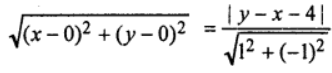
Que-22: Find the equation of the parabola whose focus is at the origin, and whose directrix is the line y – x = 4. Find also the length of the latus rectum, the equation of the axis, and the coordinates of the vertex.
Sol: Given (0, 0) be the focus of required parabola whose directrix is the line
y – x – 4 = 0
Let P (x, y) be any point on parabola.
Then by def. | PF | = | PM |
On squaring both sides ; we have
2 [x2 + y2] = (y – x – 4)2
⇒ 2(x2 + y2) = y2 + x2 – 2xy + 8x – 8y + 16
⇒ x2 + y2 + 2xy – 8x + 8y – 16 = 0
which is the required eqn. of parabola, length of latus rectum = 4a = 2 × 2a
= 2 (length of ⊥ drawn from focus (0, 0) to directrix y – x – 4 = 0)
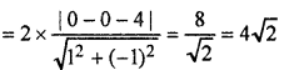
Clearly axis be the line through the focus F (0, 0) and ⊥ to directrix
y – x – 4 = 0 …(1)
eqn. of axis be given by
x + y + k = 0
it pass through F (0, 0). ∴ k = 0
Thus, x + y = 0 …(2)
be the eqn. of axis of parabola.
Let Z be the point of intersection of directrix and axis of parabola. So we solve eqn. (1) and eqn. (2) simultaneously ; we have
y = 2 and x = – 2
∴ Coordinates of point Z are (- 2, 2). and vertex (α, β) be the mid-point of FZ.
α = (−2+0)/2 and β = (2+0)/2
i.e. a = – 1 and β = 1
Thus, required vertex of parabola be (-1, 1).
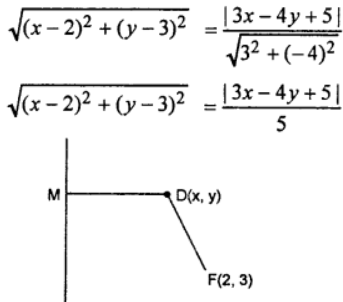
Que-23: The directrix of a conic section is the straight line 3x – 4y + 5 = 0 and the focus is (2, 3). If the eccentricity e is 1, find the equation to the conic section. Is the conic section a parabola ?
Sol: Since eccentricity of conic section be 1.
∴ conic section is a parabola,
given eqn. of directrix be 3x – 4y + 5 = 0 and focus be F (2, 3). Let P (x, y) be any point on parabola.
Then by def. | PF | = | PM |
On squaring both sides ; we have
25 [(x – 2)2 + (y – 3)2] = (3x – 4y + 5)2
⇒ 25 [x2 + y2 – 4x – 6y + 13]
= 9x2 + 16y2 + 25 – 24xy – 40y + 30x
⇒ 16x2 + 9y2 + 24xy – 130x – 110y + 300 = 0
which is the required eqn. of parabola.
Que-24: Find the equation to the parabola whose focus is (-2, 1) and directrix is 6x – 3y = 8.
Sol: Given focus be (- 2, 1) and eqn. of directrix be 6x – 3y – 8 = 0
Let P (x, y) be any point on parabola.
Then by def. | PF | = | PM |

On squaring both sides ; we have
45 [(x + 2)2 + (y – 1)2] = (6x -3y- 8)2
⇒ 45 [x2 + 4x + y2 – 2y + 5]
= 36x2 + 9y2 + 64 – 36xy + 48y – 96x
⇒ 9x2 + 36y2 + 36xy + 276x – 138y + 161 = 0
which is the required eqn. of parabola.
Que-25: The length of the latus rectum of the parabola whose focus is (3, 3) and directrix is 3x – 4y – 2 = 0 is
(a) 2 (b) 1 (c) 4 (d) None of these
Sol: Required length of latus rectum = 4a
= 2 × (length of 1 draw from focus (3, 3) to directrix 3x – 4y – 2 = 0)
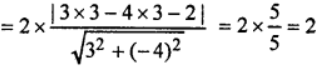
Ans (a).
–: End of Parabola Class 11 OP Malhotra Exe-23A ISC Maths Ch-23 Solutions. :–
Return to :- OP Malhotra ISC Class-11 S Chand Publication Maths Solutions
Please share with your friends
Thanks