Periodic Table Intex-3 Concise Class-10 ICSE Chemistry Selina Solutions Ch-1. We Provide Step by Step Answer of Intext-3 Questions of Exercise-1 for ICSE Class-10. The given Solutions is according to the Latest editions. Visit official Website CISCE for detail information about ICSE Board Class-10.
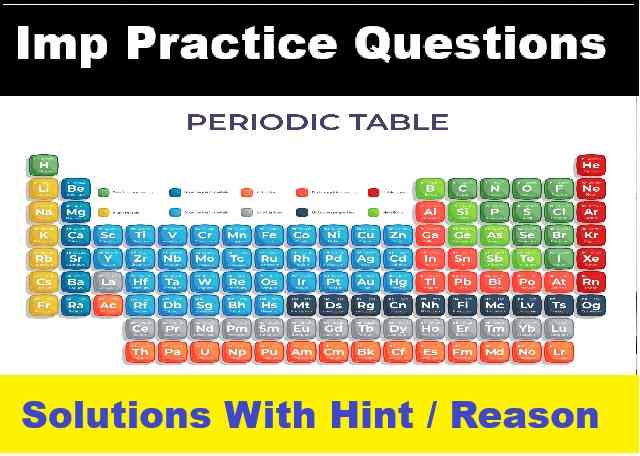
Periodic Table Intex-3 Concise Class-10 ICSE Chemistry Selina Solutions Ch-1
| Board | ICSE |
| Book / Publication | Concise / Selina |
| Subject | Chemistry |
| Class | 10th |
| Writer | Dr SP Singh |
| Chapter-1 | Periodic Table (Periodic Properties and Variations of Properties) |
| Topics | Intext -3 |
| Edition | 2025-2026 |
Intext -3 Questions
Periodic Table Intex-3 Concise Class-10 ICSE Chemistry Selina Solutions Ch-1
Page-15
Que-1:
(a) Define the term ‘ionization potential’.
(b) Represent it in the form of an equation. In which unit it is measured?
Ans:
(a) The energy required to remove an electron from a neutral isolated gaseous atom and convert it into a positively charged gaseous ion is called Ionization energy or ionization potential.
(b) M(g)+ I.E M+(g)+ e-
M can be any element
It is measured in electron volts per atom. It’s S.I unit kJmol-1.
Que-2: Ionisation Potential values depend on
(a) atomic size
(b) nuclear pull. Explain.
Ans: Ionisation potential values depend on
(a) Atomic size: The greater the atomic size, the lesser the force of attraction. Electrons of the outermost shell lie further away from the nucleus, so their removal is easier and the ionisation energy required is less.
(b) Nuclear Pull: The greater the nuclear charge, greater is the attraction for the electrons of the outermost shell. Therefore, the electrons in the outermost shell are more firmly held because of which greater energy is required to remove them.
Que-3: State the trends in ionization energy:
(a) across the period
(b) down the group
Ans:
(a) Ionization energy increases as we move from left to right across a period as the atomic size decreases.
(b) Ionization energy decreases down a group as the atomic size increases.
Que-4: Name the elements with highest and lowest ionization energies in first three periods
Ans: Helium has the highest ionization energy of all the elements while Sodium has the lowest ionization energy in first three periods.
Que-5:
(a) Arrange the elements of second and third period in increasing order of ionization energy.
(b) The element with the highest ionisation potential is:
A. Hydrogen
B. Caesium
C. Radon
D. Helium
Ans:
(a) Second period: Lithium < Beryllium < Boron < Carbon < Nitrogen < Oxygen < Fluorine < Neon
Third Period: Sodium < Magnesium < Aluminum < Silicon < Phosphorus < Sulphur < Chlorine < Argon
(b) D. Helium
Que-6:
(a) Define the term electron affinity. State its unit (2010)
(b) Arrange the elements of second period in increasing order of electron affinity. Name the elements which do not follow the trend in this period.
(c) Which has higher E.A., Fluorine or neon ?
Ans:
(a) Electron affinity is the energy released when a neutral gaseous atom acquires an electron to form an anion.
(b) Second period: Lithium < Boron < Carbon < Oxygen < Fluorine
Neon, Nitrogen and Beryllium do not follow the trend.
(c) Inert gases have zero or very low electron affinity because their outer shells are completely filled, making it difficult for them to gain electrons. Neon is an inert gas, so its electron affinity is nearly zero. Therefore, fluorine has a much higher electron affinity than neon.
Que-7: Electron affinity values generally —– across the period left to right and ——down the group top to bottom.
Ans: Electron affinity values generally increase across the period left to right and decrease down the group top to bottom.
Que-8:
(a) Define the term ‘Electronegativity’. State its unit.
(b) Among the elements given below, the element with least electronegativity is
(i) Lithium, (ii) Boron, (iii) Carbon, (iv) Fluorine
(c) The most electronegative element from the following element is:
(i) Magnesium (ii) Chlorine
(iii) Aluminium (iv) Sulphur
Ans:
(a) Electronegativity is the tendency of an atom in a molecule to attract the shared pair of electrons towards itself.
Electronegativity is a dimensionless property; hence, it has no unit.
(b) Correct option – (i).
The element with least electronegativity is lithium.
(c) option (ii) Chlorine
Que-9: Explain the following :
(a) Group 17 elements are strong non-metals, while group I elements are strong metals.
(b) Metallic character of elements decreases from left to right in a period while it increases in moving down a group.
(c) Halogens have a high electron affinity.
(d) The reducing power of element increases down in the group while decreases in a period.
(e) Size of atoms progressively becomes smaller when we move from sodium (Na) to chlorine (Cl) in the third period of the periodic Table.
Ans:
(a) On moving across a period, nuclear pull increases because of the increase in atomic number, and thus, the atomic size decreases. Hence, elements cannot lose electrons easily. Hence, Group 17 elements are strong non-metals, while Group 1 elements are strong metals.
(b) On moving across a period, nuclear pull increases because of the increase in atomic number, and thus, the atomic size decreases. Hence, elements cannot lose electrons easily. Hence, Group 17 elements are strong non-metals, while Group 1 elements are strong metals. Down a group, the atomic size increases and the nuclear charge also increases. The effect of an increased atomic size is greater as compared to the increased nuclear charge. Therefore, metallic nature increases as one moves down a group, i.e. they can lose electrons easily.
(c) The atomic size of halogens is very small. The smaller the atomic size, the greater the electron affinity, because the effective attractive force between the nucleus and the valence electrons is greater in smaller atoms, and so the electrons are held firmly.
(d) The reducing property depends on the ionisation potential and electron affinity of the elements. In a period, from left to right in a horizontal row of the periodic table, the atomic size decreases and the nuclear charge increases, so the electron affinity and ionisation energy both increase. Hence, the tendency to lose electrons decreases across the period from left to right and thus the reducing property also decreases across the period from left to right.
The electron affinity and ionisation potential decrease along the group from top to bottom. Hence, the tendency to lose electrons increases, and thus, the reducing property also increases along the group from top to bottom.
(e) In a period, the size of an atom decreases from left to right. This is because the nuclear charge, i.e. the atomic number increases from left to right in the same period, thereby bringing the outermost shell closer to the nucleus. Therefore, considering the third period given above, it has been found that sodium is the largest in size, while chlorine is the smallest.
Que-10: Name the periodic property which relates to the
(a) Amount of energy required to remove an electron from an isolated gaseous atom.
(b) Character of element which loses one or more electrons when supplied with energy.
(c) Tendency of an atom to attract the shared pair of electrons.
Ans: (a) Ionization energy
(b) Metallic character
(c) Electronegativity
Que-11: This question refers to the elements of the periodic table with atomic numbers from 3 to 18. Some of the elements are shown by letters, but the letters are not the usual symbols of the elements.
| 3 | 4 | 5 | 6 | 7 | 8 | 9 | 10 |
| A | B | C | D | E | F | G | H |
| 11 | 12 | 13 | 14 | 15 | 16 | 17 | 18 |
| I | J | K | L | M | N | O | P |
Which of these
(a) are the most electronegative element
(b) is a halogen
(c) is an alkali metal
(d) is an element with valency 4
(e) have least ionisation energy
(f) have least atomic size in Period 3
Ans:
(a) G (due to the smallest atomic size).
(b) G and O as both have outermost electronic configuration np5.
(c) A and I as both have outermost electronic configuration ns1.
(d) D (1s22s22p2)
(e) I as alkali metals have least ionisation energy. Also, ionisation energy decreases with an increase in the atomic size that decreases on moving down the group.
(f) O, as halogens have the least atomic size.
Que-12: A group of elements in the Periodic Table are given below (boron is the first member of the group and thallium is the last).
Boron, Aluminium, Gallium, Indium, Thallium
Answer the following questions in relation to the above group of elements:
(a) Which element has the most metallic character?
(b) Which element would be expected to have the highest electronegativity?
(c) If the electronic configuration of aluminium is 2,8,3, how many electrons are there in the outer shell of thallium?
(d) The atomic number of boron is 5. Write the chemical formula of the compound formed when boron reacts with chlorine.
(e) Will the elements in the group to the right of this boron group be more metallic or less metallic in character? Justify your answer.
Ans:
(a) Thallium. Because the metallic character increases down the group, thallium will have the most metallic character.
(b) Boron. Electronegativity decreases down the group as the size increases; hence, boron will be the most electronegative atom.
(c) Three. The number of electrons present in the valence shell is the same for each group. Hence, all these elements and thallium will have 3 valence electrons.
(d) BCl3
(e) Since metallic character decreases from left to right and non-metallic character increases from left to right, elements in the group to the right of this boron group will be less metallic in character.
—: End of Periodic Table Intex-3 Concise Class-10 ICSE Chemistry Selina Solutions Ch-1 : –
Return to:- Concise Selina Chemistry for ICSE Class-10 Solutions
Please Share with Your Friends if Helpful
Thanks