Periodic Table Long Ans Concise Class-10 ICSE Chemistry Selina Solutions Chapter-1. We Provide Step by Step Answer of Long Ans Questions of Exercise-1 for ICSE Class-10. The given Solutions is according to the Latest editions. Visit official Website CISCE for detail information about ICSE Board Class-10.
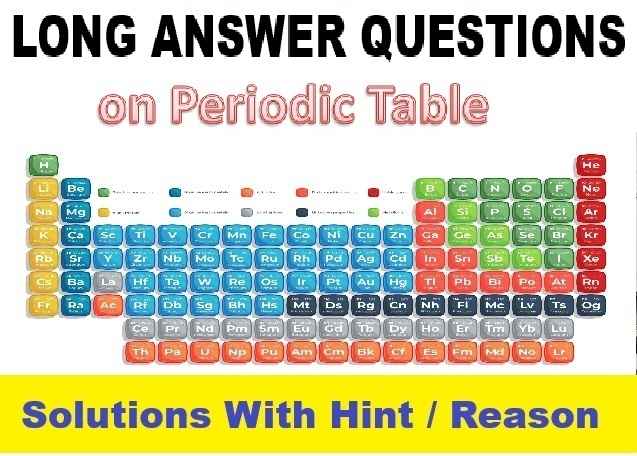
Periodic Table Long Ans Concise Class-10 ICSE Chemistry Selina Solutions Chapter-1
| Board | ICSE |
| Book / Publication | Concise / Selina |
| Subject | Chemistry |
| Class | 10th |
| Writer | Dr SP Singh |
| Chapter-1 | Periodic Table (Periodic Properties and Variations of Properties) |
| Topics | Long Ans |
| Edition | 2025-2026 |
Long Ans Questions on Periodic Table
Page-20
Que-1: Chlorine in the Periodic Table is surrounded by the elements with atomic number 9, 16, 18, and 35.
(a) Which of these have Physical and Chemical properties resembling chlorine ?
(b) Which is more electronegative than chlorine ?
Ans: (a) The elements with atomic number 9 (fluorine) & 35 (bromine) have physical properties resembling chlorine because they belong to the same group.
(b) The element with atomic number 9 (fluorine) is more electronegative than chlorine because on moving down the group electronegativity decreases.
Que-2: First ionization enthalpy of two elements X and Y are 500 kJ mol-1 and 375 kJ mol-1 respectively. Comment about their relative position in a group as well as in a period.
Ans: It is given that,
X = 500 kJ mol-1
Y = 375 kJ mol-1
Their relative position in a group is X & Y as ionization enthalpy decreases on moving down the group.
Their relative position in a period is Y & X as ionization enthalpy increases on moving across a period.
Que-3: The elements of one short period of the Periodic Table are given below in order from left to right :
Li Be B C O F Ne
(a) To which period do these elements belong ?
(b) One element of this period is missing. Which is the missing element and where should it be placed ?
(c) Place the three elements fluorine, beryllium and nitrogen in the order of increasing electronegativity.
(d) Which one of the above elements belongs to the halogen series ?
Ans: (a) These elements belong to the 2nd period.
(b) The missing element is Nitrogen. It belongs to the Group 15 and should be placed as shown below:
Li Be B C N O F
(c) Beryllium < Nitrogen < Fluorine.
(d) Fluorine.
Que-4: The atomic number of an element Z is 16. State
(a) the period to which it belongs.
(b) the number of valence electron(s) in the element.
(c) whether the element is a metal or a non-metal.
(d) State the formula of the compound between Z and hydrogen.
Ans: (a) The element belongs to 3rd period.
Hint- The element Z has atomic number 16 and so the electronic configuration will be 2, 8, 6. The number of shells present in an atom determines it’s period. Hence, Z will belong to 3rd period as it has three shells.
(b) 6 [∵ electronic configuration is 2, 8, 6]
(c) Z is a non metal.
(d) H2Z
Que-5: M is a metal and its oxide has the formula M2O. This oxide when dissolved in water forms the corresponding hydroxide which is a good conductor of electricity. In the above context, answer the following :
(i) State the number of electrons in the outermost shell of M ?
(ii) Name the group to which M belongs.
(iii) which element has more electronegativity, M or O?
Ans: Given, M is a metal
(i) Number of electrons in the outer most shell of M is 1. It is so because the valency of O is -2 and as 2 atoms of M combine with O to form M2O, hence we can say that M has 1 valence electron.
(ii) M belongs to group 1 [1A] because there is 1 electron in the outer most shell.
(iii) M is a metal which belongs to group 1 whereas oxygen is a non metal with higher electronegativity compared to a M.
Que-6: The metals of Group 2 in the periodic table from top to bottom are — Be, Mg, Ca, Sr, and Ba.
(i) Which one of these elements will form ions most readily and why?
(ii) State the common feature in the electronic configuration of all these given elements.
Ans: (i) Ba – Elements at the bottom of a group are most metallic, have large atomic size and lowest ionisation potential. So, the outer electrons are loosely held and will form ions from metals most readily and thus are more reactive.
(ii) As the elements belong to group 2 thus they all have 2 electrons in the valence shell.
Que-7: In the table below, H does not represent hydrogen. Some elements are given in their own symbol and position in the periodic table while others are shown with a letter.
| 1A 1 |
IIA 2 |
IIIA 13 |
IVA 14 |
VA 15 |
VIA 16 |
VIIA 17 |
O 18 |
|---|---|---|---|---|---|---|---|
| Li | D | O | J | Ne | |||
| A | Mg | E | Si | H | K | ||
| B | C | F | G | L |
Answer the following questions.
(i) Identify the most electronegative element.
(ii) Identify the most reactive element of group IA or 1.
(iii) Identify the element from period 3 with the smallest atomic size.
(iv) Identify the element with the highest ionization potential.
(v) How many valence electrons are present in G ?
(vi) Which element from group 2 will have the least ionization energy ?
(vii) Identify the noble gas of the fourth period.
(viii) In the compound between A and H, what type of bond is formed ? Give its molecular formula.
Ans:
(i) J is the most electronegative element.
(ii) B is the most reactive element of group IA or 1.
(iii) K is the element from period 3 with smallest atomic size.
(iv) Ne the highest ionization potential.
(v) 5 valence electrons present in G.
(vi) C is the element from group 2 which has least ionization energy.
(vii) L is the noble gas of the fourth period.
(viii) ionic bond is formed between A and H.
The molecular formula is :
2A + H ⟶ A2H
—: End of Periodic Table Long Ans Concise Class-10 ICSE Chemistry Selina Solutions : –
Return to:- Concise Selina Chemistry for ICSE Class-10 Solutions
Please Share with Your Friends if Helpful
Thanks