Periodic Table Short Ans Concise Class-10 ICSE Chemistry Selina Solutions Chapter-1. We Provide Step by Step Answer of short Ans Questions of Exercise-1 for ICSE Class-10. The given Solutions is according to the Latest editions. Visit official Website CISCE for detail information about ICSE Board Class-10.
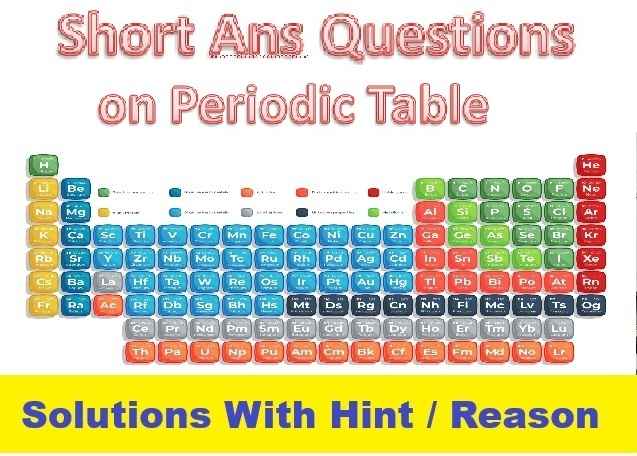
Periodic Table Short Ans Concise Class-10 ICSE Chemistry Selina Solutions Chapter-1
| Board | ICSE |
| Book / Publication | Concise / Selina |
| Subject | Chemistry |
| Class | 10th |
| Writer | Dr SP Singh |
| Chapter-1 | Periodic Table (Periodic Properties and Variations of Properties) |
| Topics | Short Ans |
| Edition | 2025-2026 |
Short Ans Questions on Periodic Table
Page-20
Que-1: What is the significance of atomic number in the modern periodic table ?
Ans: Modern periodic table is based on Henry Moseley’s modern periodic law which states that “the physical and chemical properties of elements are the periodic functions of their atomic number”.
Que-2: Arrange the following in order of :
(i) increasing radii.
(a) Cl-, Cl
(b) Mg2+, Mg, Mg+
(c) N, O, P
(ii) increasing ionisation energy.
(a) P, Na, Cl
(b) F, O, Ne
(c) Ne, He, Ar
Explain your choice.
Ans:
(i) In order of increasing radii:
(a) Cl < Cl-.
Reason — Anion is greater in size than its parent atom.
(b) Mg2+ < Mg+ < Mg.
Reason — Cation is smaller in size than its parent atom.
(c) O < N < P.
Reason — Between Oxygen (O) and Nitrogen (N), atomic size of Nitrogen (N) is more as it is to the left of Oxygen (O) in period 2. Between Nitrogen (N) and Phosphorus (P), Phosphorus (P) has larger atomic size as it comes after Nitrogen (N) in group 5A.
(ii) In order of increasing ionisation energy:
(a) Na < P < Cl
Reason — Ionisation energy increases when moving across a period from left to right.
(b) O < F < Ne
Reason — Ionisation energy increases when moving across a period from left to right.
(c) Ar < Ne < He
Reason — Ionisation energy decreases when moving down the group.
Que-3: Atomic numbers of elements A, B, C, D, E, F, are 8, 7, 11, 12, 13 and 9 respectively. State the type of ions they form.
Ans: The electronic configuration of the given elements are:
A(8) = (2, 6 ) — A forms anion.
B(7) = (2, 5 ) — B forms anion.
C(11) = (2, 8, 1) — C forms cation.
D(12) = (2, 8, 2) — D forms cation.
E(13) = (2, 8, 3) — E forms cation.
F(9) = (2, 7 ) — F forms anion.
Que-4: Give reasons for the following assertions :
(a) The oxidising power of elements increases from left to right along a period.
(b) Ionisation potential of elements increases across a period from left to right.
(c) Alkali metals are good reducing agents.
Ans:
(a) The oxidising power of elements increases from left to right along a period because electro-negativity and the non metallic character increases from left to right. As oxidising power depends on tendency to gain electrons and non-metals are good oxidising agents hence oxidising power of elements increases across a period.
(b) The ionisation potential of element increases across a period because the atomic size decreases due to an increase in nuclear charge and electrons in the outermost shell are more strongly held because of which greater energy is required to remove the electron.
(c) Alkali metals have one electron in their valence shell. In order to be stable, they easily lose this electron and get oxidised. Hence, they are good reducing agents.
—: End of Periodic Table Short Ans Concise Class-10 ICSE Chemistry Selina Solutions Chapter-1 : –
Return to:- Concise Selina Chemistry for ICSE Class-10 Solutions
Please Share with Your Friends if Helpful
Thanks