Periodic Table Very Short Ans Concise Class-10 ICSE Chemistry Selina Solutions Chapter-1. We Provide Step by Step Answer of short Ans Questions of Exercise-1 for ICSE Class-10. The given Solutions is according to the Latest editions. Visit official Website CISCE for detail information about ICSE Board Class-10.
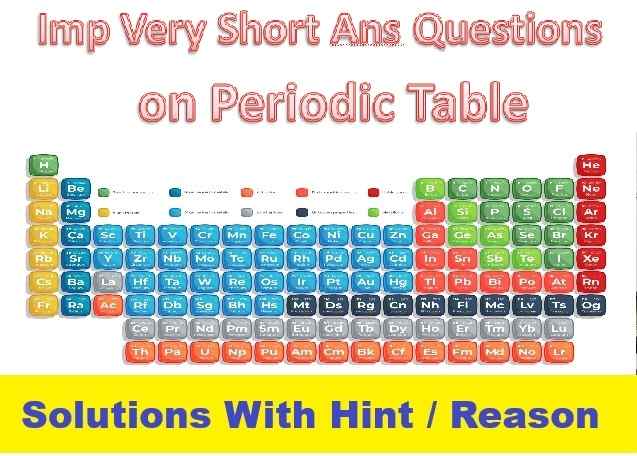
Periodic Table Very Short Ans Concise Class-10 ICSE Chemistry Selina Solutions Chapter-1
| Board | ICSE |
| Book / Publication | Concise / Selina |
| Subject | Chemistry |
| Class | 10th |
| Writer | Dr SP Singh |
| Chapter-1 | Periodic Table (Periodic Properties and Variations of Properties) |
| Topics | Very Short Ans |
| Edition | 2025-2026 |
Very Short Ans Questions on Periodic Table
Page-19
Que-1: Fill in the blanks by selecting the correct word from the brackets :
Ans:
(a) The element below sodium in the same group would be expected to have a lower (lower/higher) electro-negativity than sodium and the element above chlorine would be expected to have a higher (lower/higher) ionization potential than chlorine.
(b) On moving down a group, the number of valence electrons remains the same (remains the same/increases/ decreases).
(c) Metals are good reducing agent (oxidising agent/ reducing agent) because they are electron donors (acceptors/donors).
(d) Down the group, electron affinity decreases [increases, decreases, remains same].
(e) Electronegativity across the period increases [increases/ decreases].
(f) Non-metallic character down the group decreases [increases/ decreases].
(g) In a period, increase in electron affinity increases reduction (oxidation/reduction).
(h) On descending a group, decrease (increase/decrease) in ionisation potential as well as electron affinity decreases (increases/decreases) oxidising capacity.
(i) If an element has a low ionization energy then it is likely to be metallic (metallic/non metallic).
(j) If an element has seven electrons in its outermost shell then it is likely to have the smallest (largest/smallest) atomic size among all the elements in the same period.
Que-2: Rewrite the following sentences by using the correct symbol > (greater than) or < (less than) in the blanks given :
(i) The ionization potential of potassium is ………. that of sodium.
(ii) The electronegativity of iodine is ………. that of chlorine.
Ans:
(i) The ionization potential of potassium is < (less than) that of Sodium.
(ii) The electronegativity of iodine is < (less than) that of chlorine.
Que-3: In Period 3 of the Periodic Table, element B is placed to the left of element A. On the basis of this information, choose the correct word from the brackets to complete the following statements:
(i) The element B would have (lower/higher) metallic character than A.
(ii) The element A would probably have (lesser/higher) electron affinity than B.
(iii) The element A would have (greater/smaller) atomic size than B.
Ans: If the element are placed as B and then A in the 3rd period of the periodic table then
(i) The element B would have higher metallic character than A as metallic character decreases across a period.
(ii) The element A would probably have higher electron affinity than B as electron affinity increases across a period.
(iii) The element A would have smaller atomic size than B as atomic size decreases across a period.
Que-4: There are three elements E, F and G with atomic numbers 19, 8 and 17, respectively.
Classify the elements as metals and non-metals.
Ans: The electronic configuration of the given elements is as follows :
E = 19 = 2, 8, 8, 1
F = 8 = 2, 6
G = 17 = 2, 8, 7
We observe that E has 1 electron in the outer most shell, hence it will try to lose it’s electron and attain a stable state. Therefore, it is a metal.
On the other hand, F and G will try to gain 2 and 1 electron respectively in order to attain a stable state. Hence, they are non-metals.
Que-5: Arrange the following as per instructions given in the brackets.
(a) Mg, Cl, Na, S, Si (decreasing order of atomic size)
(b) Cs, Na, Li, K, Rb (increasing metallic character)
(c) Na, K, Cl, S, Si (increasing ionisation potential)
(d) Cl, F, Br, I (increasing electron affinity)
(e) Cs, Na, Li, K, Rb (decreasing electronegativity)
(f) K, Pb, Ca, Zn (increasing reactivity)
(g) Li, K, Na, H (decreasing order of their potential ionisation)
Ans:
(a) Na > Mg > Si > S > Cl.
(b) Li < Na < K < Rb < Cs.
(c) K < Na < Si < S < Cl.
(d) I < Br < F* < Cl.
Flourine (F) in group 17 is an exception. It has lower electron affinity than Chlorine (Cl).
(e) Li > Na > K > Rb > Cs.
(f) Pb < Zn < Ca < K.
(g) H > Li > Na > K.
Que-6: The electronegativities (according to Pauling) of the elements in Period 3 of the Periodic Table are as follows with the elements arranged in alphabetical order :
| Al | Cl | Mg | Na | P | S | Si |
| 1.5 | 3.0 | 1.2 | 0.9 | 2.1 | 2.5 | 1.8 |
Arrange the elements in the order in which they occur in the Periodic Table from left to right.
(The group 1 element first, followed by the group 2 element and so on, up to group 7).
Ans: We know that electronegativity increases from left to right in a period. Hence, the order of the elements in the periodic table is:
Na, Mg, Al, Si, P, S, Cl.
Que-7: Name : A metal present in period 3, group 1 of the periodic table.
Ans: Sodium is a metal present in period 3 and group 1 of the periodic table.
Que-8: Give one word or a phrase for : Amount of energy released when an atom in the gaseous state accepts an electron to form an anion.
Ans: Electron affinity is the amount of energy released when an atom in the gaseous state accepts an electron to form an anion.
Que-9: The formula of an ion of an element A is A2+. Element A probably belongs to which group?
Ans: 2nd Group.
Hint- Since A loses 2 electrons to form an anion, A2+ so its valency is 2. Hence, it belongs to the 2nd group.
Que-10: State the group and period of the element having three shells with three electrons in the valence shell.
Ans: The element having three shells with three electrons in the valence shell is in group 13 [III A] and period 3.
—: End of Very Short Ans Questions on Periodic Table :-
Return to:- Concise Selina Chemistry for ICSE Class-10 Solutions
Please Share with Your Friends if Helpful
Thanks